

This editorial is part of our series reflecting on the impacts of mega-events on Rio de Janeiro 10 years after the 2016 Olympic Games.
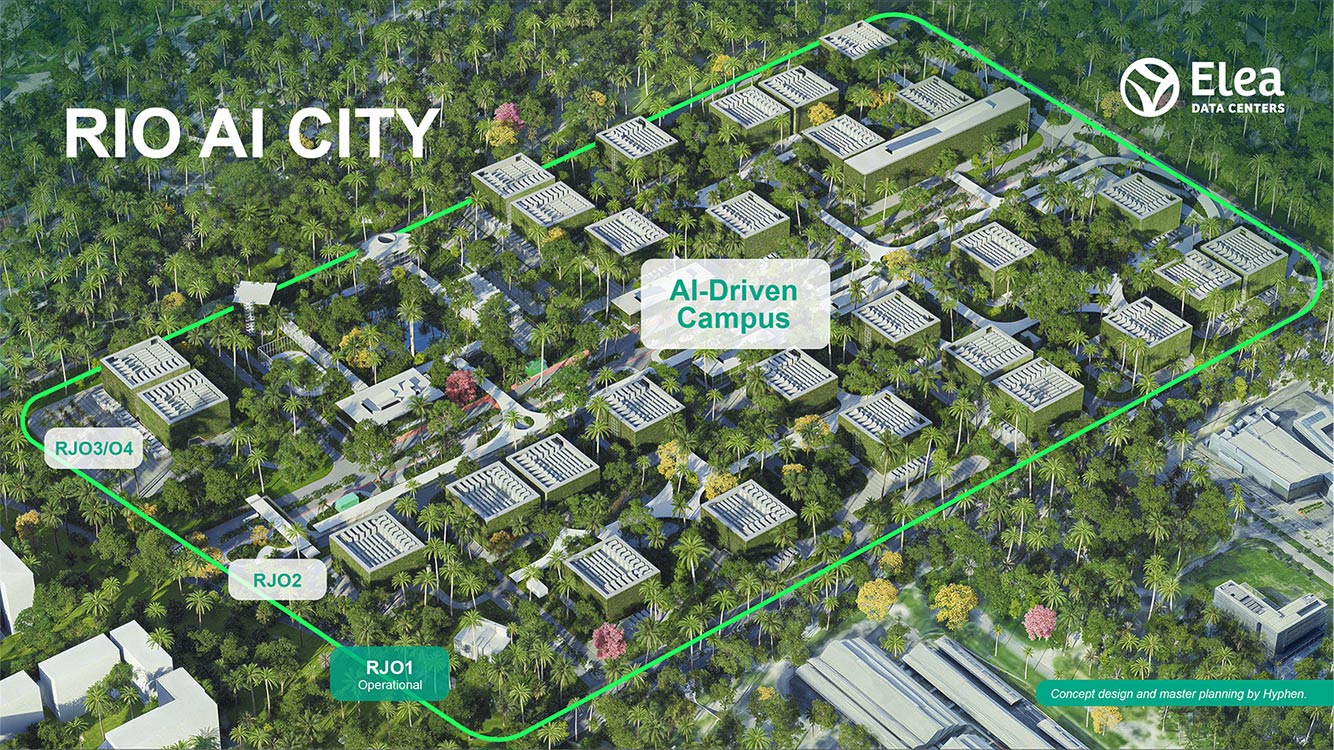
Rio de Janeiro City Hall has been promoting the Rio AI City project at the former Olympic Park site, a proposal that would turn the city into one of the largest data center hubs in Latin America. The argument is that it will increase innovation in the Barra Olímpica neighborhood—officially created in May 2024 and located in the city’s recently renamed Southwest Zone—bringing economic development and integration with the global digital economy. Behind this narrative, however, important questions arise: what type of infrastructure is being built? Who benefits? What are the impacts for those who already live in the city, especially in areas that chronically lack water, electricity and sufficient housing? What lessons can be learned from other cities that have gone through the same process? Were Rio’s residents heard?
What Are Data Centers and Why Do They Consume So Much Electricity?
Data centers are large facilities that store and process the electronic information produced by all of us on the Internet. They hold the data needed to carry out and store everything we do online: social media (such as Instagram and Facebook), streaming services (such as YouTube and Netflix), apps (such as WhatsApp and banking apps) and, increasingly, artificial intelligence (also known as AI, including tools such as ChatGPT and Gemini). For data centers to operate, they require three critical resources: a constant supply of electricity (24 hours per day), cooling systems (which consume enormous amounts of water) and large structures (requiring land).
AI in particular, which has thus far been advancing with little questioning, oversight or regulation, demands an exponential increase in resources for data processing, including electricity, water and land. The water consumption of a data center is equivalent to that of tens of thousands of homes.
What Is the Scale of the Rio Project?
According to Piero Carlo Sclaverano dos Reis, a researcher with the Electric Sector Studies Group at the Federal University of Rio de Janeiro (GESEL/UFRJ), the Rio AI City project could reach an energy demand of up to three gigawatts (GW), a scale comparable to the consumption of large urban regions. For context, this volume exceeds the average load of the Rio de Janeiro metropolitan area, estimated at around 1.8 GW. Similar projects in Brazil already point to this pattern of growth. In other states, data center initiatives may reach up to 5 GW, equivalent to the consumption of cities with millions of inhabitants.
This follows a recurring pattern. Similar projects in other parts of Brazil already consume up to five gigawatts, equivalent to the consumption of cities with millions of inhabitants. These are not small-scale initiatives but large-scale infrastructure that can negatively affect daily life in Brazilian cities, as has already been seen in other parts of the world.
Where Will the Electricity and Water Come From?
This is one of the least answered questions. In requests made by RioOnWatch under Brazil’s Access to Information Law (LAI), Rio de Janeiro City Hall did not provide data on energy consumption, water use or the environmental impacts of data centers in the city. The Municipal Secretariat of Environment and Climate (SMAC) stated that this data does not exist in its systems and that producing it would require additional work. Meanwhile, the Secretariat for Economic Development provided only institutional links, without technical details.
In practice, there is no publicly available information to understand how this project will be sustained or how Rio’s residents will be affected. What we do know is that in other parts of the world, residents in affected areas are the ones paying for the electricity used by data centers. Data analyzed by Bloomberg shows that “electricity now costs as much as 267% more for a single month than it did five years ago in areas located near significant data center activity.”
Who Benefits From These Data Centers?
Despite being built in Brazil, these centers are part of a global infrastructure. They mainly serve large technology companies, digital platforms and artificial intelligence systems. These are not services that will necessarily be used by or benefit the local population. Moreover, although often presented as drivers of development, data centers tend to generate few long-term jobs after construction. This is because they are highly automated, technology-intensive structures that require little labor for maintenance.
Why Do Companies Want To Set Up Data Centers in the Global South?
Studies indicate a pattern of three factors sought by data center companies: relatively cheap energy, water availability and flexible laws. Compared to the Global North (the US, Europe, etc.), countries in the so-called Global South (Latin America, Africa and parts of Asia) tend to have lower operating costs, often with more flexible laws and, in some cases, higher levels of corruption.
This model feeds into the concept of digital colonialism, discussed by researchers such as Deivison Faustino, a professor at the Federal University of São Paulo (Unifesp). According to Faustino, countries in the Global South bear the environmental and territorial impacts of technological infrastructure, while the economic benefits remain concentrated in countries where Big Tech headquarters are located in the Global North.
Is the World Moving Steadily in Favor of More Data Centers, or Are some Stepping on the Brakes?
Not everywhere is open to the construction of data centers. Due to the high costs they impose on local communities—particularly in terms of the power grid, water security and urban land use priorities—resistance has been growing in the Global North, where the technology originated. In Ireland and the Netherlands, local governments even suspended the building of new data centers due to pressure on electricity grids, environmental impacts and a lack of planning by companies. In the United States, the expansion of data centers has sparked debates about the need to slow their growth in order to better understand their impacts. Eleven US states are currently considering regulations, and over 100 communities have already banned the development of new data centers. In different parts of the world, communities and experts point out that these structures are putting pressure on local water and energy systems, as well as requiring significant adaptations to urban infrastructure.
Data Centers in Rio Already Show Few Benefits to the Local Population
Rio AI City aims to become the largest hub in Latin America, but there are already other data centers in the city, particularly in the North Zone. Ascenty operates two data centers in the Pavuna neighborhood, on the border with Greater Rio’s Baixada Fluminense region. One has an energy capacity of ten megawatts and a total area of approximately 7,000 m², while the other has an energy capacity of three megawatts and around 3,500 m². Both are located in an area of the city known for water shortages and power outages, affecting residents of Complexo da Pedreira, Chapadão, Morro da Lagartixa and other nearby favelas.
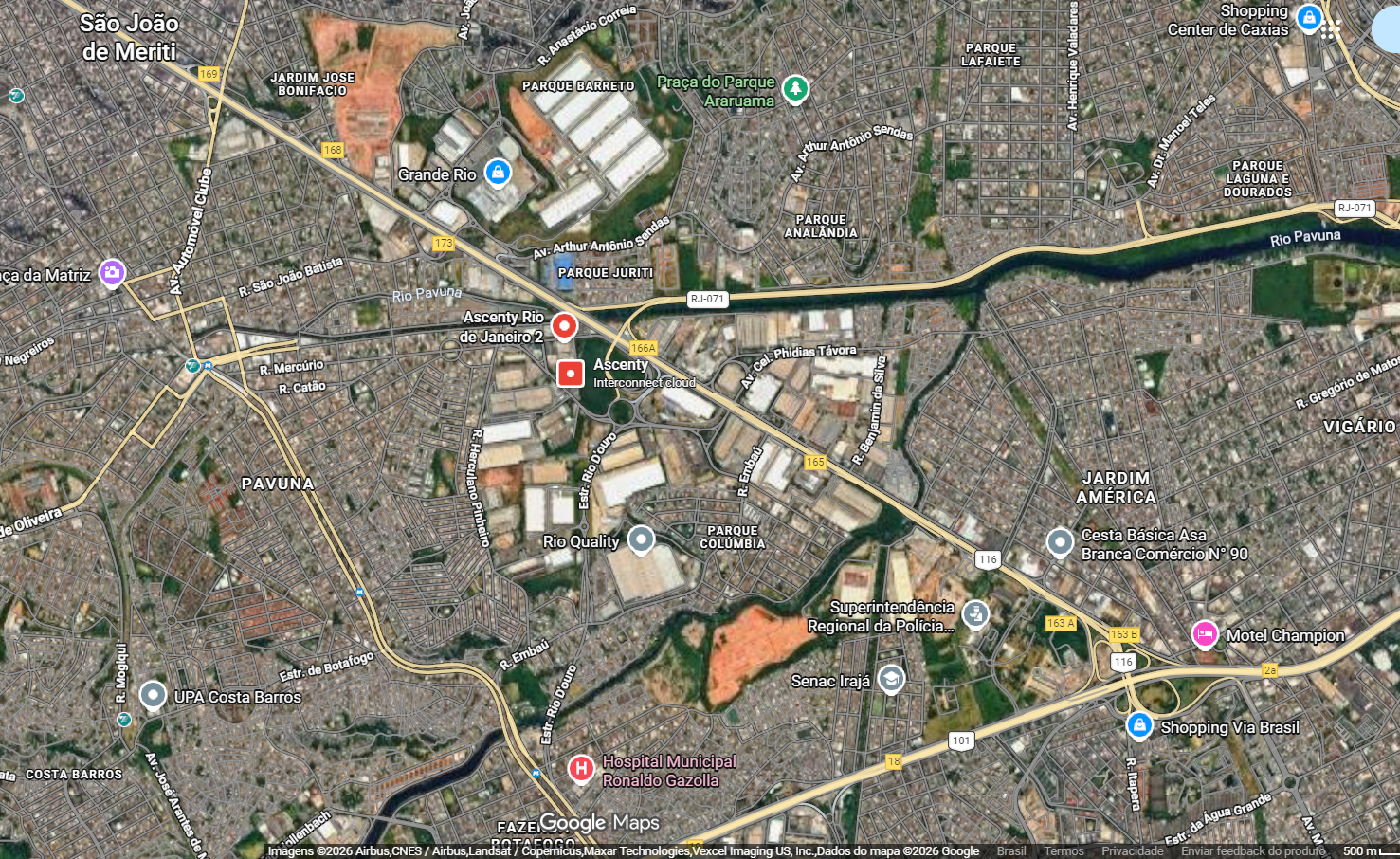
In addition to these, there is a data center in the Del Castilho neighborhood, where Equinix built RJ2. The company also operates another data center in Botafogo, in the South Zone—RJ1. In 2025, it opened a third facility, this time in Greater Rio, in the city of São João de Meriti.
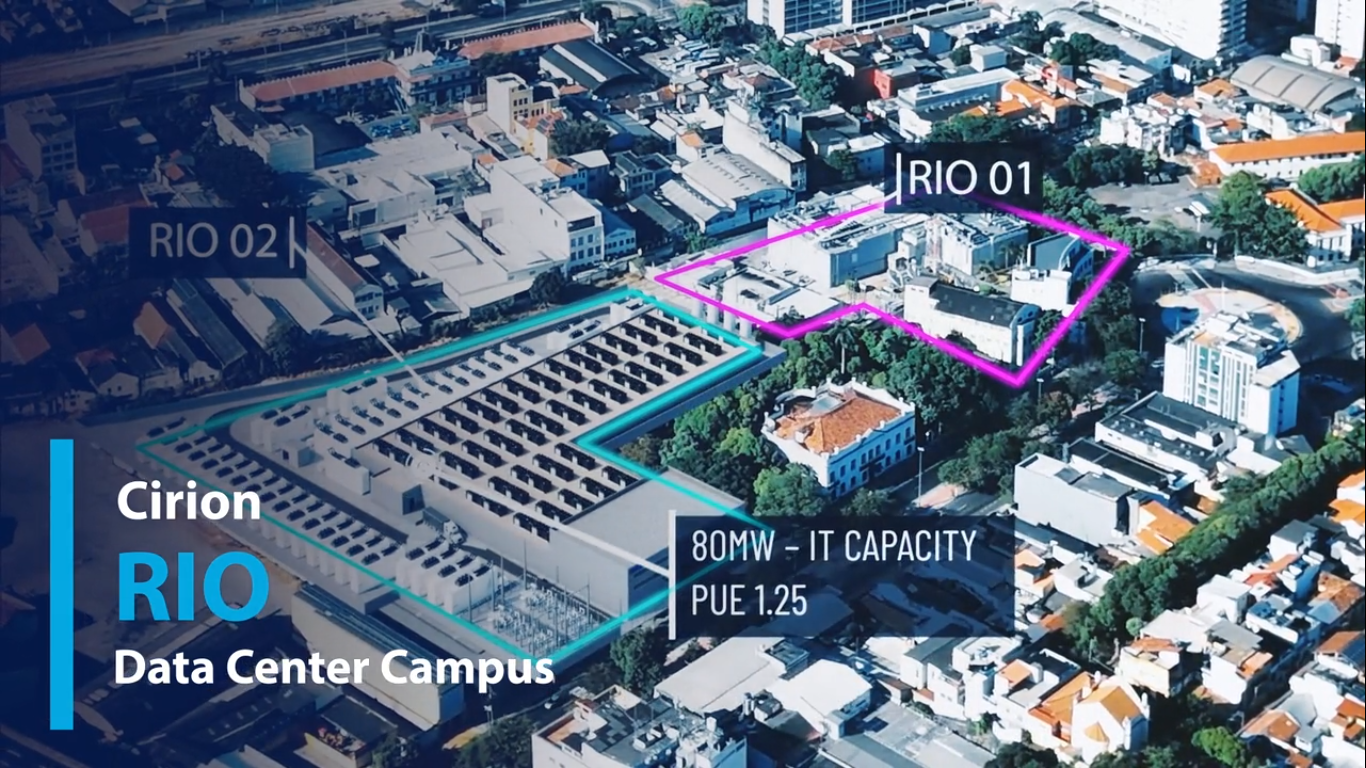
Also in the North Zone, but at the opposite end, near its boundary with the city center, Cirion operates in the São Cristóvão neighborhood. The site houses the RIO1 and RIO2 data center complexes. According to the company, the facility has a potential energy demand of 80 megawatts in the heart of a region with favelas such as Tuiuti, Barreira do Vasco and Caju, which have historically faced power outages, water shortages and a lack of sanitation.
Since these are areas in the Metropolitan Region that already face chronic water shortages, power outages, inadequate sanitation and limited mobility, the introduction of resource-intensive projects raises concerns and fuels fears of real estate pressure and rising prices, new environmental impacts and the repetition of harmful processes from the pre-Olympic period, such as forced evictions.
More than technology, this is a debate about priorities—including whether we, as a society, want to give AI this much free rein. Investing in data centers means deciding where our electricity goes, who uses the water and how the city’s land is occupied. While many cariocas face a housing deficit, a lack of basic infrastructure and limited access to essential services, why guarantee all of this to Big Tech data centers? What are our public priorities: the right of residents to their own city or the profits of foreign companies?
Is Rio Ready for This Type of Project?
At present, there is still no answer to this question. There is not enough publicly available data. There has been no debate open to the population at large.
It is important to understand, however, that this is a context in which Rio and Brazil are part of a broader debate about the expected role of countries in the Global South in the digital economy.
The expansion of data centers in developing countries can, to some extent, be compared to the dynamic observed in the 1990s, when wealthier nations began exporting waste to poorer countries. In both cases there is, on the one hand, a logic of shifting costs and impacts and, on the other, a concentration of profits and dividends. While some countries concentrate economic and technological benefits, receiving nations take on significant burdens: pressure on natural resources, increased energy consumption, environmental impacts and structural dependency. Just as waste exports were often justified by promises of development and income generation, the push to attract data centers relies on narratives of modernization and integration into the global economy.
Specifically in the Brazilian case, this trend is also being justified by the availability of hydroelectric energy considered clean in terms of its carbon footprint, as well as by the potential expansion of the renewable energy mix (solar and wind). However, reliance on hydropower and the intensive use of water make the system vulnerable to periods of drought. When the next water crisis hits, who will face water and power outages in Rio de Janeiro: Rio AI City or favelas and peripheral areas?
In this context, the lack of information, transparency, public participation and integrated planning makes one thing clear: it is urgent to pause and hold an open, broad public debate to define collectively what role these technologies will play in Rio de Janeiro.
Editorial written in collaboration with Felipe Migliani.