
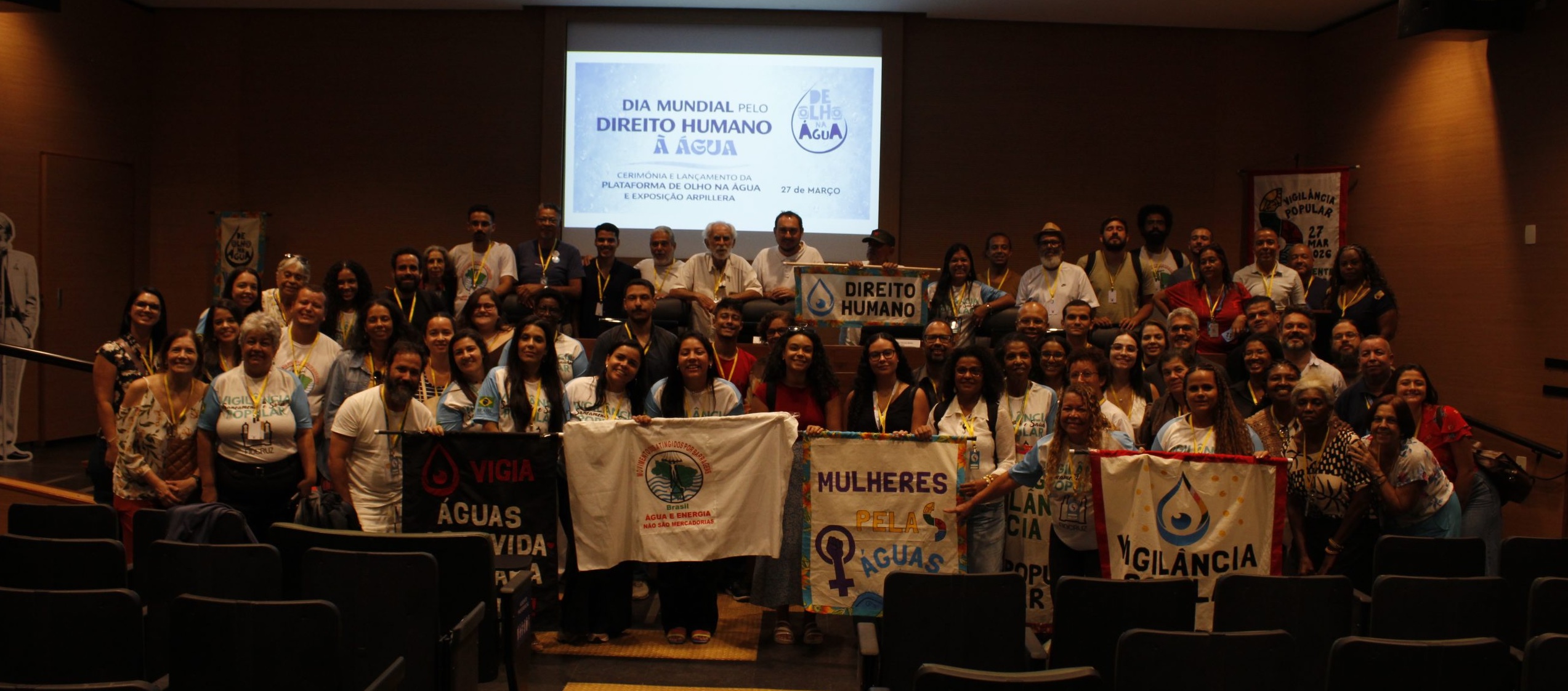

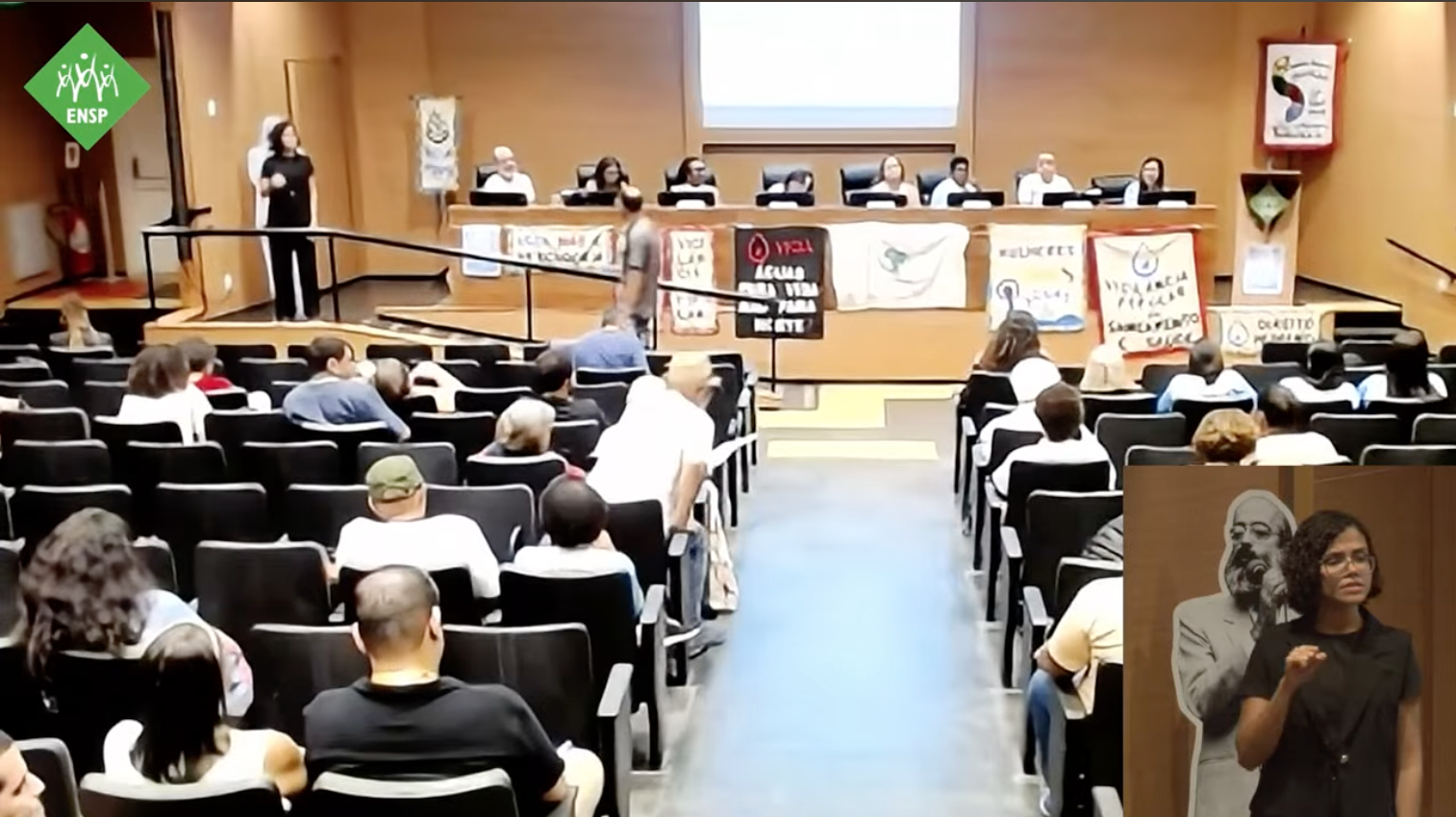
During the week marking World Water Day, the Water Watch Platform* was launched. The tool was created by the Popular Network for Sanitation and Health Monitoring of the Brazilian national health foundation’s (Fiocruz) Sergio Arouca National School of Public Health (ENSP). The ceremony was organized by the Research Group on Health, Environment and Sanitation (SAS Fiocruz) in the institution’s auditorium and drew 192 participants, both in person and online.
All Eyes on Rio’s Water Rights
The city of Rio de Janeiro is marked by deep inequalities, including in access to water and sanitation. Following the privatization of water and sanitation distribution services in 2021, the concession was transferred to the utility Águas do Rio. Although the company has expanded its coverage across the city since then, residents report worsening service, with high rates and continued difficulties accessing water. Data released by the Brazilian Institute of Geography and Statistics (IBGE) after the 2022 census show that youth, Black, brown and Indigenous people are among those most affected by inadequate sanitation, including both lack of access to the public network and limitations within their homes.
According to Rodrigo Nunes, a researcher with the Water Watch Platform, the problem will escalate due to the impacts of climate change:
“Studies by the National Water and Basic Sanitation Agency (ANA) indicate a decline in water bodies nationwide, largely due to fires and deforestation… In Rio de Janeiro, we are heading into a period of significant difficulty when it comes to water security.”
According to data from ANA, Brazil’s bodies of water could be reduced by over 40% by 2040, affecting water levels in river basins across the North, Northeast, Central-West and parts of the Southeast regions, as a result of climate impacts.
This reduction represents serious risks to the population: the spread of disease, food insecurity and a consequent worsening of social problems in already vulnerable areas.
“Another study by Trata Brasil found that… [Greater Rio municipalities of] São Gonçalo, Belford Roxo, São João de Meriti and Duque de Caxias [currently have] the worst sanitation levels nationwide, among 100 municipalities analyzed. Anyone arriving in Rio de Janeiro notices the smell of sewage in bodies of water anywhere. Data are essential for policymaking, to bring people closer [to the issue] and to develop the economy. Our state is in complete disarray.” — Rodrigo Nunes, researcher with the Water Watch Platform
A Collective Tool to Fight Environmental Racism
Inspired by projects such as Cocô Zap, a sanitation monitoring initiative from the group of 16 favelas that make up Complexo da Maré, in the city’s North Zone, the Water Watch Platform’s primary aim is to promote collective, civil society monitoring, where data production and social participation work together to enable effective pro-sanitation policymaking. Only through collective mobilization can these challenges be addressed.
Through an environmental sanitation survey, people from vulnerable areas, such as favelas and peripheral neighborhoods, can submit information on the quality and availability of sanitation services in their communities, as well as their perceptions of environmental health, changes observed after the transfer of services to a private provider and the health issues affecting each area. This information is catalogued and made available to the public on the website’s home page, in the data section, forming an ongoing overview of the sanitation conditions in these areas.
These data are also available on the project’s interactive map, which cross references data submitted by residents with data collected by official bodies, such as IBGE and the National System of Information on Basic Sanitation (SINISA).
Users can also submit georeferenced complaints, access reports and research made available by the project team, as well as follow related news, as explained by Adriana Martins, coordinator of the Popular Sanitation and Health Monitoring Project.
“It will include a log of complaints, where everyone will be able to see others’ messages. If there is a buildup of water shortage issues in one area, the problem can be referred to the Public Defenders’ Office, which can also access it directly, and a lawmaker can view it as well. It’s a very quick and direct way for citizens to consult complaints. Citizens will also be able to see whether a complaint has been forwarded, archived, is under analysis or has any pending issues.” — Adriana Martins, coordinator of the Popular Sanitation and Health Monitoring Project
Different Challenges in Access to Water Create New Layers of Inequality
Highlighting conditions in different areas, field researchers pointed to some of the most critical issues faced daily by residents, including numerous adversities caused by difficulty accessing water and sanitation services.
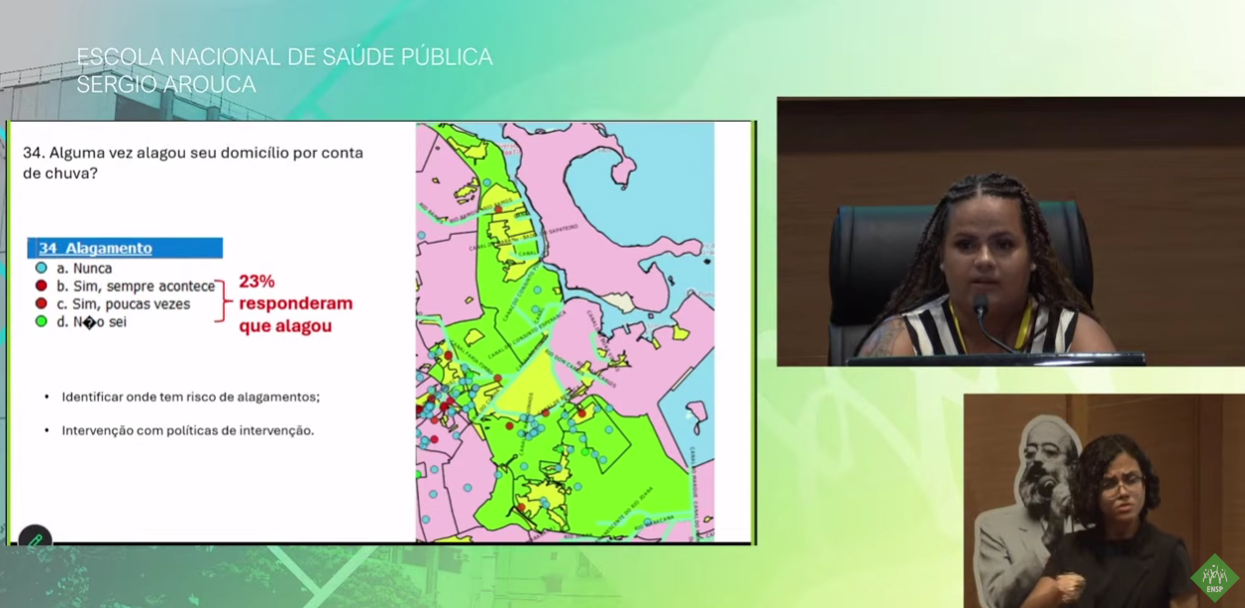
Ericka Kathellin, a researcher and biomedicine student born and raised in Manguinhos, mapped her community and described how environmental racism is embedded in everyday problems.
“When we asked whether the pipe supplying the home with water was at risk of coming into contact with sewage, 40% of respondents said yes. So people often experience recurring illnesses such as diarrhea and viral infections. They don’t know why—they don’t have the information that it’s because their water is being cross-contaminated with sewage. [In parallel to this] 22% of these people report that their homes flood. Recently, at the end of last year, everyone saw what happened in Complexo de Manguinhos [in Rio’s North Zone] after the heavy rains. The entire group of favelas flooded. I’m 1.5 meters tall (~4ft 11in) and the water rose above that. I was trapped with my daughter [on the street]. What is the government doing? Why does the flooding reach Avenida dos Democráticos [in a region far from the river and paved]? Where are the public works?” — Ericka Kathellin
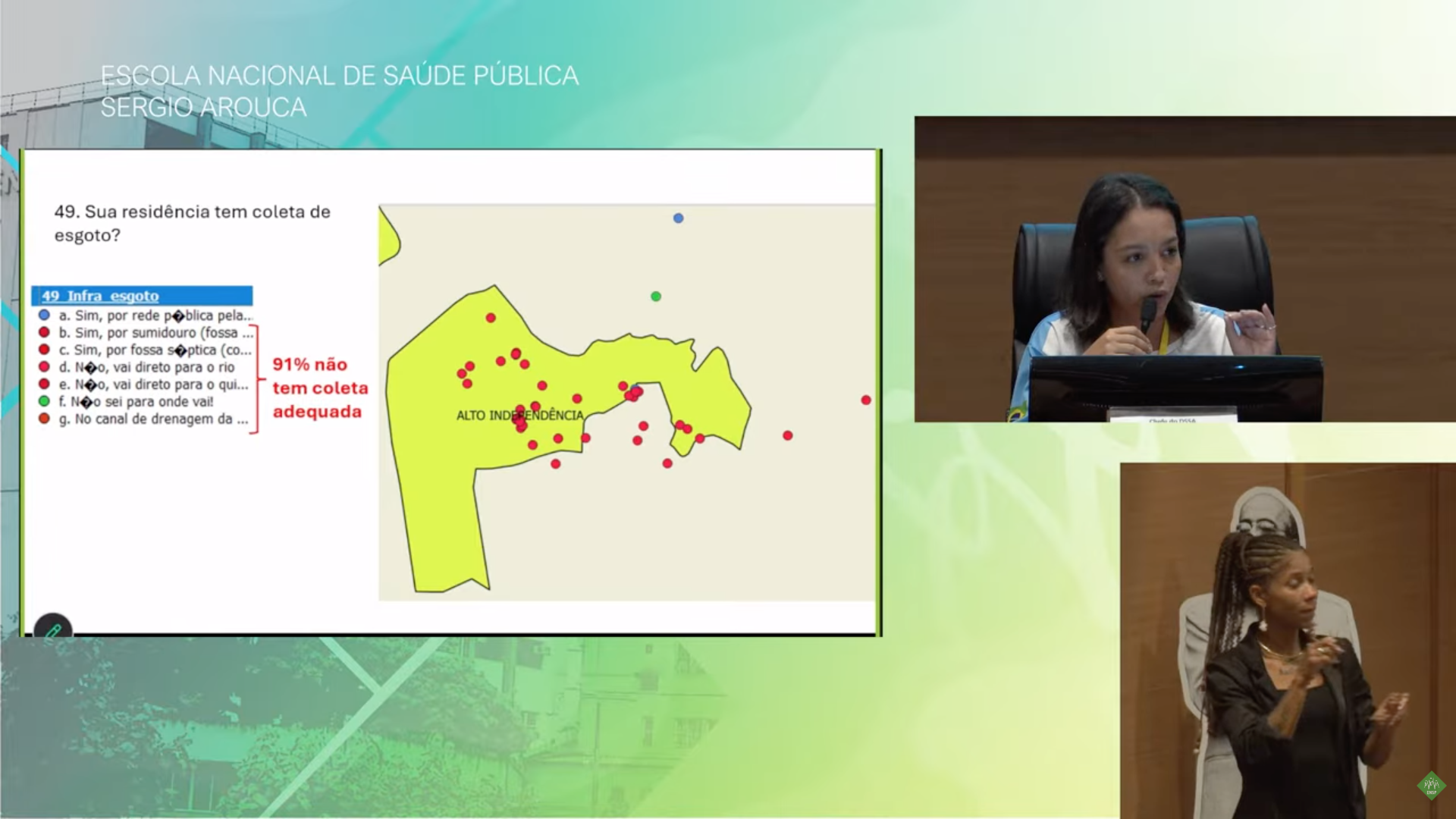
In Petrópolis, a city in the state’s mountain region and part of Greater Rio, in the Alto da Independência neighborhood, Suelen Sousa shared that local residents, primarily low-income individuals, saw their water bills double overnight. She stated that this abusive increase occurs even though the company is not providing the service it is being paid for, as in addition to the lack of water, there is no public sewage collection in the community.
“It’s in the survey: 91% say there’s no sewage collection, but the utility [Águas do Imperador] is treating us as if there were. [Our] community is also demanding: who was it that put in the piping [in our neighborhood]? We did! Not the utility. And they’re charging us 100%, which is something we need to discuss: what gives them the right to charge up to 100% [on top of the original service cost]? Water bills have doubled… That’s absurd! We need to [question]: why have we normalized this? Legally, companies do this, but it’s an abusive fee, and people in Alto da Independência can’t afford it. They implemented this charge without [providing] proper treatment, without providing the service. And the social tariff is not being applied to this area.” — Suelen Sousa
In Greater Rio’s Leste Fluminense region, to the east of Guanabara Bay, in Complexo do Salgueiro, in the city of São Gonçalo, researcher Ana Santos states that 84% of the population do not have running water on a daily basis and regularly have to buy bottled water.
“The issue of water is dire in this region. We found that 33% have one or no water access points in their homes, meaning that 88% must store water to ensure water security. Many of them have to buy water tanker trucks or cannot access wells… We are very pleased that this research has crossed the [Rio-Niterói] bridge, because São Gonçalo needs to be seen, especially Complexo do Salgueiro, which is not easily accessible.” — Ana Santos
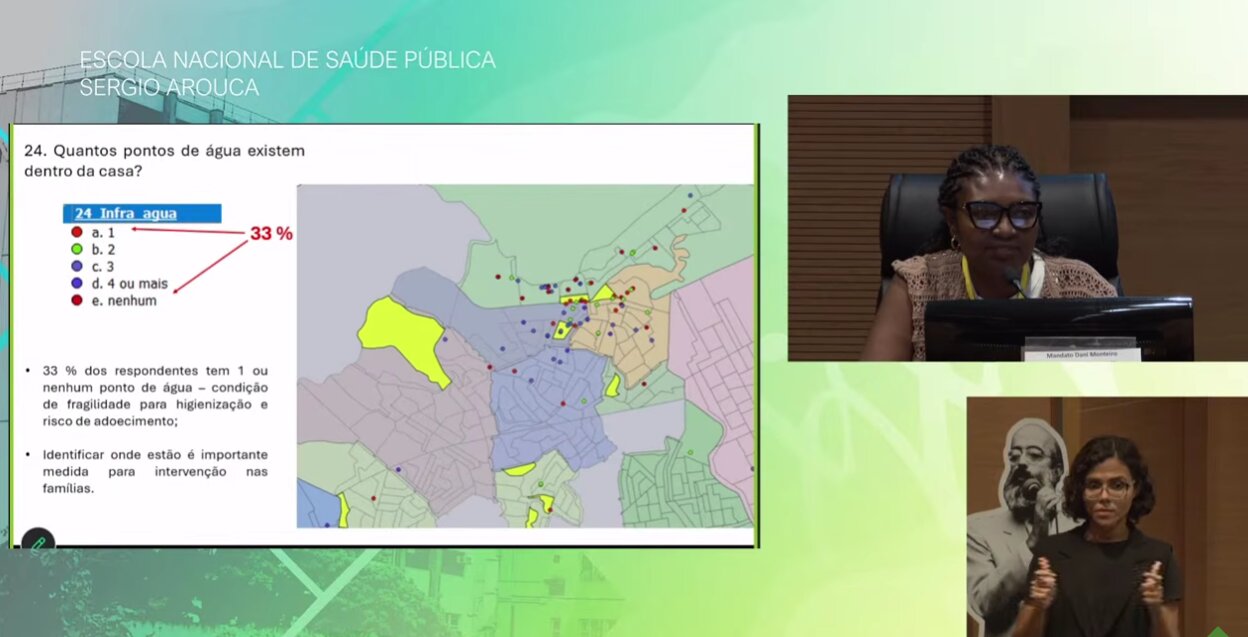
The full list of data available so far can be viewed on the website. In total, 33 municipalities are currently being surveyed.
View the Launch Event of the Water Watch Platform:
*The launch’s opening panel included State Deputy Dani Monteiro, Federal Deputy Tarcísio Motta and Thales Rabello, advisor to Federal Deputy Henrique Vieira. It also included Adriana Sotero, professor at the institution, ENSP Director Fátima Rocha, Marcos Denicio from the Department of Environmental Sanitation and Health (DSSA) and Maria José Salles from the SAS Fiocruz research group. Also present were Rafael Nunes, researcher with the Water Watch Platform, and field researchers Éricka Kathellin (Manguinhos, Maré and surrounding areas), Lúcia Soares (Jacarezinho/Jacaré), Alex Freitas (Rocinha, Vidigal and surrounding areas), Ana Santos (Complexo do Salgueiro, in São Gonçalo), Suelen Sousa (Alto da Independência, in Petrópolis), Priscila Moura (Unamar/Tamoios, in Cabo Frio) and João Ricardo (Vigário Geral and surrounding areas). Representatives from various organizations were also present, including the Brazilian Press Association (ABI), the Movement of People Affected by Dams (MAB), the Canal do Cunha Watershed Observatory and the Living Bay Movement, as well as public officials and members of civil society.
About the author: Amanda Baroni Lopes is a journalism student at Unicarioca and was part of the first Journalism Laboratory organized by Maré’s community newspaper Maré de Notícias. She is the author of the Anti-Harassment Guide on Breaking, a handbook that explains what is and isn’t harassment to the Hip Hop audience and provides guidance on what to do in these situations. Lopes is from Morro do Timbau and currently lives in Vila do João, both favelas within the larger Maré favela complex.