
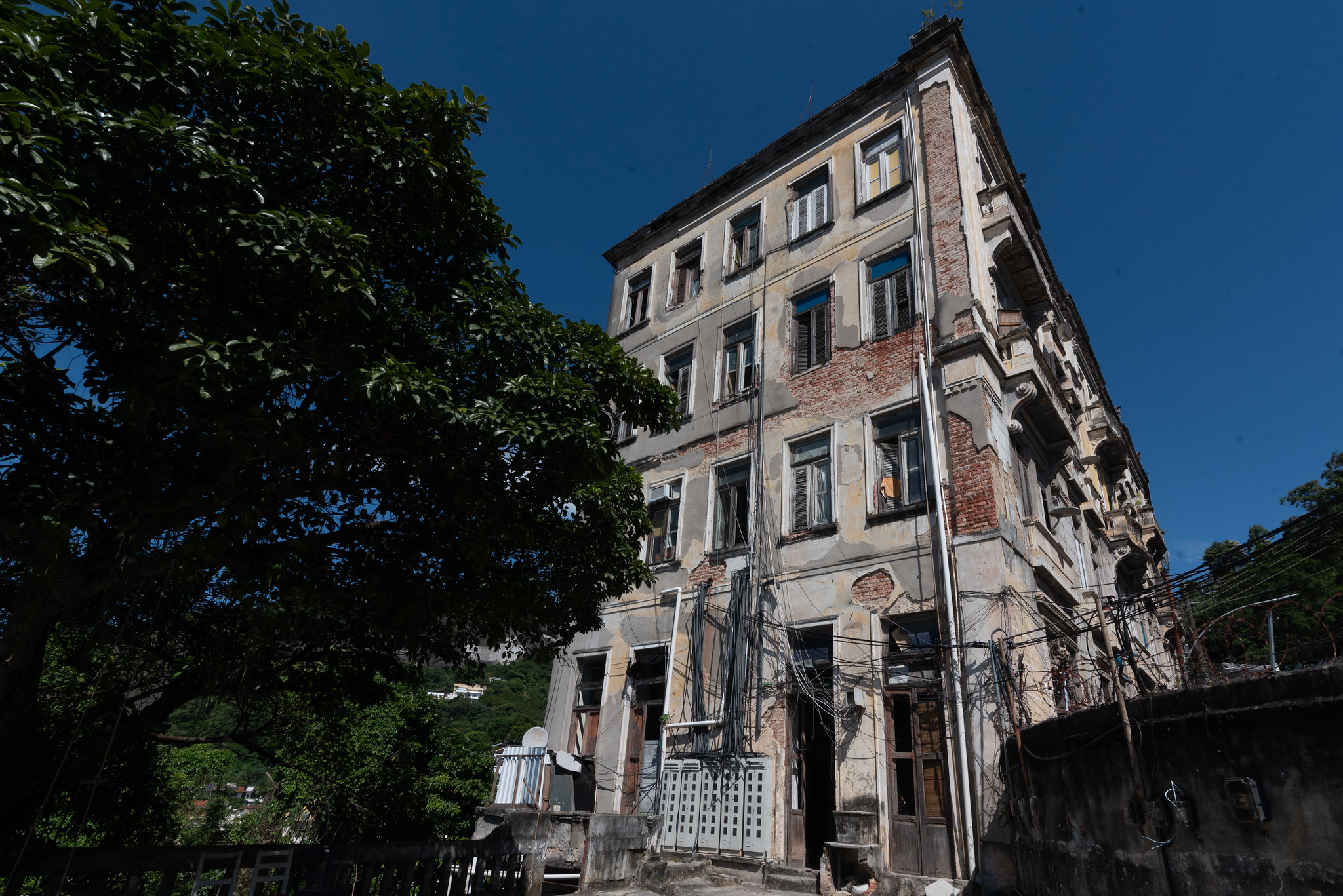

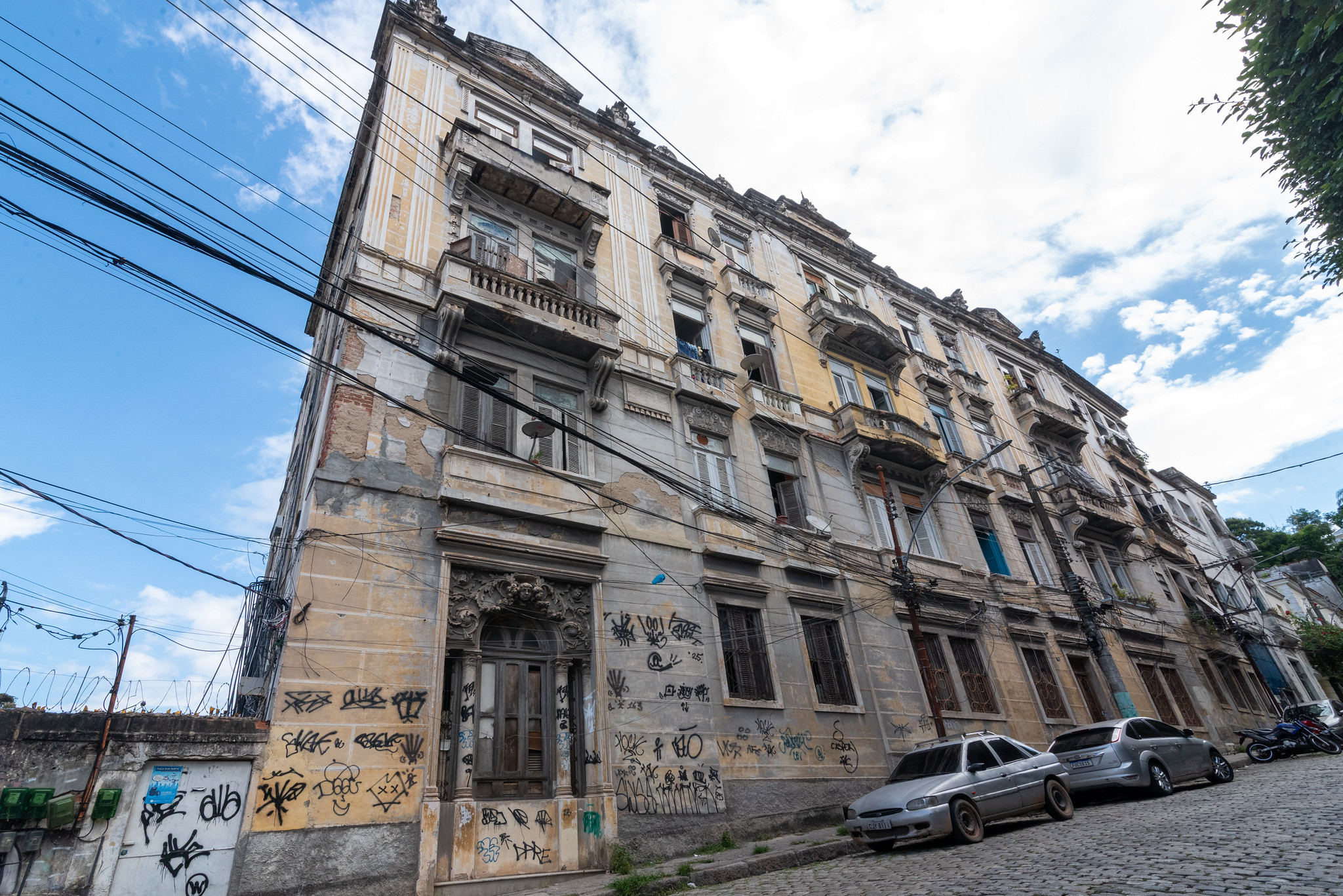
Residents of the Cândido Mendes Mansion in Santa Teresa, a neighborhood in central Rio de Janeiro, are at imminent risk of repossession proceedings leading to eviction after a construction project contracted out by Brazil’s Secretariat of Federal Patrimony (SPU) caused damage to one of the building’s pillars. Built in 1914 as a luxury hotel, the structure has also served as a convent. Since the 1990s it has been occupied as social housing, mostly as a home for former convent and informal workers.
A coalition of residents, technical allies including lawyers, architects and professors from the Federal University of Rio de Janeiro (UFRJ), Fluminense Federal University (UFF), and the Pontifical Catholic University of Rio de Janeiro (PUC-Rio), as well as the Rio de Janeiro State Public Defender’s Office and the Federal Prosecutor’s Office, however, disputes the need for expulsion. According to technical reports, emergency repairs to the building are needed to ensure that residing families can remain safely in their homes.
Reparations: A Historic Building Now Serves as Social Housing
The Cândido Mendes Mansion has had various uses throughout its history. Initially built as Hotel Moderno, an international luxury hotel in the 1940s, it was later incorporated into the SPU’s assets due to the former owners’ debts. In 1952, it was ceded to the Order of Our Lady of the Most Holy Trinity. When the Order left the property, use rights to the building were transferred to the Order’s former live-in workers.
Dona Francisquinha is the occupation’s oldest resident. At 95, she has lived there for 37 years, since 1989, and is one of the workers from the building’s convent era.
“I’ve lived here for 37 years, back when this was a convent, when it belonged to nuns. They lived here since the time of [President] Getúlio Vargas. Then, when they were founding the Order, Dom Jaime de Barros Câmara was the one who spoke with Vargas and got this building for them. It used to be a famous hotel. [The owners] were in debt with the government and gave up the building. That’s how they helped found the Order of Our Lady of the Most Holy Trinity. The nuns lived here for almost 50 years. Around that time, they called me to work here because I was a receptionist. So I came and stayed. Over the years, [the Order] left and I stayed on. I’m still here because I need to be, you know? And that’s why I’m still here, even today.”
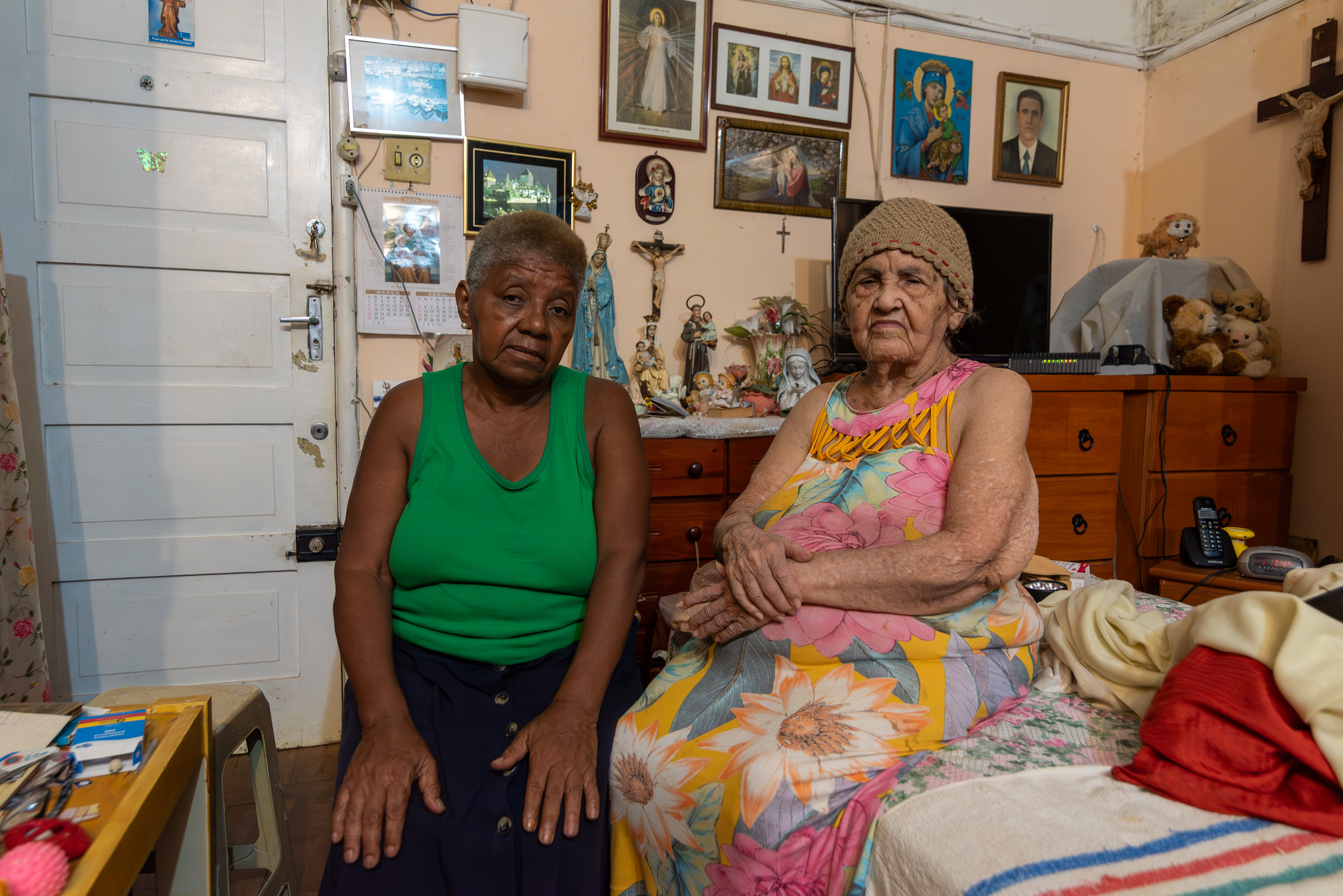
Another long-time resident, Maria da Conceição Vicente, 69, has lived in the Mansion since 1995, for 31 years now:
“I first came here in 1980, when I brought my brother-in-law lunch—he had a room here. I got here and Sister Terezinha told me [I was unemployed at the time] she needed someone to clean the rooms of the ladies who couldn’t do it themselves, who were much older… So, I accepted [the offer] and started working here. Later, I started working in other places, but on Saturdays, I’d come here to do laundry for the ladies and clean for them… In 1995, I came to live here and I’m still here; [at the time] my youngest daughter was three and my oldest was twelve.”
Nathanael José Pereira, 71, has lived in the building for 36 years. Now retired, he also worked for the Order:
“I came to live here through my partner, who already knew the place and worked [here] back when the nuns were still around. Then, when a spot opened up, she spoke with the administrator, Sister Cinila. We came here with my whole family, to live and work.”
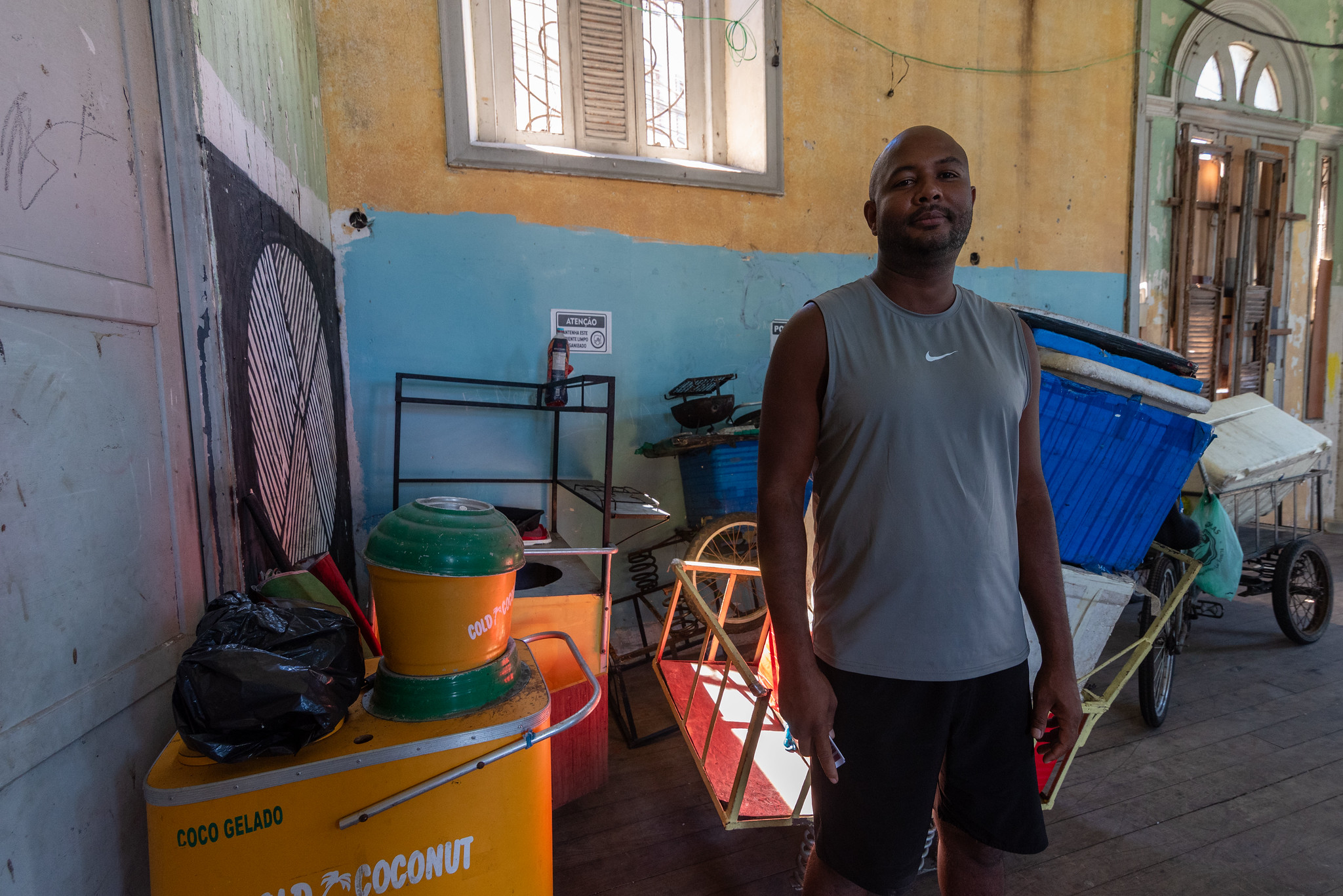
Aside from workers from the time of the Order who remained in the building, other informal workers also live in the Mansion. This is also an important issue: living in the city center means having better work opportunities. Ivo Manuel dos Santos Faria Júnior, known as ‘Júnior,’ 37, is a street vendor and has lived in the mansion since 2020:
“I’ve lived here since 2020. I work in the street [as a vendor], taking advantage of the [opportunities in the] area, which is well located. I also managed to bring my family here, who used to live in Santa Cruz, a neighborhood [in the extreme West Zone of the city] where it’s hard to find work. Here, through informal street work, they were also able to buy their own home, where they like living… this is also their home base. Every carnival, they come here to work. It’s very important for us to be here and remain because, besides housing, this place was a starting point for improving our lives. Not just mine, but my mother’s too—a 64-year-old woman who came here at 50, never had a formal job and always worked informally. She has a [vendor] cart to work samba events and other events. And all of this is possible because we live here.”
The mansion is also an alternative for people seeking more affordable housing amid the reality of high rents in the city center. As Maria da Penha dos Santos, 68, who has lived in the building for 19 years, explains:
“I came here with my four children and four grandchildren through a recommendation. I was living in a place where the rent was very expensive, and I couldn’t afford it anymore. I lived on Ladeira de Santa Teresa, very close to the Lapa Arches. So I came here. I worked in two different places, so this place is great for me. And my children also studied and worked around here. My children and I love living here.”
Maíra Martins, a professor in the Architecture Department at the Pontifical Catholic University of Rio de Janeiro who also coordinates the Interdisciplinary Research and Extension Center for Collaborative Social Interest Projects and Practices (COLABIS), emphasizes that residents’ presence plays an important role in preserving the Cândido Mendes Mansion. Residents make improvements to their units, maintaining the building as best they can and preventing it from being completely abandoned, along with all the effects that come with that.
According to Martins, the mere fact that the building is occupied prevents further structural degradation, pest infestation and garbage accumulation, among other issues. In this sense, occupations serving as social housing also end up playing an important urban role by giving use to structures that would otherwise be subject to rapid deterioration. Martins emphasizes that residents have kept the Cândido Mendes Mansion functional for at least 30 years through renovation work:
“As much as they can, [the residents] make improvements to the building. They renovated the roof lining due to leaks. They also repaired walls and removed tree roots and frequently remove crumbling plaster from the façade, specifically to prevent falls or accidents. So, they take a series of precautions, a kind of ‘soft’ maintenance, which is all they can do. For deeper maintenance, they need more funding… The issue with an empty building—an unoccupied one—is that it presents a much higher risk of structural problems than an occupied building, due to the [lack of] attention and maintenance. This is very important for the surrounding area, because every abandoned property generates a process of deterioration around it. This means the area does not become unsafe, poorly lit or frequented by fewer people. So, the simple fact that [the building] is occupied is already a way for this property to bring life to the area around it.”
A Series of Mistakes Made by the Secretariat of Federal Patrimony
Attorney Mariana Trotta serves as the key legal council on the Cândido Mendes Mansion case. After the occupation’s case was referred to the Land Solutions Commission of the 2nd Region Regional Federal Court (TRF2), the property’s residents’ association requested support from Trotta, a law professor at UFRJ and coordinator of the Luiza Mahin Popular University Legal Assistance Center (Najup). According to her, the mansion has been the target of a repossession action filed by the SPU since 2020. However, in December 2025, even with the case under review by the TRF2 commission, which aims to mediate conflicts and prevent forced evictions, the trial court ordered the building’s immediate evacuation without a deadline for the eviction or any alternative housing. This sparked intense concern among residents, whose work and income are closely tied to the economic flows of the region where they live. Most have nowhere to go if the eviction moves forward. They would be left without work and without a home.
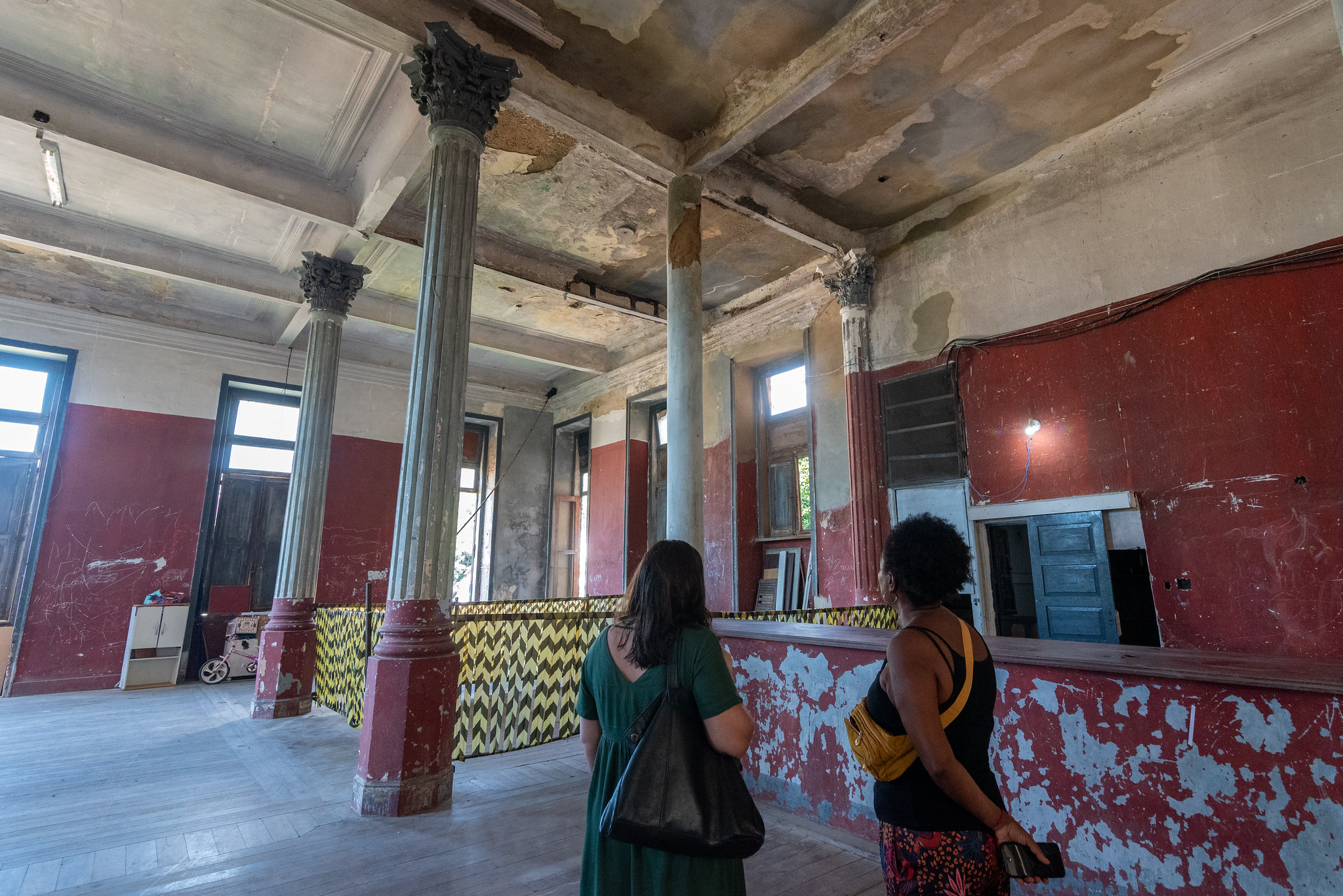
According to Trotta, the SPU justifies the forced eviction based on the building’s structural risk. However, expert reports—prepared with technical assistance from UFF/OPPHUS-EAU and PUC Rio/COLABIS in collaboration with the occupation—indicate that there is no such imminent risk requiring families to leave:
“We know that the building needs structural repairs from the federal government. It’s a property that these families have lived in since the 1990s, one that needs maintenance. But there are reports by UFF and PUC that prove there is no imminent risk requiring the families to leave. In fact, [the same reports say] it would be feasible to carry out repairs on the building while allowing families to remain there, simply by relocating them within the building.”
Trotta also points out that the SPU is responsible for the building’s structural damage following interventions carried out by the agency itself. Therefore, the secretariat should resolve the problem it caused instead of evicting residents.
Amid fears of eviction, negotiations remain in process—proposals to transfer families to a housing complex in Guadalupe, in Rio de Janeiro’s North Zone, have been rejected by residents. They are demanding to remain where they are while the necessary renovations are carried out and have been awaiting a solution from the SPU since January 2026.
Sandra Kokudai, an architect and urban planner who works as a parliamentary assistant with a focus on housing policy, says that the Cândido Mendes Mansion has long been the site of a struggle for land regularization. According to Kokudai, the building came to be designated for social housing and included in proposals under the Minha Casa Minha Vida-Entidades federal public housing program for self-built housing, whose project was recently approved with support from the Oscar Niemeyer Social Institute for Projects and Research.
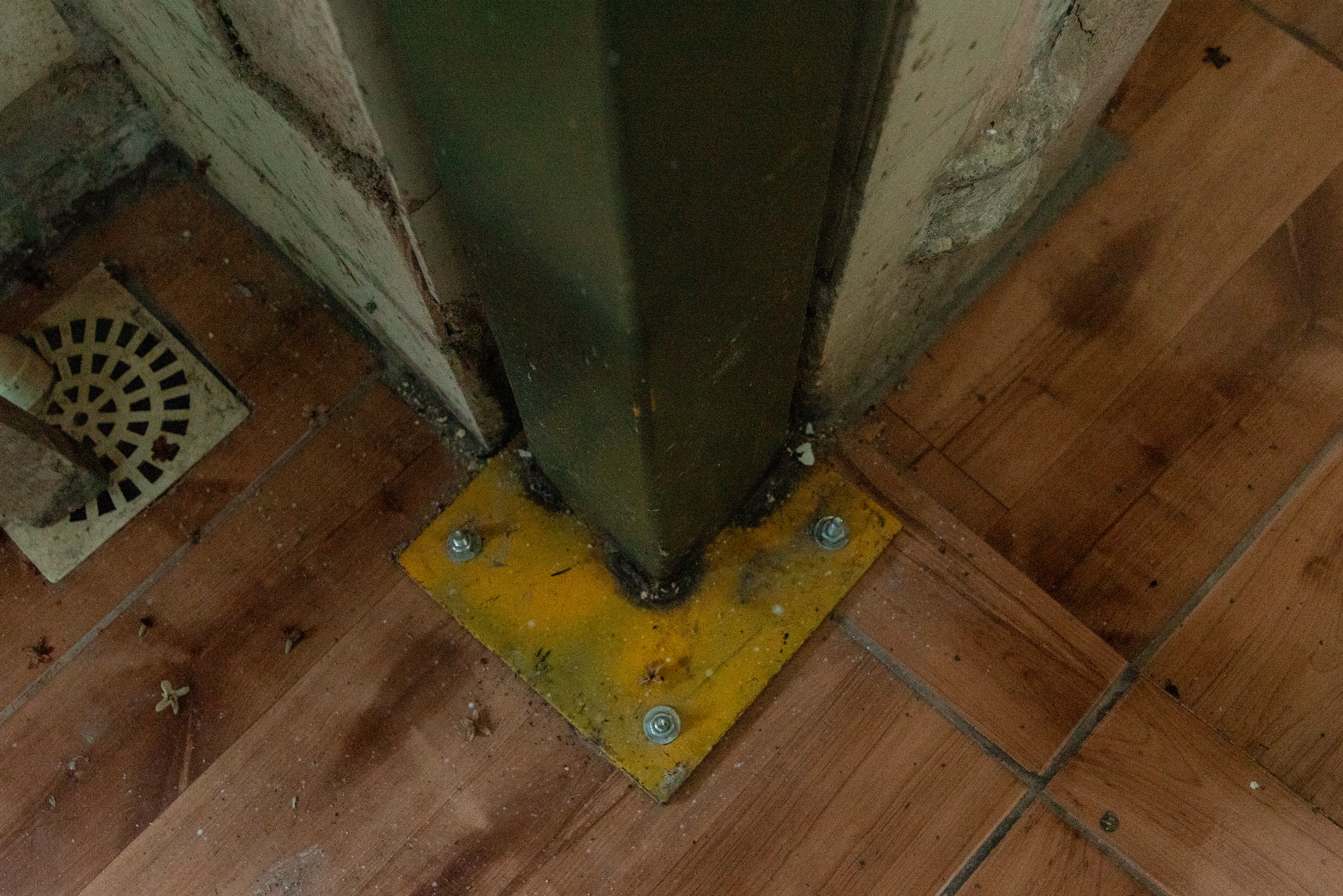
Kokudai explains how the problem was caused by negligent roof works carried out by a company hired by the SPU for renovations. According to the architect, the improper accumulation of construction debris caused one of the building’s pillars to give way. Despite this, expert reports indicate there is no imminent risk of collapse, although emergency work is necessary—such as proper shoring and correcting leaks aggravated by flaws in the execution of recent interventions, including the installation of metal support pillars.
“SPU hired out the roofing project, which was a long-standing demand, even pursued in court by the residents themselves in an effort to preserve the building. Finally, this request was granted last year. Residents repeatedly stressed that the rooftop terrace could not take on too much weight… The contractor accumulated rubble from the work on the rooftop, then it rained and it was chaos. A pillar from the metal structure gave way and opened a crack in a wall.
The building is [like] an elderly lady who needs care, but she’s standing, she’s walking, she’s still strong. If you look at the building’s structure, the walls are very thick. The question was whether the building’s internal metal structure would hold up after the pillar gave way. There were several reports, the city’s Civil Defense came here, the SPU hired a company to prepare a report and the families, through partnerships with UFF and PUC, also conducted analyses to determine whether the building was truly safe. All the reports indicate that there is no imminent risk. So, the building is safe, although emergency repairs are needed.” — Sandra Kokudai
Matilde Guilhermina de Alexandre, 67, has lived in the occupation since 2010 and actively participates in the fight to improve the building’s conditions. She was a key figure in negotiations with Light and CEDAE—respectively Rio’s private electric utility and public water utility—which cut off services to the ocupation during the pandemic. De Alexandre also closely monitors the situation with the company contracted by the SPU to carry out the renovations that caused one of the building’s pillars to give way:
“[The contractor] presented about seven timelines at the time, and we were skeptical… We had meetings with the SPU [and despite our complaints,] they hired the company [anyway]. They started working on the roof in October. [Out of nowher] they handed the project over to the SPU [as if it were finished,] but not to us. [The contractor] handed over a project that wasn’t finished. And, when the first rain came, the whole roof came down. Everything they had done collapsed, and water kept pouring into the homes. There are videos of people desperate as water came gushing in.”
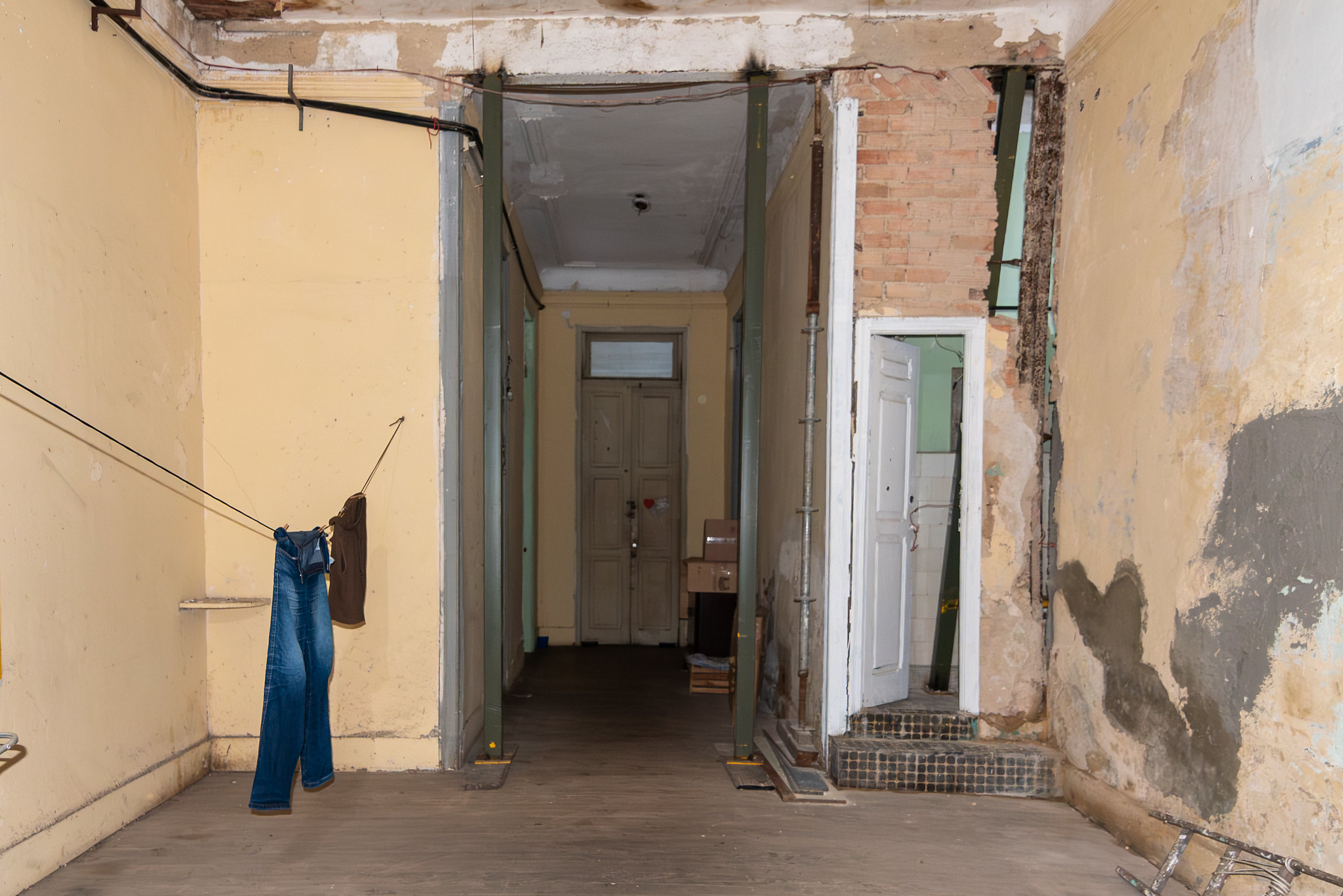
De Alexandre explains that from then onwards, there were a series of building inspections. Reports from PUC and UFF confirmed that the building was not at risk of imminent collapse although repairs were needed to guarantee the residents’ safety. However, on December 15—just before Christmas—she says an officer of the court knocked on the Mansion’s door:
“The process server arrived here at around six or seven o’clock in the evening and said, ‘Look, this is a legal action against you, it’s a repossession order, you’re going to have to leave and five residents need to sign here.’ But before that, on August 22, 2025, the SPU nominated our building to participate in the Minha Casa Minha Vida-Entidades federal housing program. It was published in the Official Gazette and they told us: ‘You’ve all been here for many years, I think it’s your turn to participate in the program.’”
In an interview, Daniel Cardoso, a professor in PUC-Rio’s Civil and Environmental Engineering Department who authored the structural assessment report and recommendations regarding the Cândido Mendes Mansion, explained that despite the building’s fragilities resulting from its age, lack of maintenance and additional structural load over time, the structure demonstrates good overall stability:
“The structure has redundancy and the ability to redistribute structural forces, which explains why the damage observed in the pillar did not spread. The external structural masonry is robust and contributes to the building’s overall stability, while the internal metal structure, although more slender, also has sufficient redundancy. With the adoption of shoring, loads can be adequately redirected, even with the localized loss of capacity [due to the pillar’s collapse]. There is therefore no evidence of an imminent risk of global collapse, but it is essential to adopt measures such as load reduction, shoring the primary beams and carrying out localized repairs, especially given the building’s ongoing deterioration.”
Residents Risk Being Evicted and Forcibly Relocated to Guadalupe
A major concern was the roof work, which caused structural damage to one of the building’s pillars and water seepage into the walls following the installation of metal beams, apparently due to technical incompetence by the contractors hired by the SPU to carry out the work. This is what fuels fears of relocation to an army residential complex in the neighborhood of Guadalupe, 31 kilometers from the city center.
Lucinalva de Sousa Santos, a resident of the mansion since 1997, explains how the struggle for housing rights and improvements to the building has been a longstanding one:
“Here, we have a very high demand for maintenance and papers proving this place is ours. We’re not invaders; most of us came here back when there were still priests and nuns, because this was a hotel that housed priests and nuns from abroad who came here to study. We’re still fighting. Now, we’ve managed to be included in the Minha Casa Minha Vida-Entidades program and we’re fighting for land regularization. But we still don’t have the land use concession we need. They were going to send us to Guadalupe, which is very far from here and completely different from what we have here. We’ve lived here for 30 or 40 years. We have our whole lives here—work, school, health clinics… So, I believe [taking us away] is not fair, because they said there’s an imminent risk [of the building collapsing], but nobody has been able to prove it.”
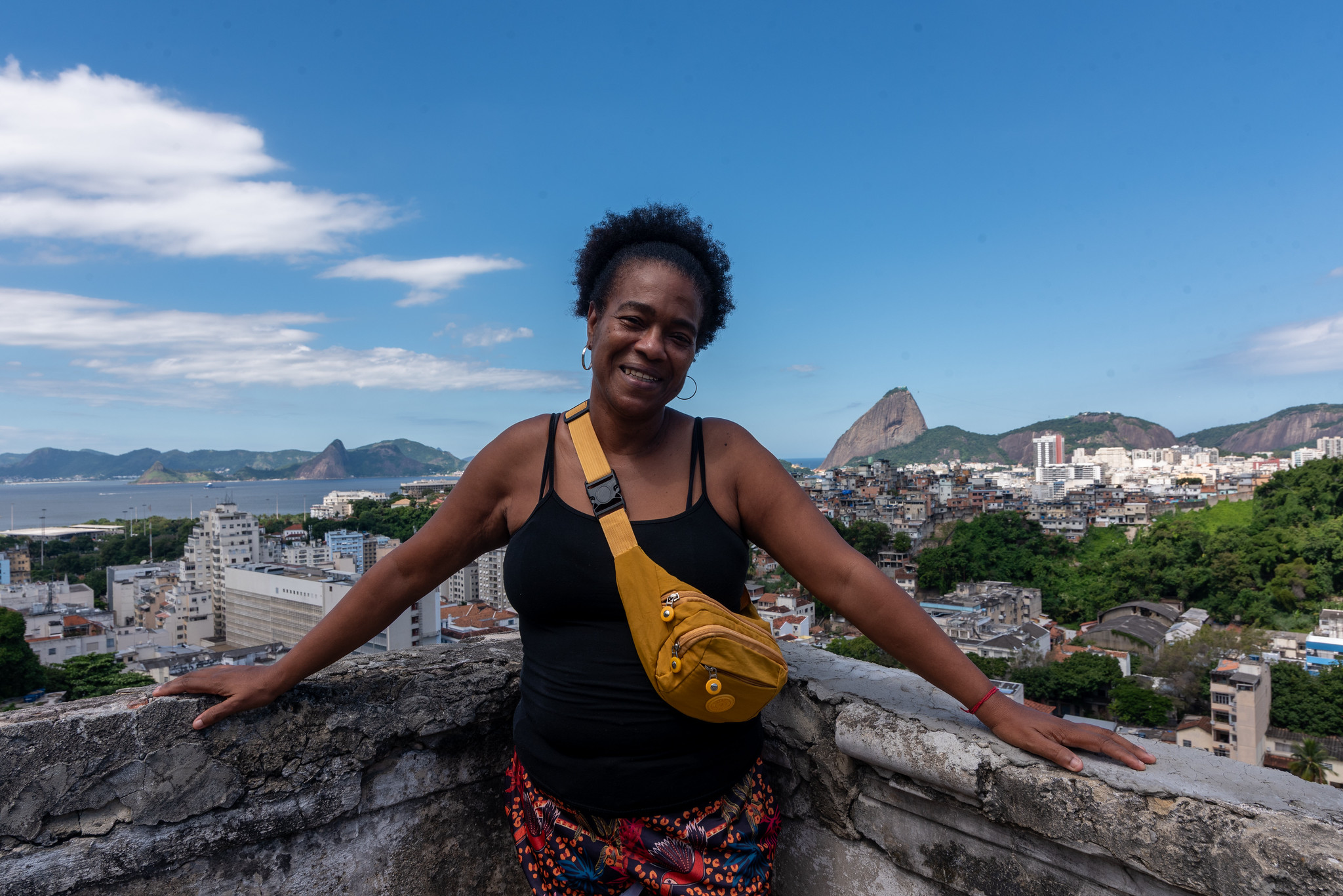
The feeling regarding an impending eviction was palpable among all residents interviewed, because they believe that if they were to be evicted, they would lose their connection to the community, to their support network and have a hard time accessing basic services, work and income. Resident Maria da Conceição Vicente explains their concerns:
“I was born here, I was baptized here, I grew up here, my doctor is here. I mean, if I go [to Guadalupe], I’ll be lost. I told them this, but I don’t know if it will make any difference, because nowadays we don’t get to decide where we go, right? They’re the ones who decide where they’re going to throw us. My dream is to be able to stay and live here. These are our roots. We continue to live in what is practically our birthplace, because I was born and raised in Santa Teresa, so this is where my life began.”
Marian Silva, 36, has lived in the occupation for 31 years. Raised in the mansion herself, Silva explains that she has an asthmatic daughter and depends on the nearby healthcare network for her daughter’s care. She has no idea what she will do without the local healthcare network.
“I have a child with asthma; she’s five years old… How am I supposed to manage in Guadalupe? Commuting from Guadalupe so she can get treatment here in Flamengo, at the Fernandes Figueira Institute, won’t work. Am I supposed to leave [Guadalupe] in the middle of the night to work here, at Rua Benjamin Constant? How can I leave Guadalupe in the middle of the night to take her to the hospital? For me, staying here is essential, not only for me, but also for her.”
Moreover, the residential complex in Guadalupe, where families are at risk of being relocated, is itself riddled with structural damage, as confirmed during an inspection conducted by Ronaldo Brilhante, an architect and urban planner and adjunct professor at UFF/EAU’s Housing and Social Urbanization Project and Research Group (OPPHUS), one of the technical allies providing support to the occupation. During a visit to the residential complex in Guadalupe, Professor Brilhante assessed:
“A significant portion of the [Guadalupe complex’s] pillars have compromised reinforcement due to water seepage. There are also several areas of concrete spalling, in addition to exposed rebar. There is a chronic problem with the plumbing system because the original piping is made of iron. In other words, all of this is much more expensive to repair than the shoring we intend to carry out at the Cândido Mendes Mansion.”
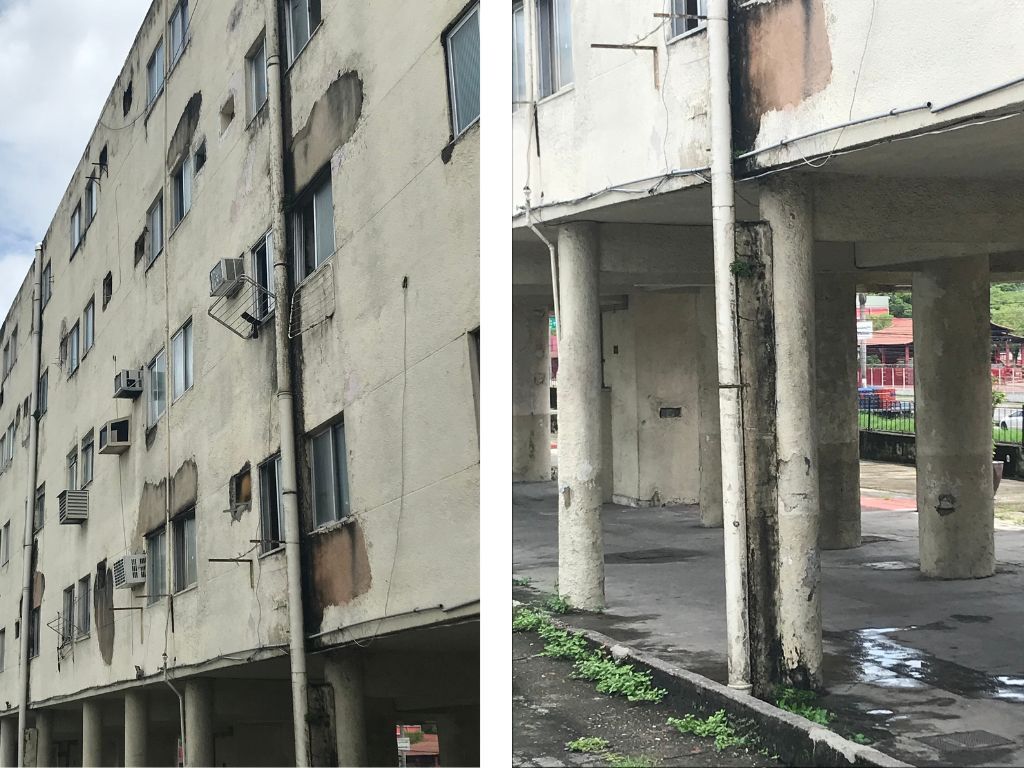
Professor Brilhante is one of the authors of the Technical Inspection Report on the mansion, which emphasizes that there are no risks to residents’ physical safety, provided that ongoing technical monitoring is carried out to assess the occurrence of new structural deformations. He also states that there is no need to remove families due to the damage caused by the construction work. He recalls the case of Ferreira Diniz Urban Quilombo, whose structural problems were more serious than those at the Cândido Mendes Mansion, but where it was still possible to carry out emergency repairs while families remained in the building after being internally relocated.
The most recent meeting between residents and the SPU took place on February 27, 2026, when the agency promised to urgently install shoring, resolve a serious leak above one of the pillars and adopt broader measures to address the problems identified. However, none of these measures have been carried out so far. De Alexandre summarizes residents’ concerns regarding the SPU’s delays and the outstanding repossession order:
“The case is ongoing, the repossession order is still pending, and at any moment the judge could say: ‘Okay, go ahead and throw them out’…”
What the Agencies Involved Say
RioOnWatch requested comment from Federal Prosecutor Julio Araujo, who has been following the case since it reached the Rio de Janeiro Land Solutions Commission. Their main recommendation was that the families should not be removed, since expert reports did not prove an imminent structural risk to the property. According to Araujo, although repair work is necessary and falls under the federal government’s responsibility, the building’s designation as social housing through the Minha Casa Minha Vida-Entidades program is also necessary. The prosecutor hopes that a solution can be reached that combines the repairs with the families’ permanence on site:
“I think today’s greatest challenge is to prevent the courts from carrying out any kind of immediate eviction. We need to ensure a more accurate and specific analysis in light of the discrepancies in expert reports and the fact that none of them indicates an imminent risk requiring families to leave. Thus, we must ensure that the property will be designated for social housing and that emergency repairs are planned and carried out, including assessing the possibility of doing so while residents, even if not all of them, remain there. And even if they must be relocated, there must be a [legal] provision [guaranteeing] their return.”
Public Defender Thales Arcoverde Treiger believes the current situation is positive for the families, because of the dialogue with the SPU and ongoing efforts to carry out renovations through the Minha Casa Minha Vida-Entidades program. According to Treiger, there is no risk of imminent eviction, despite the formal repossession order, because he believes the federal government has not shown a real interest in evicting the families. Treiger expressed concern about the inadequacy of the emergency repairs carried out so far, but affirms that the approach taken has been one of institutional negotiation.
In an email sent to SPU, RioOnWatch inquired about the process of designating Cândido Mendes as social housing, about the incomplete repairs and structural damage observed after SPU’s roof work. Despite residents’ reports to the contrary, SPU responded that the emergency repairs were in fact completed. SPU’s full response is below:
“The Ministry of Management and Innovation in Public Services (MGI) states that the Government of Brazil, through the Secretariat of Federal Patrimony (SPU), is developing a permanent housing solution for the families currently occupying the federal building known as the Cândido Mendes Mansion/Hotel dos Ingleses in Rio de Janeiro, ensuring greater safety for residents in coordination with the Minha Casa Minha Vida-Entidades program.
As far as SPU’s jurisdictional reach is concerned, the building has been reserved and designated for this purpose, although the project is still contingent on being selected by the Ministry of Cities and Caixa Econômica Federal [Brazilian Federal Savings Bank].
Moreover, it highlights that successive reports from technical authorities and from the Rio de Janeiro Municipal Civil Defense attest to the building’s poor structural conditions.
Maintenance work on the roof of the Cândido Mendes Mansion/Hotel building began in March 2025 and was completed in October of the same year. A final acceptance certificate was issued on November 21, 2025.
During the execution of work on the roof of the four-story building, movement was observed in a small metal pillar located on the second floor, causing part of the adjacent masonry and plaster to detach.
After being alerted, the city’s Civil Defense inspected the site and recommended the immediate installation of shoring to reinforce the structure in the area affected by the buckling of the metal structure. This intervention was contracted and carried out on an emergency basis by the Secretary of Shared Services (SSC) of the MGI in support of the SPU.”
A Mansion Full of Dreams
Despite all the concerns surrounding the SPU’s elusiveness, residents of the Cândido Mendes Mansion still dream about the future: a renovated and safe building for their families that guarantees the right to dignified housing in the city center.
Marian Silva dreams of staying: “Everything is close by here.” Her dream is similar to that of Maria da Conceição Vicente: “I hope they take pity on us and help us rebuild this home. That’s what I wish for.” Similarly, Júnior not only hopes to continue living in the mansion, but also wants to see it repurposed as a cultural hub for the area:
“Our dream is for this project to happen. We deserve to live in a good place and, since there are many workers here, to have a beautiful hall where we can bring culture through samba circles, music and other forms of art. We want this place to involve culture in a way that allows everyone to work and use it to support both their livelihood and housing.”
Lucinalva dos Santos envisions a future where the mansion becomes part of the Minha Casa Minha Vida-Entidades program, in partnership with the Oscar Niemeyer Institute, which proposes not only renovations but also the creation of an arts and trades school:
“So, the Oscar Niemeyer Institute wants to invest here to create this [arts and trades] school, where people from here and from other communities can learn the craft [of restoration]. And we believe in that, we really want that.”
Adriano Queiroz, advisor to the Oscar Niemeyer Institute—the organization that, together with the Mansion, is applying to lead this initiative through the Minha Casa Minha Vida-Entidades program—says that the project to create an Arts and Trades Workshop School is based on Municipal Law 8,454 of June 26, 2024, authored by City Councilor Edson Santos. Queiroz was the one who brought the idea to Rio based on highly successful experiences in other Brazilian states.
This proposed vocational school program aims to train youth in the craft of restoring historic buildings. By restoring historic buildings across the city through a process that combines theory and practice, youth are trained for the job market, all while helping guarantee the right to housing in spaces like the Cândido Mendes Mansion.
Paulo César Ribeiro, resident and president of the Cândido Mendes Residents’ Association, explains how their struggle for permanence is unfolding on several fronts. Despite all odds, he remains hopeful about staying:
“SPU keeps saying that it doesn’t have the money to make this building habitable. This building is over a century old and really needs structural work—that’s undeniable. The work was estimated at R$33 million (~US$6.7 million), and of course SPU wasn’t going to be able to cover that amount. So, SPU proposed relocating residents. [But] through this new Minha Casa Minha Vida-Entidades partnership, which was submitted to [the federal government in] Brasília by the Oscar Niemeyer Institute, [we may be able to] bring in the necessary funding to carry out the work.
“I don’t think it will be a complete retrofit, but rather bringing this building up to the standards required by the Minha Casa Minha Vida-Entidades program. Under the program, all units must have a bathroom and a kitchen, which some units here currently lack. We also have a project estimated at R$14 million (~US$2.9 million), which would also be funded by Caixa Econômica Federal, because SPU claims it doesn’t have the funds. That’s why [SPU] insists on relocating [us]. But we’re seeking resources with our partners and will continue pursuing this goal. Our strategy is to show that there are other paths, other partners, so that SPU can’t say we’re not working toward a solution.”
For More Photos, View the Full Album Here:

About the author: Bárbara Dias was born and raised in Bangu, in Rio’s West Zone. She has a degree in Biological Sciences, a master’s in Environmental Education, and has been a public school teacher since 2006. She is a photojournalist and also works with documentary photography. She is a popular communicator for Núcleo Piratininga de Comunicação (NPC) and co-founder of Coletivo Fotoguerrilha.