

This article is part of our series reflecting on the impacts of mega-events on Rio de Janeiro 10 years after the 2016 Olympic Games.
Ten years after the end of the traumatic Olympic-era forced evictions in Rio de Janeiro, which affected 80,000 people across the city, the Vila Autódromo favela, in the city’s recently renamed Southwest Zone, next to the Olympic Park, remains a symbol of resistance. Of the 600-700 families who lived in the community before the 2016 Olympics, only 3%, or 20 families, remain. Over 80% of the original area is now covered by grass and trees, whose maintenance is left to the remaining residents.
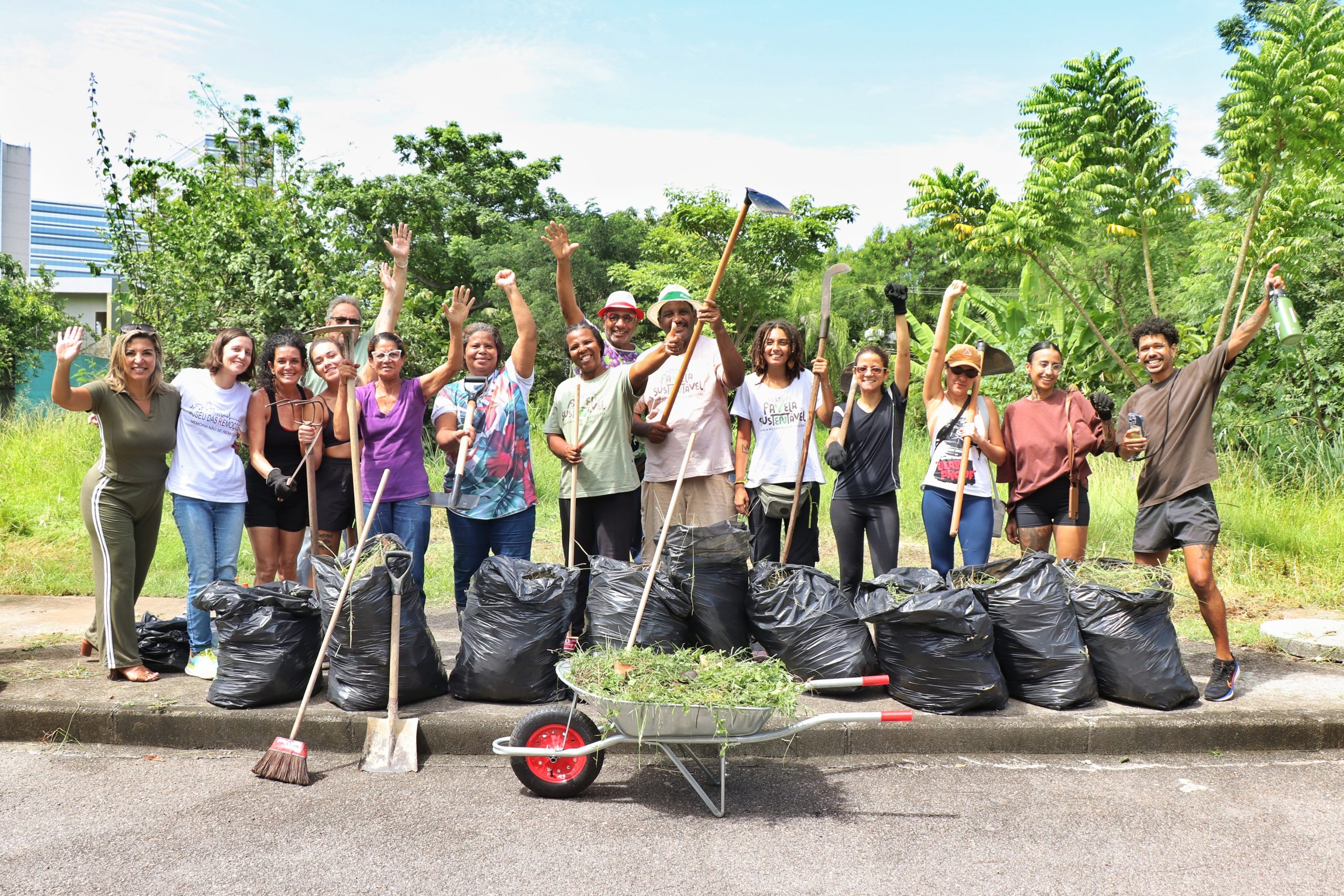
On the morning of Saturday, April 11, a collective action of care—a long-standing tradition in Vila Autódromo—was carried out in a local green space, highlighting ongoing mobilization in support of the area and the Evictions Museum. The action represents reverence for the community’s memory and serves as a response to the lack of attention shown by the city government. Residents, volunteers and partners gathered to ensure, with their own hands, the upkeep of the Evictions Museum exhibition path. The activity was part of the Sustainable Favela Network’s (SFN)* Collective Calendar.
“This May we celebrate ten years since we managed to stay. Ten years since Vila Autódromo’s victory! We also have the ten-year anniversary of the Evictions Museum and a memory route we developed, which won an award from the National Institute of Historic and Artistic Heritage (IPHAN), visited by people from around the world. But the exhibition path was covered by brush due to a lack of maintenance by [waste collection utility] Comlurb, creating a sense of abandonment and insecurity. [That’s why we are here today clearing the vegetation and cleaning, so that we can hold the celebration!]” — Sandra Maria
Nathalia Macena, born and raised in Vila Autódromo, led the mostly-female group. The distribution of tools, coordination of tasks and walk to the area in need of intervention began at 9am, marking the start of the workday. Despite the invasive grasses and other vegetation, the collective effort accompanied by smiles on sweaty faces made evident the group’s sense of accomplishment.
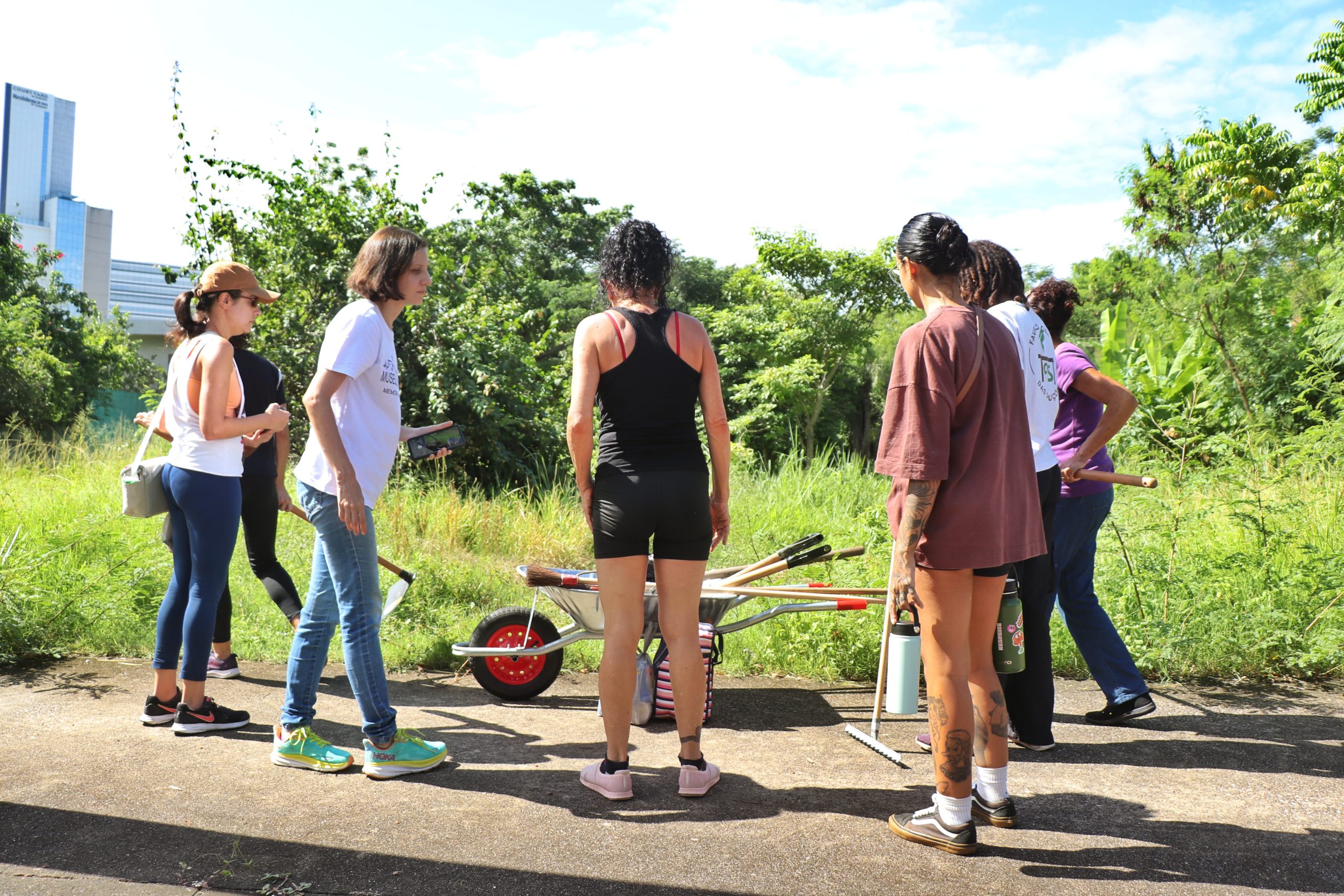
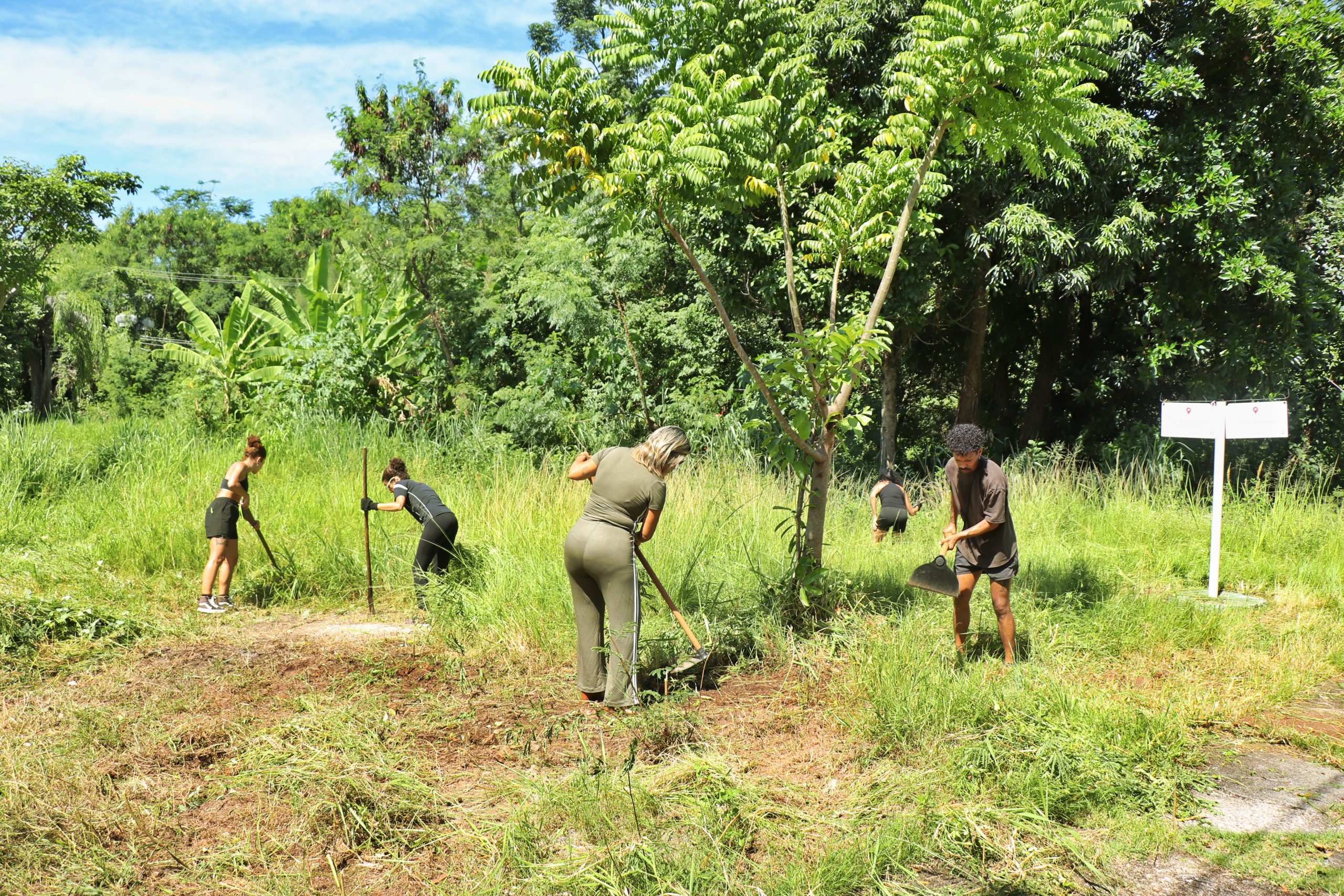
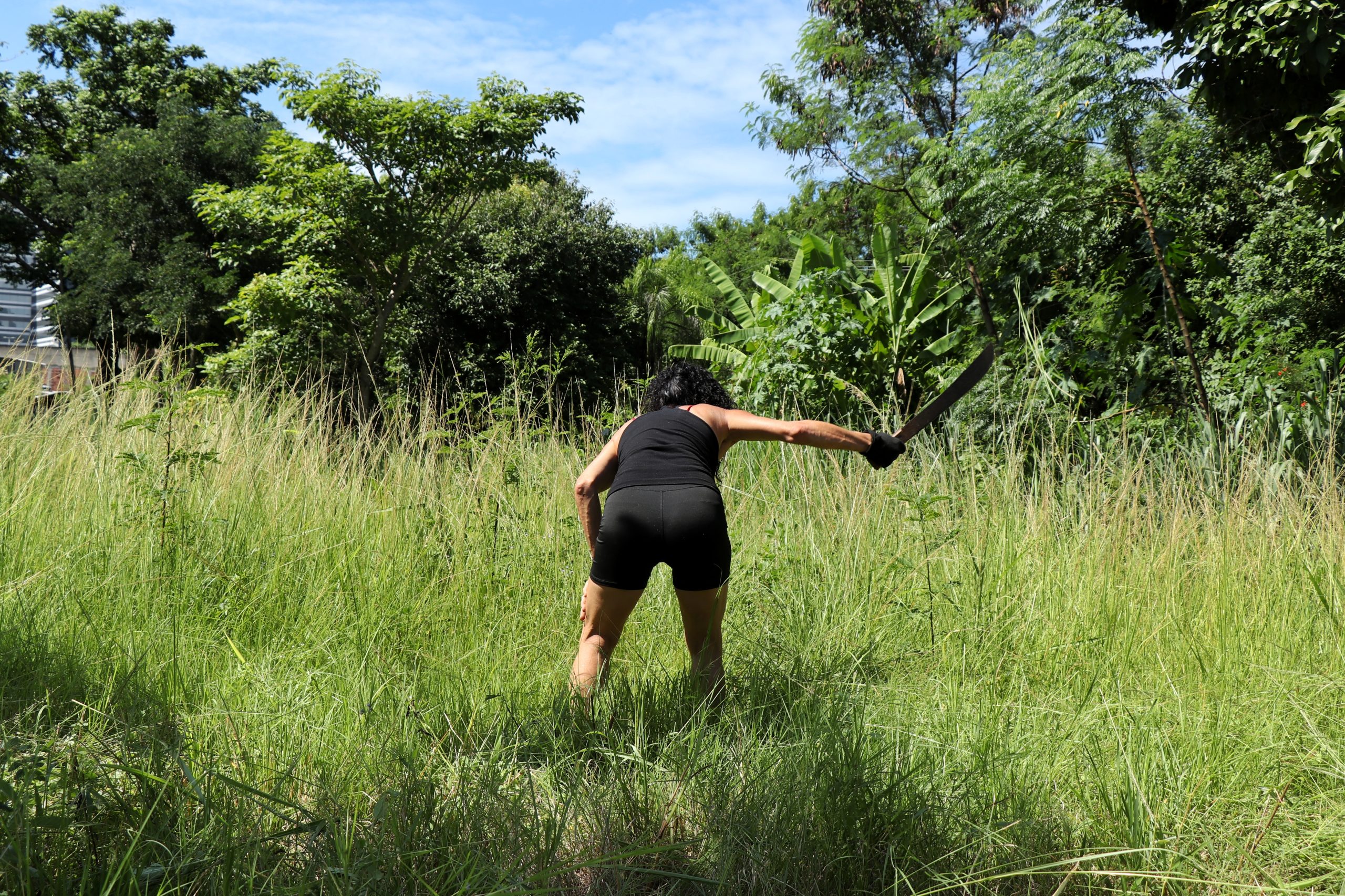
With hoes and machetes in hand, participants began cutting through the toughest growth to open paths in areas that were still hard to access. Strength, repetition and precision were evident in the weeding, soil turning and manual removal of organic material. Gradually, what had been a field overtaken by brush, covering the Museum’s plaques, began to reveal the earth beneath and once again became a usable space of memory.
Biodiversity has always been a hallmark of Vila Autódromo, as have the challenges and neglect characteristic of its relationship with public authorities. Among the fruit trees are avocado, mango, star fruit, seriguela (a close relative of the hog plum), tangerine, Malabar plum, guava, jambo, persimmon, jenipapo, soursop and tamarind, including several that survived from the gardens of demolished houses. With its growing fruit cultivation, Vila Autódromo now supplies both residents and visitors. In addition, capybara families—and their preservation—have always been part of community actions over the years.
“During the forced evictions, the city government cut down 500 to 600 trees, many of them protected by environmental laws. Our entrance street was entirely lined with fruit trees. In two days, they cut down 200 trees. Suddenly, you went from living in a green neighborhood to stifling, gray, hot, suffocating surroundings, with no shade. In the end, we were left with a deforested area and began a process of replanting. Today, in my backyard, I have a lime tree, a soursop tree, an orange tree, Surinam cherry, Barbados cherry, guava, jabuticaba, avocado, mango, aloe vera, chia, saffron, tomatoes and arrowleaf elephant ear. In other backyards, there is sugarcane, lemongrass and lemon balm.” — Sandra Maria
Among the initiatives by Vila Autódromo residents concerning the preservation of local biodiversity, the Evictions Museum installed two signs at the entrances warning drivers, cyclists and pedestrians to be mindful of animals, especially capybaras, so they are not run over, fed or hunted in the community.
Luiz Claudio Silva, key to the planting of recent seedlings in the neighborhood, emphasized that it should be up to the sub-prefecture to install warning signs, as it does in neighboring residential complexes. The authorities’ absence forces residents to act. Even when the city government does meet local demands, it takes far too long.
“Vila Autódromo has always been a place with many trees, both in the backyards of the homes that were removed and in the streets. It used to be a very green area. From the time of the forced evictions, I have documents from the city government and the Secretariat of the Environment, including a license signed by the secretary authorizing the cutting of 362 trees in one document alone. They’d come to cut the trees, show the document and I’d take photos. I have documents for 100 trees, 200 trees. When [what remained of] the community was redeveloped, there were almost no trees left. It became an open field, with us in the middle. Then we began this reforestation work. There are many species, both fruit-bearing and native.” — Luiz Claudio Silva
He also spoke about the waste unility’s engagement with Vila Autódromo.
“The squares [in the community] need maintenance at least once a month, but Comlurb comes every three to four months. I took a photo of the vegetation covering the playground equipment—it was taller than my wife.” — Luiz Claudio Silva
With her daughter and grandson alongside her at the event, Sandra Maria emphasized the importance of unity among favela residents. During a break, she stressed the importance of more opportunities for collective actions organized by favela residents across the city, working in networks.
“The collective action was important for several reasons. First, because of the unity of the social movement itself, and the importance of the work that the Sustainable Favela Network does, which brings together favelas, enabling connection and collective work. This breaks the isolation that favelas are subjected to by the State and broader social realities. Society fears favelas. Beyond the social and economic challenges faced by the favela population, it is a constant rush, a daily struggle for survival. We are so focused on survival, how do we organize ourselves within that, right?
We had people come here from far away, from Ilha do Governador and Sepetiba, to support our community, our struggle. That is wonderful. We live in a favela that the public authorities try to keep abandoned at all costs. The area that is now empty, where 600 families once lived and were forcibly removed, is now abandoned by the authorities, overgrown, with a proliferation of trees and invasive species that destroy native species.” — Sandra Maria
Sandra Maria also cites Comlurb as one of the public entities neglecting the community:
“We have a situation with Comlurb, which should maintain this area but doesn’t. The area [of the community] near the hotel [Courtyard Marriott, built on a plot that was originally part of Vila Autódromo] is kept clean. But the area beyond the houses [in the community], we need to file multiple official requests for them to clean it. We have to complain, go there, demand it and try to get in touch with people within Comlurb. It’s exhausting, extremely tiring work, and we don’t always manage to do it.”
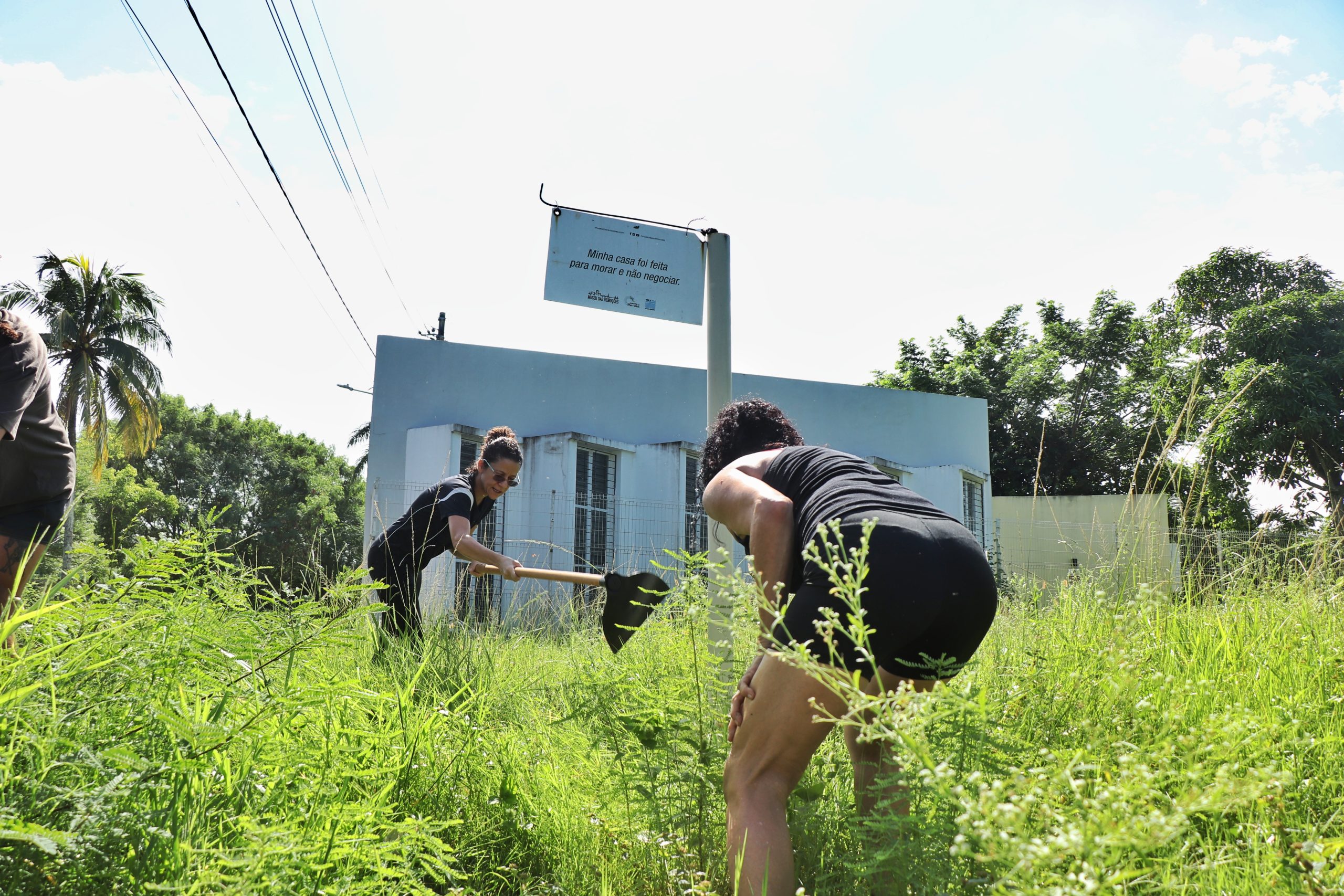
Amid memories of the struggle to remain in the favela, the collective action gained meaning beyond a group effort. For Sandra Maria, actions like this connect the past, resistance, and the meaning of collective work. With three generations of her family cutting through the overgrowth under the hot sun, machete in hand, Sandra Maria said:
“I can say that participating in this resistance, in this struggle, marked my life and who I am as a person. There is a woman before the forced evictions and a woman after the forced evictions. It changed my way of being a woman and my relationships with my family, of fighting for this community, for our home… It was a learning experience for our family, and I feel that the message passed on to my daughters was one of strength, of a woman who fights, and that it’s possible to win, because we’re still here. A woman’s reality is very difficult, we know that. We live in a sexist, patriarchal society, and every right women have was won through great struggle—even at the cost of many lives… As a mother of three daughters, I feel a sense of fulfillment. We must not accept having our rights taken away or being silenced. Instead, we must roll up our sleeves, fight and claim our spaces, our lives and our freedom.”
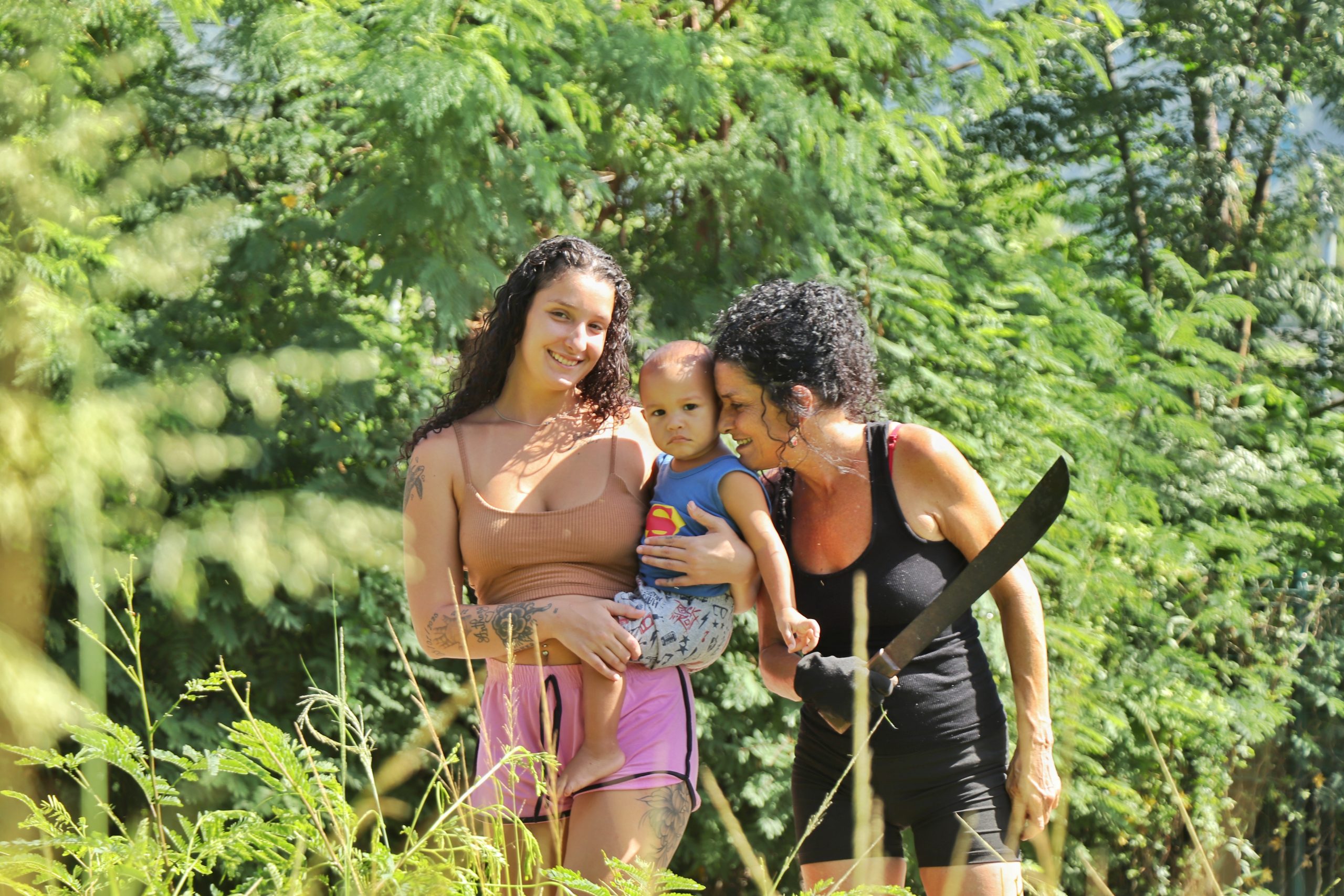
Sandra Maria points to the women of Vila Autódromo as the main driving force behind the fight to remain in the community:
“The visible leadership of women is wonderful and is part of the history of Vila Autódromo’s struggle. During the resistance in the period of the forced evictions, this was already something that stood out very strongly. One characteristic of this struggle has always been the significant presence of women. In the fight for the right to housing, women are somehow the majority, [because they are] more connected to the family and to these rights.”
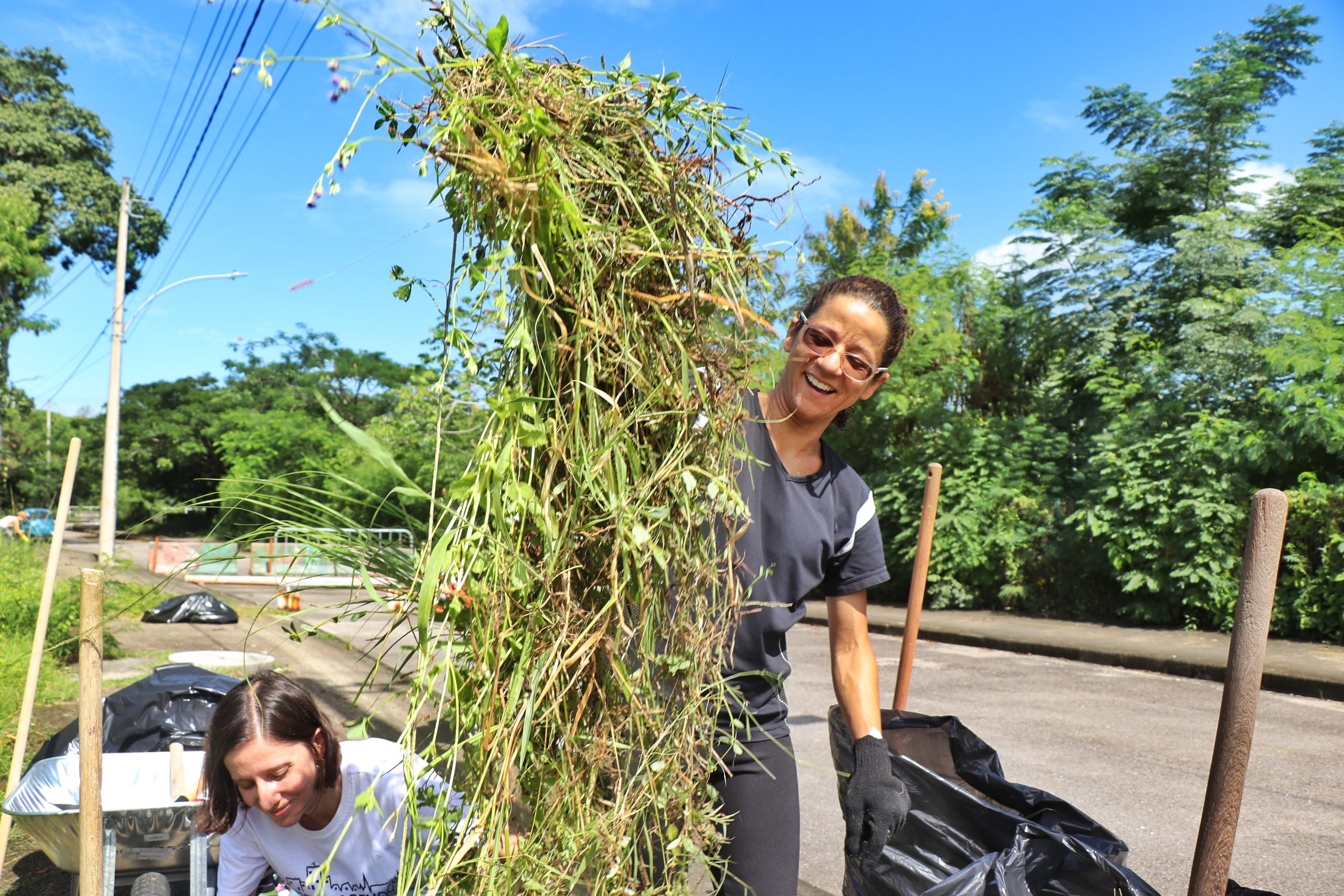
Nathalia Macena, coordinator of the collective action, shared the initiative’s results and its next steps. For her, the most important thing is that the work continue. Showing the organic material separated for disposal, she said:
“The collective action was very productive, even though we didn’t manage to plant seedlings. The most urgent task was clearing the brush, which grows very quickly and which, unfortunately, we can’t keep under control on our own. We often ask Comlurb to trim the brush. Normally, they only do it in the area closest to the hotel. The area where we held the collective action is more neglected and isn’t cleared as often as it should be, so the vegetation grows too high, putting people’s safety at risk—both Vila residents and pedestrians and those using the bike path… It was great to welcome people from other communities and volunteers who heard about our collective action and came to join us. We exchanged experiences, which creates new learning opportunities. Even though the collective action was a one-time activity, it doesn’t end there.”
*The Sustainable Favela Network (SFN) and RioOnWatch are both initiatives realized by not-for-profit organization Catalytic Communities (CatComm).
About the author: Alexandre Cerqueira is a photojournalist, teacher and researcher focused on childhoods in Rio de Janeiro’s favelas and condominiums. Originally from Engenho Novo, in Rio’s North Zone, he holds degrees in International Relations and Education and works in basic education. His work connects education, human rights and communication through photography and audiovisual media. He participated in the SUSI for Student Leaders program, represented Brazil at the UN Youth Assembly and was part of the United Nations Information Centre for Brazil (UNIC Rio).