
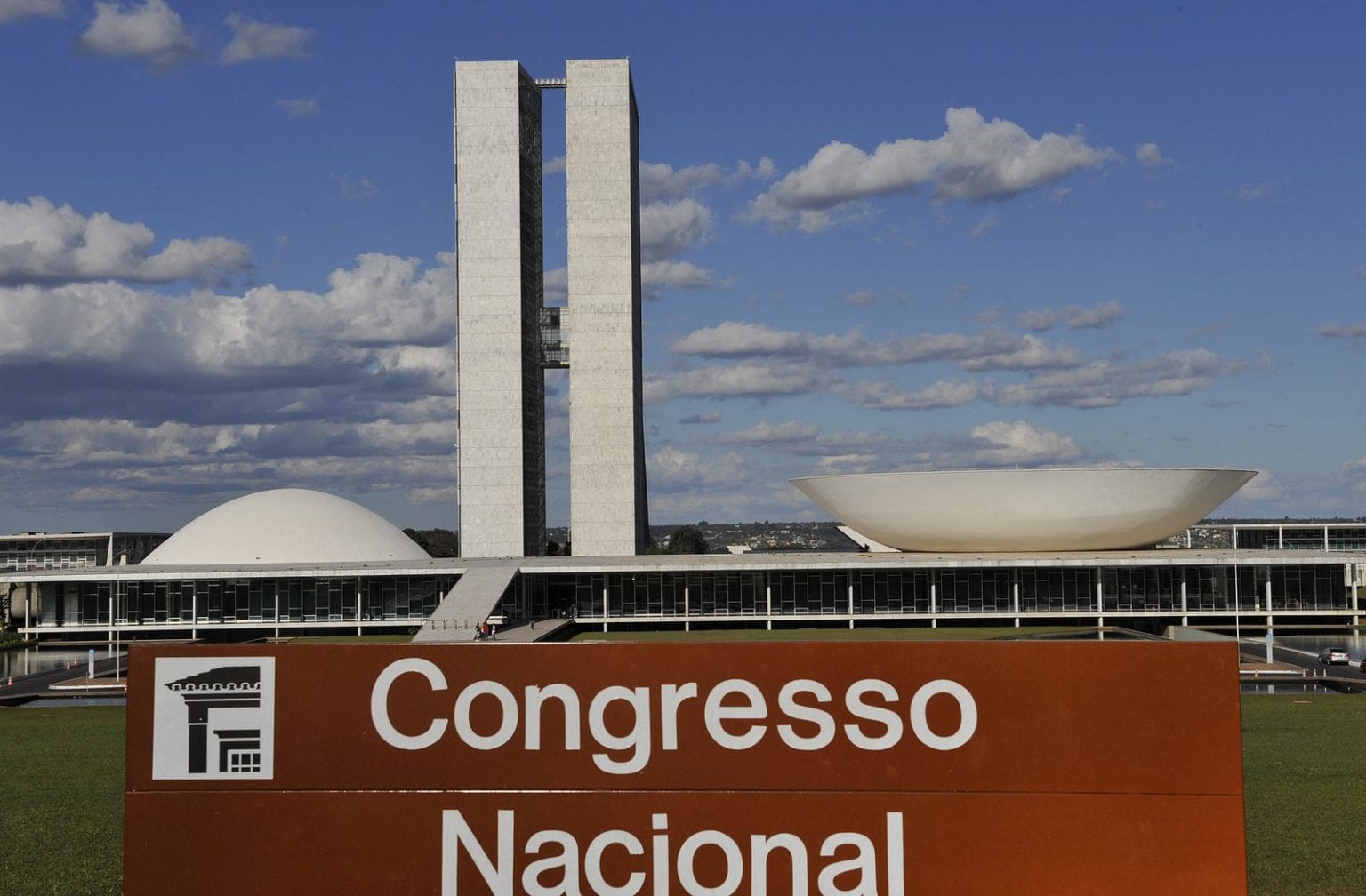
National Congress building in Brasília. The dome on the left, facing downward, is the Federal Senate, while the dome on the right, facing upward, is the Chamber of Deputies. Photo: CNBB

This article is part of a series on the 2026 Brazilian elections, focusing on the perspectives of Greater Rio’s favelas.
Over the past decade, parliamentary amendments have changed the balance of power between the Brazilian National Congress and the Executive Branch (the President of the Republic) in deciding how Brazil’s public budget is allocated. In recent years, billions of reais from the budget have come under the direct control of deputies and senators. Parliamentary amendments are at the center of disputes over transparency, traceability, misappropriation of funds and the constitutional limits on the Legislative Branch’s role in executing the federal budget. On the other hand, for favelas, communities historically marked by unequal access to State investments, understanding who makes decisions, where this money goes and what interests guide its distribution is essential to fighting for a share of the public budget in Brazil today.
What Are Parliamentary Amendments?
In Brazil, as in other presidential democracies, the Executive Branch is responsible for defining and executing the budget. To try to ensure well-informed decisions on how to invest public funds, the president, his ministers and allies draft a budget proposal every year with clearly defined priorities and submit it to Congress. There, the proposal is debated and amended, and then either approved or rejected. In most cases, it is approved. Once approved by the Legislative Branch (deputies and senators), the Executive, through its ministries, oversees the execution and disbursement of funds.
But in Brazil, over the past decade, this process, which was previously carried out collectively by all our representatives, has been eroding, giving way to parliamentary amendments. A parliamentary amendment strips power from the Executive and Congress as a single body and hands it over to federal deputies and senators, who can individually decide where part of the public money should go. Parliamentary amendments are projected to grow at a rate three times faster than the government’s discretionary budget through 2030.
Why Do You Need to Know About Parliamentary Amendments?
Although the 1988 Federal Constitution allows members of Congress to propose amendments to the budget, there was an important difference between approving an amendment and executing it. Congress could include a specific expenditure in the budget, but its execution depended on a decision by the Executive. This required the lawmaker who proposed the amendment to negotiate its execution with the federal government. In this context, the release of funds was part of the negotiating relationship between the Executive and Legislative Branches, which also ensured a certain degree of transparency.
In 2014 and 2015, amid the crisis between President Dilma Rousseff’s administration and Congress, the dynamics changed. During discussions of the 2014 Budget Guidelines Law (LDO, by its Portuguese acronym, in reference to Law No. 12,919/2013), members of the Chamber of Deputies and the Senate included a provision mandating the budget execution of individual parliamentary amendments. In 2015, this provision became part of the Constitution with the approval of Constitutional Amendment No. 86/2015. This thus established what is known as the “mandatory budget,” requiring the federal government to execute amendments proposed by lawmakers.
In 2019, the situation became even more extreme. Congress approved Constitutional Amendment No. 100/2019, which also made it mandatory to execute state caucus amendments—those signed jointly by legislators from a single state. That same year, Constitutional Amendment No. 105/2019 established “special transfers,” known as “Pix amendments,” which go directly to states, making it harder to monitor them and undermining transparency.
In 2020 and 2022, another controversial development was the increase in rapporteur amendments, which became known as the “secret budget.” Lacking transparency and without identifying those responsible for allocating the funds, the Brazilian Supreme Court (STF) ruled them unconstitutional. Even so, lawmakers found another way to continue these same practices, this time through committee amendments, which increased by 6,687% following the end of the “secret budget.” Every month seems to bring a new murky process related to these expenditures, funded by our tax money.
In Political Terms, What Has Changed During This Decade of Parliamentary Amendment Supremacy?
Under the current model, following the adoption of the mandatory budget, the Legislative Branch approves the parliamentary amendment and the Executive carries it out, as required by the Constitution. The Executive thus loses some of its discretionary power, while legislators gain greater autonomy in allocating resources.
As a result, members of the National Congress as individuals—not Congress as an institution, as it was designed—have been concentrating more and more power. Although the Executive continues to control the administrative apparatus and a portion of the budget, it has lost much of its investment power, as well as a significant portion of its bargaining power with deputies and senators.
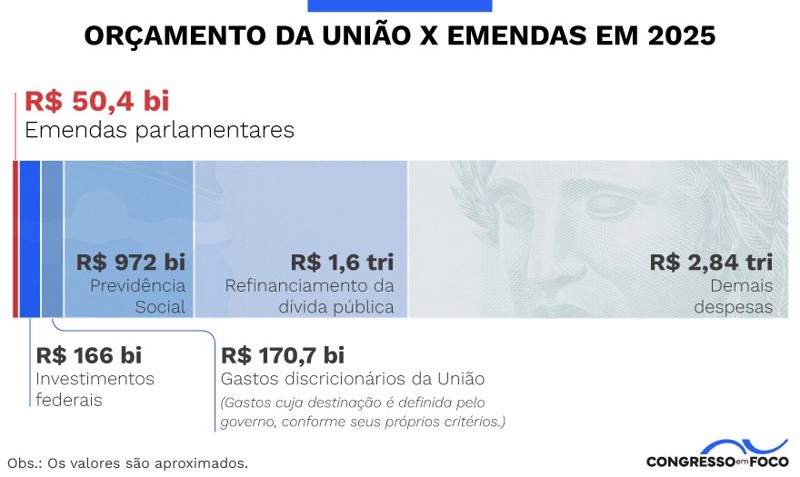
Without the necessary controls in place, this can jeopardize democracy as a whole, facilitating everyday corruption and exacerbating our already established difficulty in ensuring the continuity of public policies. As the share of expenditures tied to parliamentary amendments grows, the Executive’s discretionary budget decreases proportionally. In other words, the funds available to the Executive to set priorities for public policies and social programs, which would be debated by Congress and approved transparently for the benefit of the entire nation, are reduced. The government is left with less capacity to govern and meet the needs of the population.
What Is the Significance of Parliamentary Amendments for Favelas?
In 2025, Congress was responsible for allocating approximately R$50.4 billion (US$9.7 billion) through parliamentary amendments. In the context of favelas, it is important to assess what political agendas are being discussed and where this investment is being directed.
While we lack data analyzing how much of this investment is directed toward Brazilian communities with the highest concentrations of people most affected by the country’s inequalities—favelas—some organizations and collectives have found that parliamentary amendments offer opportunities to address gaps in specific communities. In the absence of systemic and structural public investments for favelas, these organizations have been working together to ensure that amendments benefit initiatives in their areas. Examples include organizations such as Redes da Maré, Roots in Movement Institute, Maré Museum/CEASM and the Brazilian national health foundation (Fiocruz), which secured funding through parliamentary amendments for Complexo da Maré, Complexo do Alemão and Manguinhos. Another emblematic case is that of the Complexos coalition, composed of organizations such as the Institute for the Defense of the Black Population (IDPN), Right to Memory and Racial Justice Initiative (IDMJR), Movements, Straight Talk Institute and Decodifica Institute, which advocated for and secured R$9 million (US$1.7 million) in parliamentary amendments, allocated to human rights and redress for violations; the Living Periphery Program; democratization of access to justice; and the Black Youth Alive Program.
After All, Are Parliamentary Amendments a Tool or a Setback for Investment in Favelas?
Unlike public policies, which are designed for the medium and long term, parliamentary amendments have a limited effect in terms of time and scope, with funds allocated on an annual basis. This makes it even more challenging to ensure the continuity of the initiatives undertaken.
Therefore, in addition to reducing the government’s ability to implement more sustainable and well-planned policies, this exposes society to investments that are often electioneering in nature, lack strategic planning, are of questionable effectiveness and temporary in nature, and have a very limited capacity to address complex issues and structural problems. They are also frequently driven by the private interests and beliefs of legislators, who are not subject to the same institutional and political scrutiny and oversight as the Executive. Carefully designed projects, such as those listed above by established community and government organizations, are few and far between.
Currently, the main debate surrounding parliamentary amendments revolves around numerous corruption cases. Recent ones illustrate how amendments earmarked for Rio de Janeiro have come under investigation for suspected misappropriation or improper use of funds, particularly allegations involving illegal transfers of public funds to leaders of Rio de Janeiro-based militias. A prime example is the amendment for the Players of the Future project. Through this allocation, Senator Flávio Bolsonaro allocated nearly R$200,000 [US$38,580] to militia member Robson Calixto, known as “Peixe.” Calixto was sentenced by the STF to nine years in prison for being a member of an armed criminal organization responsible for the murders of Councilwoman Marielle Franco and her driver, Anderson Gomes. According to the investigation, conversations between the senator’s aide and the militiaman took place before the funds were sent to the sports project run by the José Carlos Procópio Professional Training Institute (IFOP) in Taquara, in Rio’s West Zone. In addition, an audit by the Federal Court of Accounts (TCU) identified irregularities in the project’s execution, including the hiring of a law firm registered in the name of the IFOP president to provide soccer lessons for children, even though this was not a core business activity of a law firm.
Another case involving the same type of criminal activity was uncovered by Operation Emendatio, also launched in 2026. Federal Police (PF) investigators suspect the crimes of embezzlement, money laundering and participation in a criminal organization, as well as the misappropriation of funds. According to the investigations, funds from parliamentary amendments were used in contracts from which a portion of the money was allegedly diverted through the use of other companies, overpriced services, collusive bidding, failure to fulfill contractual obligations and the concealment of the origin and destination of the funds. Among those under investigation in the operation are Chiquinho Brazão, a former federal deputy who is already in prison after being sentenced by the STF to 76 years for masterminding and financing Marielle’s murder, and, once again, the militiaman Peixe, a member of yet another gang involved in the misappropriation of public funds.
As in these cases, countless others involving parliamentary amendments and allegations of corruption, embezzlement, misuse of funds, misappropriation, money laundering, participation in criminal organizations and conspiracy, among other crimes, have ended up before the STF, which has imposed limits. The court ruled that “Pix” amendments and the “secret budget” (rapporteur amendments) are unconstitutional. At issue are a lack of transparency, traceability and identification. In some types of parliamentary amendments, it is unclear who allocated the funds, which project received them or how they were to be used. Therefore, although parliamentary amendments are legally approved, the way public funds are being managed and administered by the Legislative Branch has become unconstitutional and will need to be reviewed in the coming years.
It is up to voters to find out what their candidates for the National Congress—federal deputies and senators—propose regarding the system of parliamentary amendments and their priorities for the allocation of the federal budget managed by Congress. Never before have the candidates they elect to Congress held so much power.
About the author: Ramon Vellasco is a freelance photojournalist and reporter, born and raised in Vila da Penha. He focuses on issues related to human rights, culture, education, diversity, and marginalized social groups, primarily working in favela and peripheral areas.