

 This article is part of a series created in partnership with the Behner Stiefel Center for Brazilian Studies at San Diego State University, to produce articles for the Digital Brazil Project on environmental justice in the favelas through RioOnWatch.
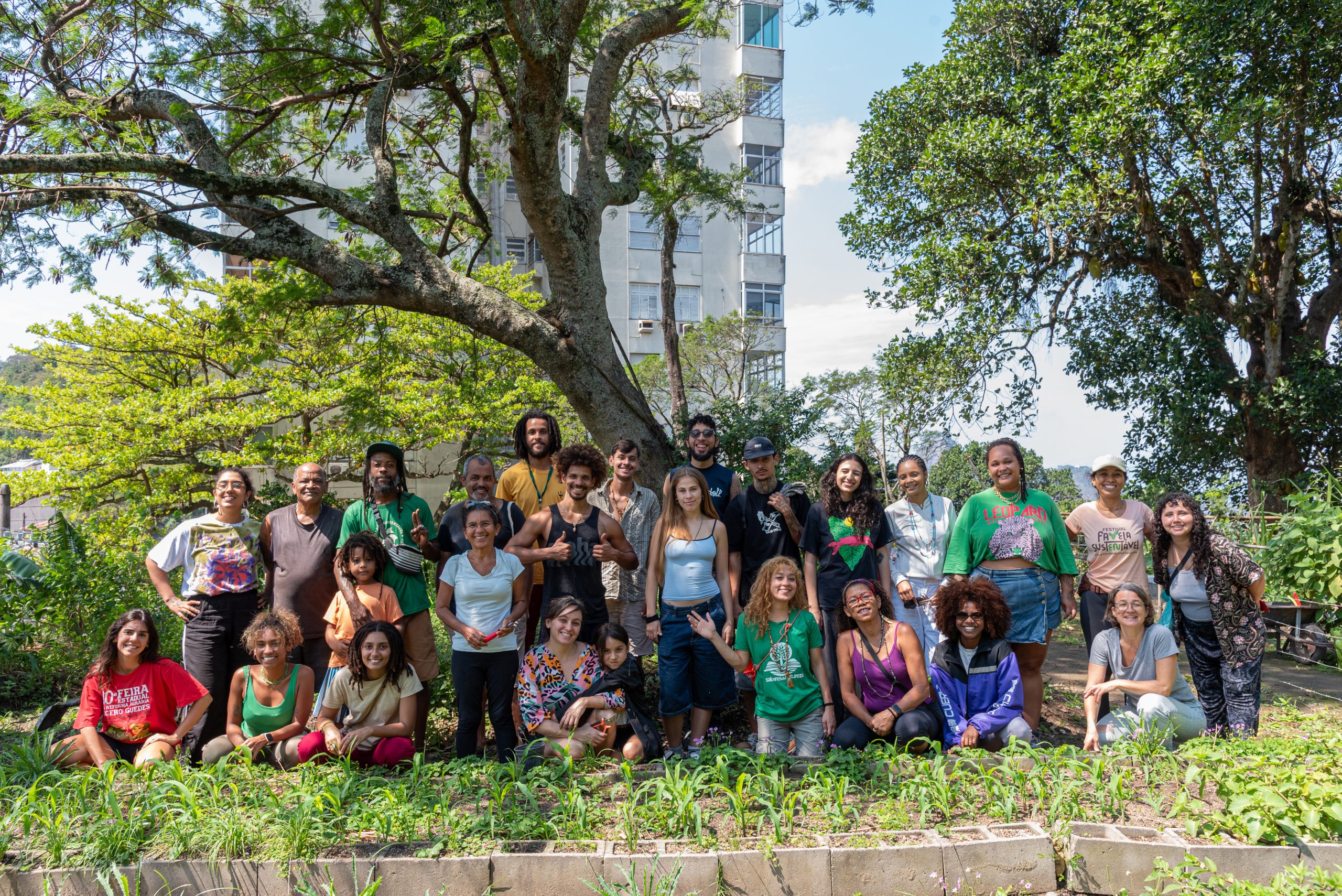
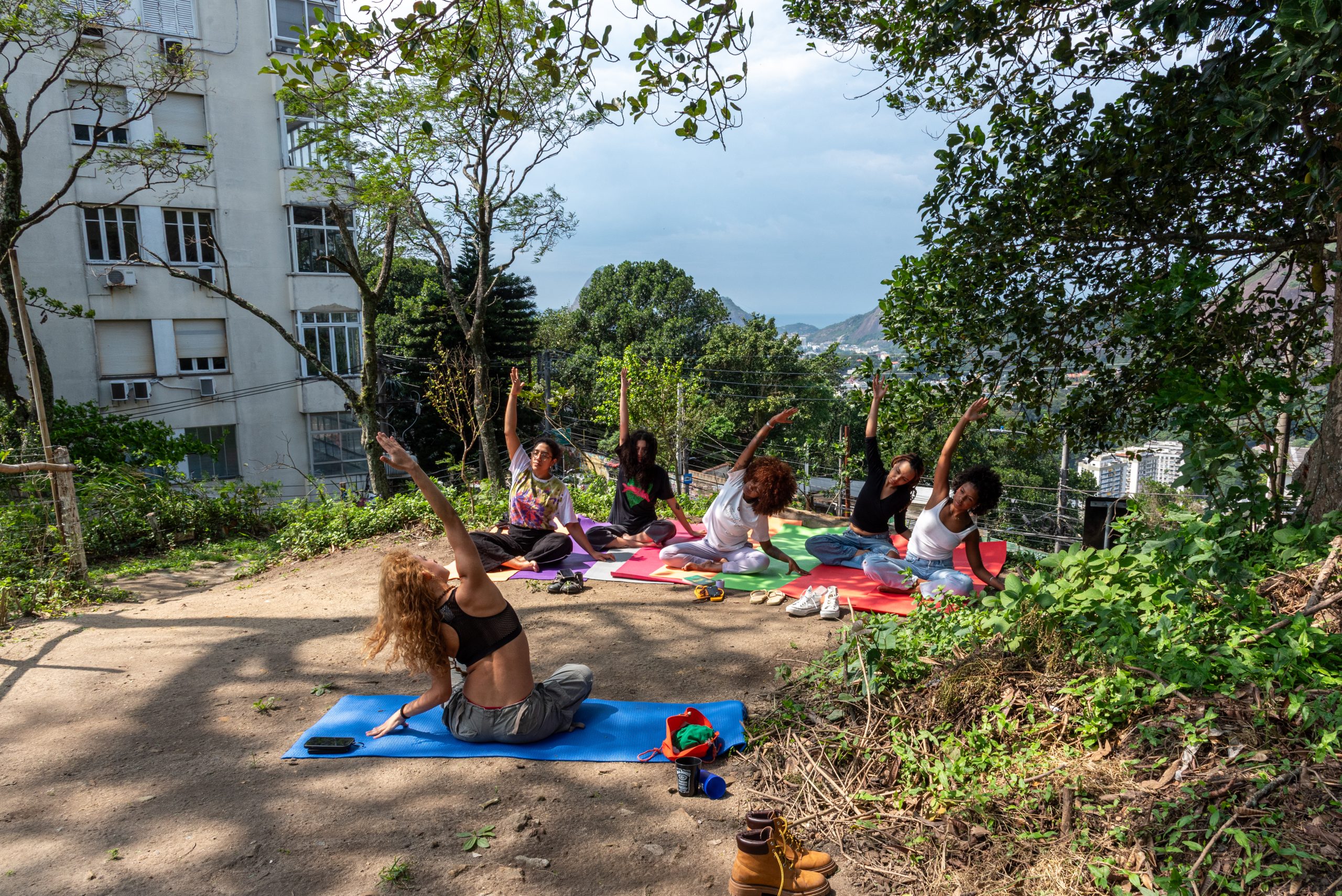
A collective action held at the Prazeres Community Garden, in the Morro dos Prazeres favela, in Santa Teresa, in Rio’s central region, brought together around 30 people on September 5. In addition to restoring and caring for the space, the event’s program included a workshop on making bait traps for stingless bees, the production of sprouts, a seed exchange, yoga for women, activities with children and a collaborative meal. Several collectives active in Morro dos Prazeres took part: Nature’s Wisdoms, Roots of Prazeres, Favela-Park RJ and Evolux Institute. The event was part of the Sustainable Favela Network’s (SFN)* Collective Calendar.
Before activities began, there was a brief circle to introduce the Prazeres Community Garden project, with remarks from several local leaders and people directly involved in the work. Wellington Fyah, an MC and singer, cook at Vital Food Industry and farmer at the Prazeres Community Garden, opened by explaining the importance of reconnecting with ancestral knowledge, such as growing food:
“We’re reclaiming knowledge that we’ve been losing over time… ancient, ancestral knowledge, which is the oldest technology in the world: putting the seed in the ground, having the patience and care to tend to it and then eating what it yields. This is a moment of reclaiming [that knowledge]. To me, the garden symbolizes that… I think recognizing the place where you live is very important, whether it’s recognizing ourselves in our homes or through what surrounds us. I think plants give us that. They make us look at ourselves [through them]. Looking at a plant is seeing ourselves. Watching what we planted grow is also watching ourselves grow.”
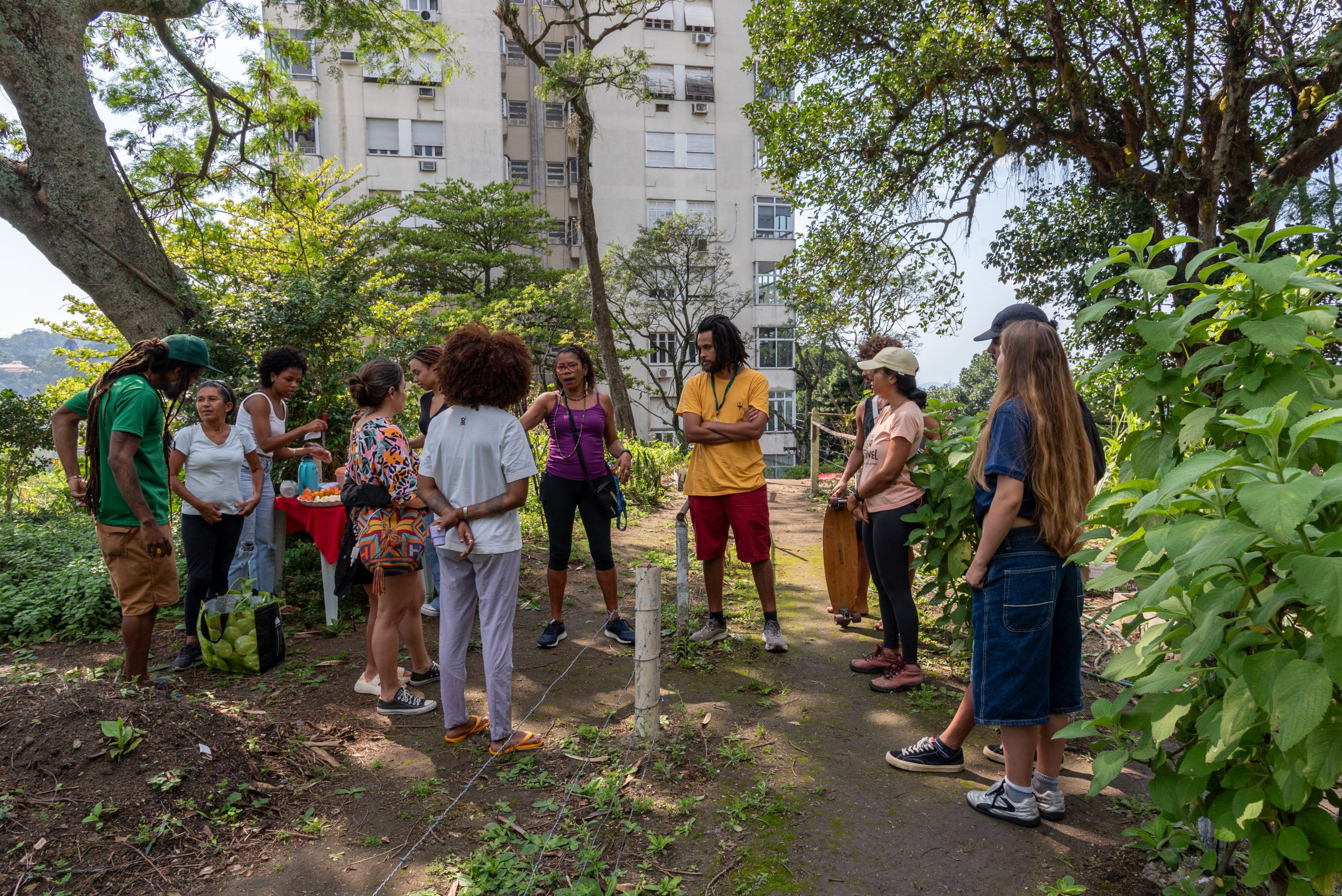
Gey, an environmental sciences student, co-creator of the Prazeres Community Garden and coordinator of the Women’s Yoga project, aimed at the women in Prazeres, reiterated the importance of reconnecting with ancestral knowledge, while also stressing the need for volunteers to care for the garden, which has now been running for five years:
“We’ve been in this struggle for almost five years now, resisting in the favela where it’s really hard to work. These days, particularly when it comes to collective work, people always do things last minute, they don’t have time. ‘Oh, it’s just a hobby’… It’s hard to find people who are committed, who will get out of bed early on a Saturday to be here. So, we’re always trying to awaken that in you and in ourselves. We need to be present, face-to-face, reminding ourselves of our objectives.”
Cris dos Prazeres, founder of the Evolux Institute, her latest initiative in three decades of living and working in the community, was closely involved in the creation not only of the Prazeres Community Garden, but also of other pioneering favela garden projects. She shared some of this history, including her involvement with ReciclAção:
“I think I’ve been following the Prazeres Community Garden project since the ReciclAção days, because we started out by holding a few collective actions and encouraging the community to plant. And we wanted to plant Atlantic Forest seedlings… Dio, who’s a really cool guy, took over an area up there that we call Pocinho, which is at the highest point of Prazeres, a space with a natural spring. There was a huge garbage dump there and we held about four collective actions… Then the place started to turn into a garden: the Pocinho Community Garden. That got [Prazeres residents] looking at places and saying, ‘Oh, that’s a vegetable garden!’”
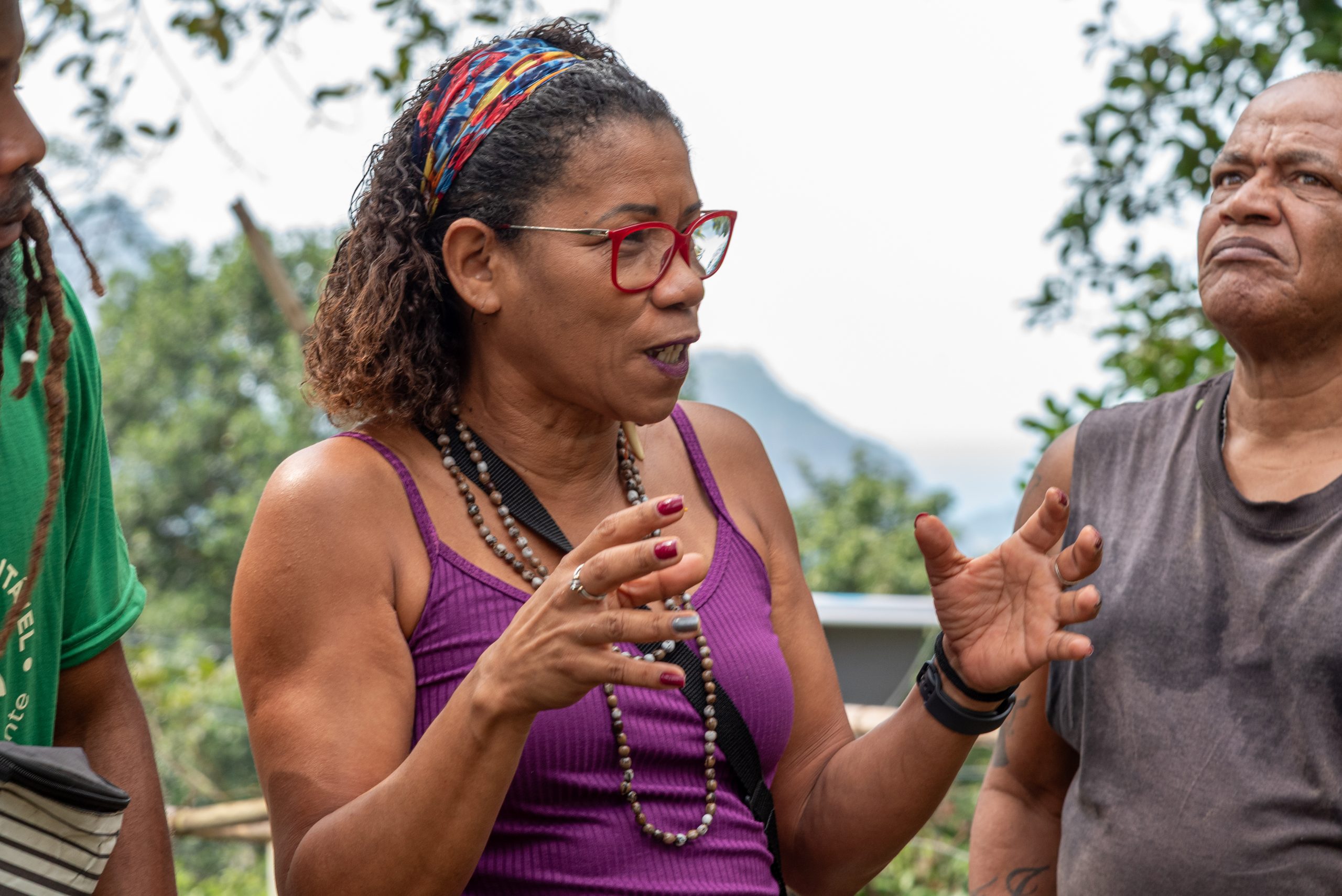
She explained that there had already been interest in using the space where the Prazeres Community Garden now stands:
“I’d had my eye on this space for many years, dreaming of creating an agroforestry system… Because this is City property: it’s the backyard of [Municipal Cultural Center] Casarão dos Prazeres. Can you imagine this place full of things to eat, full of flowers, full of fruit? What a dream! I thought, ‘I’m going to call the City!’ [Current mayor] Eduardo Cavaliere was Secretary of the Environment at the time, and we started [trying to get in touch]. Carolzinha, who’s a great partner of ours, started sending photos to the mayor’s office: ‘Look, these people want a garden, they want to expand this little garden that’s already here. [Municipal project] Hortas Cariocas has to go there… Let’s put some pressure on them to take the Hortas Cariocas project there!’ So, this place is a collective dream.”
The City of Rio’s Hortas Cariocas Program was created in 2006 to promote urban agriculture in communities and schools, making use of vacant areas to grow food. The initiative aims to promote food security, food sovereignty, environmental education and access to healthy food in vulnerable areas.
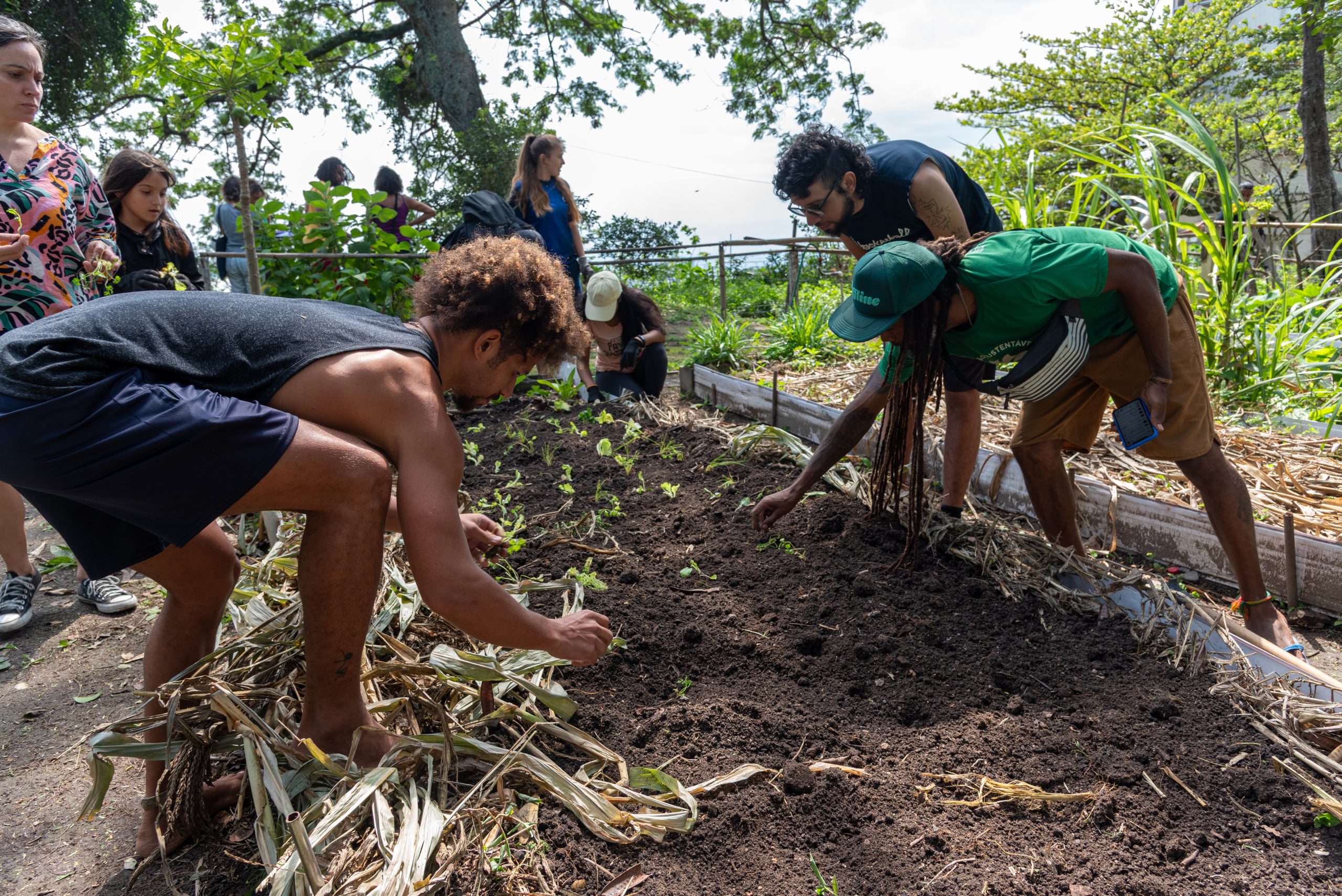
After the initial exchange, activities got underway and participants split into different work groups. Throughout the day, one group prepared the soil and weeded the garden beds, while another planted and cared for areas already under cultivation. The collective action resulted in a joint effort to restore and care for the garden in downtown Rio.
See More Photos in the Album:

*The Sustainable Favela Network (SFN) and RioOnWatch are both initiatives of not-for-profit organization Catalytic Communities (CatComm).
About the author: Bárbara Dias was born and raised in Bangu, in Rio’s West Zone. She has been a photojournalist and documentary photographer since 2016, focusing on human rights, socio-environmental justice, religions and favela communities. A popular communicator trained by the Piratininga Communication Center (NPC), she is currently pursuing a degree in Journalism at Candido Mendes University (UCAM). A co-founder of Coletivo Fotoguerrilha (2016–2025), she holds a degree in Biological Sciences from the State University of Rio de Janeiro (UERJ), a master’s in Environmental Education from the Federal Institute of Rio de Janeiro (IFRJ), and is a public school teacher.