
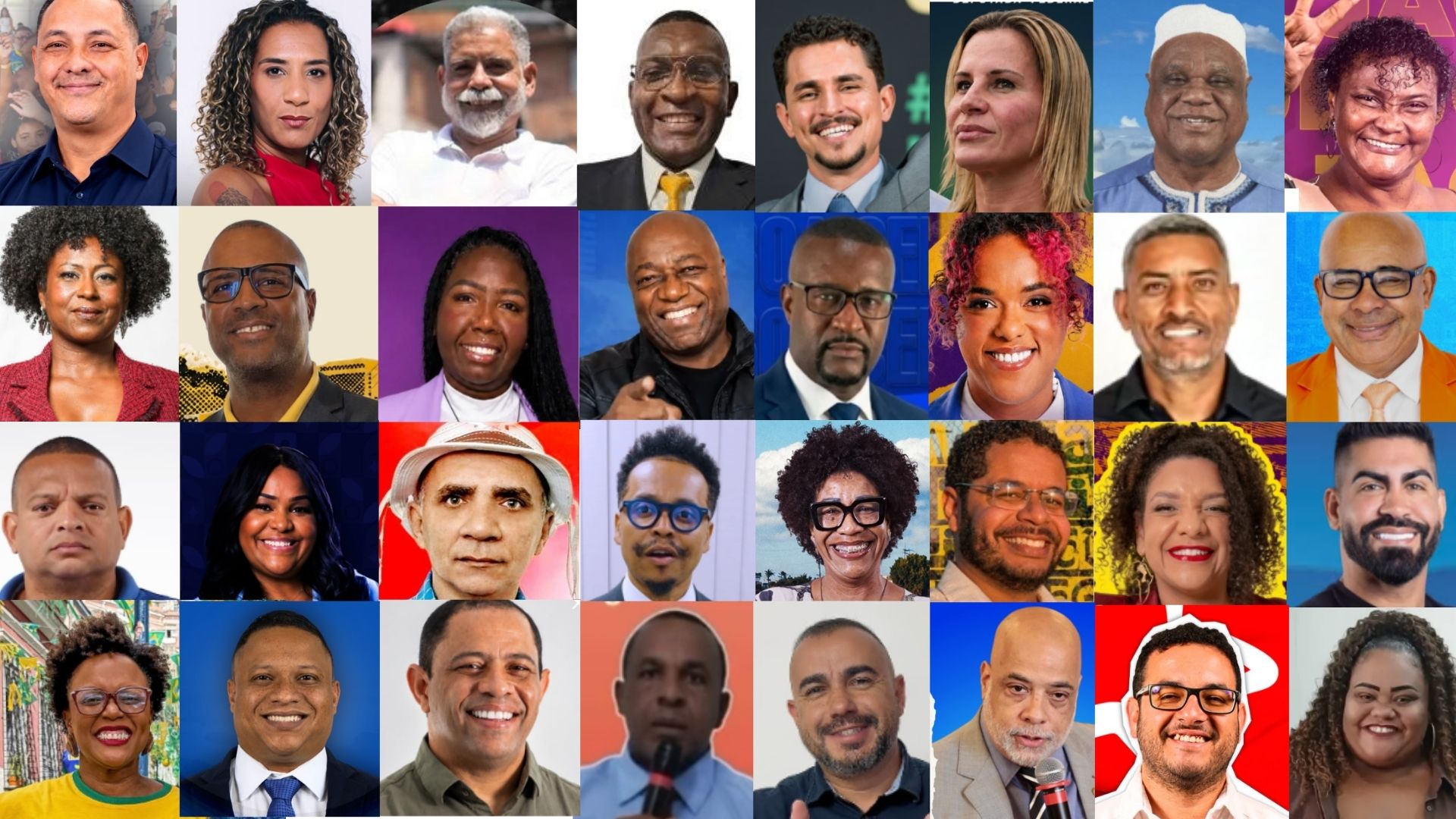

This article is part of a series on the 2026 Brazilian elections, focusing on the perspectives of Greater Rio’s favelas, and provides an overview of candidacies for federal and state deputy from favelas across Greater Rio.
Of the 1,944 candidate registration requests in Rio de Janeiro, 50 self-identify as born and raised in favelas or as favela residents.*
Favelas in the state of Rio de Janeiro are home to over 2.1 million people across 1,724 communities, a population large enough to influence the course of an election. However, this enormous constituency remains underrepresented in spaces of power, where crucial decisions are made about their rights, and public policies that impact their lives are developed.
In 2022, RioOnWatch conducted an analysis of candidates originating in Rio de Janeiro’s favelas. Four years later, we have done the same for the 2026 elections. This year, leaders and residents of these communities are bringing, through their candidacies, experiences shaped in areas directly affected by government action—or inaction. Among the 781 candidates for federal deputy and 1,163 for state deputy registered in the state, RioOnWatch identified, as of publication, 50 candidates who self-identify as being from Greater Rio favelas: 26 are running for the federal Chamber of Deputies and 24 for the Rio de Janeiro State Legislative Assembly (ALERJ). Proportionally, in 2026 only 2.6% of candidates for state or federal deputy self-identified as born and raised in favelas or as favela residents: 54% of them on the Left, 27% in the Center and 18% on the Right.
Regardless of where they stand on the political or party spectrum, candidates from favelas increase the representation of favela residents, who want to see themselves in the Chamber of Deputies and ALERJ. However, electing someone who lives or has lived in a favela does not, in itself, guarantee that the interests of these communities will be represented. Favelas are diverse, as are their residents and motivations. This analysis, therefore, is not intended to tell readers whom to vote for or to assume that these candidates form a politically homogeneous group. Rather, it aims to bring visibility to candidates who are often left out of major election surveys.
The list below was compiled by searching Superior Electoral Court (TSE) records, candidates’ social media profiles, news outlets and favela community media, in addition to recommendations received from favela communicators and residents. This range of sources and verification methods is necessary due to the lack of organized data on favela candidates in the Electoral Justice system’s official databases.
Candidates for Federal Deputy:
| FEDERAL DEPUTY | PARTY | FAVELA | NUMBER | |
| Adelson Guedes | PT | Rocinha | 1311 | @guedesadelson |
| Alexandre Beça | PSD | Morro do Borel | 5506 | @alexandrebecaoficial |
| Anielle Franco | PT | Complexo da Maré | 1330 | @aniellefranco |
| Diego Quaquá | PT | Favela do Caramujo | 1313 | @diegoquaqua |
| Douglas Andrade | Podemos | Complexo da Maré | 2021 | @douglasandrade2021 |
| Dr. Willian Brand | PRD | Vila Aliança | 2540 | @willianbrand_oficial |
| Fabinho da Feira | PSD | Complexo da Maré | 5509 | @fabinhodafeira_ |
| Felipe Brasileiro | PSD | Complexo da Maré | 5560 | @felipebrasileirorj |
| Felipe Boró | PSD | Vila Vintém | 5515 | @felipeboro.rio |
| Kelly Ferreira | PRD | Morro do Caixa D’Água in Piedade | 2500 | @kellyferreiraoficial_ |
| Lau Furacão | PDT | Complexo da Maré | 1261 | @laufuracao |
| Leny da África | PP | City of God | 1132 | @lenydaafrica_ |
| Léo CDD | PT | City of God | 1325 | No personal profile |
| Luciana Nery | PT | Parque Esperança | 1369 | @luciananeryoficial |
| Luciane Costa | PSD | Complexo do Faz Quem Quer | 5562 | @lucianecostaoficial |
| Major Fabiana | Avante | Morro dos Prazeres | 7022 | @majorfabianadepfed |
| Marcelo Diniz | PSD | Muzema | 5577 | @marcelodiniz.rj |
| Michel Vila Nova | Solidariedade | Vila Nova | 7778 | @michelvilanova.oficial |
| Professor Ivanir dos Santos | PSB | Favela do Esqueleto | 4060 | @ivanirdossantos.rio |
| Rafael Satiê | PL | Jacarezinho | 2237 | @rafaelsatie |
| Romério Duarte | PSB | Morro dos Marítimos | 4010 | @romerioduarterj |
| Rubinho da Divinéia | PT | Divinéia | 1342 | @drrbinho_ |
| Salvino Oliveira | PSD | City of God | 5525 | @salvino.oliveira |
| Sandrão da Saúde | PT | Favela do Barbante | 1314 | @sandrocezarpt |
| Tainá de Paula | PT | Comunidade do Loteamento | 1377 | @tainadepaularj |
| Zé Roberto Amigo do Povo | Republicanos | Mangueira | 1099 | @zerobertoamigodopovo |
Candidates for State Deputy:
| STATE DEPUTY | PARTY | FAVELA | NUMBER | |
| Adilson Pires | PT | Vila Aliança | 13620 | @adilsonpiresrj |
| Dani Monteiro | PSOL | São Carlos | 50050 | @danimonteiro.psol |
| Débora Magalhães | MDB | Complexo da Maré | 15026 | @deboramagalhaes.rj |
| Deise Franklin | PSB | Cantagalo | 40450 | @deise.franklin |
| Dinny da Vila | PSB | Morro dos Macacos | 40351 | @dinny_da_vila_oficial |
| Dr. Sérgio Lopes | PSB | Morro dos Macacos | 40040 | @drsergiolopes |
| Elaine Martins | Solidariedade | Complexo do Alemão | 77180 | @elainemartinsoficial |
| Emilia Souza | Avante | Horto | 70057 | Not found |
| Flávio Szanta Marta | PSB | Santa Marta | 40023 | @flaviosantamarta_vote_40023 |
| Inês Brasil | PSB | Vila Kennedy | 40169 | @ines.brasilofc |
| Jaque Joy | PSB | Rocinha | 40555 | @jaque_joy_rainha_das_favelas |
| Jorge Braga | PT | Turano | 13157 | @jorgebraga607 |
| Marcelinho das Comunidades | PSD | Rocinha | 55551 | @marcelinhodociep |
| Márcio Canella | União Brasil | Morro do Malhapão, Belford Roxo | 44444 | @marciocanellarj |
| Marli Alves | Agir | Campinho | 36127 | @marlialves1959 |
| Mc Smith | REDE | Morro do Caracol, Complexo da Penha | 18123 | @mcsmithoriginal |
| Monica Cunha | PSOL | Manguinhos | 50077 | @monicacunhario |
| Pastor Jonathan Ferreira | Solidariedade | Vila Operária | 77241 | @pastorjonathanferreiraoficial |
| Ralph Gracie | PL | Rocinha | 22221 | @ralphgracie |
| Renata Souza | PSOL | Complexo da Maré | 50007 | @renatasouzario |
| Rose Cipriano | PT | Vila Cruzeiro | 13007 | @professorarosecipriano |
| Vania do Alemão | Christian Democracy Party | Complexo do Alemão | 27006 | @vaniadoalemao |
| Wallace, O Abençoado | PV – Green Party | Rocinha | 43111 | @wallacejkpereira |
| Wesley Teixeira | PSB | Morro do Sapo, Duque de Caxias | 40777 | @wesleyteixeiras |
To get a sense of the diversity among candidates from a single community, we contacted the five candidates who self-identified as being from Rocinha, asking what motivated each of them to enter politics, their proposals and why it is important to have people from favelas in spaces of power. We received three responses, shared below.
State deputy candidate Wallace, O Abençoado (Wallace Pereira), from the Green Party (PV), says unfulfilled promises motivated him to enter politics.
“They [politicians] promise [basic rights], electricity, water, sewerage, sanitation, healthcare [and don’t deliver]… That awakened in me [the desire to] fight to secure these rights for the community. We managed to bring an Emergency Care Unit to Rocinha, a sports complex, improvements to streets that were left unfinished… [As part of my proposal] I want to fight so that not only Rocinha, but other communities as well, have a complete sanitation system [serving 100% of the community]. I’m a resident and I know the needs of each area well, everything that’s needed here. I intend to leave a legacy of education, prioritizing autistic people—because there are many in Rocinha. And I will fight hard to put an end to the system that automatically passes students in schools because many don’t know how to write a text, even after finishing their education. I want us to have full-time schools and access to healthcare services within schools.” — Wallace, O Abençoado, PV candidate from Rocinha
Also a candidate for state deputy, Marcelinho das Comunidades, from the Social Democratic Party (PSD), sees favela leadership as key to the change favelas need.
“Favelas need to have a voice in order to truly have their needs met. I, for example, have three projects in my community: Family at the Table, which helps residents in vulnerable situations; Oil at the Spot, focused on the disposal and recycling of used cooking oil; and Soap from the Favela, a local brand that also produces environmentally friendly soap. I’m going to turn [these initiatives] into bills so they can be set up in other favelas to bring dignity to other residents, as well as propose state-run technical schools in all 92 municipalities in the state.” — Marcelinho das Comunidades, PSD candidate from Rocinha
The only candidate for federal deputy from Rocinha, Adelson Guedes, from the Workers’ Party (PT), focuses on public security in the area.
“What motivates me is looking around and seeing people suffer [the consequences of violence]. Paying for a [crime] they did not commit. My proposals aim to reduce violence here by removing weapons from favelas and eliminating criminal factions. Being from a favela means bringing hope for [new] opportunities.” — Adelson Guedes, PT candidate for federal deputy from Rocinha