Posts tagged Aldeia Maracanã
‘O Maraca é Nosso!’ Citizens denied entry to stadium bidding process
Apr 19th
On Thursday morning, April 11th, approximately 400 protesters representing various social and political movements marched from Largo do Machado to the Palácio Guanabara in Laranjeiras to demonstrate against the privatization of Rio’s historic Maracanã stadium. Inside the Palace, envelopes were being opened to determine which companies would be able to compete in the bidding process to administer the Maracanã complex for the next 35 years.
“Today is the day the carioca (Rio native) population takes to the streets and says ‘enough!’…These mega-events, the World Cup and the Olympics cannot violate the rights of the city of Rio de Janeiro! [They] cannot violate More >
‘The City is Ours!’ A Protest for Rio’s Public Spaces
Mar 24th
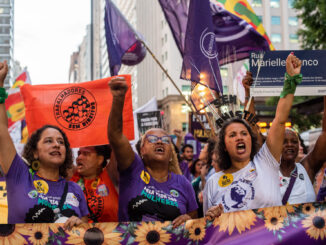
Last Saturday, March 15th, a few hundred spirited citizens gathered in unity to protest the wave of privatization that is accompanying Rio’s preparations for next year’s World Cup and the 2016 Olympic Games, in a march from Praça Saens Peña in Tijuca to the Maracanã stadium.
The event, named ‘The City is Ours!,’ was organized by the Popular Committee for the World Cup and Olympics, an organization created to chronicle and redress the violence, abuses and illegalities in the run-up to the events. As the band began playing, brightly-colored facepaint, stickers, t-shirts and pamphlets circulated, journalists interviewed and took notes, and banners with More >
Forced Eviction of Aldeia Maracanã: How Not to Make a World Cup
Mar 23rd
Click here for original article in Portuguese, published on Blog da Raquel Rolnik, Special Rapporteur to the UN on Adequate Housing. Rolnik introduces the essay below, writing, “This morning we were taken aback by news of the violent eviction of Aldeia Maracanã, which occupied the former Indigenous Museum, located in the vicinity of the Maracanã stadium in Rio de Janeiro. Below is a text on the incident by Professor Fernanda Sánchez, from the Fluminense Federal University (UFF).”
Is this how we make a World Cup?
By Fernanda Sánchez*
On Friday, the Batalhão de Choque da Polícia Militar (Military police’s Shock Batallion) stormed the Aldeia Maracanã, the former Indigenous More >
Four Examples of Resistance
Mar 11th
For the original article by Maíra Mathias, Raquel Júnia and Raquel Torres in Portuguese, click here.
There was a community hampering Rio de Janeiro making itself beautiful for tourists coming to the 2014 World Cup and 2016 Olympics. And still is, thanks to the resistance of hundreds of people, and in spite of the government’s systematic intrusions and tired arguments that you can’t stop progress, that the families will be compensated, that the city will help with the displacements, that a parking lot is more important now, etc. In this interview with Brasil de Fato, people who actively participate in the resistance process More >
What moves Rio State Governor, Sérgio Cabral, against the Indians?
Jan 16th
For original article in Jornal do Brasil click here.
On Saturday, January 12, a scene unfolded in Rio de Janeiro which to the untrained eye appeared anachronistic to the 21st Century: a heavily armed battalion of military police Special Forces (“Batalhão de Choque,” known locally by the acronym BOPE) – uniformed and ready for battle – surrounded a building inhabited by native Brazilian Indians carrying bows and arrows. Travesty aside, it exemplified the undemocratic manner Rio State authorities have adopted in upgrading the Maracanã Stadium.
On those very grounds, on July 16, 1950, Brazil was stunningly defeated when Uruguayan player, Alcides Ghiggia, scored More >