

This is the first of two articles complementing official coverage of the 2nd Sustainable Favela Festival. Click here for part two.
Organized by the Sustainable Favela Network (SFN)*, the 2nd Sustainable Favela Festival took over downtown Rio de Janeiro on October 18, offering 140 activities led by favela-based collectives and allies from the Greater Rio area. One of the innovations of this second edition was a special area dedicated to promoting food security and food sovereignty, as well as preserving the culinary heritage of the favelas. Bringing together community organizers and other members of civil society, the activities in this space also explored the role of food in strategies to confront the climate crisis.
Several activities showcased initiatives that are already changing their communities’ realities. Among them, projects dedicated to agroecological cultivation, training in ancestral cooking and the creation of solidarity-based food distribution networks demonstrated how collective action strengthens community autonomy and generates solutions to food insecurity, an issue that is likely to intensify as a consequence of climate change.
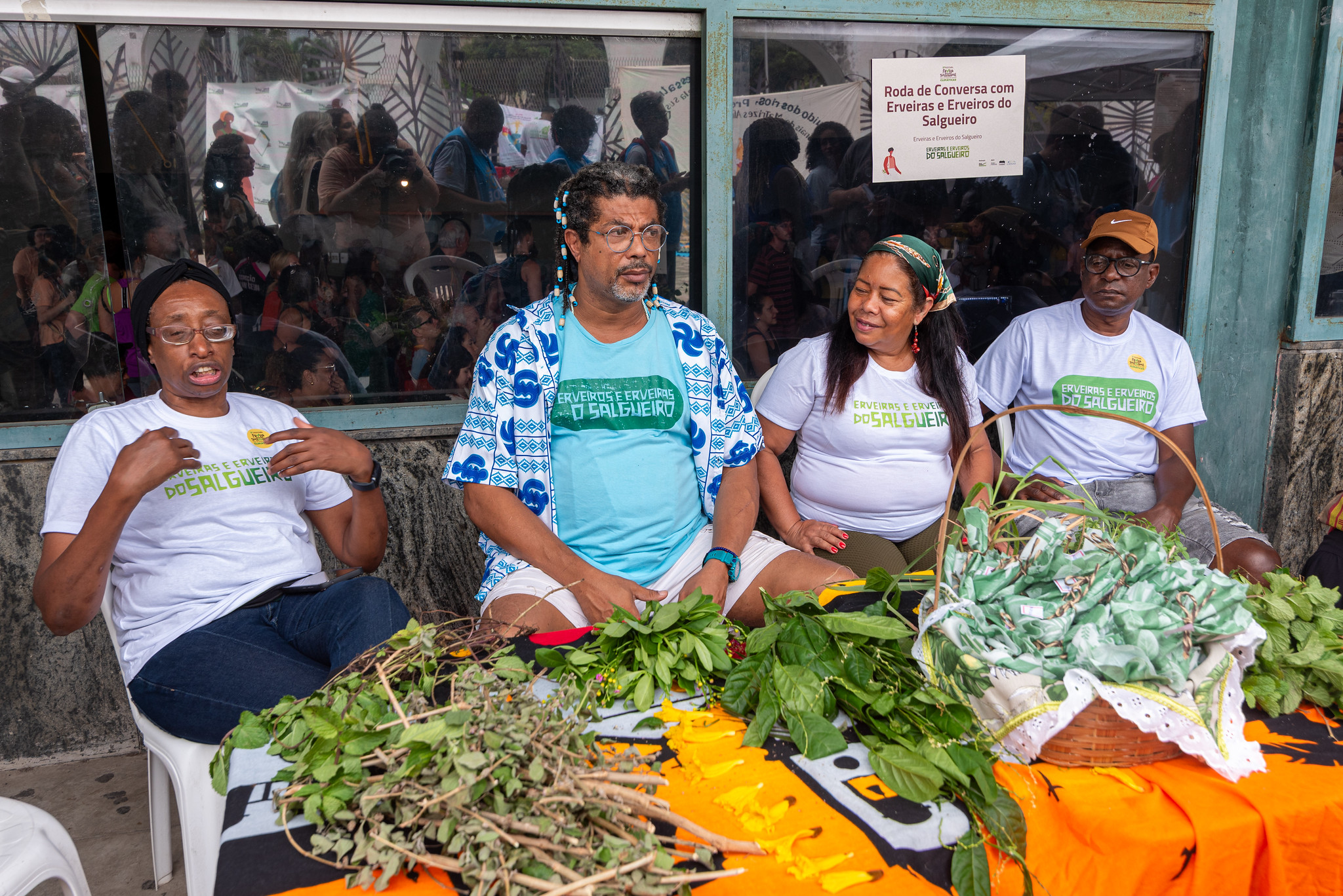
Two of these activities were discussion circles—one with the Salgueiro favela Herb Growers Collective and another titled “Hand in Hand for Better Food,” organized by the Rio de Janeiro Municipal Council for Food and Nutritional Security (CONSEA). During these exchanges, members of the Herb Growers expressed frustration over the lack of municipal support for the Hortas Cariocas program, which works alongside the group to cultivate crops and medicinal plants in the Salgueiro community. According to Jorge Silva, a CONSEA representative who participated in the discussion circle, the meeting created an opportunity to acknowledge the issues raised and foster closer coordination between public authorities and community initiatives in order to address them.
In 2024, the Rio de Janeiro City Council’s Parliamentary Front Against Hunger and Poverty, in partnership with the Josué de Castro Institute of Nutrition at the Federal University of Rio de Janeiro (UFRJ), published the first Hunger Map of the City of Rio de Janeiro. The study identified geographic inequalities in access to adequate, high-quality food, showing that families in the North and West Zones are those who most experience hunger, with the Alemão, Maré and Penha favela complexes, the neighborhood of Madureira, and the Jacarezinho favela being the most impacted by food insecurity.
Another activity that explored community agroecology as a pathway to food security, Baú do Plantar: Senior Citizens’ Social Garden, led by residents of Parque Arará in the North Zone, also featured in the festival. The initiative brings together actions focused on agroecology, environmental education and mental health, all developed in partnership with the Maurício Silva Olympic Medalist Family Health Clinic. One of the project’s activities, the Senior Citizens’ Social Garden, is grounded in the concept of deep ecology. This notion, developed by environmental activist and philosopher Arne Naess, is based on the principle that nature and all living beings have intrinsic value and do not exist to serve humanity, contrary to dominant logic. The project views sustainability as a chain that depends on a series of processes to ensure food security, seeing soil preparation as the foundation for cultivating truly healthy food.
“Someone may be doing sustainable work by producing food through agroecological methods and all that, but if their neighbor is spraying pesticides, that cloud of poison will reach them too—through the water, through the soil. So when we talk about food security, we’re talking about a proposal for changing the world that’s grounded in the idea of deep ecology, and that’s what this project seeks to prioritize.” — Sérgio Anversa, biologist, environmental educator and technical ally of the Parque Arará Social Garden
Members of the project shared that, this October, they established a partnership with the Araras Institute, located in Parque Arará, to put environmental education into practice. The community-based organization promotes educational and social development initiatives for children and young people in Arará. Vanessa da Silva, 24, born and raised in the community and currently the institute’s sustainability director, explains that the organization’s work represents the first contact many of its participants have with environmental issues. In addition, da Silva, who is pursuing a doctorate in Mathematical and Earth Sciences at the Federal University of Rio de Janeiro, is developing a project that, based on her academic research, aims to build a weather station to study the effects of climate on air quality in the region. She explains that the data collected in the study will complement the project’s ongoing activities.
“With the data [gathered through my research], we would be able to analyze the sources that emit pollutants—those linked to the expressways and nearby industrial zones—as well as the receiving points, which are initially the clinic and the garden. From there, we could understand what types of pollutants are reaching the area and whether they pose any risk to the community’s food security. If they show a negative impact on the crops, we plan to develop new projects to explore solutions that can improve air quality.” — Vanessa da Silva
Another area of action for the Lilian Cecília Social Garden involves promoting residents’ mental and emotional health. Recognizing that emotional stability and autonomy are key to building a sustainable environment, the garden’s upkeep is integrated with craft activities carried out with women at the local clinic. The Parque Horácio Women’s Movement offers training courses aimed at strengthening support networks among participants and providing an alternative source of income. Ana Luísa Glaser Barbosa, a 53-year-old artisan and lifelong resident of Parque Arará, learned about the women’s collective through its founder, Maria Aparecida Vieira, known as Tia Cida, after experiencing a period of depression resulting from episodes of domestic violence during the pandemic. Barbosa, whose vision is impaired by cataracts, emphasizes the importance of the project in fostering a community of support among women and sustaining artistic practice.
“I think this kind of activity is essential in the favelas, because people don’t always have the means to attend therapy. Even at the Family Clinic, it’s hard to get an appointment with a psychologist or psychiatrist. [Meanwhile,] in the project, the embroidery sessions become a moment for chatting, for sharing—a space where you can let out things your heart is carrying. Many women in the community suffer domestic violence in silence because they have no one to talk to. In the project, we build that kind of community. It’s also about understanding and showing others that this matters. Beauty matters in our lives.” — Ana Luísa Glaser Barbosa
In the future, the project also plans to launch a training course in Grassroots Education and Health based on the crops grown in the Family Health Clinic’s garden.
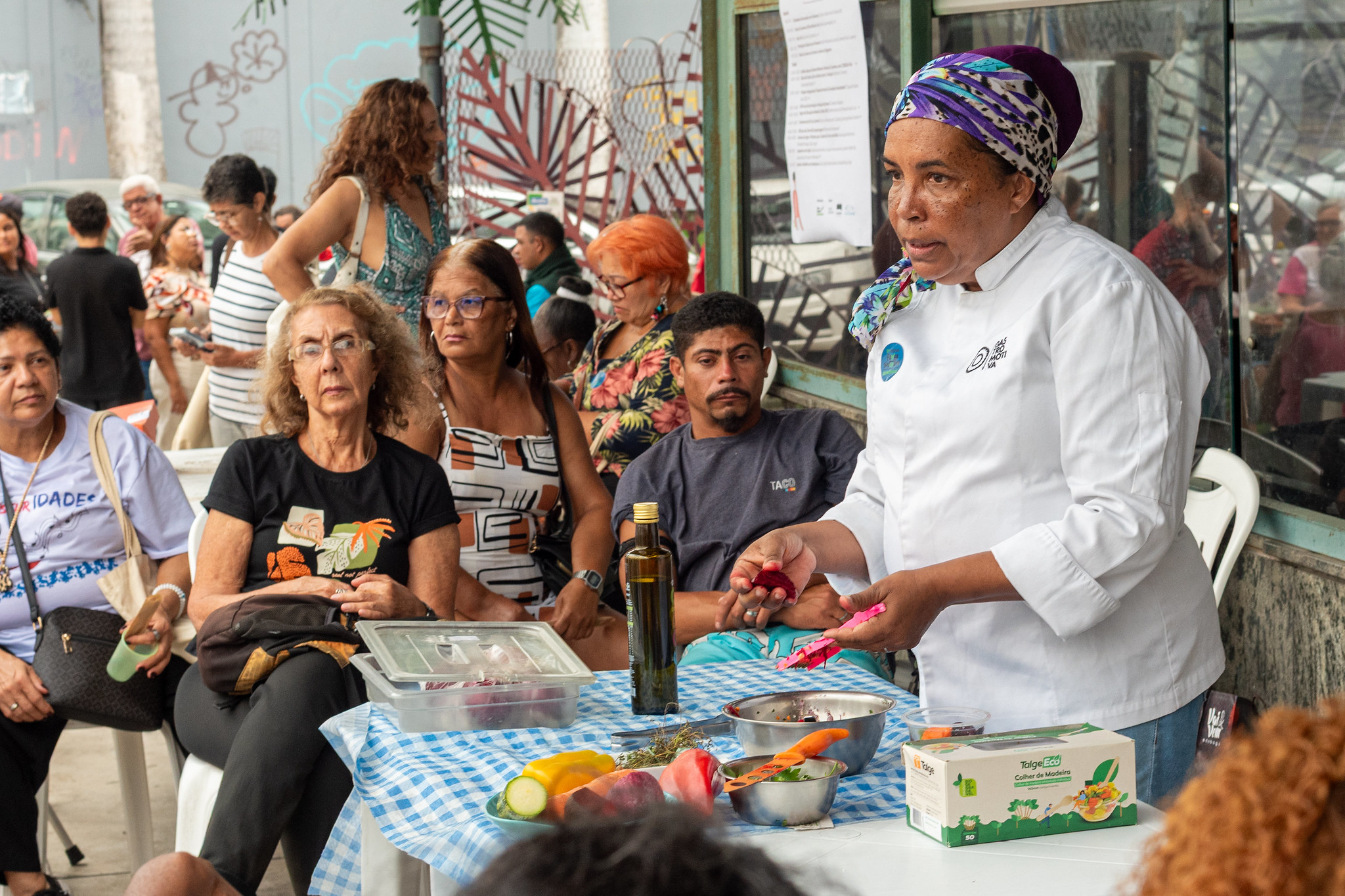
In the afternoon, Claudia Queiroga, a volunteer cook with the organization Gastromotiva and a resident of Nova Campinas, led the workshop “Grandma’s Kitchen Chat.” Queiroga also runs Sweet Memories, a project that combines cooking and agroecology, transforming ingredients such as jackfruit into innovative savory dishes. During the activity, she taught recipes using few ingredients, working with foods in their entirety and emphasizing to participants the importance of avoiding waste and valuing every step of the preparation process—something she learned from conversations with her grandmother.
“I draw on my grandparents’ ancestral knowledge to guide my cooking today. I try to revisit these teachings. My grandmother always talked a lot with me and my family about the path food takes to reach our table, and about valuing every step so that nothing goes to waste.” — Claudia Queiroga
On the day, Queiroga prepared a flavored oil using assorted vegetable stems which, once processed, become a pesto sauce. In the same bowl, she grated a few vegetables, such as carrot, beet, and zucchini, creating what she calls a “funky vinaigrette.” When speaking about her time with her grandmother, the cook recalls that fruit peels were always reused to make sweet preserves and infusions for cakes and juices. On her mother’s side, she carries the fond memory of scrambled eggs with Malabar spinach and classic homemade mate tea.
Queiroga credits her training and work to her involvement with the Gastromotiva network. Since 2006, the organization has used gastronomy as a tool to restore human dignity and combat food insecurity and waste, offering an experience that values both the food and the people who receive it. Its model operates through a restaurant in Lapa that charges for lunch served to the general public in order to provide a free dinner for people in situations of social vulnerability. Queiroga emphasizes the importance of ensuring access to quality food and the right to choose as a fundamental principle of citizenship.
“We’re always talking about the importance of food, about a kind of cuisine that transforms. It’s about the real opportunity to feed people with dignity, because that matters. And we’re not talking about just any kind of meal, we don’t serve processed foods, we don’t serve pasta with hot dogs. We serve real food: rice, different kinds of beans, quality meats, vegetables… We also offer vegan and vegetarian dishes… Climate justice has to do with a concern that goes beyond the environment. We also have to think about people.” — Claudia Queiroga
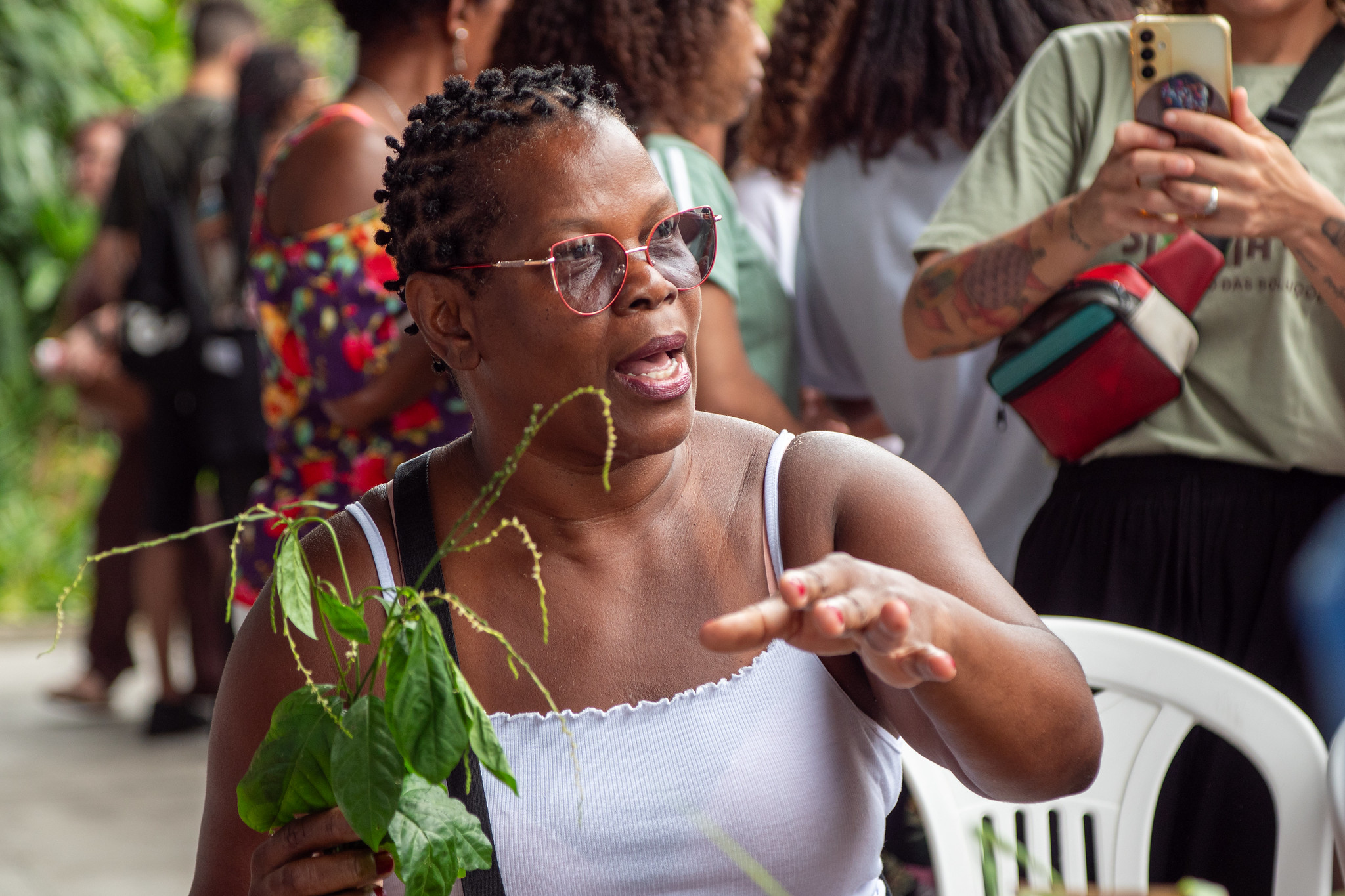
Born in Itabuna in southern Bahia, of Moroccan heritage and raised in Islamic culture, Yamayck Libarino, 31, lives in Rio and is currently experiencing homelessness. He is one of the beneficiaries of the project and was invited by Queiroga to take part in the workshop. Libarino was introduced to Gastromotiva through Street Yoga, which facilitates yoga sessions and discussion circles and, in partnership with Gastromotiva, provides vegetarian meals to people in situations of social vulnerability.
“Since my parents were strict about religious doctrine [Muslim, which only permits the consumption of animals slaughtered according to the Halal rite], I grew up not eating meat. Sometimes I don’t have a choice. When the food caravans come by offering meals to people living on the streets, it’s usually pasta with hot dogs, so I eat a little, or give it to someone else. But I really prefer vegan and vegetarian food.” — Yamayck Libarino
This year, the 2nd Favela Sustainability Festival once again showed that the solutions to food insecurity—as well as to other issues that will intensify with the global climate crisis—emerge from the peripheries of power, where collective creativity and community organization turn into concrete actions for change and well-being. The festival strengthens community initiatives, joining together in a broad pact for climate and environmental justice for Rio de Janeiro’s favelas.
Save the date! The Sustainable Favela Network has already confirmed that the 3rd Sustainable Favela Network Festival will take place on October 17, 2026. It’s going to be even more unmissable! Mark your calendars!
This is the first of two articles complementing official coverage of the 2nd Sustainable Favela Festival. Click here for part two.
Check out the Photo Album of the Food Justice Space at the 2nd Sustainable Favela Festival on Flickr:

*The 2nd Sustainable Favela Festival: Favelas at the Center of Climate Solutions is organized by the Sustainable Favela Network with the support and partnership of re:arc institute, Fundição Progresso and CEDAE. Individual donors to Catalytic Communities have provided extra support, allowing the event to scale beyond initial projections. The 2025 event is also part of three other essential pre-COP agendas taking place in the city of Rio de Janeiro: the Rio de Janeiro Sustainability Turnaround, the 15th Annual Rio Agriculture Week, and UN-Habitat’s Urban October. The Sustainable Favela Network (SFN), the Community Land Trust (CLT), and RioOnWatch are initiatives of the NGO Catalytic Communities (CatComm).
About the author: Joana Stewart is a fourth-semester journalism student at PUC-Rio, with interests in the areas of environment, culture, and politics. During her studies, she has taken part in extension projects, external assignments and has explored different areas of communication both inside and outside the academic setting.