
Clique aqui para Português
Check out our complete series of community media profiles here.
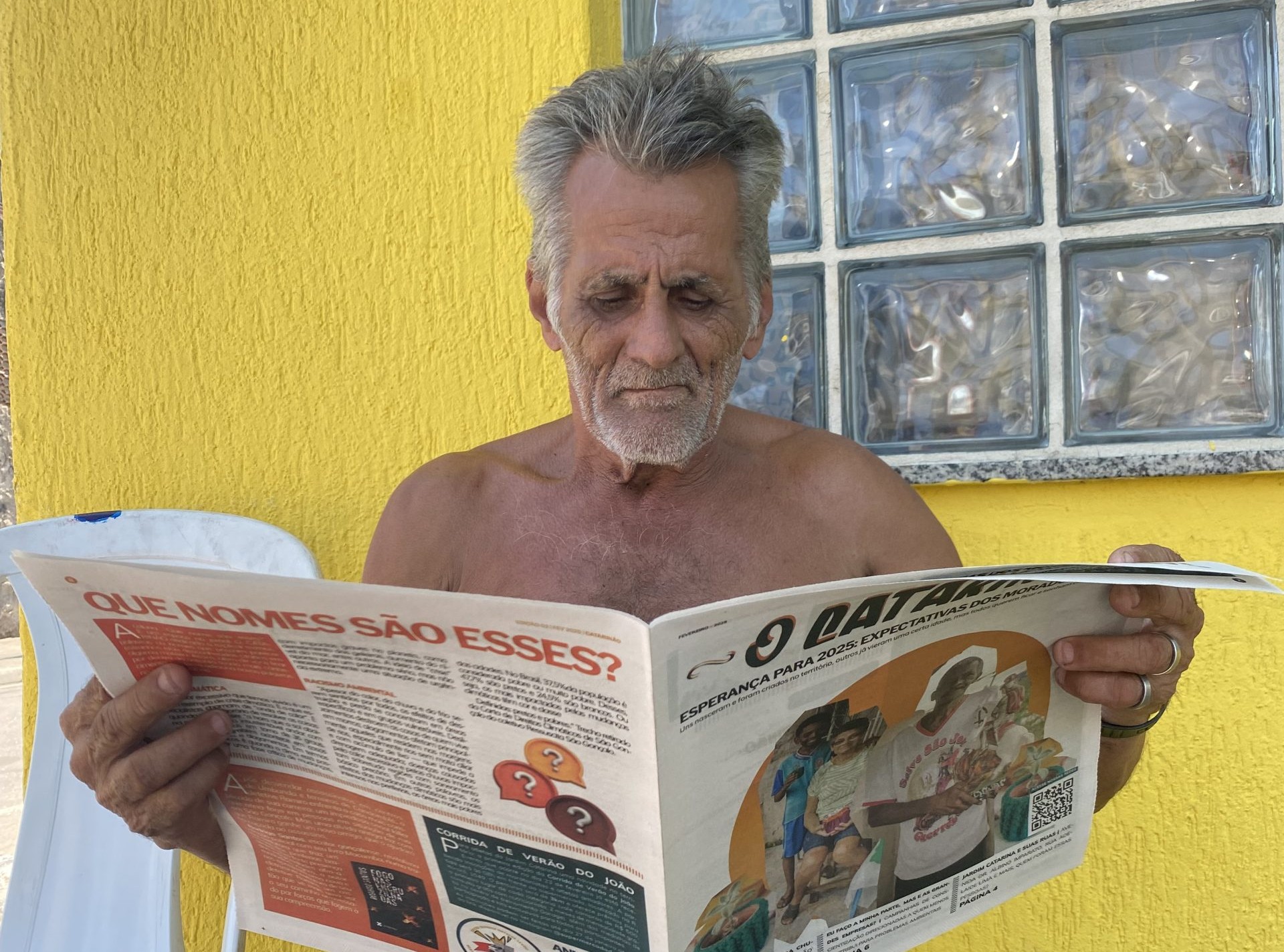
Launched in October 2024, the newspaper O Catarinão portrays the favela of Jardim Catarina in São Gonçalo, a municipality in Greater Rio de Janeiro‘s Leste Fluminense region, to the east of Guanabara Bay. The paper focuses on providing relevant information to residents while helping recover the community’s history, memory, and identity. With 6,000 monthly printed copies, the publication created by journalist Samara Oliveira promotes a sense of belonging through quality local reporting. In addition, O Catarinão is a tool in the struggle of this marginalized community, amplifying local voices and demanding residents’ rights.
The project’s founder was born and raised in Jardim Catarina and believes that communication can bring about change for the area. According to Oliveira, the motivation to create the newspaper came from her discomfort with the way her community was portrayed in mainstream media: always through the lens of violence and criminality, ignoring all the power built there.
“Communication can change realities. One thing that has always bothered me about Jardim Catarina is how little people know about its history. I believe every favela newspaper begins with discomfort over how the hegemonic media portray our favela, our community… ‘O Catarinão’ was born out of that discomfort—from knowing that this is a very rich community, with a wealth of history that is little known even by its own residents. I grew up feeling restless about Jardim Catarina’s story. So the main point was to reclaim memory and identity.” — Samara Oliveira
Distributed free of charge, the newspaper is produced by a permanent team of seven people, including reporters, producers and social media professionals, along with volunteers. “I do a lot of the work myself, but others [do a lot for O Catarinão] too. Without them, I wouldn’t be able to do all this,” says Oliveira.
Considered the largest informal subdivision in Latin America and the most populous neighborhood in São Gonçalo, Jardim Catarina faces many everyday problems that cause significant damage and impact residents’ health. One example is the frequent flooding that hits São Gonçalo and other cities in Greater Rio every summer, which typically remains invisible to both traditional media and the State. “In summer, at the start of the year, we published [articles] about the heavy rains and constant flooding in Jardim Catarina… We explained why it happens and also brought in the historical context,” says Oliveira.
Like every community media outlet, the newspaper faces enormous challenges to keep running.
“The challenges are always tied to a lack of funding, of money, because even though many people want to invest in the paper, we can’t accept just any offer. I always say that it’s not just about getting money—it’s about securing funds that align with our values… Among the many impacts a favela-based media outlet can have on its community, reclaiming memory and identity are the main ones. We share the history of Jardim Catarina—from its beginnings as a subdivision to how it developed into what it is today. This news outlet is essential to informing the residents of São Gonçalo’s most populous neighborhood.” — Samara Oliveira
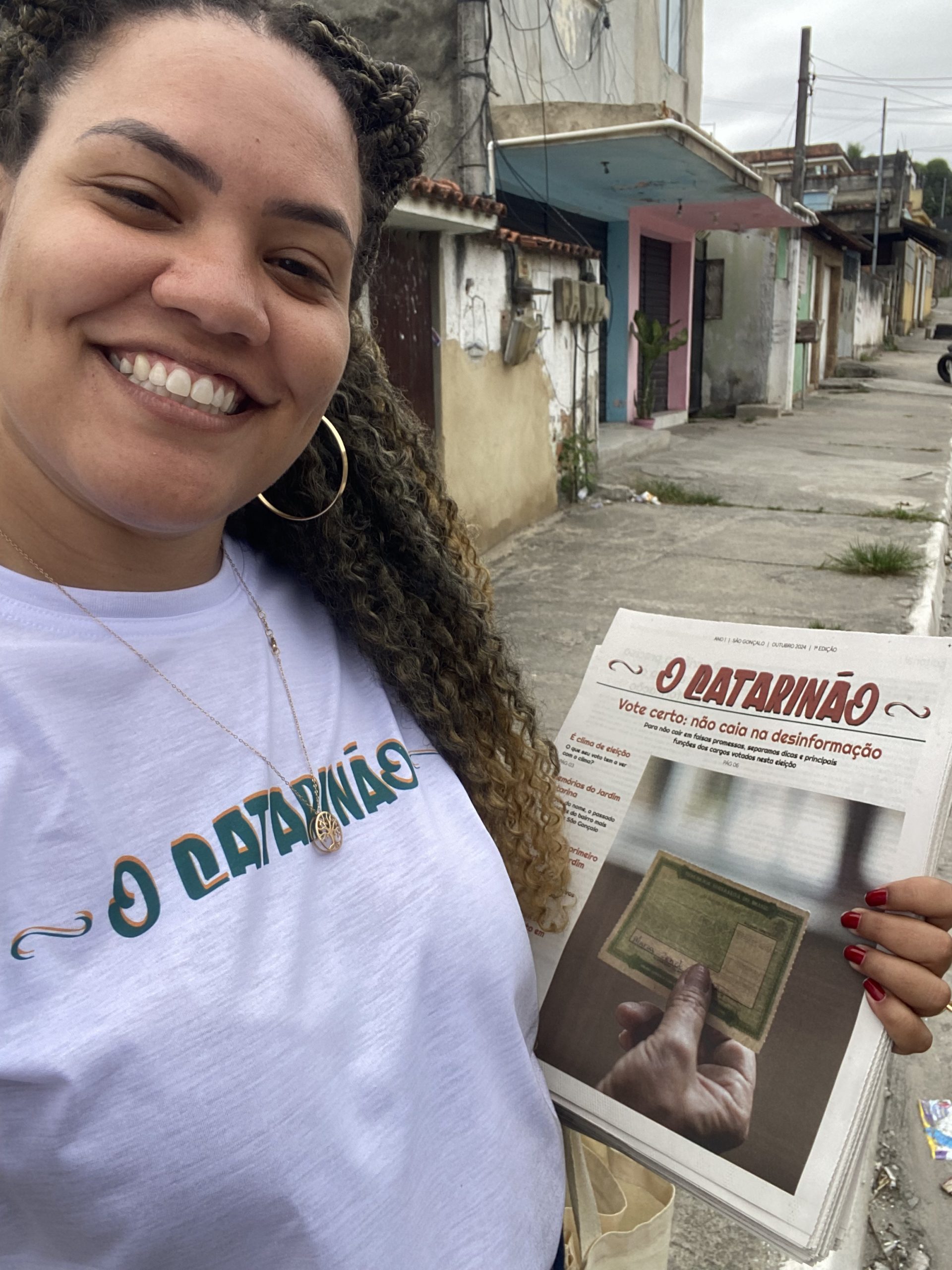
According to the newspaper’s creator, there’s no set number of editions to be produced, but there is a clear effort to build a sense of belonging to the region through community memory. “Once we feel people are equipped with information and knowledge about their neighborhood’s history, then we’ll start covering more subjects,” says Oliveira.
“While we were distributing the paper, there was an elderly man sitting on the sidewalk. We handed him a copy too. Later, I noticed he was crying, visibly moved, looking at the newspaper. I walked over and asked if everything was okay, and he said yes—he was just feeling emotional because his friend, Marcos Delfim, had been remembered and featured in the paper. Marcos Delfim was the first journalist from Jardim Catarina to publish a newspaper and, whether by coincidence, ancestry, or the universe itself, Marcos Delfim happened to be my uncle.” — Samara Oliveira
The young woman’s uncle has passed away, but while he was alive, he coordinated the newspaper Folha Popular. Oliveira says she doesn’t know how long the paper lasted, as her family has no records of the project.
The current O Catarinão adopted a bimonthly schedule due to the printing costs involved. The project’s first edition, which focused on electoral misinformation, received funding from an organization that had already intended to support the newspaper’s printing. With that funding, two additional editions were published, the most recent centered on environmental misinformation. This bimonthly edition is currently in production.
As a tool for bringing about change in the community, O Catarinão seeks to amplify favela voices in their fight for rights.
“Just by being there, we’re already stirring things up and demanding rights. And that comes through in the articles too—when we inform residents about the rights they have.” — Samara Oliveira
Looking ahead, the goal is to publish in-depth feature stories. “So it’s not just a paper handed from one person to another on the street, but a tool that mobilizes and fuels the fight for real improvements in our community,” says Oliveira.
In addition, the newspaper seeks to become a formalized entity and to be able to pay its collaborators. Another goal is to turn the initiative into an institute, allowing it to broaden its reach and actions.
“We have a plan for how we want to create impact beyond the newspaper, beyond communication. I see ‘O Catarinão’ as an institution doing work on the ground, with people who struggle with alcohol and drug abuse, maybe even working to fight hunger as well. And thinking about that not just as handing out basic foodstuffs, but finding ways to generate income together with these people.” — Samara Oliveira
Ever since it began circulating, the newspaper has been received warmly by local residents. “People have always welcomed it with excitement and enthusiasm. When they realized it was a newspaper from Jardim Catarina, they’d turn around and come talk to us, ask how it’s made, who’s behind it. I see a lot of potential for it to become a tool for organizing—because what is grassroots communication, if not this?” asks the founder.
Oliveira is the only journalist on O Catarinão’s staff. She believes the newspaper must inform ethically, with precision and quality. “I carry a big responsibility. Beyond producing quality, accurate reporting, I also have to use language that’s not just accessible, but rich with knowledge for readers. I know we need to bring the language in: make it the [everyday] language of peripheral areas, of the favela, but it’s also important to expand the vocabulary of our readers,” she says, pointing out that the paper includes a page called ‘What Names Are These?’, a glossary explaining the terms used in each edition.”
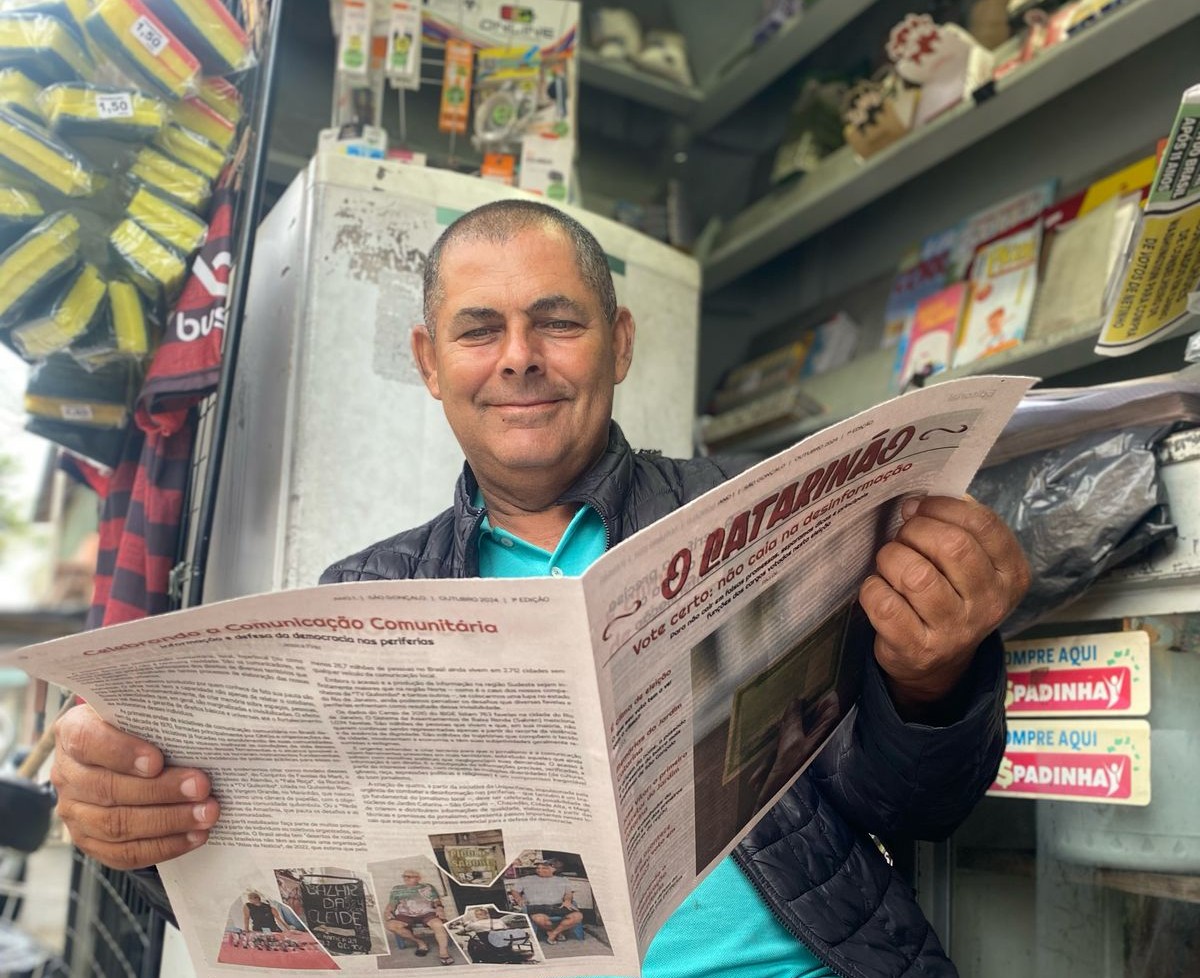
Oscar da Silva Lima, a 57-year-old resident and newspaper vendor who has worked in the neighborhood for over 20 years, talks about how he’s been contributing to O Catarinão. He’s in charge of one of the distribution points: his newsstand. “Everyone who reads the paper likes learning about the neighborhood’s history. People enjoy it,” says Lima. For him, keeping the newspaper in print is essential—especially in this era of the Internet and smartphones.
“These days, it’s all about cell phones. People wake up with their phones already on the bedside table, so they don’t go to the newsstand anymore.” — Oscar da Silva Lima
The newsstand owner explains his strategy for getting the paper to more residents. “Here’s what I do: when someone comes by to buy another newspaper, I slip in a copy of O Catarinão too. But people also come looking for it, and I hand it over. Anything that informs people about the neighborhood is a good thing,” he says.
Resident Lucas Siqueira Gonçalves says the newspaper can be found in several key community spaces. The 27-year-old actor and geography teacher says he often finds copies at distribution points like local hardware stores and markets, in addition to those handed out by the team itself. “I remember when I was a kid, I didn’t really understand what mayors did. I used to say I wanted to be the mayor of Jardim Catarina, because I always wanted to see this neighborhood grow and move forward. When I see O Catarinão—a newspaper dedicated to Jardim Catarina—it’s deeply moving to realize I’m not alone in this fight for the neighborhood.” Gonçalves says he sees himself in the stories told in the newspaper.
“There’s a real variety of stories and news in there. I think that’s what makes me connect even more with ‘O Catarinão,’ you know? And there’s also this love I have for the neighborhood, which I carry into my love for the paper too. Because Jardim Catarina—being the largest informal subdivision in Latin America—holds a huge diversity of stories and events that touch many families and impact the whole community.” — Lucas Siqueira Gonçalves
The teacher and resident draws attention to the newspaper’s digital version, which is also available through a website. “We can share it virtually too—not just by word of mouth, but in a way that social media can help make the news reach more people,” says Gonçalves, highlighting the language used in the paper as “perfectly accessible and understandable, both for people with little schooling and for those with more.”
Among the paper’s main themes, the teacher says he enjoys the fun facts about the neighborhood: “Knowing that it used to be an orange grove and this is the reason behind the name Jardim Catarina. I always identify most with these historical fun facts.”
Confirming Gonçalves’ perspective, Samara Oliveira says the newspaper is very well received by residents and enjoys the support of the Jardim Catarina community. According to her, this is because, before O Catarinão, residents didn’t see their own narratives reflected in the media. The same reason that led Oliveira to create the paper is what makes it so well accepted by her neighbors in Jardim Catarina.
“We receive support in whatever ways the community can help—whether by spreading the word or through local business owners who ask us to leave copies at their establishments for distribution, because they truly like and support the initiative. We get messages on social media asking us to drop off papers here and there, or wanting to know how they can come pick some up. We’ve been embraced by the community. I never doubted it would happen, but it’s really good to see it actually happening.” — Samara Oliveira
About the author: Igor Soares was born and raised in Morro do Borel and has a journalism degree from the Federal University of Rio de Janeiro (UFRJ). He currently contributes to #Colabora and works as a freelancer. He has experience covering topics related to cities, human rights, and public security, having previously worked at Estadão, Portal iG, and produced reports for Folha de São Paulo.