

Check out our complete series of community media profiles here.
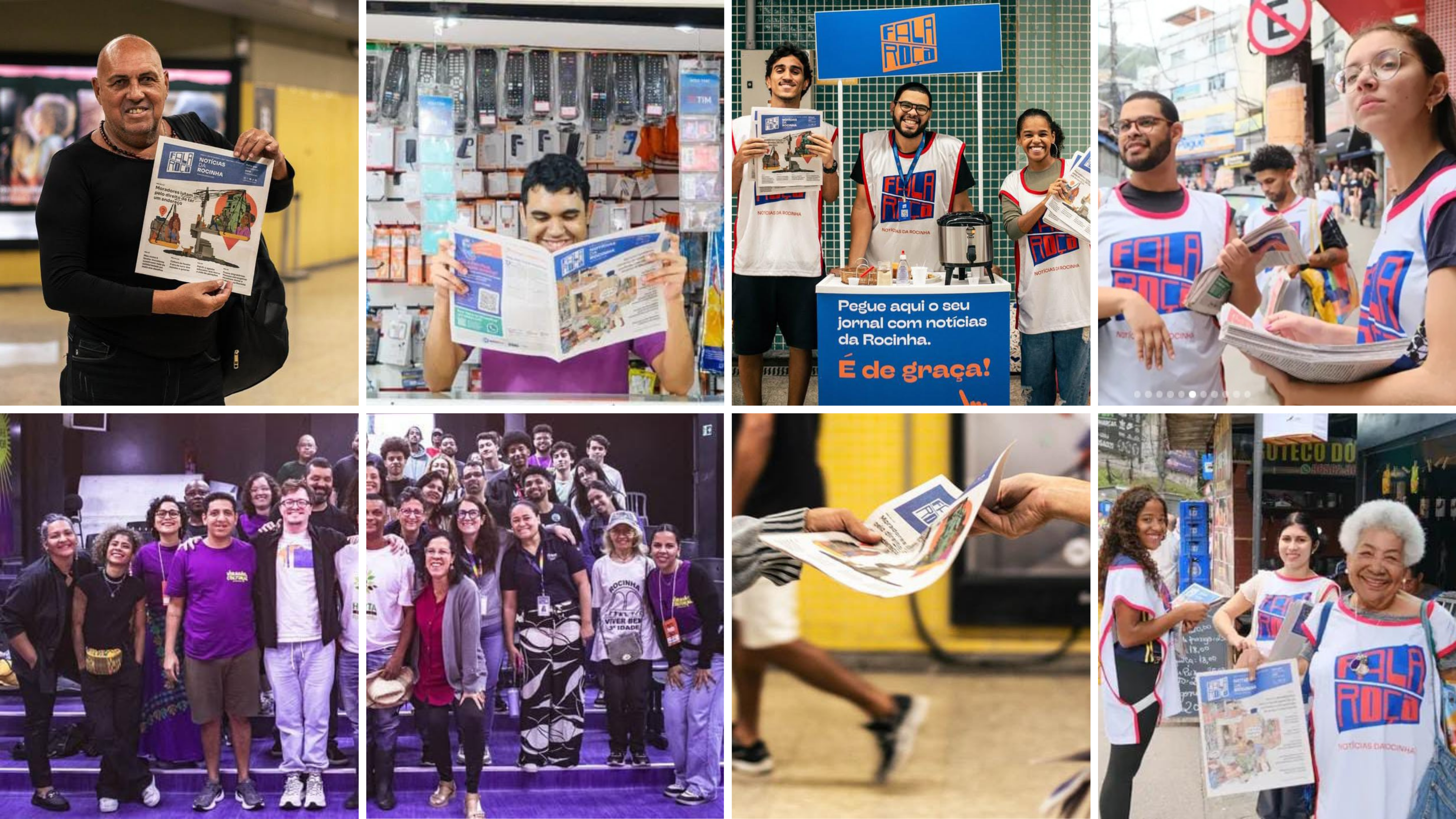
Founded in 2013, Fala Roça is a community media outlet based in Rocinha, in Rio de Janeiro’s South Zone. Its mission is to meet the many needs of Brazil’s largest favela. Through diverse initiatives, the outlet fosters integration within Rocinha—no small feat given the neighborhood’s vastness and high resident turnover. Over its 13 years, Fala Roça has built an important legacy by strengthening connections, promoting community improvements and citizenship.
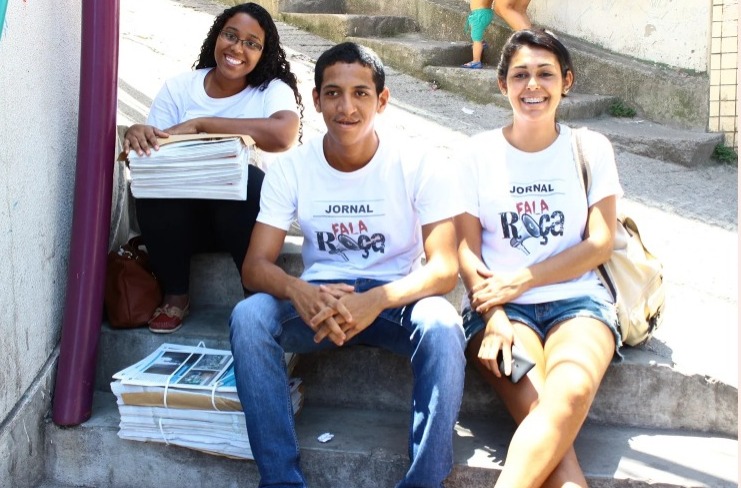
Fala Roça was officially launched following a training program offered by the Agência de Redes para Juventude, which supports and empowers youth-led projects in Rio de Janeiro. Among them was the fledgling Fala Roça, which received seed funding to help take off.
Its first edition, released on May 13, 2013, was published solely in print—a format still used today alongside its website and social media platforms—as a deliberate effort to democratize access to news, according to executive producer Osvaldo Lopes. Not everyone in the favela is digitally literate or has digital devices.
“It’s extremely important because part of the population still isn’t online. When we talk about Rocinha, we’re talking about a community where many people are semi-literate or illiterate. So when we focus too heavily on digital, we end up excluding people who not only don’t know how to use technology, but even if they do, may not know how to properly consume that kind of news. Sometimes we need to read the newspaper to a resident to truly reach them. Someone might live at the very top of Rocinha and have no idea what’s happening down below, or they may only watch TV, and Rocinha only appears on TV when there’s a shootout. When a paper like Fala Roça arrives with positive stories about what’s happening in the community, people are often surprised. That’s why we strongly believe print journalism isn’t going to die.” — Osvaldo Lopes
From Farmland to Favela: Rocinha’s History
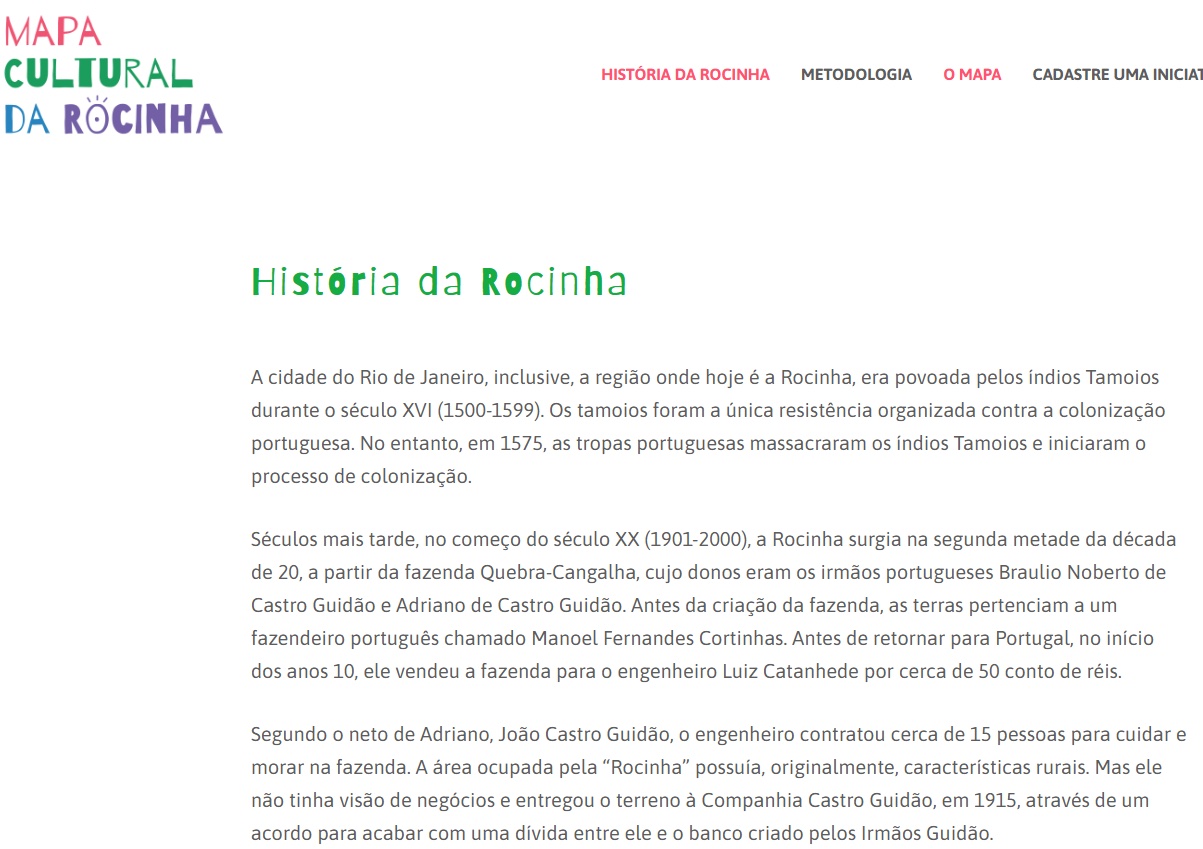
The newspaper’s name reflects a reclaiming of community memory. Long before it became the densely populated neighborhood it is today, filled with shops and buildings, the area was a vast and steep agricultural region known as the Quebra Cangalha Farm, owned by the Portuguese Castro Guidão brothers, according to the Rocinha Cultural Map. A fun fact about the region’s history is that it was once full of wooden yokes, called “cangalhas,” that broke easily (thus the name “quebra cangalha”) during animal transport.
Beginning in the 1930s, however, the farmland was subdivided under directives from the federal government, encouraging people from various regions to settle there and gradually shaping the favela as it exists today.
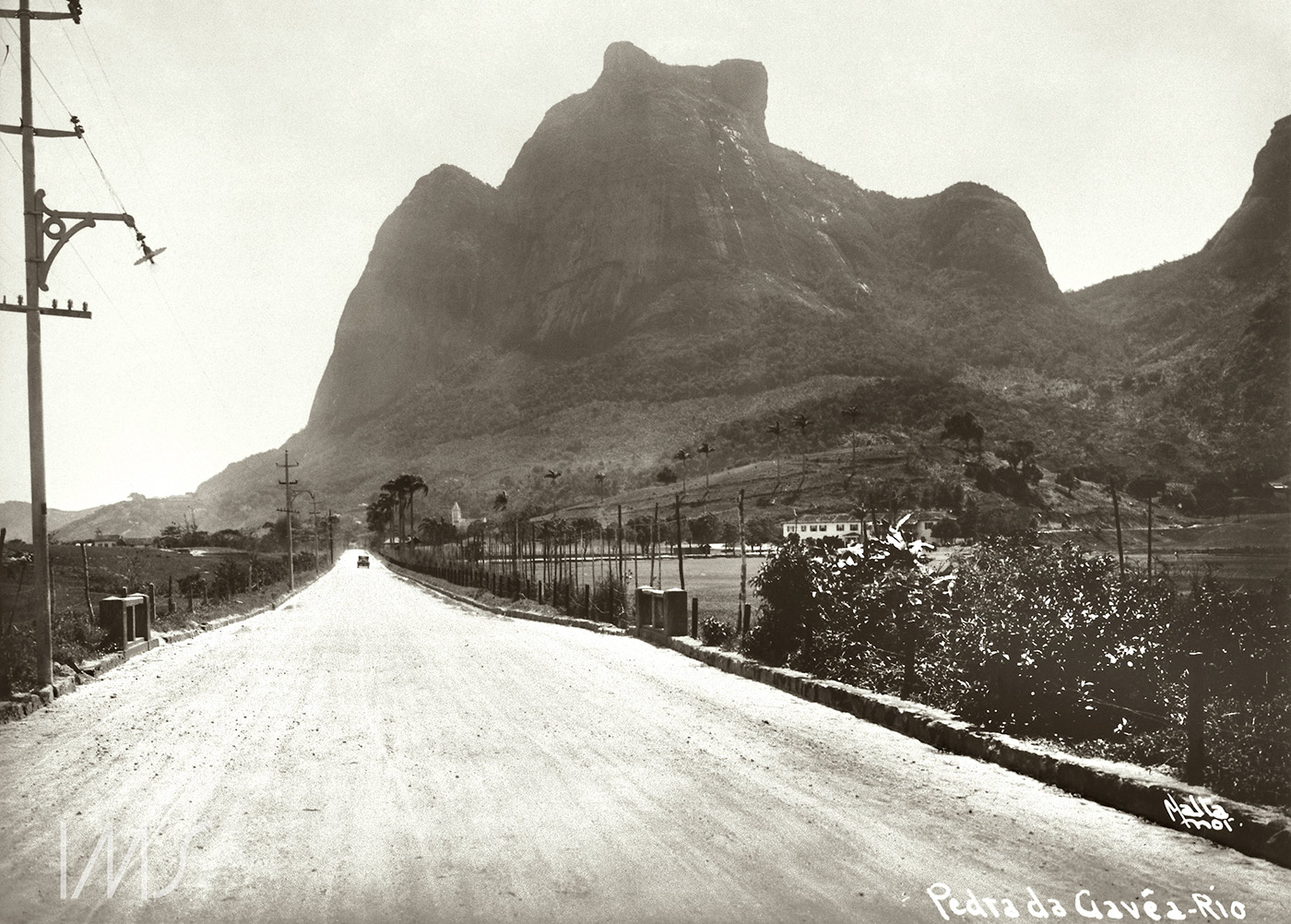
“Although the Castro Guidão company sold some land plots, it went bankrupt in 1938. Many residents did not pay off their debts, and people began occupying the company’s plots, claiming the land had no owner. The paving of Estrada da Gávea (Gávea Road) further contributed to the occupation of the hillside.” – Excerpt from the Rocinha Cultural Map
In 2015, Fala Roça was recognized as Cultural Heritage of the City of Rio de Janeiro through the “Local Actions” call for proposals, part of the city’s 450th anniversary celebrations. That same year, it launched the Rocinha Cultural Map, cataloging over 150 cultural initiatives within the community. The project helped connect local cultural activities with residents and strengthen collaboration across Rocinha.
A Tool for Grassroots Oversight, from Residents, for Residents
Fala Roça also plays an important role in holding public authorities accountable. In one investigation during the Covid-19 pandemic, the outlet questioned the appropriateness of installing a CT scanner in an evangelical church in the community. The report gained enough visibility that the equipment was eventually relocated to Rocinha’s Emergency Care Unit (UPA).
Around the same time, another report exposing vaccine shortages in the community led to the delivery of second doses, helping protect thousands of families from infection.
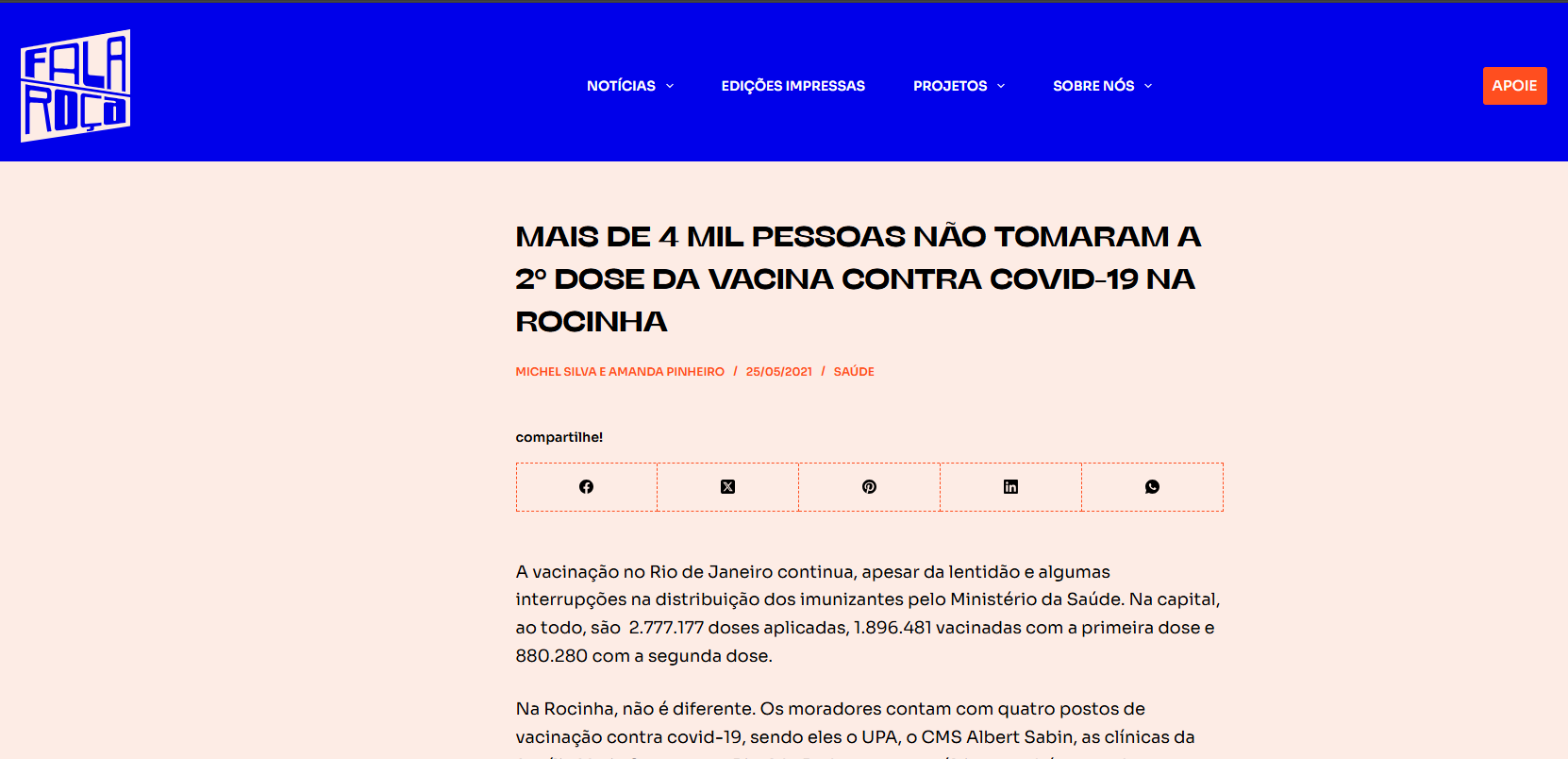
More recently, Fala Roça hosted the 3rd Conference on Favela and Peripheral Journalism, in partnership with Agência Mural. It was the first edition to bring together nearly 60 community media outlets from across Brazil.
Ver essa foto no Instagram
Over the years, the paper has expanded its activities to include events such as the annual Viradão Cultural—a non-stop, free-of-charge open-air cultural occupation of Rocinha—and training programs focused on community communication, including the Favela Communication and Culture Network and the Communication and Cultural Management Course.
Ver essa foto no Instagram
Today, Fala Roça has a team of 27 people, including ten full-time staff members and seven freelancers—most of whom are alumni of its training programs. In 2024 alone, around 300 people participated in its courses, workshops and seminars. According to reporter and institutional communications coordinator Karen Fontoura, offering stipends is essential.
“We always try to make sure participants come from favelas, whether from Rocinha or elsewhere. Whenever a grant allows us to offer a stipend to participants in one of our training programs, we make sure to pay them, because we understand that… it makes a difference. R$200 or R$300 (~US$40 or ~US$60) can help cover groceries for the month or transportation to get here.” — Karen Fontoura
The newspaper reaches 25,000 to 35,000 readers per month, and in 2025 it surpassed the milestone of 100,000 copies distributed, a number that underscores both the impact of Fala Roça’s work and the demand for community-based media. It also addresses needs often overlooked by mainstream media.
“There’s still a barrier between mainstream media and favela journalism. But the truth is, their work doesn’t exist without ours. They know they often can’t enter our territory, but we can produce high-quality, incredible work and still don’t get that recognition. They [mainstream media] often insist on formal journalism degrees, but Fala Roça is right here, operating. Everyone here is professionally trained in their respective fields, and we prove that people from the favela are capable. We’re powerful and we’ll continue producing communication on equal footing. Our main mission is to strengthen by-us-for-us media. We no longer need a [journalist] from the outside to come tell our stories. We’re fully capable of narrating our present and, together, building a quality future for the next generations and for those who are here now.” — Osvaldo Lopes
Ver essa foto no Instagram
“Together, We’re Stronger”
Despite their achievements, Lopes explains that some challenges—particularly police operations—remain without simple solutions and can disrupt the newspaper’s routine.
“A paper might be running normally, but something might happen in the community. The situation might not be very [positive]. If there’s a major shootout in another favela, how can we post a cheerful story on Instagram while everyone’s feeds are flooded with videos of police raids? Sometimes we hold back on certain content out of solidarity. It’s a community just like ours, so that’s a daily challenge. Still, we manage to resist and keep delivering what’s [of interest to the favela], what we believe in: a grandmother who saw her grandson in the paper, a local social project that gained momentum after being featured in Fala Roça… These are all impacts, big and small. What… [we focus on] are our people [Rocinha residents], those right beside us.” — Osvaldo Lopes
Ver essa foto no Instagram
Despite the obstacles, Fala Roça continues to expand community media, citizen participation and integration in Rocinha.
“There was a piece about someone who is extremely well known here, a local school inspector named Petrô. He organized field trips, so a lot of people knew him, but no one knew where his nickname came from. We told that story in our print edition. A young reader commented: ‘I read his story and saw he started working when he was 12, just like me. I thought that was really cool.’ People truly feel represented, which doesn’t happen in other [larger] media outlets. We also think about how to expand our training programs because we get so much [positive] feedback, from residents and from visibility within the community, which is crucial for Fala Roça. Our goal is to speak with the community and reach as many people as possible, because together we’re stronger.” — Karen Fontoura
About the author: Amanda Baroni Lopes holds a degree in Journalism from Unicarioca and was part of the first Journalism Laboratory organized by the Maré community newspaper Maré de Notícias. She is the author of the Anti-Harassment Guide in Breaking, a handbook that explains what is and isn’t harassment to the Hip Hop audience and provides guidance on what to do in these situations. Lopes is from Morro do Timbau, a favela within the larger Maré favela complex.