


From October 30 through November 1, 2025, Rocinha, Brazil’s second largest favela in Rio de Janeiro’s South Zone, hosted the 3rd Conference on Favela and Peripheral Journalism—a national meeting that offered an immersion in journalism and climate issues for communicators and leaders of community media outlets from favelas and urban peripheries across the country.
The event offered training sessions and lectures that addressed the challenges faced by community-based media, including funding, public policies, climate issues in favelas and community organizing, as well as discussions on climate justice in these communities.
With the theme “Climate Justice for Favelas and Peripheral Areas,” the free event was co-organized by Rocinha’s Fala Roça newspaper and Agência Mural, from São Paulo. The partnership gave the conference an unprecedented scope, bringing together media collectives from multiple states to discuss how to secure climate justice for favelas at a national level.
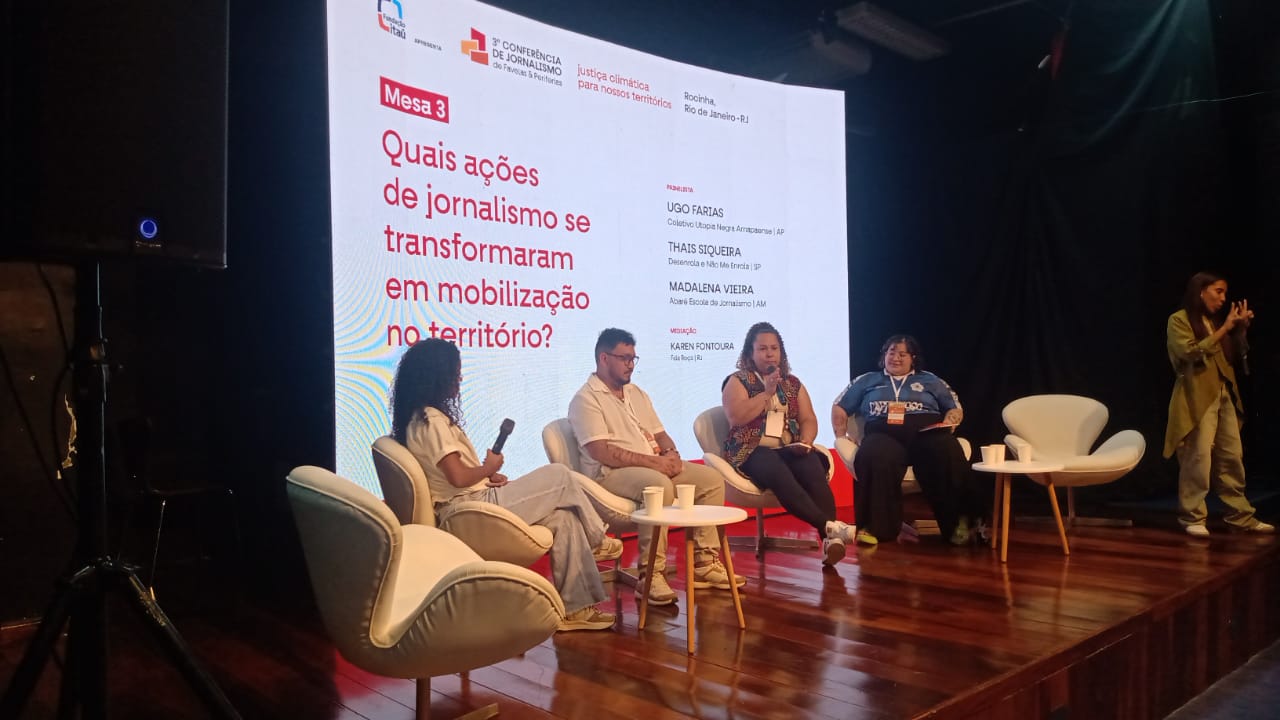
According to Tatiana Lima, coordinator of journalism and editor-in-chief at Fala Roça, this edition’s new format enabled collective reflection on the environmental challenges faced by peripheral communities across the country, especially given the lack of spaces dedicated to discussing issues that intersect favelas and the environment.
“Our [favela perspective] on climate justice is rooted in access to rights and public policies that are properly scaled. It’s not just about mitigation and containment of climate change and everything [this] brings, but also about confronting the structural racism that favelas and peripheral areas face—and that climate change only manages to worsen. When do we ever have a space that is truly ours, where we can listen from within and speak to our own realities? Almost never, right? Peripheral and favela-based media—local media—are also a pillar of democracy. Our ecosystem complements other ecosystems. Sometimes it converges, sometimes it diverges. We take part in that broader ecosystem, but we also have our own, which needs to be sustainable, financially viable and mindful of public policies. Is the solution that worked in territory ‘X’ applicable to Rocinha? And can the solution that worked in Rocinha help a favela in Amapá?” — Tatiana Lima
Ancestral Communication to Meet Contemporary Demands
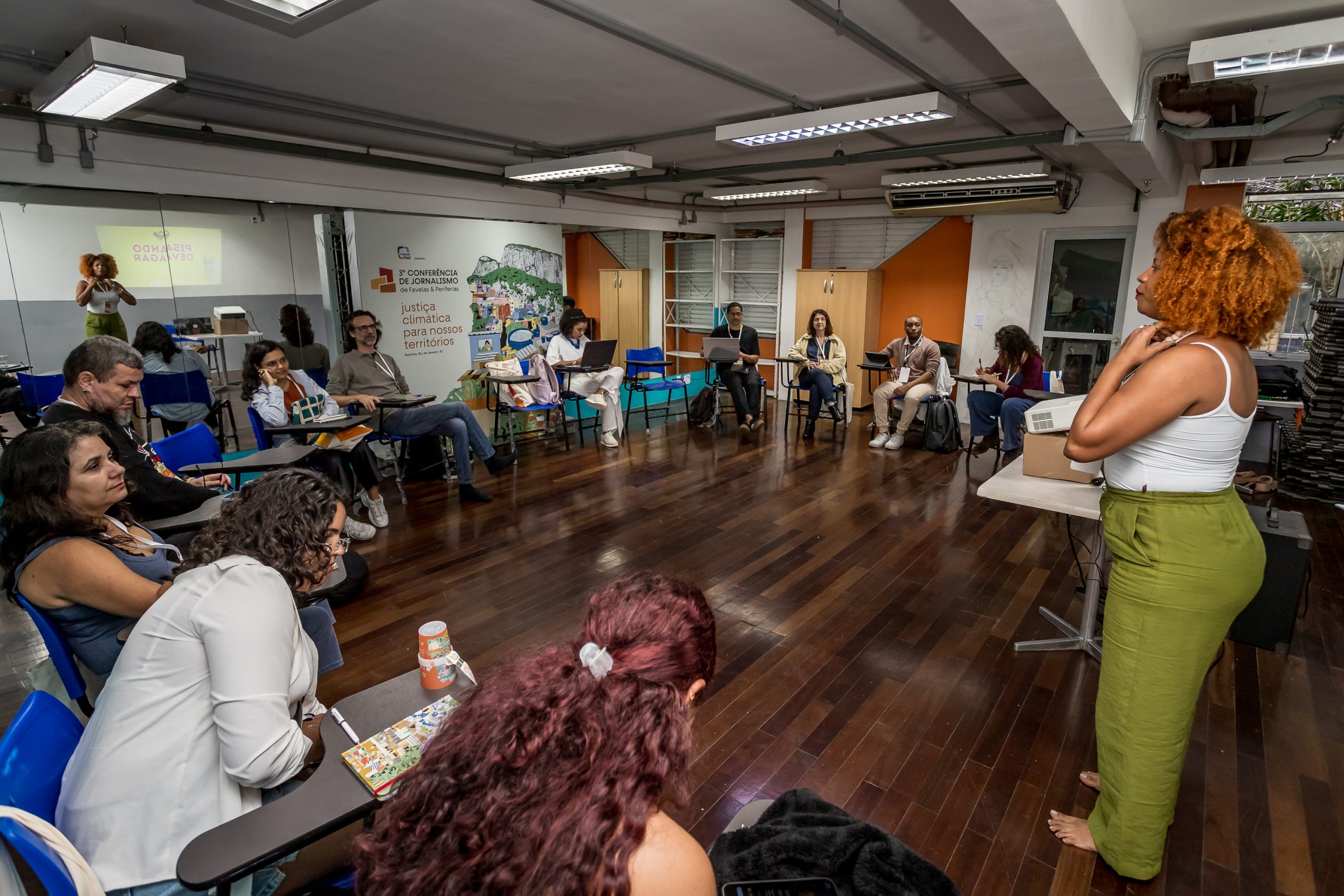
With this in mind, the way communities communicate and connect also matters. The workshop “Ancestral Communication for Possible Futures,” led by Lene Ferreira, a journalist from the northeastern state of Pernambuco and member of the Afoitas portal, offered guidance on how to build assertive communication—an essential tool for bringing favelas closer to climate-related discussions in a society that is increasingly hyperconnected, yet often disconnected from its own surroundings.
“I don’t see how it’s possible to do journalism without having a direct relationship with people living in favelas, especially those who are faced with the constant violations of their rights… Our profession is a service to society. It demands a great deal of responsibility and commitment to marginalized communities—particularly those at the base of the social pyramid, who have endured countless violations throughout history. Communication is a way for us to build reparations for the Black people in this country, who have been humiliated, neglected and abandoned for too long.
We cannot build communication that truly serves this population without it being rooted in the knowledge, doings and [everyday] practices of peripheral territories. In the people who are actively and truly shaping their communities through culture. Every time we stop to think about journalism and reflect on its role, we are pushed—and required—to take on a more engaged and activist role, ensuring that [our] agendas have a greater reach. There’s no way to do that if we aren’t close to these populations. Ancestral communication calls for a reconnection with these territories, a reconnection with people, so that through [this reconnection] we can produce journalism that makes sense, that generates meaning and that also sparks transformation.” — Lene Ferreira
Leonardo Nogueira, a resident of Santa Cruz in Rio’s West Zone and a journalist at Data Labe, cited the tradition of loudspeaker announcements as an example of how established communication practices, combined with today’s technological resources, can support this mission.
“Technologies need to coexist—not replace one another. Radio, for example, is an ancestral form of communication, created long before us, yet still used today for specific purposes in our areas. Connecting communication and ancestral knowledge means thinking about how we can better communicate our existence and how we can better communicate with the people we want to reach, the people we want to speak to.” — Leonardo Nogueira
Despite the importance of these outlets—and their crucial role in bringing the agenda of favela climate issues to the forefront—those working in community-based media still face significant challenges.
Community Media Means Being Part of the Solution
Elize Mayara, a communicator with the Tapajônico Youth Collective from Belém, capital of the Amazonian state of Pará, explains that addressing this topic within communities requires not only communication, but also mobilization and awareness-building. To her, it means being part of the solution—especially because many people still do not associate the problems they experience in their daily lives with the climate crisis.
“I believe that, in order to enter a favela and talk about climate justice, we first need to show the climate injustices we face, right? Because when we turn to people and say, ‘I’m here to talk about climate justice,’ their reaction is often, ‘Well, for me, climate change is something that happens when ice melts somewhere far away.’ So, to begin this discussion and show that [environmental issues are] real, not something made up, we need to start by talking about [the problems]. In my region, for instance, we’ve been dealing with mercury levels in people’s blood, which are extremely high. They’re conducting studies and collecting data on this. But then what? What happens to these people afterward? How do we solve it? How many people are affected? What are we going to do? I find myself thinking about the situation in my state regarding this. As a collective, we get paid very little, we get very little funding. If it’s difficult for you here [in the Southeast], imagine what it’s like for us.” — Elize Mayara
Lack of Funding Limits the Reach of Climate-Focused Community Media
The lack of funding and public policies was a central theme of the event, identified as one of the main bottlenecks for those running community media projects. Despite their importance and the urgent, unique role they play, many community-based outlets operate on a tightrope to stay afloat.
The difficulty in securing funds forces many to rely on grants—something that, according to Fernanda Calé, born and raised in the West Zone favela of Rio das Pedras and cofounder of Agência Lume, is not always feasible.
“We see grant calls that demand very complex requirements, others not so much, but sometimes [the actual approval] ends up being very subjective, right? We [at Agência Lume], for example, applied to over 15 calls for proposals and never even heard back [which jeopardized the sustainability of our project]. So how do we rethink this logic and break free from [relying solely on] grants? In the end, not everyone can be awarded them. Beyond discussing how to access philanthropy—which is extremely important, just as grants are, and something we discuss at every conference—how do we build a new strategy? Of course, this means shifting the paradigm; it’s almost like inventing a new one. We’re all here trying to figure it out, but how can we also direct our attention toward changing this logic? What kind of logic can we create in its place? Sometimes a small amount of support for one organization can become meaningful support for other [media projects] that are just starting out.” — Fernanda Calé
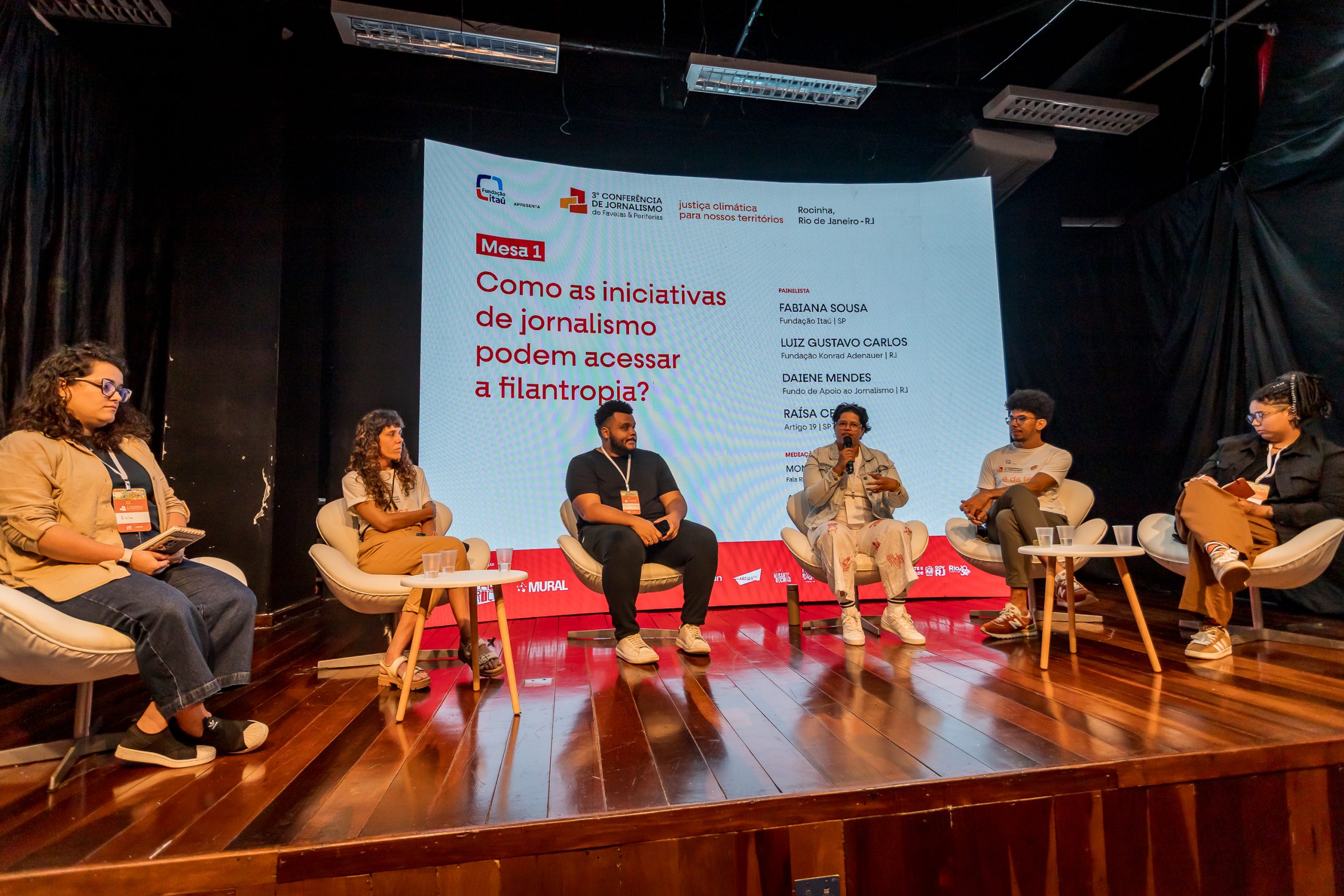
In this context, Daiene Mendes, born and raised in Complexo do Alemão in the North Zone and now serving as director of Rio’s Journalism Support Fund, explains that philanthropy has become an alternative for sustaining community-based media outlets. Even so, she says the most powerful tool for driving this change is creating these exchange spaces—spaces where access to information circulates within the communities themselves.
“Philanthropy is a system that operates on trust. You build trust with someone—it’s about relationships. And who has [historically] had access to philanthropy? Those who [can] spend time on [affluent] Leblon beach. They go out to dinner [together], then to a show on Flamengo Beach. There’s no complex formula—that’s how it works. Historically, this space has been extremely restricted. If we look back, the journalism organizations that received philanthropic funding have shared a very specific profile, haven’t they? They were historically white, elitist organizations. So, it’s important to highlight something interesting about this panel we’re on right now: the diversity represented here directly impacts who will receive funding. Because the moment this funding reaches our hands—people with little money, but with a commitment to our territories—[that changes the whole scenario].” — Daiene Mendes
‘As Long as Environmental Racism Exists, There Can Be No Climate Justice’
According to Osvaldo Lopes, executive producer at Fala Roça, the event marks an important step in establishing community journalism as an authority in grassroots communication and as a reference for guiding how this work should be carried out to meet the needs of favelas.
“This year, we are building communication from our areas alongside what I like to call our ‘sister territories.’ Making this national movement to strengthen the construction of a network is very important because it shows mainstream media that we, too, are professional, high-quality journalists, reporting from within our own communities. The time has come for us to tell and narrate the problems, the lived experiences and the victories of our communities from our own perspective. Ever since we started holding this conference in 2022, we’ve been learning and systematizing all of this to create a comprehensive and truly diverse report based on the realities of each state. This will allow us to define [how] grassroots communication should be done and [what] level of journalism quality we truly need.” — Osvaldo Lopes
Joining the discussions on the panel “What Is Climate Justice for Our Favela Territories?” was Antônio Firmino, co-founder of the Rocinha Sankofa Museum responsible for organizing the Rocinha Climate Memory Circle.
He explains that, due to the community’s longstanding lack of basic sanitation services, Rocinha residents began mobilizing in the 1970s to clean and restore the area’s open sewage channels. This initiative eventually allowed for the installation of a primary healthcare unit in Rocinha—showing how collective mobilizations can drive change and improvements within the community. The conference, he adds, is one such effort.
“In order to prevent Rocinha from being removed in the 1970s, residents began cleaning the channels, which were natural waterways for rain and spring water… The residents organized collective cleanups of these channels, benefiting everyone. [This struggle] brought Rocinha a family health clinic that has now been around for 43 years… Talking about justice means talking about basic rights. This lack [of public investment in improvements], and the few public policies in this regard, affects us every single day. How can we expect climate justice if there’s no concern for basic sanitation in this country? Does anyone consider where the trash goes after putting it in a dumpster or bin?… We just get rid of the waste, but we also have a responsibility. As long as environmental racism exists, there is no climate justice.” — Antônio Firmino

For social media manager and Rocinha resident Isabelle Trindade, the idea of holding a communication conference in Rocinha is a strategy that represents the first step toward climate justice: including the favela in the debate.
“We need to be able to speak from our own standpoint; we need to talk about our reality. We always see mainstream media talk about what they think, what they believe and sometimes it doesn’t actually apply to where we live or to how we live. So it’s very important that we’re able to speak and give visibility to the perspectives of people who belong to that territory. We need to understand that we are part of these discussions and part of the environment. We have to take care of where we live and be aware of what we can do to change the climate reality, which is becoming increasingly harmful and impactful. Soon, we won’t have a future if we don’t start looking at the reality we live in [now].” — Isabelle Trindade
Ver essa foto no Instagram
In total, the event brought together around 200 people, including nearly 60 independent media collectives from 12 Brazilian states. These included: Bem TV, PPG Informativo, Fórum Grita Baixada, Agência Lume, O Catarinão, Site da Baixada, Voz de Guadalupe, Coletivo Jovem Tapajônico, Tapajos de Fato, Rede Wayuri, Abaré Escola de Jornalismo, O Varadouro, Coletivo Utopia Negra Amapaense, Instituto Eficientes, Afoitas, Sargento Perifa, Nordeste Eu sou, Mangue Jornalismo, Coar Jornalismo, Desenrola e Não Me Enrola, Nós, mulheres da Perifeira, Manda Notícias, Coneccta Cabana, Site Coreto, Perifa Connection, NPC – Núcleo Piratininga de Comunicação, Voz das Comunidades, Notícia Preta, Território da Notícia, Podcast Pé no Ouvido, Periferia em Movimento, Calango Notícias, TV Bonja, Retratos de Favela, TV Comunidades, TV Quilombo, Jornal O Pedreirense, Rede Tumulto, Mojubá Mídias e Conexões, Conquista Repórter, Rede Kalunga Comunicações, Tec Perifa, Rádio Favela, O Cidadão, Fala Akari, Fala Manguinhos, CDD Acontece, Favela em Pauta, Maré de Notícias, Entre Becos, Desterro – Observatório de Violência em Florianópolis, Canal Meio and A Terceira Margem da Rua. Additionally, the gathering featured a closing show by pagode group Os Caramelos.
Also in attendance were Minister Anielle Franco, from the Ministry of Racial Equality, as well as civil society entities and organizations such as Rocinha 2030, Fundação Itaú, the Journalism Support Fund (FAJ), Pulitzer Center, Reporters Without Borders, the U.S. Consulate, Artigo 19, the Brazilian Institute of Geography and Statistics (IBGE), Brazilian Association of Investigative Journalism (Abraji), Bem-Te-Vi Diversidade, Rio de Janeiro Legislative Assembly (Alerj), Instituto da Mulher Negra Mãe Hilda Jitolu, Redes do Beberibe, the Media Collective of the National Coordination for the Articulation of Rural Black Quilombo Communities – CONAQ, Redes da Maré, Straight Talk Institute, Decodifica Institute, Maré Mobilization Front, Latina Pé no Chão, State Secretariat for the Environment (SEAS), the Institute for Culture, Communication and Advocacy (ICCI), Konrad Adenauer Foundation (KAS), the United Nations Development Programme (UNDP) and Rota do São Benedito.
About the author: Amanda Baroni Lopes has a degree in journalism from Unicarioca and was part of the first Journalism Laboratory organized by Maré’s community newspaper Maré de Notícias. She is the author of the Anti-Harassment Guide on Breaking, a handbook that explains what is and isn’t harassment to the Hip Hop audience and provides guidance on what to do in these situations. Lopes is from Morro do Timbau, a favela within the larger Maré favela complex.