

Youth are increasingly present at United Nations Climate Change Conferences (COPs), whether at the official event, where governmental climate negotiations take place, or in parallel spaces organized by civil society, which at COP30 in Brazil last month was the People’s Summit at the Federal University of Pará (UFPA). And they are not there as mere spectators: children and teens think and propose ways to fight climate change.
This year, the People’s Summit’s Children’s Summit brought together around 600 youth. Children led public discussions on issues they face related to climate change, socio-environmental justice and well-being, drawing on their perspectives and communities. They presented the resulting Children’s Letter at the People’s Summit’s closing event, on November 16, to national Brazilian officials.
The following day, November 17, the official COP30 event, organized by the Brazilian government and the United Nations (UN), also dedicated its program to listening to children and youth from around the world. Held in the Blue Zone, where official debates negotiations took place between government representatives, young people were able to influence climate negotiations directly with their own ideas and proposals.
Those Most Affected by the Crisis Must Be Seen and Heard
The report Early Childhood at the Center of the Climate Crisis highlights that children are the group most affected by the climate crisis. According to the document, children born from 2020 onwards will face 6.8 times more heat waves than those born in 1960. In Brazil, 40 million children and adolescents already face at least one type of climate risk, and 1.1 million live with water scarcity.
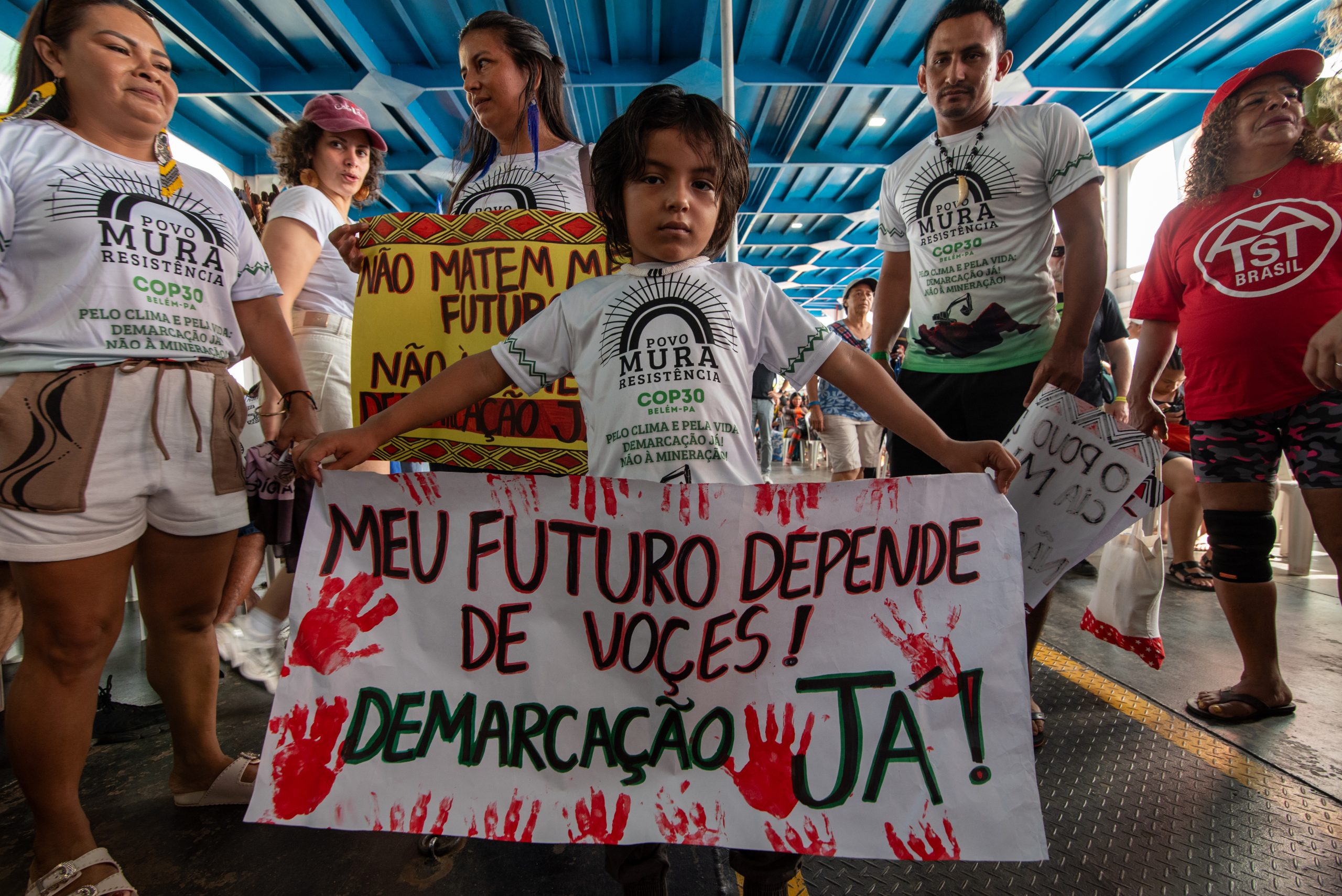
In general, children are not historically seen as a social group with their own place in society. Instead, childhood is seen as a period of life to be lived up until reaching adulthood, when children achieve full citizenship. As a result, children end up being treated as spectators of processes that occur in the world, which places them in a position of non-decision, that is, of not being understood as subjects of rights, capable of deciding on the factors that affect their own lives.
In his article Childhood as a Structural Form, Jens Qvortrup notes that the demand for a voice emerged because, traditionally, children were considered to be in a “preparatory” phase for adulthood. The author highlights that “a child is not an adult integrated into society. This does not seem to be a necessary precondition, however, for being complete as an individual.” In other words, despite not being an adult, a child is an individual, a rights holder, who can and should participate in discussions about society.
In many favelas and peripheral areas, children and youth live in surroundings that are disadvantaged in terms of nature, with little tree cover and few green spaces, as well as high temperatures and risks associated with extreme weather events such as floods and landslides. It is only fair that those affected by these issues should also be able to express how they are affected and how they hope these impacts can be addressed or mitigated.
Childhood in Terra Firme, a Favela in Belém
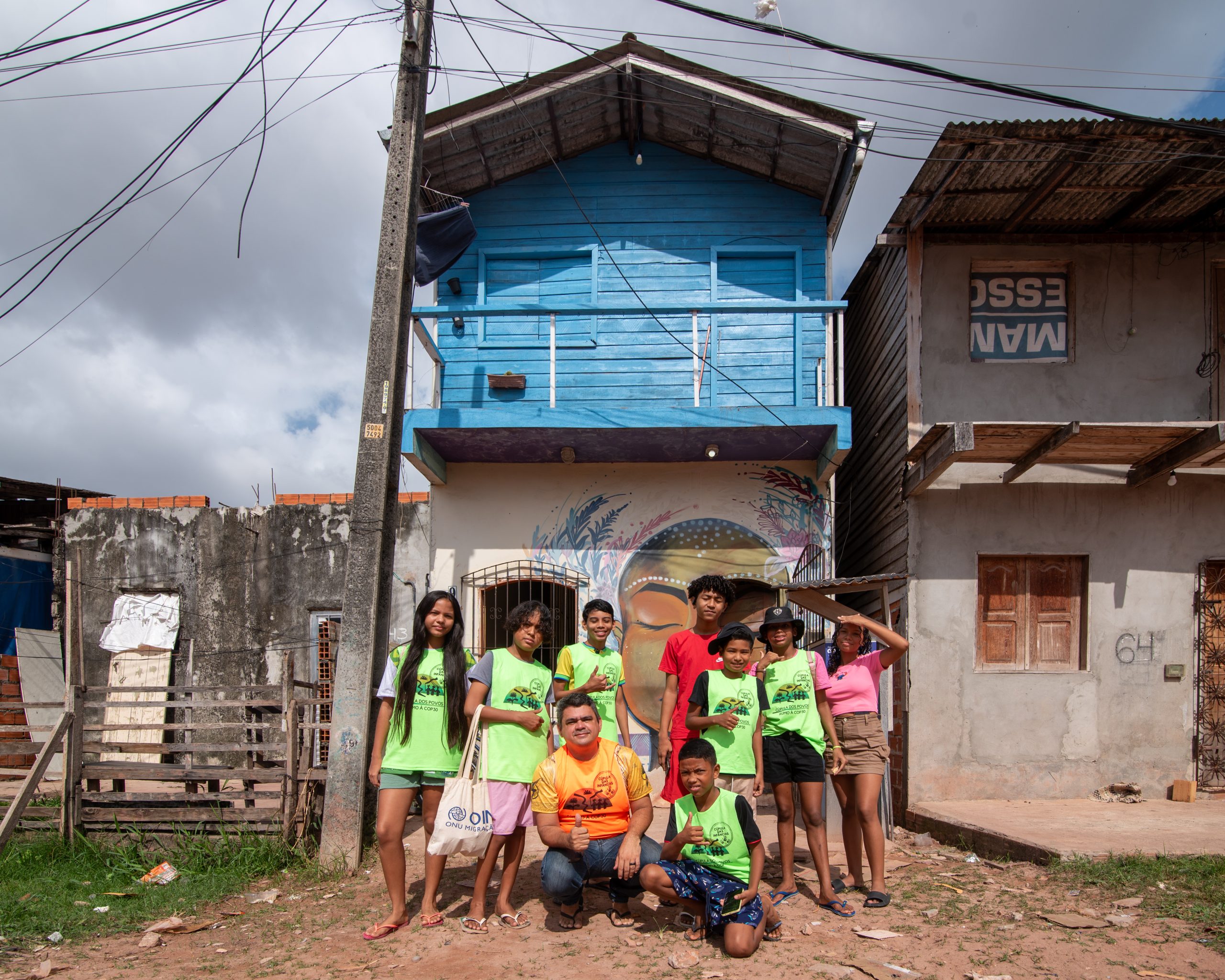
Every child and teenager relates to their territory and has perceptions about the environmental issues that surround them. RioOnWatch interviewed two children living in Terra Firme, a favela in Belém, who participated in the Children’s Summit.
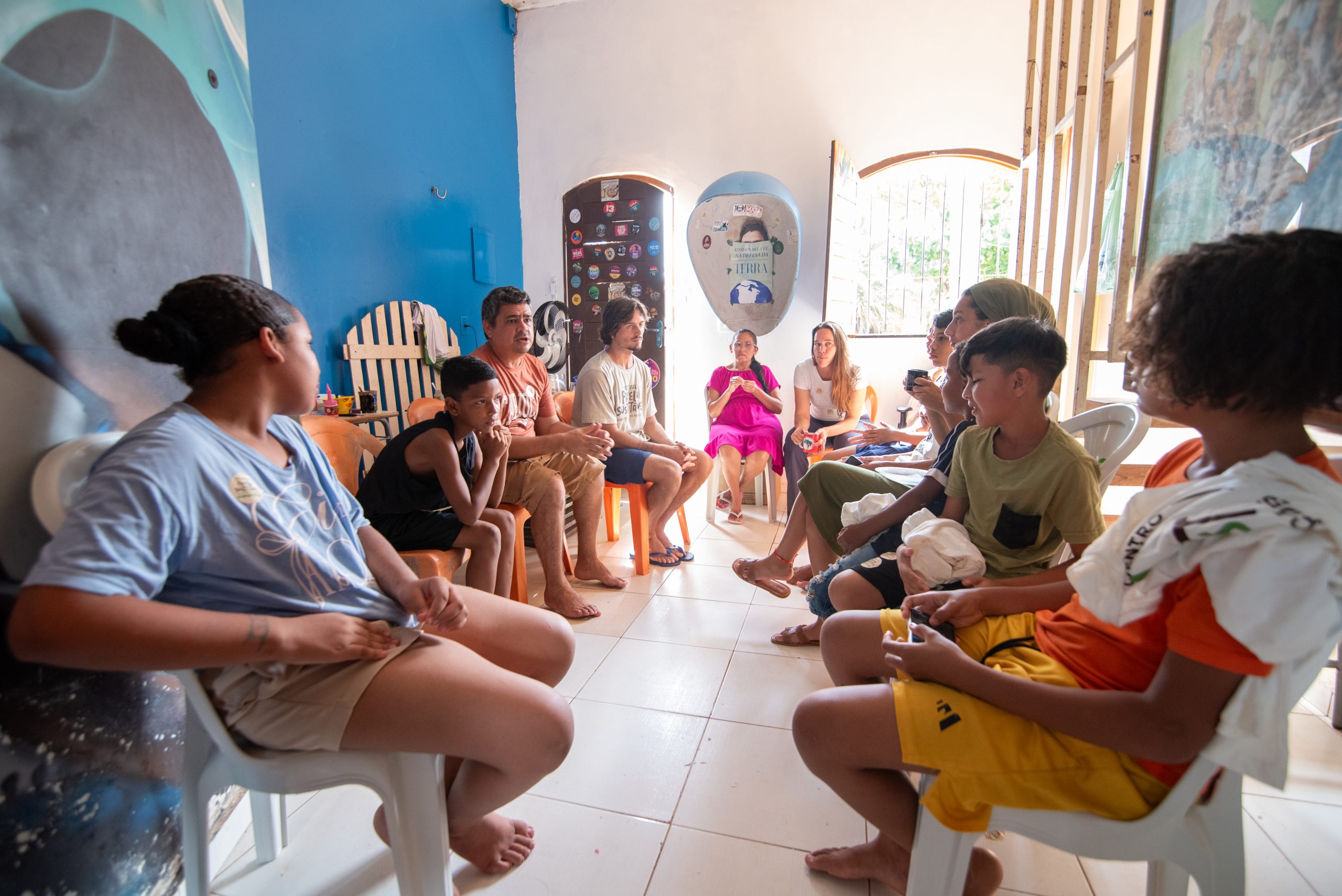
In total, ten children and teenagers assisted by the Peace Chalet—a space for connection, experiences, culture and art in Terra Firme—participated in the Children’s Summit. In addition to participating in cultural events, panels and other activities, they came together to express their views on decisions that affect their future. The result was the Children’s Letter at the 2025 People’s Summit, delivered to Brazilian government ministers and the COP30 presidency.
Watch the Reading of the Children’s Letter at the Closing of the People’s Summit:
Carlos Davi Ferreira dos Santos, a 12-year-old student, was happy to reach such influential people through the Children’s Summit. The boy’s testimonial shows how important it is that youth occupy political spaces and take part in decision-making processes, especially on issues that directly affect them.
“It was really good to reach such important people. The Summit was a great experience and learning opportunity. I wrote that bridges need to be improved to make it easier for cars and motorcycles to get around. The trash problem should also be improved. I dream that the government will improve the streets, cause less destruction, take better care of trash and reduce the number of wildfires.” — Carlos Davi Ferreira Santos
Santos and Maria Sofia Marciel Rodrigues delivered the Children’s Letter at the People’s Summit to Ambassador André Correa do Lago, president of COP30; Ana Toni, CEO of the Conference; Minister of the Environment and Climate Change Marina Silva; Minister of Indigenous Peoples Sônia Guajajara; and Minister of the General Secretariat of the Presidency Guilherme Boulos.
Rodrigues, also a 12-year-old student, said that her participation in the Children’s Summit was a great learning experience.
“It was great, we learned very interesting things for us as children, and we played… at the same time. It’s important that we participate in these moments, because there are many adults who say that children can’t participate in these things… It’s clear [that children need to participate], because it’s children who feel it most. I dream that there will be more trees, that the world will be cleaner, mainly the rivers and that we stop deforestation.” — Maria Sofia Marciel Rodrigues

Francisco Batista, founder of the Peace Chalet and of the Terra Firme Collective, a Terra Firme community leader, explained how the youth of the Peace Chalet took part in the process.
“We were at the Children’s Summit from (November) 12 to 16, with a group from the Peace Chalet who participated in several moments, two of them particularly important: the process of drafting the Children’s Summit Letter and the delivery of this letter to the authorities. It was Sofia and Davi who went on stage, but the rest of the group was also there to witness the moment. So, the children of the Chalet contributed to the letter drawing on their own reality. We’re here in Terra Firme, one of the least green areas of Belém, which experiences socio-spatial segregation. It’s a struggle to live here. And this generation, this new generation, is doing its part. And that’s very important. It’s a lesson for adults who are complacent. Children are voicing their outcry to create a better world, with climate justice and without environmental racism.” — Francisco Batista
From Rio to Belém, Children Send Their Message at COP30
In Barra de Guaratiba in Rio de Janeiro’s West Zone, children of the Quintal das Pedrinhas Miudinhas (Yard of the Little Stones) were very active before COP30. They ran the pré-COPzinha (the little pre-COP30), an activity geared toward showing the importance of COP30, the official meeting of global leaders. The pré-COPzinha started as a space for children and youth to understand these discussions, reflect on their territory and participate in the creation of environmental solutions.
Iyá (Priestess) Katiuscia de Yemanjá, one of the leaders of Terreiro Òbá Labi, the Candomblé temple that created Quintal das Pedrinhas Miudinhas, attended COP30. She took with her a video in which children who participated in the pré-COPzinha sent their message during the panel discussion on Black women and traditional knowledge in confronting the climate crisis, which took place on November 15 at the Círculo dos Povos in the COP30 Green Zone.
“I presented the Quintal das Pedrinhas Miudinhas, which is a traditional environmental education project for a future with climate justice originating from the traditional Black community of Terreiro Òbá Labi, located in the far West Zone of Rio de Janeiro.” — Iyá Katiuscia de Yemanjá
Ver essa foto no Instagram
COP30 Had a Youth Day
2025 is the first year in which children and youth took part with significant presence—and were actually heard—at a Conference of the Parties. Children were mentioned across different areas:
- Just transition: youth participation, the right to a healthy environment, and the value of education;
- Adaptation: recognizing children as agents of climate adaptation, with a focus on equity and human rights;
- Technology: attention to the specific needs of children in climate technologies; and
- Action agenda: initiatives related to education, health, school meals and protection from extreme heat.
In total, there were 19 direct references to children and youth, an increase that reinforces the view that climate decisions need to include those who represent 1/3 of the world’s population, most of whom live in the Global South. This progress was made possible thanks to a global effort by young people participating in the MiniCOPs, a methodology that promoted intergenerational dialogues in ten countries, produced letters delivered to world leaders and enabled the unprecedented presence of many children and adolescents at the COP. As a result, COP30 accredited 170 children and brought together over 40 of them for an exchange with adults, an unprecedented event.

Imagining New Worlds
Be it in the official spaces of COP30, at the People’s Summit, or in their own territories, children and youth should be given the possibility to imagine new worlds, as Indigenous leader and activist Ailton Krenak invites us to in his book Life Is Not Useful.
For Carla Souza, a master’s student in the Graduate Program in Education (ProPed) at the State University of Rio de Janeiro (UERJ), researcher on the relationship between children facing social vulnerability and nature and founder of the Ẹbí Project, children must be guaranteed the right to exercise their imaginations.
“Worlds must be imagined based on the worlds that are already offered to children. From what perspective do we view these childhoods? How do we recognize their interactions with the spaces they inhabit? Where do the desires and expectations we project for the future come from?” — Carla Souza
Read the Full Text of the Children’s Letter (in Portuguese) Produced by 600 Children at the 2025 People’s Summit:
Good Living and Climate Justice:
Only with the Participation of Children and Adolescents!
Belém – Pará – BrazilWe are children and adolescents from many places in Pará, the Amazon,
and other parts of Brazil and the world. We come from hot places, crowded neighborhoods, islands,
riverside communities, Indigenous and quilombola territories, large cities,
humble homes, and schools that do not always have shade and ventilation.We came together at the Children’s Summit to discuss an issue
that affects our lives every day: THE CLIMATE.We decided to write this LETTER because we want the world to hear our voice;
and what we feel in our bodies and in our daily lives!The heat is really intense. Seriously. Some days we get headaches,
feel dizzy and almost faint.There are children who can’t play out in the sun, who study in hot classrooms,
or who walk on dusty streets. There are schools that don’t have trees to provide shade.
There are neighborhoods where the wind hardly ever blows.WE FEEL SADNESS WHEN WE SEE:
Trees falling
Smoke from wildfires
Rivers full of trash
Animals suffering
The forest shrinking
People getting sick from heat and pollution.ALL OF THIS MESSES WITH US!
It messes with us so much that some of us drew what we feel:
Big colorful trees, children playing under the sun, blue rivers, birds flying,
houses surrounded by plants, forests on fire, signs saying “TAKE CARE OF NATURE.”
These drawings are a way of saying what our mouths cannot.WHY DO WE CARE ABOUT THE CLIMATE?
We care because NATURE is our home and much more… We are nature,
the planet is nature. Nature is everything!
We are very young and want a BEAUTIFUL FUTURE to live in,
but we also want it NOW!
We want to keep studying, playing soccer, playing, planting, swimming, going to places we like.
We want animals and forests to keep existing!AND WE SAY:
The death of the FOREST is the end of our lives
You cannot SHOOT AND KILL ANIMALS
Heat affects people’s HEALTH
Without nature, there is no HUMANITY
We breathe the AIR of forests and rivers
Climate change makes CHILDREN SICK
We have to care for and protect the AMAZON
We want to PLANT more trees
We CARE because we live hereALL OF US AGREE ON ONE THING:
We don’t want to grow up in a destroyed world!
We aren’t asking, but demanding our rights.
We want you to take care of the planet as if it were a child—alive,
needing attention!HERE ARE OUR PROPOSALS:
We have to plant more trees, lots of trees everywhere
Stop deforestation and burning
Have places to dispose of trash properly
Clean up rivers and seas and protect fish
Take care of animals that are losing their homes
Teach about the environment in schools with practical activities and well-trained teachers
Make the environment part of the health policy
Listen to the communities that live in the forest
Real participation of children and adolescents in political decisions
Adults must do their part because we are doing ours.Adults should listen to children—
BECAUSE WE ARE TOLD TO SHUT UP WHEN WE TRY TO SPEAK.WHY DID WE WRITE THIS LETTER?
Because we believe that our voice needs to reach the whole world.
COP30 is big and so is our hope!
We don’t have power, money or important positions,
But we have the FUTURE AND THE PRESENT!WE DEMAND
Help to protect the Amazon
To care for the Earth
So that the future CHILDREN AND ADOLESCENTS aren’t scared of the heat,
of the smoke, of the lack of water and of animal extinction
So that they can draw living forests—not dying ones.We are many: children and teenagers from ages zero to 17.
Each of us different, with our own drawing, our own words, our own dreams.
But all of us with the same GOAL!Take care of our planet now. We want to stay alive!
We want to grow up in a beautiful world, in a world that is still breathing.
With hope and without fear!Children and Adolescents of the Children’s Summit
Belém, November 15, 2025
About the author: Bárbara Dias was born and raised in Bangu, in Rio’s West Zone. She has a degree in Biological Sciences, a master’s in Environmental Education, and has been a public school teacher since 2006. She is a photojournalist and also works with documentary photography. She is a popular communicator for Núcleo Piratininga de Comunicação (NPC) and co-founder of Coletivo Fotoguerrilha.