
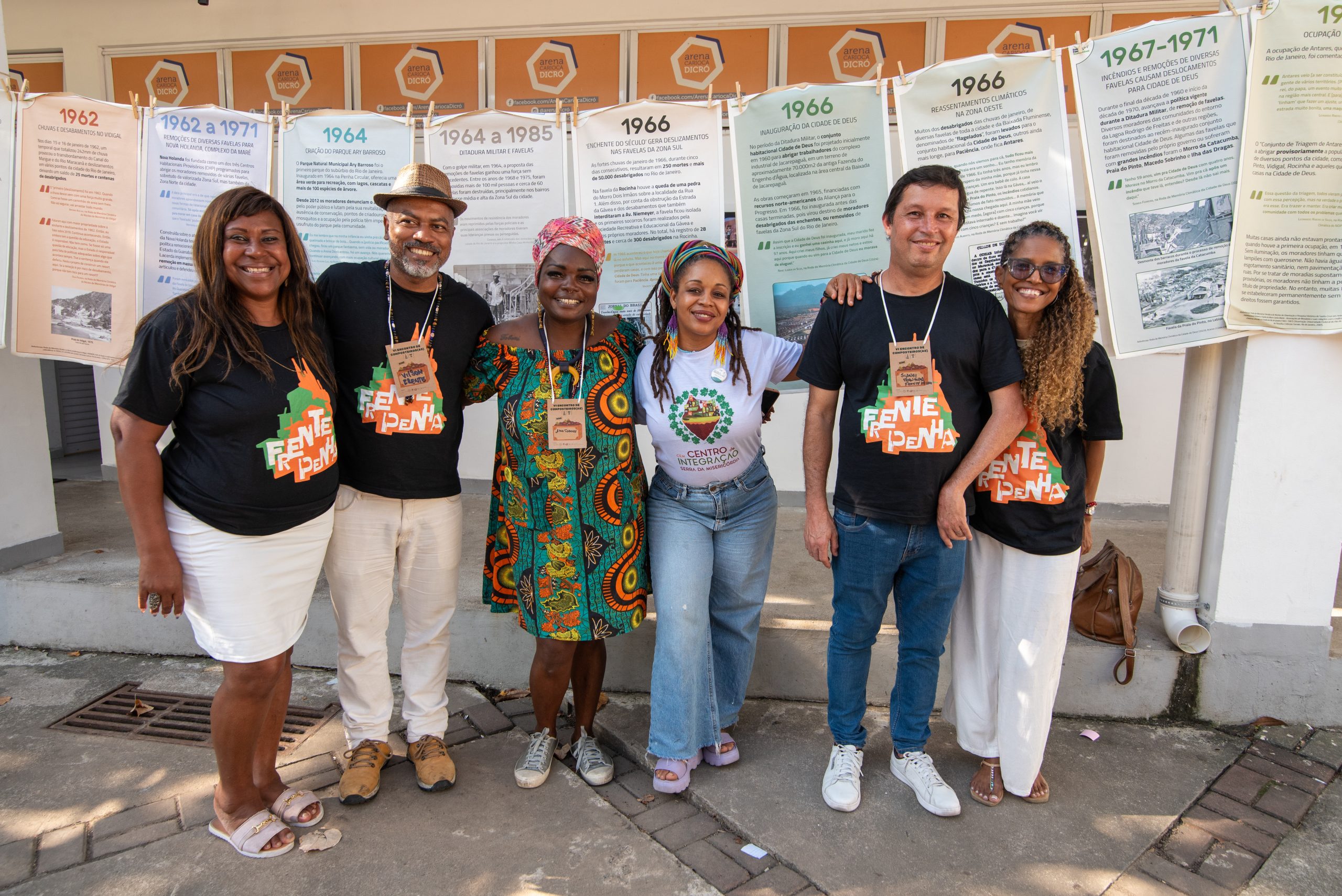

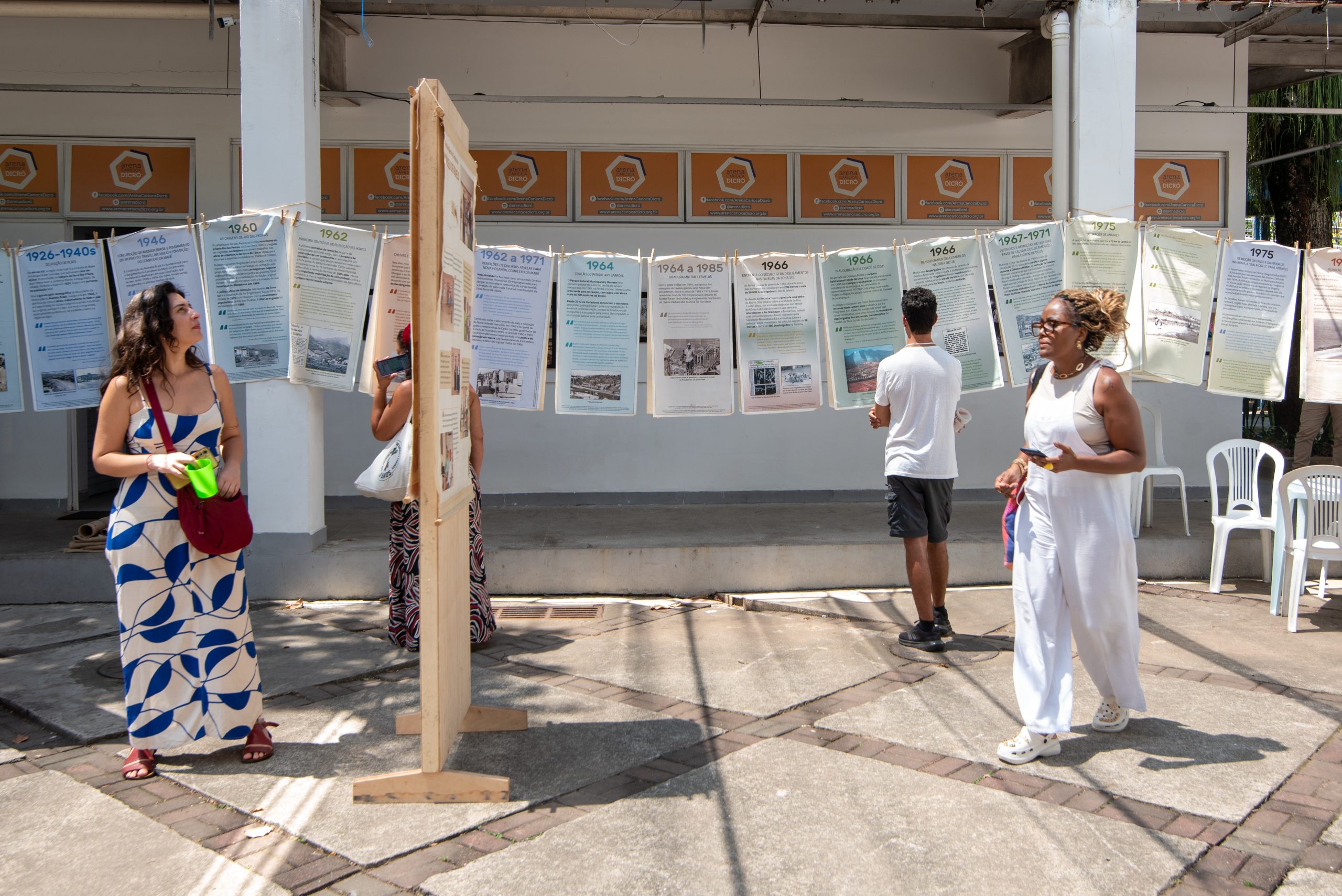
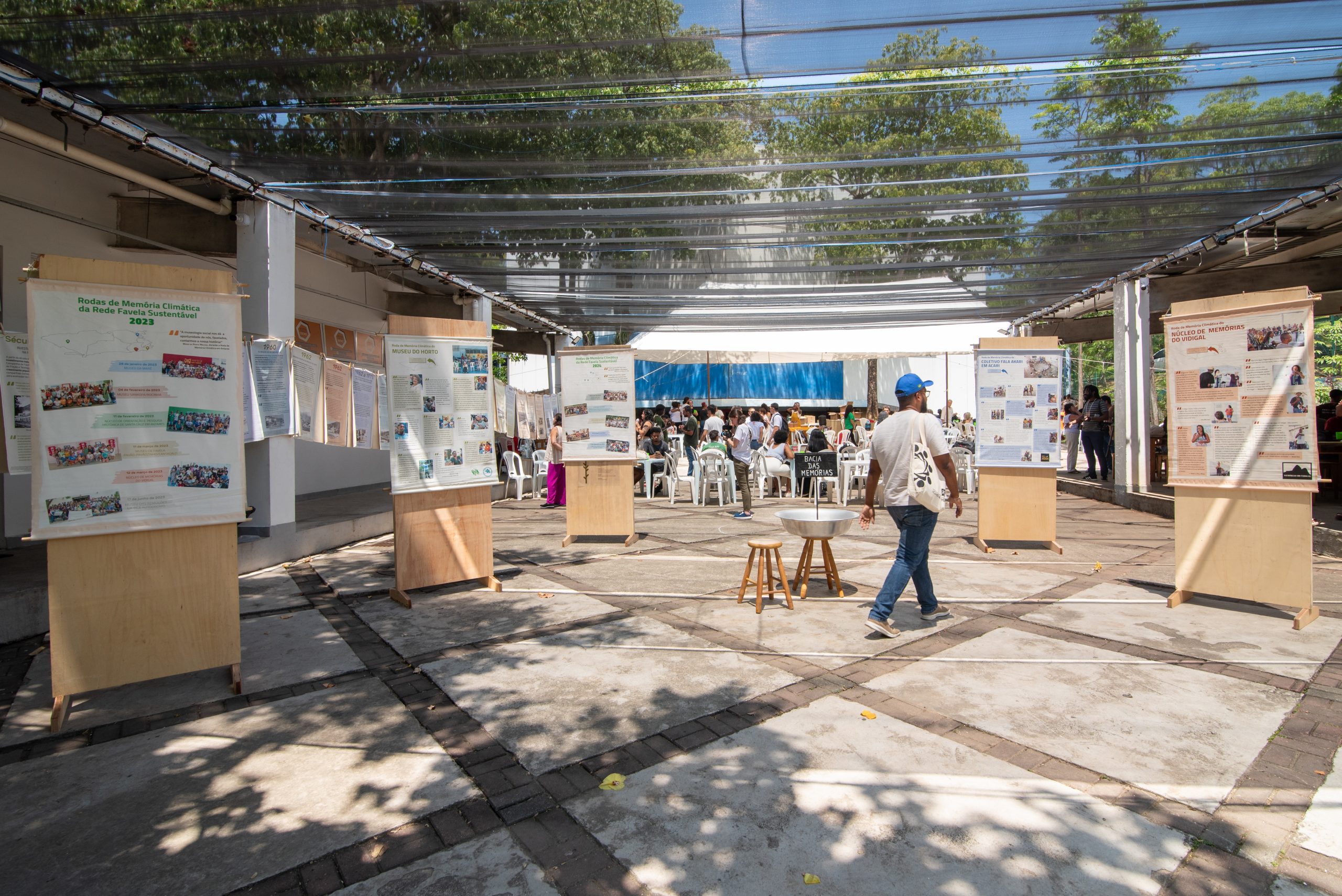
In December, Complexo da Penha, in Rio de Janeiro’s North Zone, hosted a number of community-run events just weeks after Rio de Janeiro’s deadliest police massacre took place in the same set of communities. On December 5 organizers held the 6th Annual Composters’ Meet-Up and the latest annual Favela Health Meet-Up, at the municipal cultural center, Arena Dicró, where they also had the Favela Climate Memory exhibition on display. Over several weeks, the exhibition, organized by Rio’s Sustainable Favela Network (SFN)*, circulated across the favela complex, with a schedule of activities that began on November 24 at the Brant Horta Municipal School, featuring a discussion circle that engaged students. The closing took place on December 10, at Praça do Mineirinho, in Vila Cruzeiro, with activities open to the public.
At the December 5 event, Ana Santos, from the Serra da Misericórdia Integration Center (CEM) and the Frente Penha collective, responsible for organizing the Penha Climate Memory Circle featured in the exhibition, explained how the day’s program was conceived.
“Penha is hosting this major exhibition for the first time. It was featured as part of our local school’s educational content, which has been working on issues related to the river, the ‘valão’ [river-turned-sewage ditch], climate issues and Ary Barroso Park. So we had to take the exhibition into the school, to youth and families, so that, beyond sharing with Penha residents broadly, we recognize youth who are building a territory of well-being. Today, we were at Arena Dicró, which originally hosted our Climate Memory circle. The arena is located inside Ary Barroso Park, a conservation unit. So why not have this exhibition alongside the annual Composters’ and Favela Health Meet-Ups?
In a single day, we managed to bring together groups from different favelas that work on environmental issues through composting. We know that waste—what many people call trash—is one of the major problems, and it came up repeatedly, including in our Penha Climate Memory circle. But today, we only spoke about solutions, climate solutions in the favela. I’ve been part of the Sustainable Favela Network since the beginning, and I find it extremely satisfying to be engaged in this debate and, above all, in this entire visual experience, which not only places Penha at the center of things but also brings in all the other favelas. On December 10, Human Rights Day, this exhibition will be out there, in Vila Cruzeiro. And it’s also a matter of reparations, after the massacre that took place here. What we want to see in Vila Cruzeiro aren’t bodies taken from the ground: it’s our memories, our stories, recognition of the people here constantly creating solutions to live better and build well-being as a network.” — Ana Santos
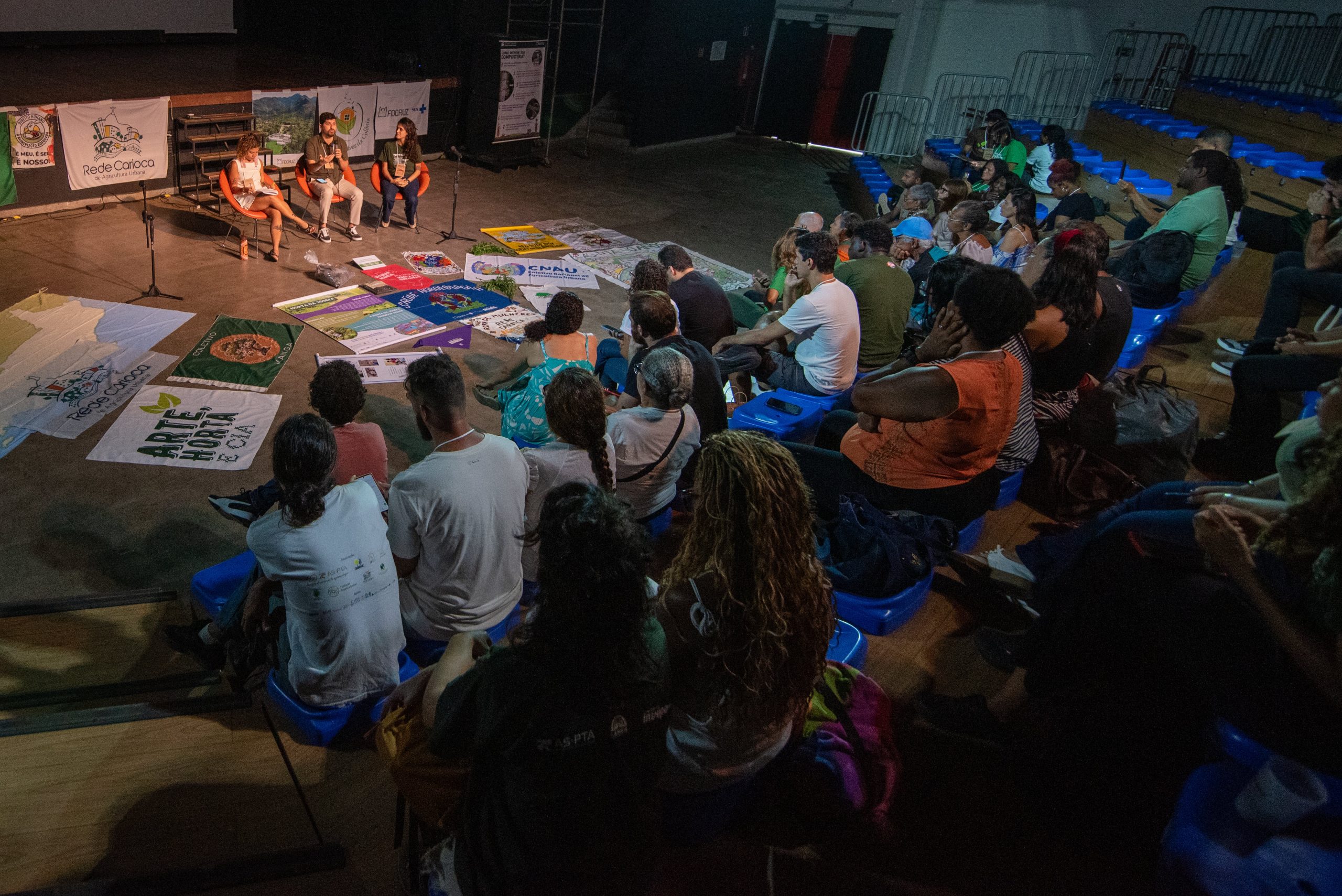
The 6th Composters’ Meet-Up began in the morning with a discussion circle mediated by Paulo Monteiro, with Felipe and Davi Apolinário, from the Family Compost collective, and Rose Trovão, from CEM, who shared experiences of favela community composting. Rose Trovão spoke about the composting project currently being carried out in Terra Prometida, a relatively young favela where CEM is located.
“We started out a short time ago; it’s been six months since the first compost was ready, and we used it in our own vegetable garden with the children. In the future, the next batches of compost will work like a currency: people bring their waste and take a certain amount of compost. [They can] bring [organic] waste, cooking oil too, so we can make soap, and get a kilo or two of compost.” — Rose Trovão
During the event’s second panel, city councilors William Siri and Maíra do MST discussed the importance of public policies for strengthening composting and detailed steps toward developing supportive legislation. According to William Siri, a report prepared by his office, focusing on the West Zone, showed that over 40% of waste generated is organic. In this context, a Composting Program is being developed with the support of other councilors, including Maíra do MST.
“It’s essential that we build collectively because we know that it’s the front lines in favelas that are taking concrete action, even stepping in for the state, which seldom—or almost never—provides opportunities for these public policies to be implemented… We are part of the City Council’s Food Security Committee, and I believe that it is from the perspective of food security that we join this fight for composting. I think Rio de Janeiro has very interesting experiences: here we have partners from Compostaê, the Angélica Goulart Foundation and our partners from CEM.” — Maíra do MST
After lunch, participants from the morning event headed to Serra da Misericórdia, where they visited CEM and learned about its initiatives in composting and agroforestry. Meanwhile, at Arena Dicró, between the morning and afternoon, visitors explored the Favela Climate Memory exhibition, where they learned about residents’ memories of climate in the ten Rio favelas that created the exhibition.
Vilson Luiz, from the Frente Penha collective, which also organized the Penha Climate Memory Circle on display in the exhibition, highlighted how positive it was to bring the installation back to the community. According to him, the exhibition “gives a sense of satisfaction” about the process that was built by residents.
“We’re often in the favela and people take pictures of us, ask questions and then don’t come back to show us what was developed from that. So it was great at the school because we were able to show this to the children: the power of the favela. Today we return here to Arena Dicró with another event to present the exhibition and let people grasp the entirety of what was collected—everything that was produced and that is being presented. This is about Penha, it’s about favelas and about imagining what we can also do in a favela… talking about memory and showing that favelas have a memory, that their communities have a memory. And we’re not just talking about ours; we’re talking about all favelas. And understanding that all favelas are connected in a network.” — Vilson Luiz
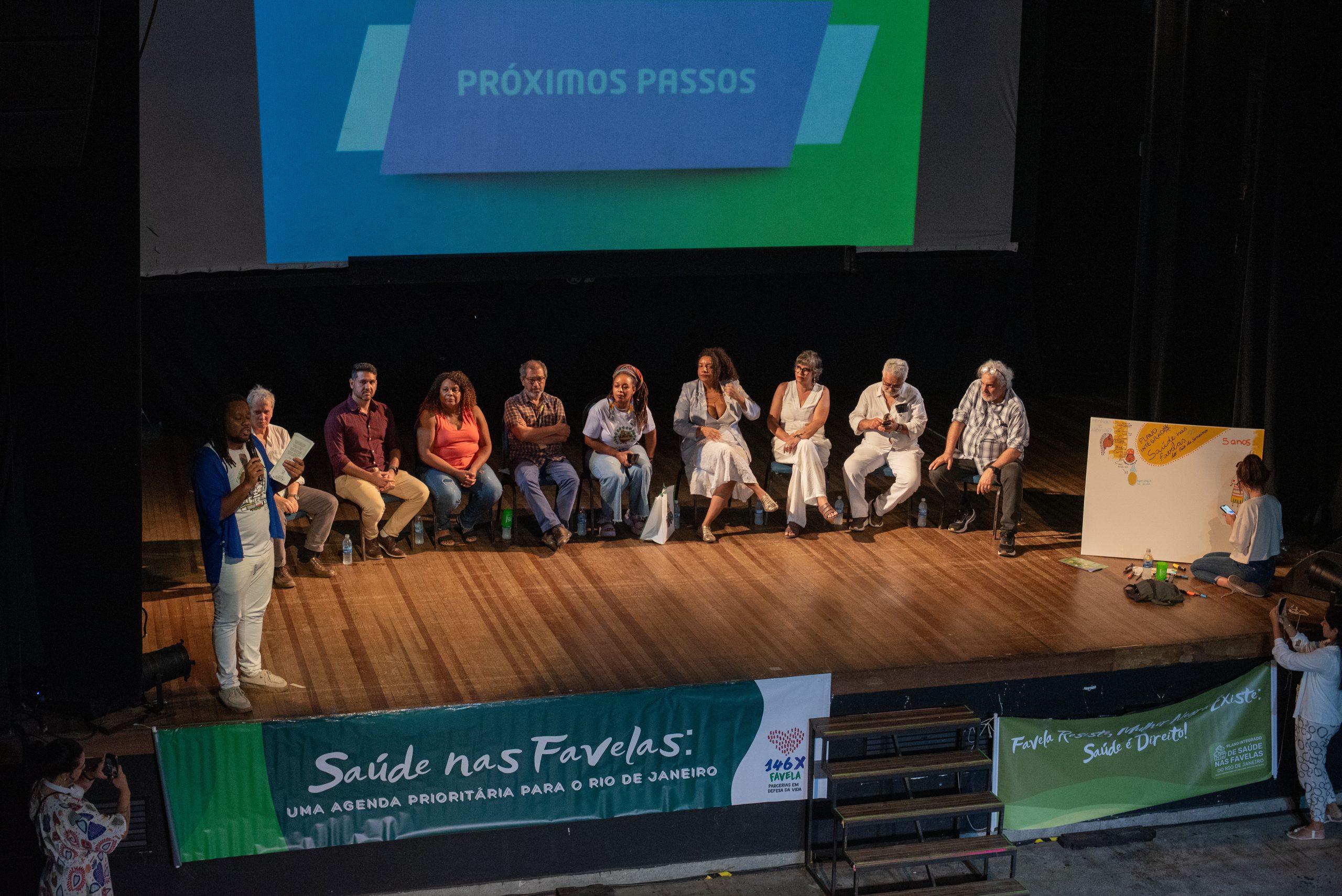
Later in the afternoon, the Annual Meet-Up of Rio’s Integrated Favela Health Plan took place, during which data on actions carried out in the state’s favelas were presented. The choice of venue was symbolic, as the event united organizations operating across the state, including in Complexo da Penha, which will be facing the impacts of the recent massacre—in which 121 people perished—for years to come.
Legislators such as State Deputy Renata Souza were there: she commented on initial results from the state’s health plan.
“We’ve seen very important results, with around one million people directly impacted by the Integrated Favela Health Plan: 176 favelas served across 33 municipalities in the state of Rio de Janeiro. It makes a difference when we ensure that public policies and budgets reach who they’re meant to. So, here we are in Complexo da Penha, where a massacre took place, which is the politics of death, necropolitics. What we do with the Integrated Favela Health Plan is the politics of life, ensuring the possibility to dream, hope and overcome social inequities.” — Renata Souza
Sidnei Fernandes, another member of the Frente Penha collective and participant in the Memory Circle that gave rise to the exhibition, stated that having it set up in the area reinforced residents’ sense of belonging.
“This place [Ary Barroso Park] is important to me, as a person with a disability: I couldn’t walk or talk, so my friends used to carry me here… Participating in the Climate Memory circle here [in the park], being a resident and knowing the importance of this place… [And now having this exhibition back here,] it’s affective memory: the memory of being here and seeing this exhibition here. For me, it’s a memory of territoriality, of belonging, because [it’s moving] when you’re in a place where you grew up, that you frequented and you see all this. Going to the [exhibition launch] in Maré, participating there, seeing the whole project there as well, also [taking it there] to that favela, [we grasped] the importance of the land, of the environment, of this climate memory. Seeing [the exhibition] here is a joy, an achievement of belonging.” — Sidnei Fernandes
The Favela Climate Memory exhibition, the 6th Composters’ Meet-Up and the Annual Favela Health Meet-Up—all held in Complexo da Penha—reaffirm the importance of community organizing as a driving force that cares, transforms waste into potential, promotes health and builds memories about the favela. Favelas have memories and are capable of generating multiple solutions to everyday challenges, with creativity, self-management and solidarity.
View the Full Photo Album of the ‘Favela Climate Memory’ Exhibition in Penha:

*The Sustainable Favela Network (SFN) and RioOnWatch are both initiatives of not-for-profit organization Catalytic Communities (CatComm). The ‘Favela Climate Memory’ exhibition brings together 1,145 testimonials from 382 residents of ten favelas across Rio de Janeiro, collected and analyzed over three years, produced through a collective oral history project. The exhibition was developed by eleven museums and favela memory collectives that are members of the SFN: the Maré Museum (Complexo da Maré favelas), the Sankofa Museum (Rocinha favela), the Historic Orientation and Research Nucleus of Santa Cruz (organizer of the Antares climate memory circle), the Favela Museum (Pavão-Pavãozinho/Cantagalo favelas), the Vidigal Memories Nucleus (Vidigal favela), Alfazendo (City of God favela), the Serra da Misericórdia Integration Center (Complexo da Penha favelas), the Horto Museum (Horto favela), Fala Akari (Acari favela), Conexões Periféricas (Rio das Pedras favela), and the Evictions Museum (Vila Autódromo favela).
About the author: Bárbara Dias was born and raised in Bangu, in Rio’s West Zone. She has a degree in Biological Sciences, a master’s in Environmental Education, and has been a public school teacher since 2006. She is a photojournalist and also works with documentary photography. She is a popular communicator for Núcleo Piratininga de Comunicação (NPC) and co-founder of Coletivo Fotoguerrilha.