
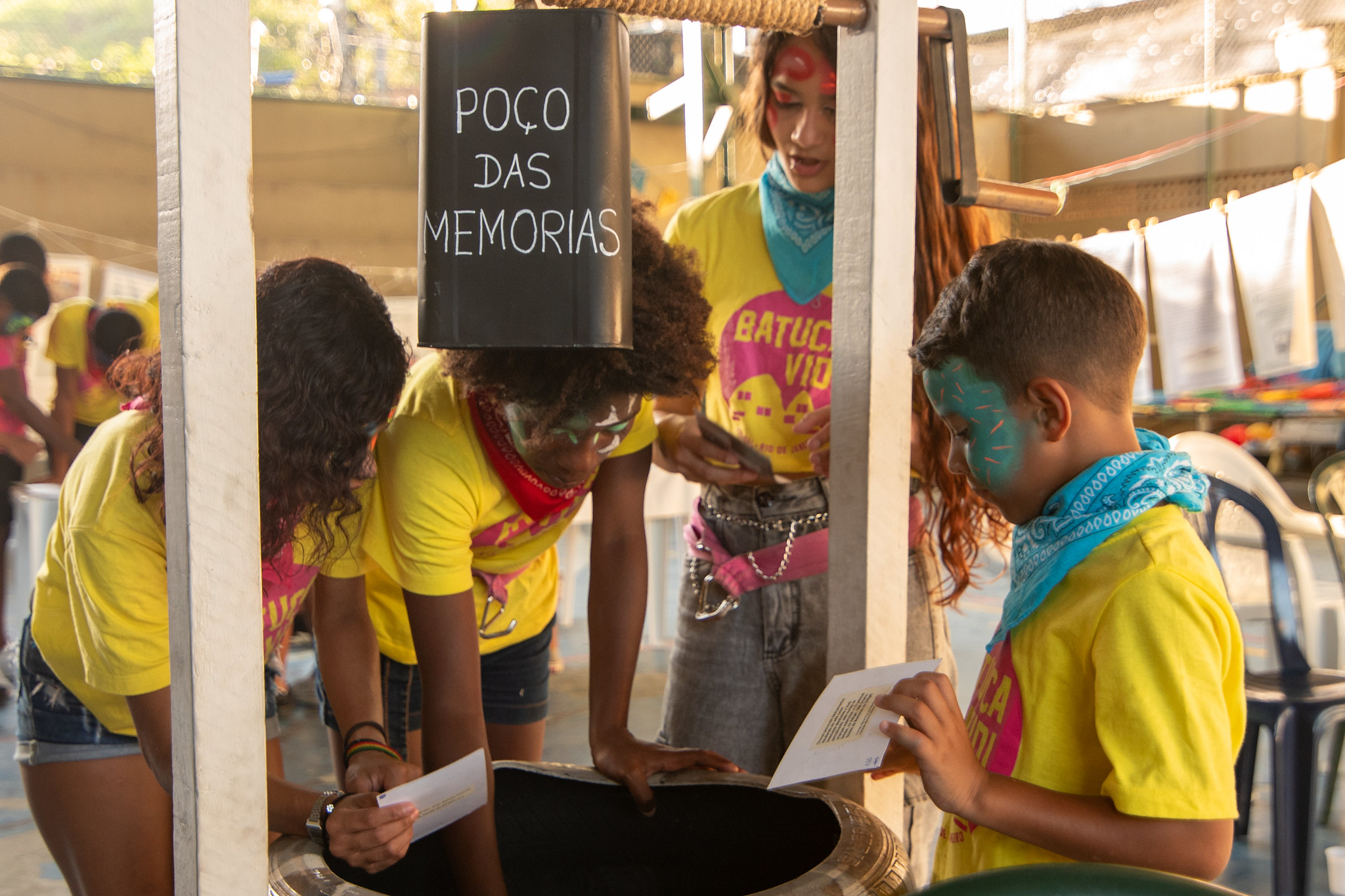

On October 26, Vidigal, a favela in Rio de Janeiro’s South Zone, celebrated its 85th anniversary. Organized by the Vidigal Memories Nucleus, the celebratory event featured the Favela Climate Memory exhibition, a discussion circle, the presentation of the Commander Armando Almeida award, a capoeira circle performed by groups Laje Cultural Rocinha and Acorda Capoeira, “Vidigal Memories Told as Cordel Literature,” a “Vidigal in Poetry” activity and musical performances by groups Vidiga na Social and Batuca Vidi. The day of activities also featured cultural and artistic presentations as well as contributions from local personalities, collectives and social projects that transform the Vidigal community.
The Favela Climate Memory exhibition, a result of discussion circles developed and carried out by ten museums and memory project members of Rio’s Sustainable Favela Network,* has recently circulated through the Maré, Acari, City of God and Rio das Pedras favelas. Bárbara Nascimento, born and raised in Vidigal and co-founder of the Vidigal Memories Nucleus, which organized the community’s discussion circle reflected in the exhibition, introduced and mediated an exchange inspired by the showing.
“Today we’re going to talk about our memories of Vidigal, relating them to climate, which is a common issue to all favelas. Anyone who has seen the exhibition can see this, because [the climate issue] is either [used as] an excuse to evict us, or it evicts us anyway, because of tragedies and calamities. So, I invite everyone here to speak.” — Bárbara Nascimento
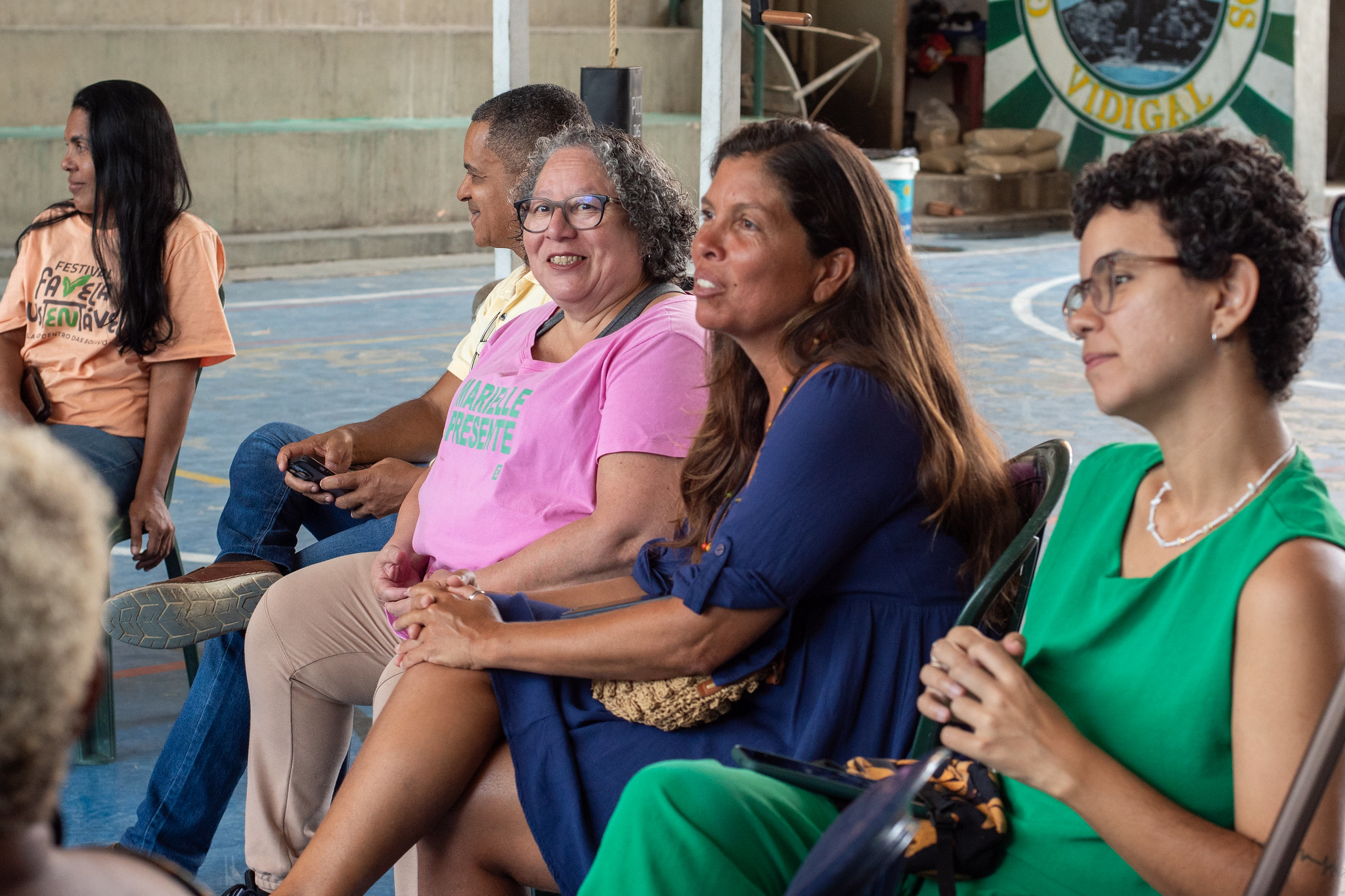
Guti Fraga, born and raised in Vidigal and founder of the multi-decade “Nós do Morro” theater group, was honored at the event. He shares his perspective on the changes that have taken place in Vidigal over the years.
“Those of us who are from Vidigal have memories and feel a longing, don’t we? We really do! We miss so many things. I’ve been reminiscing… And all the great moments we lived here in Vidigal keep coming to mind. One of the funny things I always say is that I remember when I used to go play pool in Largo do Santinho. We’d look at Avenida Niemeyer and stop a little to enjoy the view from the rock, right? The other side was all forest. When talking about the environment, imagine, it was all forest. There was only one house, which belonged to Cabeça, who lived over there. As we see Vidigal’s evolution, on the one hand we are filled with this enormous longing, but on the other, we can’t really escape the Vidigal of today, a Vidigal that also makes us proud. Seeing these fighting, resilient people and who are still so young, it fills us with pride.” — Guti Fraga
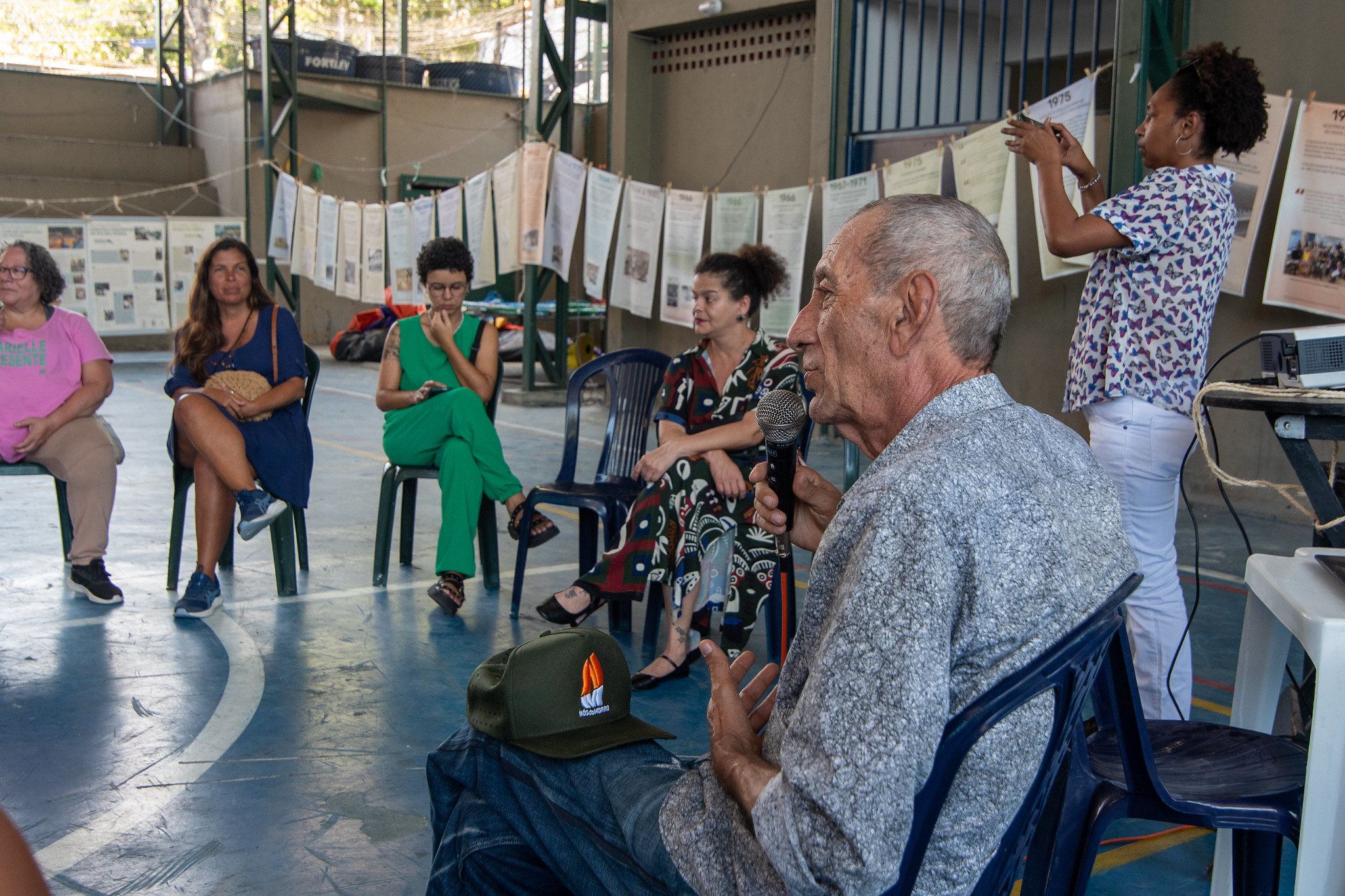
Osias Peçanha, another resident of Vidigal, lawyer and doctoral student in the Social Sciences, analyzes the importance of preserving memories and fighting against forced evictions, recalling the protest that closed Avenida Niemeyer in the 1970s.
“Memory is important, both for the good and the bad moments, so that they don’t repeat themselves. What happened to the enslaved and formerly enslaved Black people? They burned our memories. I’d like to know what tribe I came from, my mother came from, my grandmother who came here, one of the first families to come to Vidigal. Memory is very important. Those who make History, those who were part of it. For example, those here in Vidigal who were part of the resistance, the teachers who took the students to close off Niemeyer [so eviction trucks couldn’t get through].” — Osias Pecanha
During the discussion circle, the group recalled the impacts of rains and landslides in Vidigal. Resident Maria Custódia, known as Bigu, remembered these events and their impacts.
“In 1996, the people up at the top [of the hill] would say ‘come on, so and so,’ calling their neighbors, ‘come on, there are people buried,’ and people went down to help even before the firemen arrived. So, this unity we have here in Vidigal can’t be lost. Vidigal’s unity has to go on, because those arriving today don’t have love for our land, our roots, our seeds… And we, as long-standing residents, can’t lose this essence. Let’s make Vidigal’s stories visible, so that the people getting here now will respect them.” — Maria Custódia
Rita Machado, also a resident, recalled the 1970 evictions and the historic 1988 landslide as key events in the community’s history.
“Before the flood in 1996, there had been another big one… there was also a landslide up here in 1988… Many people were buried, many died… So, Vidigal has always gone through this because of its geography, these tragedies. I was looking at the exhibition and it’s really beautiful, really moving. Sometimes we’re unaware of the work we do over the course of a life… I understand that the important thing is for us to constantly revive our memory, because when you lose your memory, you lose your History, you lose your essence, and you become deterritorialized.” — Rita Machado
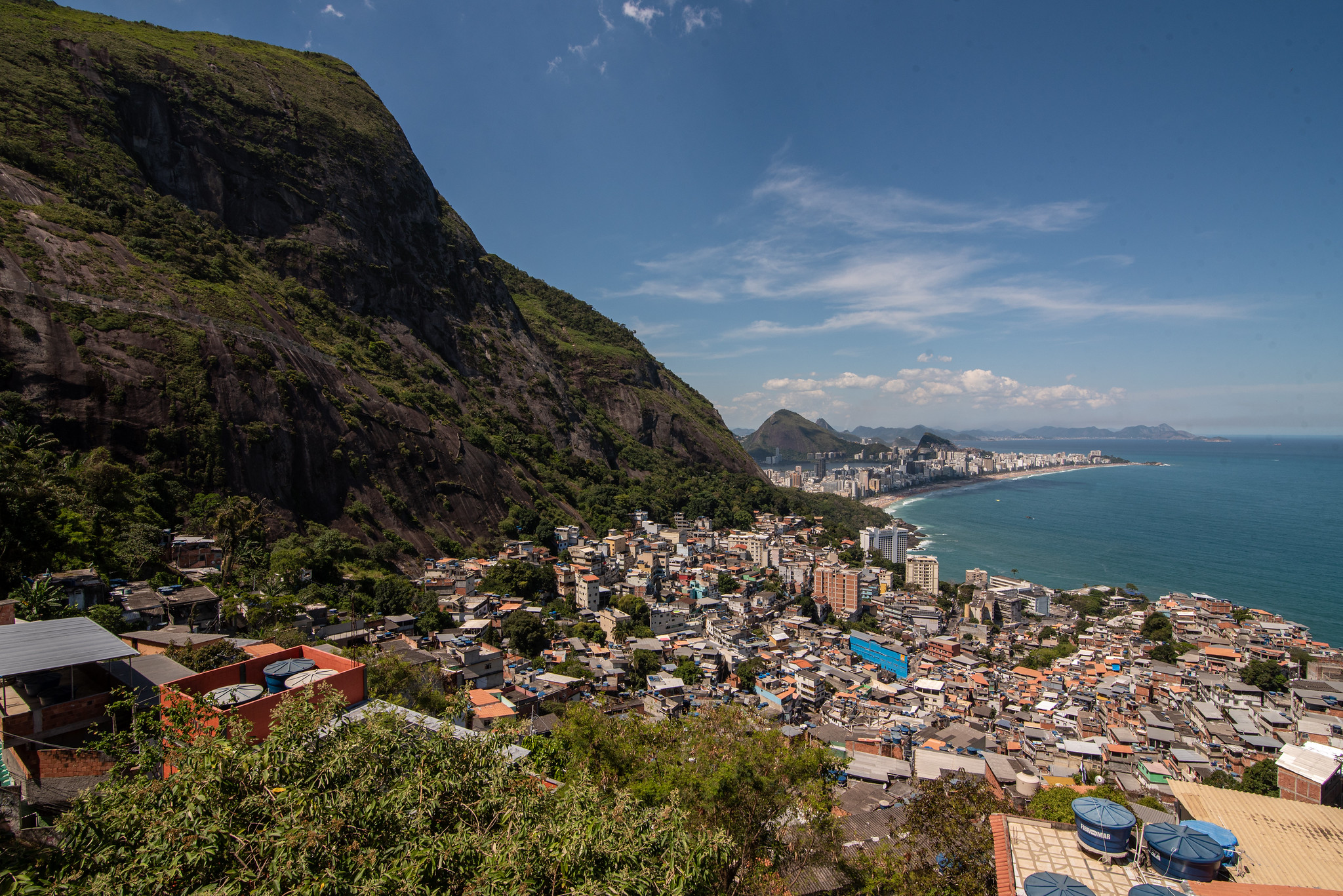
Simone Rezende is a resident of Santa Marta, another favela in the South Zone, in the neighborhood of Botafogo. As an elementary school teacher who worked in Vidigal, she recognizes the improvement in the favela’s conditions. However, she also questions the processes of touristification and gentrification in the community.
“Guys, I’m from the days of shacks, from the time when neighbors helped each other build their homes. We walked paths made of mud—that’s the time I’m from. So, [Vidigal] has evolved a lot, thank God, it’s improved a lot, but in other aspects, unfortunately… It’s really bad because people come up to the community to see the view, to see the beautiful, amazing spots in Rio de Janeiro, but they don’t know our struggle. If they at least knew our struggle, our history… I think tourism has to start telling the community’s history.” — Simone Rezende
Ana Lima, a tour guide born and raised in Vidigal, spoke about the importance of tourism being led by local guides who know the community’s history.
“My brother decided to open the first hostel in Vidigal. Some people here mentioned tourism, and I’m a local guide. It’s very important that those of us who are from the place be the ones guiding tourists… I tell the story of all these experiences, because I lived through all of this.” — Ana Lima
Evania de Paula is a visual artist and cofounder of the NGO Horizonte. Born and raised in Vidigal and currently living in Pedra de Guaratiba, she shares her views on the favela’s growth without the necessary infrastructure.
“When I came back, in 2021, as a researcher… I was terrified by how many people there were. I was scared by the level of verticalization the community had taken on. I think Vidigal is exhausted and, because of that, has been experiencing urban heat waves so frequently, and these impacts of climate change are directly linked to the lack of infrastructure. [Vidigal] hasn’t been able to keep up with the number of people and has become a tourist ‘hotspot’… but there has to be infrastructure [for them].” — Evania de Paula
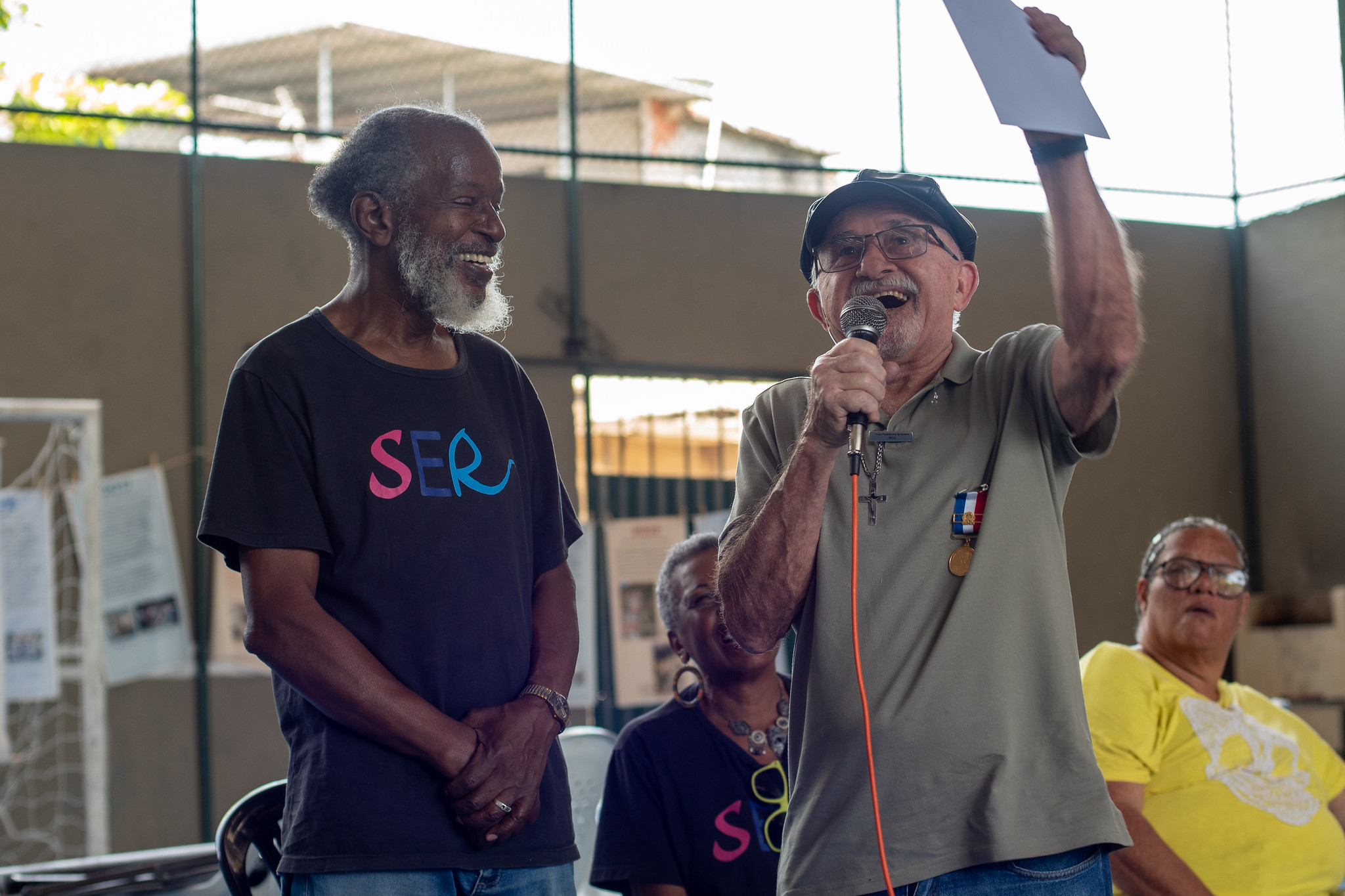
Armando Almeida Lima, known as Seu Armando, one of Vidigal’s longest-standing residents, shared how he, alongside others, created the Vidigal Residents’ Association (AMVV).
“I always say the Residents’ Association is my eldest child. I never gave up on it. It was founded in July 1967, with the participation of some residents who are no longer among us. It was created precisely to fight people who claimed to ‘own the area’ and wanted to remove us from here… Through this struggle, we were able to kick these supposed owners out, stop a forced eviction in the midst of the military regime and bring services to the community, which at the time was ‘all forest’… We managed to bring in running water, electricity, a health clinic, a headquarters for the association and paved roads.” — Armando Almeida Lima
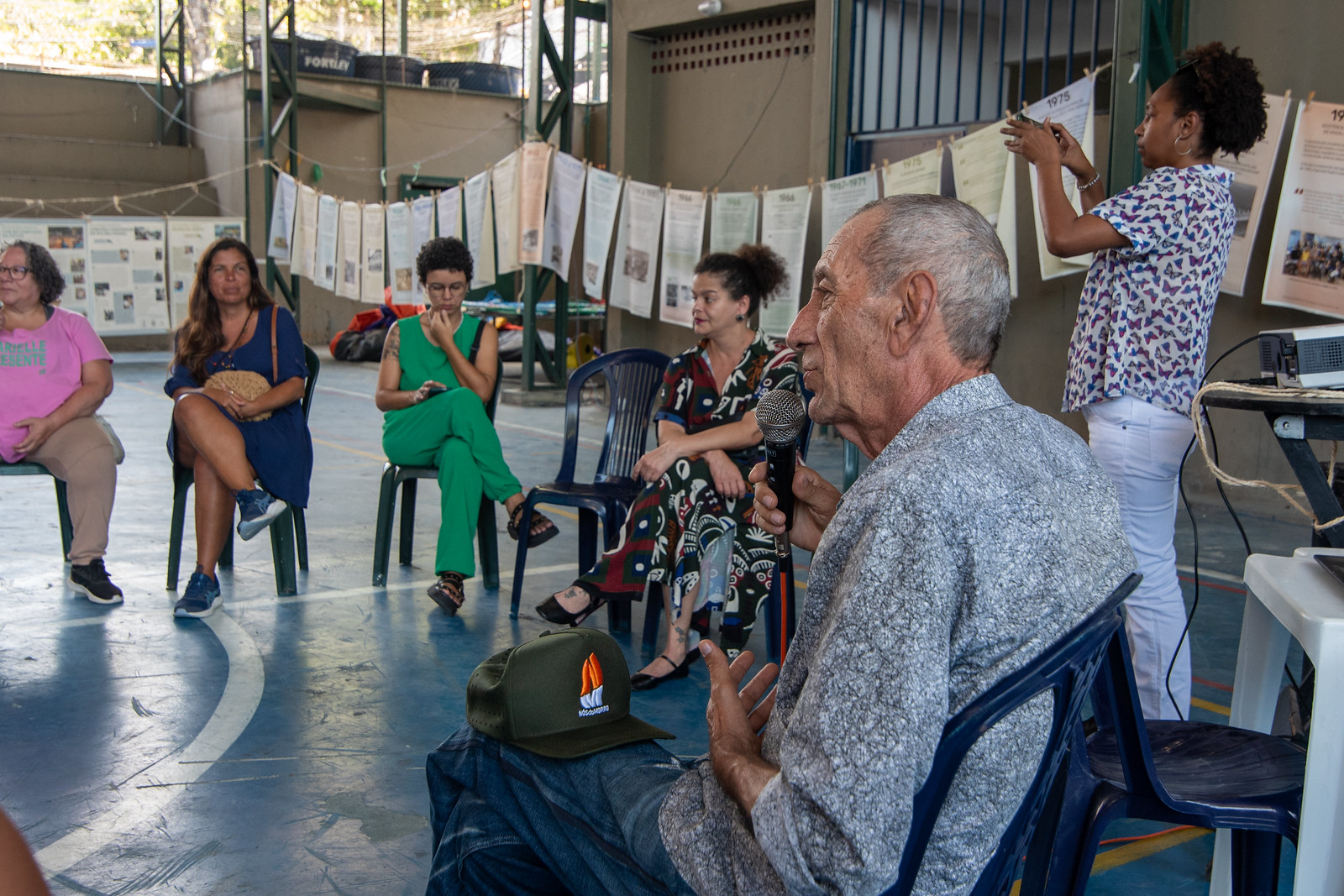
After a morning of exchanges in the discussion circles, the afternoon program continued with visits to the exhibition, film screenings and displays of old photos and cultural performances.
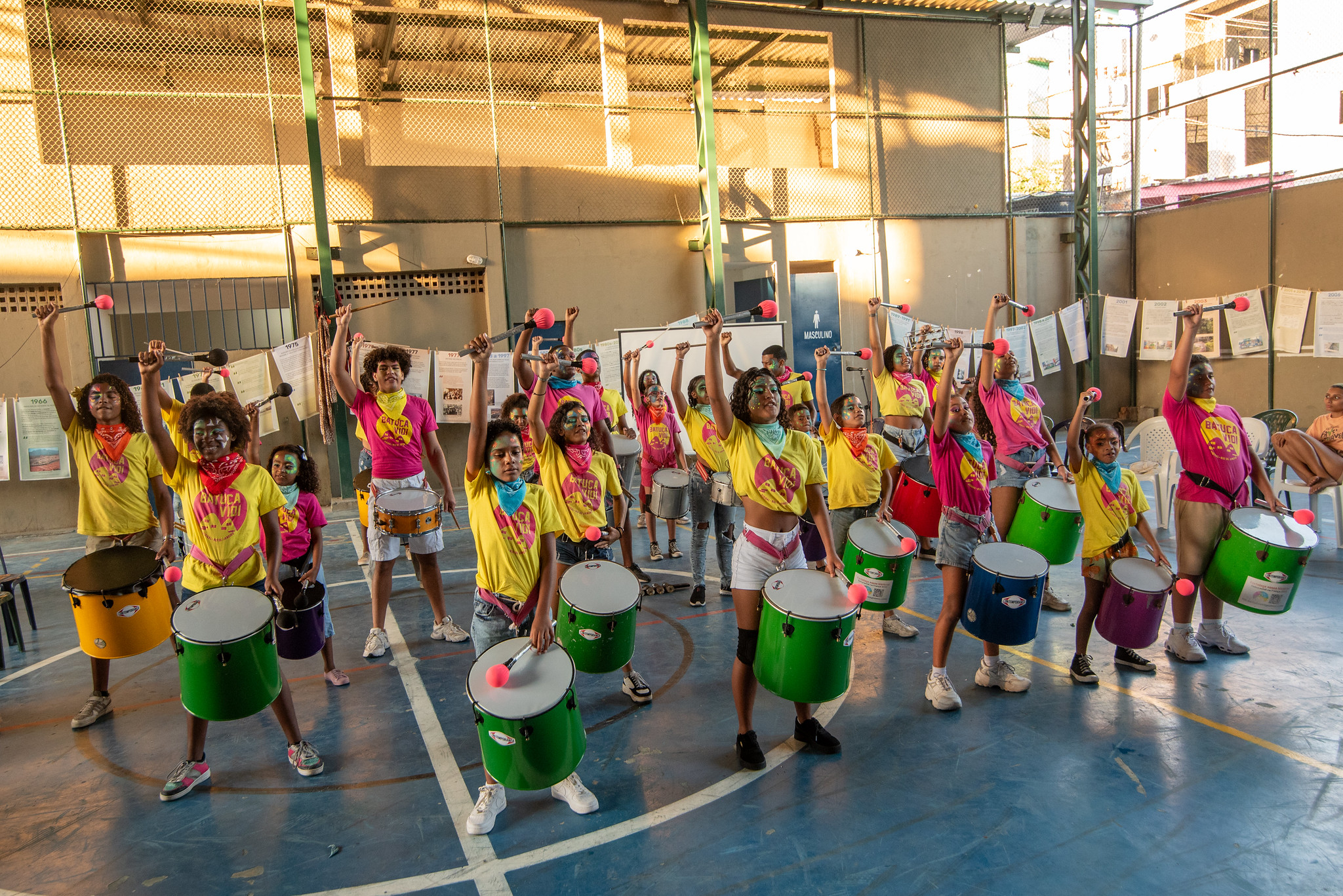
In addition to the capoeira circle performed by the groups Laje Cultural Rocinha and Acorda Capoeira, Ninho de Paula performed his theater sketch Greeting the Ancestors and cordel literature artist Victor Lobisomem read his poem “Memories of Vidigal Told in Cordel Literature.” In one passage, he recounts Pope John Paul II’s visit to the favela, which helped residents’ struggle for the right to remain.
“Right before the visit
A moment long awaited
The Vidigal favela
Was expropriated
For all social purposes
The papers were signed and officiatedThe fight was not in vain
To the land the people held on
The right to housing
Vidigal won
Other struggles persist
The mission is not done.”— Victor Lobisomen
See the Full Album of Vidigal’s 85th Anniversary Celebration with the Climate Memory Exhibition:
*The Sustainable Favela Network (SFN) and RioOnWatch are both initiatives of not-for-profit organization Catalytic Communities (CatComm). The ‘Favela Climate Memory’ exhibition brings together 1,145 testimonials from 382 residents of ten favelas across Rio de Janeiro, collected and analyzed over three years, produced through a collective oral history project. The exhibition was developed by eleven museums and favela memory collectives that are members of the SFN: the Maré Museum (Complexo da Maré favelas), the Sankofa Museum (Rocinha favela), the Historic Orientation and Research Nucleus of Santa Cruz (organizer of the Antares climate memory circle), the Favela Museum (Pavão-Pavãozinho/Cantagalo favelas), the Vidigal Memories Nucleus (Vidigal favela), Alfazendo (City of God favela), the Serra da Misericórdia Integration Center (Complexo da Penha favelas), the Horto Museum (Horto favela), Fala Akari (Acari favela), Conexões Periféricas (Rio das Pedras favela), and the Evictions Museum (Vila Autódromo favela).
About the author: Bárbara Dias was born and raised in Bangu, in Rio’s West Zone. She has a degree in Biological Sciences, a master’s in Environmental Education, and has been a public school teacher since 2006. She is a photojournalist and also works with documentary photography. She is a popular communicator for Núcleo Piratininga de Comunicação (NPC) and co-founder of Coletivo Fotoguerrilha.