
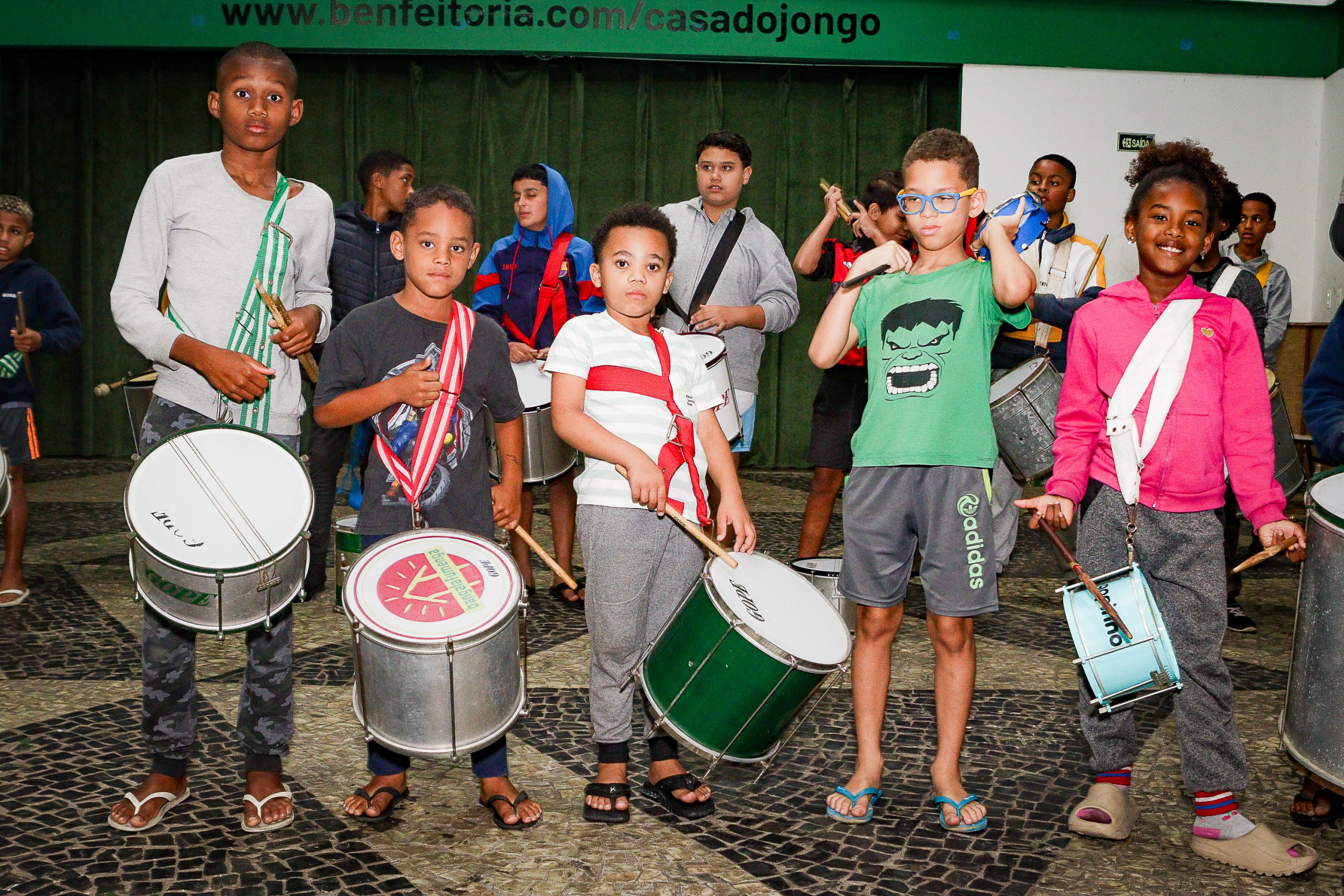

This 2026 Rio de Janeiro carnival, RioOnWatch paid a visit to the traditional, century-old Serrinha favela to get to know the Mulecada Que Agita project by interviewing its founders and members. This report begins by gently stepping onto this sacred ground.
Halfway through 2017, through the initiative of musician Jorge Quininho, 45, Mulecada Que Agita (roughly, “Kids Who Make Things Happen”) was founded—a socio-musical project that operates out of the Jongo House in the Serrinha favela, in Madureira, in Rio de Janeiro’s North Zone. Training children ensures the continuity of the musical legacy initiated by Império do Futuro, the first children’s samba school, rooted in the community.
Serrinha is widely recognized for nurturing artists. The community where the Império Serrano carnival samba school was founded, on Balaiada Street, is a cradle for samba masters and jongo greats who maintain Afro-Brazilian memory. The neighborhood is celebrated in the works of samba group Fundo de Quintal, Silas de Oliveira, Dona Ivone Lara, Master Darcy do Jongo and Wilson das Neves, among others.
Quininho received his very first instrument to join Império do Futuro’s rhythm section through Priminho, the son of Tia Ira Rezadeira, or Aunt Ira, the healer, an important religious and cultural leader in the community and the nephew of Império do Futuro’s founder. Similarly, today he encourages the youth of Serrinha, where he was born and raised, to connect with music.
Ver essa foto no Instagram
One of the young people who began his musical journey with Quininho was Lucas Badeco, 23, now a percussionist and mentor in the very project where he was once a student. In 2017, Badeco and other youth, including Derik Pagaio, 24 and William Mendonça, 23, came together to learn percussion and formed a children’s group, which would later be named Mulecada que Agita.
Ver esta publicação no Instagram
The project carried out its activities for the next three years, until the coronavirus pandemic in 2020. In compliance with World Health Organization guidelines, they shut down.
Ver esta publicação no Instagram
Mulecada que Agita resumed in 2024, with some students from the first group now at the forefront of the initiative, serving as mentors and passing on the rhythm initiated by Quininho to a new generation. Beyond music, the project works to build self-esteem, offers opportunities in music and, above all, a new perspective, presenting different possibilities for the future. Viewing children and teens as citizens with needs that go beyond the classroom, the project provides food at every rehearsal.
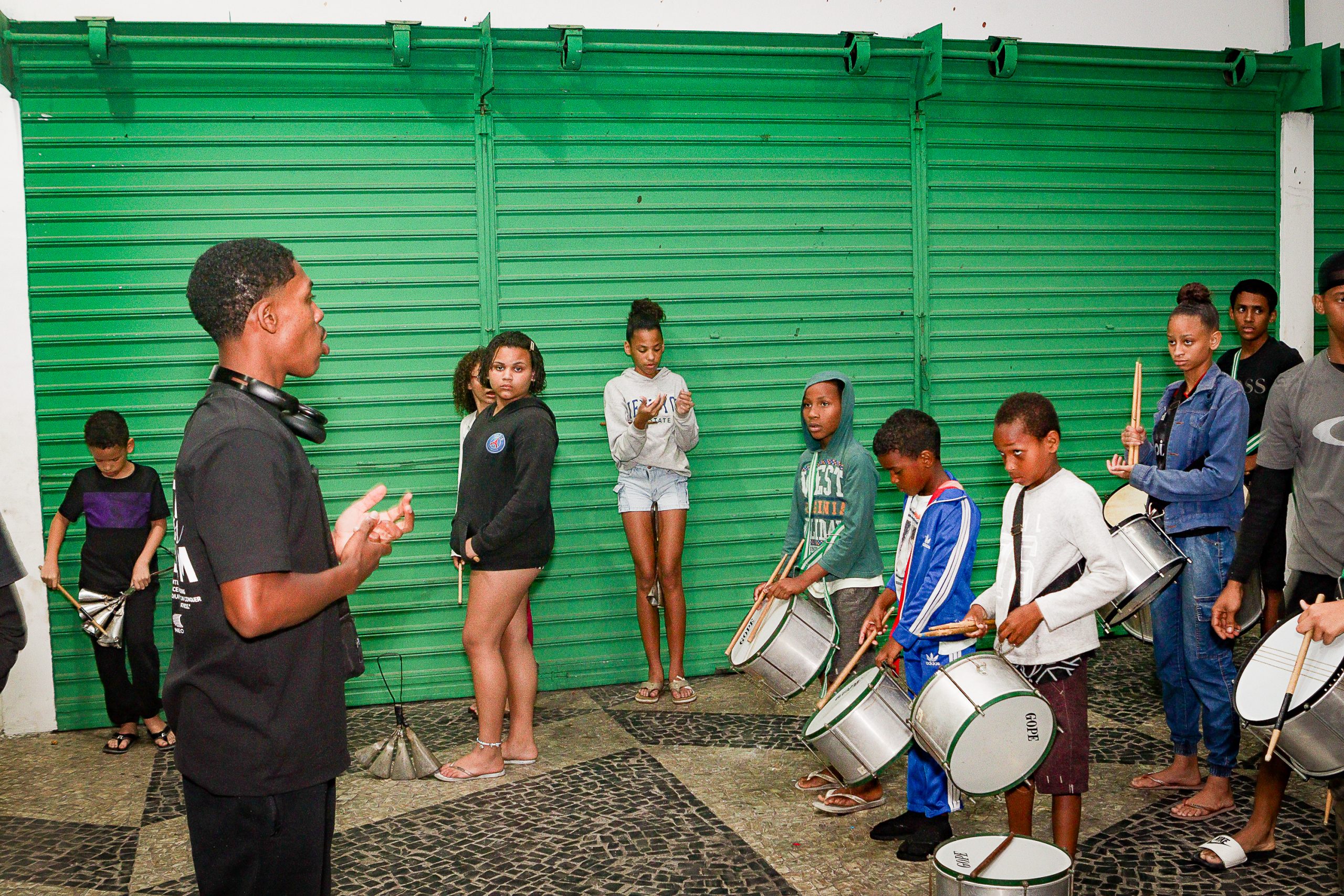
To tell this story, RioOnWatch went up Serrinha and interviewed community leaders who are crucial to the project and its success: Jorge Quininho, the project’s founder; Lucas Badeco, William Mendonça and Derik Pagaio, former students who are now mentors (alongside Pedro Zé, Jonas Venicius and Renato Souza); Suellen Tavares, a teacher at Casa do Jongo da Serrinha; and mothers of students served by the project, such as Pamela Oliveira and Luna Bouças. These make up a powerful record of community and cultural organization in one of the favelas that helped shape Rio de Janeiro’s carnival.
RioOnWatch: Quininho, first of all, thank you for agreeing to have this chat with us. Could you please introduce yourself and tell us a bit about how the project came about?

Quininho: My name is Jorge Quininho. I got started in music late, because first I did a whole lot of other things. By my early twenties, music was all that I had left. I needed to change my life, and when I looked around, there was music. Later I understood that since I only started in my early twenties and still got to where I am today, that if I tell the kids coming after me to start much earlier, their lives will be much better than mine.
This opened my mind to the idea of having a project. Actually, not to “have” a project, but to continue what I’d received, because I’m also the product of a social project. When I came here, the people who were making things happen were Priminho and Tio Careca, both from Tia Ira’s family, and I started out with them. From a very young age, I understood the importance of social projects.
I was given my very first instrument by Priminho, because I was in the rhythm section of the Império do Futuro children’s samba school, but there were no instruments my size. So Priminho decided to buy one my size. I remember what it felt like to have an instrument because that changed my life. I spent a whole year going to rehearsals, arguing with my brother because I wanted to play the surdo [large bass drum, essentially the heartbeat of samba], but the surdo was too big and I couldn’t handle it. I couldn’t lift it or play it without it touching the ground—and when the drum touches the ground, the sound doesn’t carry. So my brother would get really annoyed with me because I wanted to play the third surdo, but couldn’t because I was too little. Then Priminho, watching all that racket, bought an instrument for me. The day before carnival, he called me over and said, “I bought you a gift.” The funny part is that I was the one kid who really got on Priminho’s nerves. I actually loved annoying him! I remember those days really well—when he got angry, he’d start spitting like crazy, and as long as he did not spit, we wouldn’t stop. It was always like that: I was the one he backed the most and, at the same time, the one who bothered him the most.
From very early on, I understood the importance of social projects, of a samba school rhythm section and of having a path to follow. A few years later, I ran into Badeco and Fofão—Hamilton Fofão, a musician born and raised in Serrinha, who happens to be Badeco’s uncle. He had a project in the favela where he taught cavaquinho [small guitar-like Portuguese instrument]. So I told him, “I’ll help with whatever you need.” I think he had about ten students, and I managed to get him ten cavaquinhos. But at a certain point he moved away and ended up pressed for time, so Fofão had to stop the project. After that, the only one who stayed close to music was Badeco, who was kind of lost.
I called Badeco and Jonas over and said, “Let’s do something? Let’s learn how to read sheet music?” They agreed. We spent about two months studying. It was crazy hot—summer, mosquitoes everywhere. Wow… it all just came back to me. I came full circle when they started the project without needing me for anything. When they carried the project on by themselves, I said, “They’ve got it!” So I told them, “Look, I can’t do this anymore. I was only coming here for you. Now I’m leaving.” And they kept the project going. Now, when I see them there, it makes me incredibly happy. It worked!
RioOnWatch: How did the Mulecada que Agita project get started?
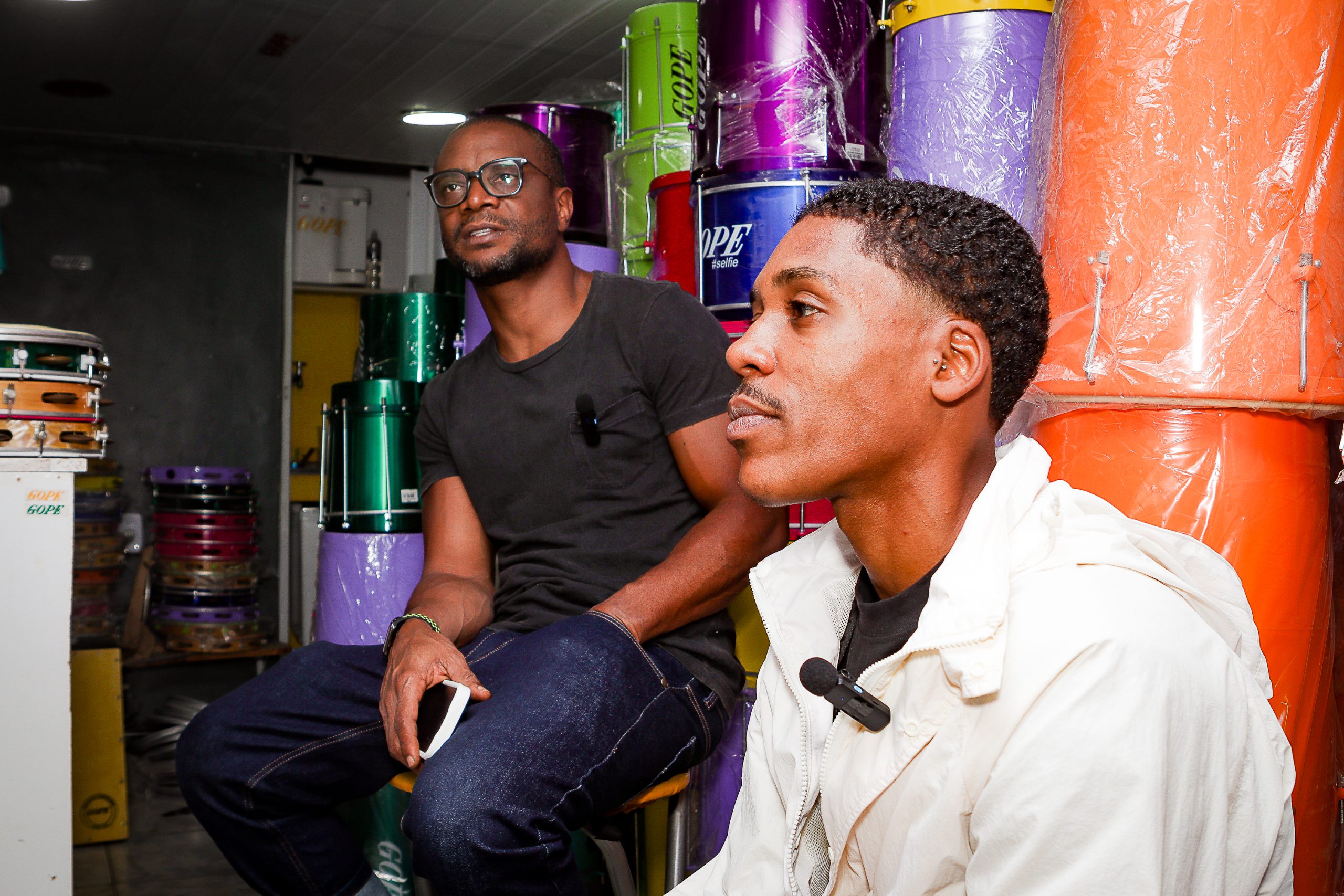
Badeco: My name is Lucas, but my stage name is Lucas Badeco. I’m 23 and I’m part of Mulecada que Agita. It was around 2017, when Quininho sent a picture of the instruments he had in his place in Cascadura and said, “Pick an instrument.” I chose a red, size-eleven tan-tan [a cylindrical Brazilian hand drum; the size eleven is used for higher-pitched, faster cuts]. Quininho said, “If you take the instrument and study two hours a day, you’ll be okay. Three hours, you’ll get a bit better. Five, seven, eight hours… then you’ll start getting good. You’ll start making money. You can live off of it.”
That’s what made it click for me. I already played cavaquinho, was already doing my thing, but in my head it was just kid stuff: “I already play cavaquinho, so I don’t need to study.” But the moment I got my own instrument, I actually started practicing—and everything changed. Then Derik came along, William came along, and all the other students, making up a class of almost 50 youth rehearsing at Casa do Jongo until the pandemic hit.
When the pandemic came, everyone kind of drifted apart, a kid in the favela, without much to do, without a weekly rehearsal to attend like we used to. I looked at my mom who never gets a holiday. Even now, she works every other day. When she thinks about resting, she has other things to deal with. I thought, “I don’t want that life for myself.” So I grabbed the instrument and started practicing three hours a day, then four, then five. I’d get out of school and play outside while the other kids played soccer. I started getting calluses on my hand—that’s when I felt I was getting somewhere.

RioOnWatch: Quininho, can you tell us a bit about the impact music has had on your life, as someone who was born and raised in Serrinha, and on your professional journey?
Quininho: We live in the favela. Up to the main street, we know what’s going on, but past that, all the way to Edgard Romero [one of the North Zone’s most important streets], it’s a whole other world. If you cross the road you’re at a complete loss, and getting out of this little area, that’s tough. But when someone from the favela manages to go down the hill and see that things are different outside—not that it’s easy, but you can live better—your mindset changes. When I got into music, there were already opportunities for musicians. I didn’t have to struggle like my brother Pretinho da Serrinha, who, when coming home from downtown with his surdo on the bus, used to get into fights with the workers [on the bus].
When I got started, my brother was already playing with Seu Jorge, at the height of his fame. So the first band I played in was Seu Jorge’s at its peak. We were already in a huge place, but when I looked around, all I saw was us, and I thought, “These kids could pick this up in a snap.” And I wanted them to understand that, because it was the only thing that could change their lives: having that drive to succeed. But how can someone want to achieve something they don’t know about? If a kid has never left the favela, he doesn’t even know what’s out there. So I had to open their minds, and there was no other way but to be there. I always dress when I go see them in the favela, and go by car, by motorcycle, so they can see that it’s not just criminals who make it.
RioOnWatch: William, Derik and Badeco, you’re also instructors at Mulecada que Agita. Can you tell us a bit about your journey and the impact the project has had on your lives?

William: Man, I started in music really young, in a music project up in Serrinha called Projeto Herdeiros (roughly, “Heirs Project”): Cadu, Fernandinho, Flavinho, Maria Julia and others.
When I joined Mulecada que Agita in 2017, Quininho was teaching sheet music to Badeco and Jean. Zé Galinha and I have always hung out together—we’re also brothers. We heard about what was going on and got interested, especially since we’d already done Herdeiros. It went from just two people to four of us. Then Biel joined and more people just kept showing up. That’s when Quininho said, “Man, this can’t just be a pagode group. There’s too many people. We need to take this to the next level.”
Nowadays, I mostly handle the operational side. I think that’s true for most people, for all of us, right? We all pitch in with the admin and operational work. We help each other out. What one person doesn’t know, another does, and we fill in the gaps. We complement each other. Our project today is made up of all the members who were part of it before Mulecada (2017–2020), back when Quininho was teaching us. Now we’re all doing the project.
Badeco: And we keep going just like that. We don’t have a ton of information about things, but that’s how it works. Derik’s better with the Internet, he gets things faster. So I said, “Alright, that’s it: Derik handles Instagram, got it? William takes care of announcements, Chico hypes up the kids and Jota (Jonas) checks the instruments and welcomes the kids.”
We’ve got this kid, Anthony—he plays tamborim [small Brazilian frame drum played with a drumstick or beater]. He’s next. The cool thing is his mom loves that he plays. There’s no other toy for him besides an instrument. He’s part of Priminho and Tia Ira’s family, so as expected, he’s carrying the family name forward.
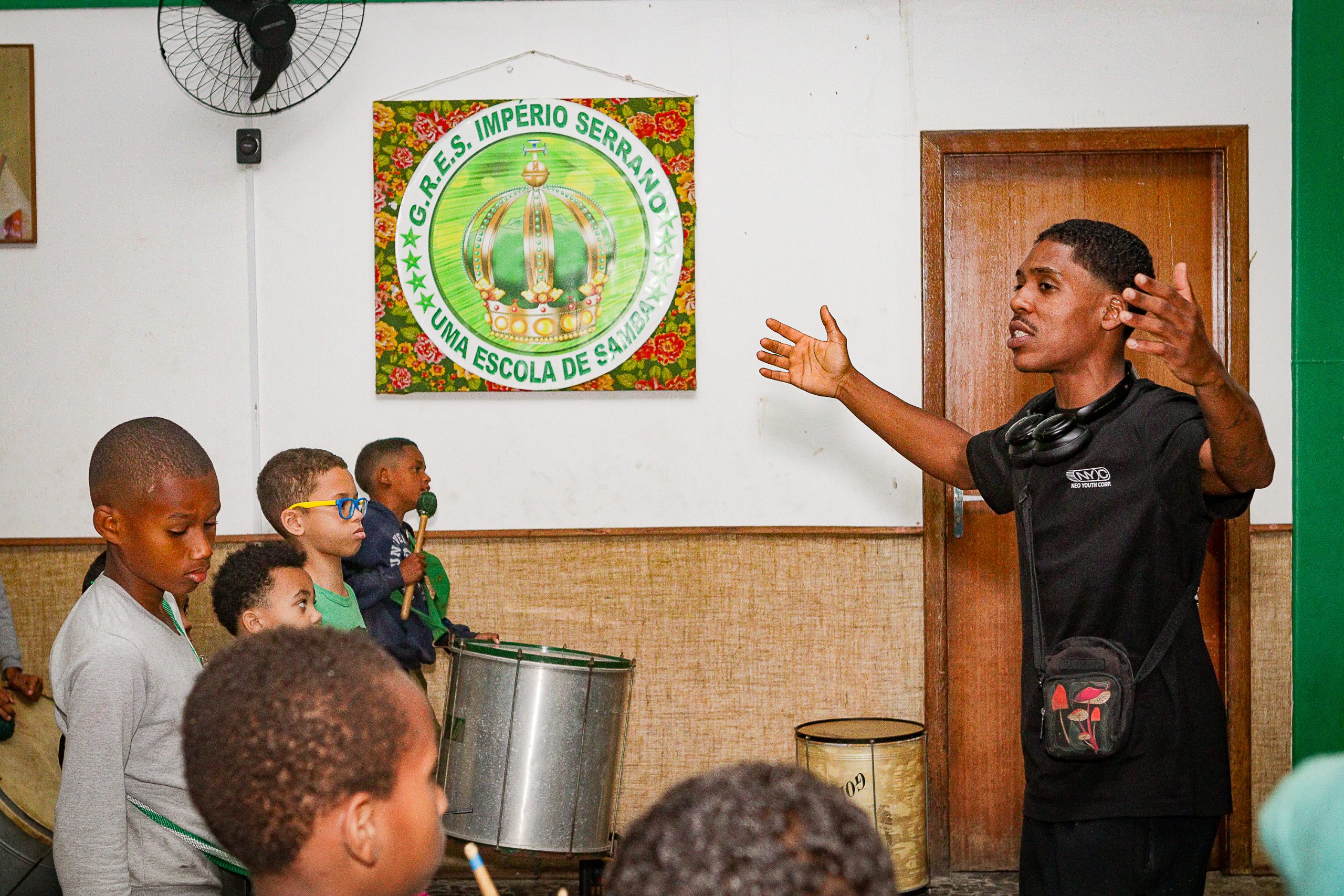
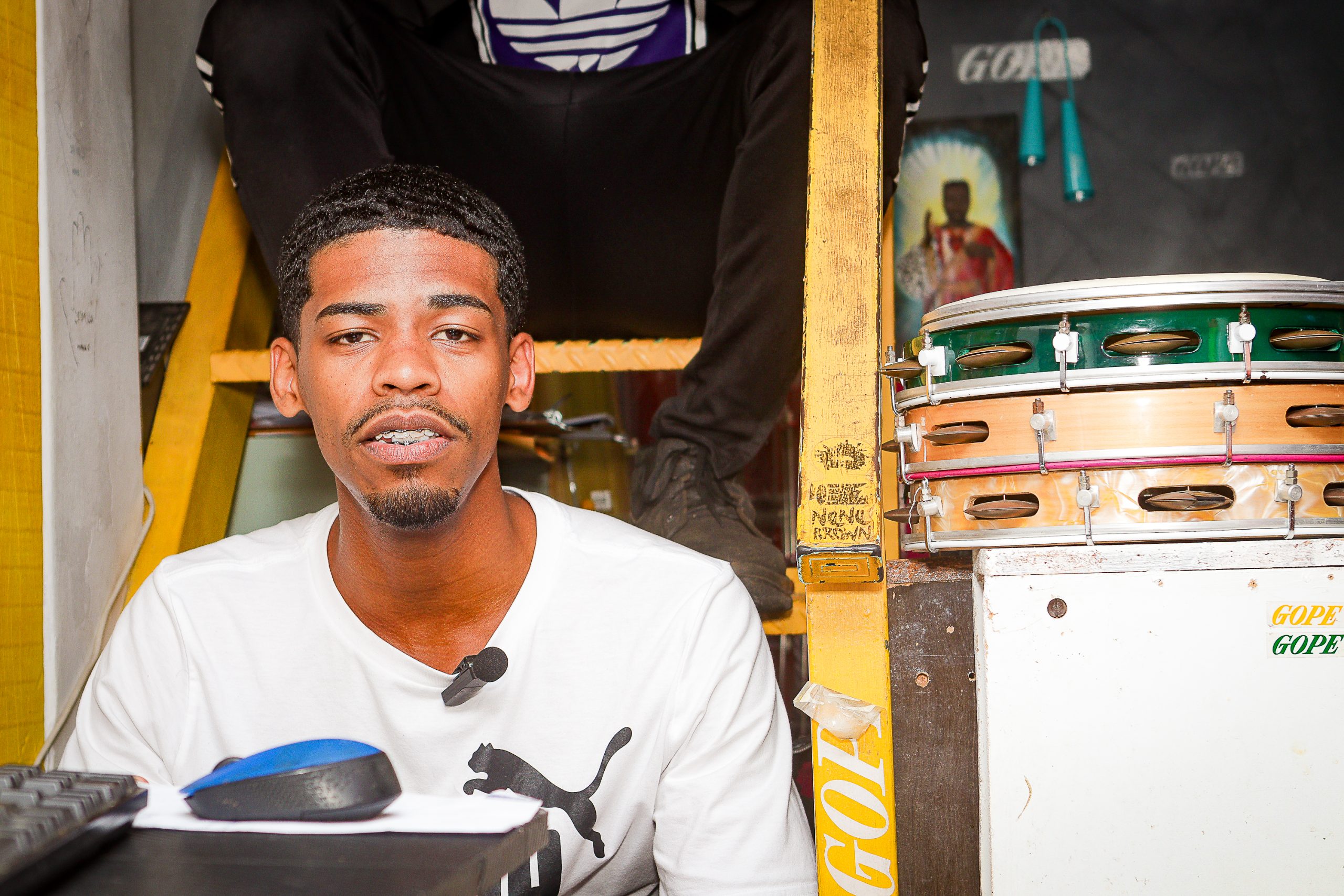
Derik Pagaio: I never had much of a connection with music. My connection with music was basically zero—until I met Badeco. I grew up in an evangelical family. Then, I met Badeco in 2016. Actually, we already knew each other from the favela. I used to go to the Cajueiro favela because my dad used to live there. And Badeco went there too because that’s where his cousin, Bitocão, lived. We’d already seen each other around and it just so happened that we ended up in the same classroom at school. And we hit it off right away.
One day, Badeco turns to me and says, “I take cavaquinho lessons with my uncle, you want to come?” I thought a bit and said, “Cavaquinho? Cool, I’m there,” but I didn’t go the first week. Then one day, Badeco tells me, “Bro, you’re going. I’ll come to your place, and you’ll walk over with me. No way out, so let’s just go.” So we went. I took the cavaquinho class, I liked it, but I didn’t take it very seriously at first because I didn’t have a grasp of what music really meant back then, it was just… “What am I going to learn to play this instrument for? It’s not going to take me anywhere.”
Time went by and our friendship stayed strong. Then, one day, there was going to be a party for a friend of ours, Fabiano, who also plays. I was supposed to go to school, but Badeco sent me a message: “Come to Fabiano’s party with us.” When I got to the party, William and Zé Galinha were there too. Everyone there was part of the project that was happening in my favela at the time: Herdeiros.
We went to the party and, after a while, they started playing. Man, I was blown away! I remember Zé Galinha (the guy who came up with the name Mulecada que Agita) was playing the third surdo, and he’s always been this scrawny little guy. “Man, what’s Zé Galinha doing on the third surdo?” I thought, “How can this little guy be doing that?” I said, “I want to do that. I want to play!” So Badeco invited me to go to rehearsal at Casa do Jongo on Tuesday. When the fateful Tuesday came and I got to Casa do Jongo they were all rehearsing inside the little theater with Quininho.
Music literally changed my life, because before I started playing, I used to hang around another type of crowd, get it? There was this bad cloud hovering above me. I used to think, “Bro, what am I doing here?” I don’t even like that stuff, you know? And when I found music, that’s what pulled me away from that other side and I started hanging with those guys (the musicians from Herdeiros and Mulecada que Agita). And I thought, “Man, these are my people!” Chill, smart kids. When I joined them, I’d already lived through stuff they hadn’t, you know? In many ways. Then they taught me the more pure side of things, so to speak, and I passed along a bit of savvy to them. That’s what our friendship has always been like. It’s always been about complementing each other in whatever ways we can.
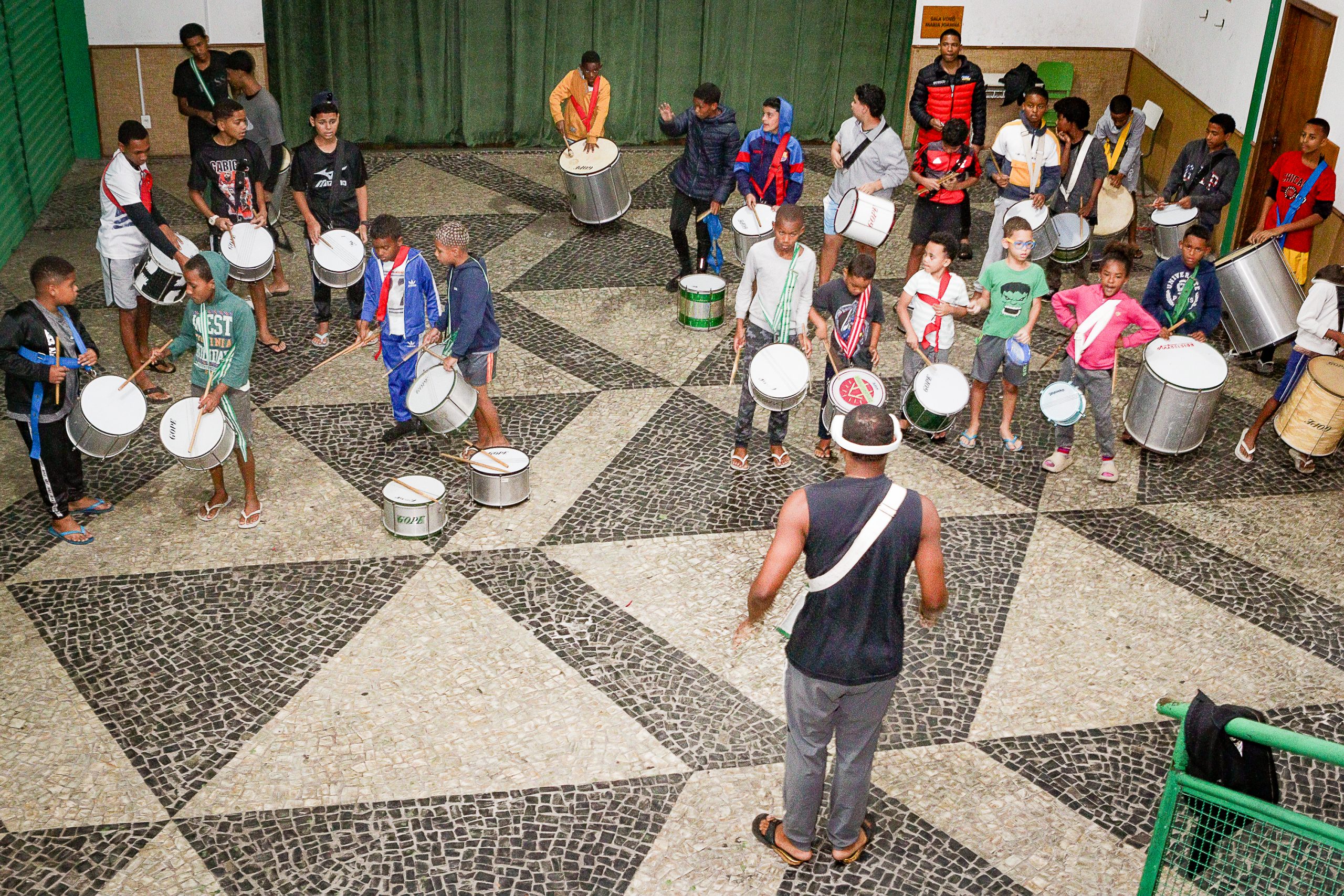
RioOnWatch: How did the Mulecada que Agita project pick back up after the pandemic?
Derik: We decided to bring the project back because we felt the favela had lost a bit of our culture, you know? Back in the day, the older generation lived that, man—the favela pulsed with Império Serrano!
Badeco: There was a time when something was always going on in Serrinha. Music, dance, capoeira, anything.
Derik: We don’t feel that as much today. So this mission becomes ours, right? Because we’re the current generation. That’s why we brought the project back. At first, we didn’t want to go to Casa do Jongo. We restarted rehearsals at Campo da Balaiada. But then there was a moment when we looked at each other and said, “There’s no way around it, we have to go to Jongo!” Because there were drones dropping grenades on people’s heads, you know? They don’t care if you’re a resident.
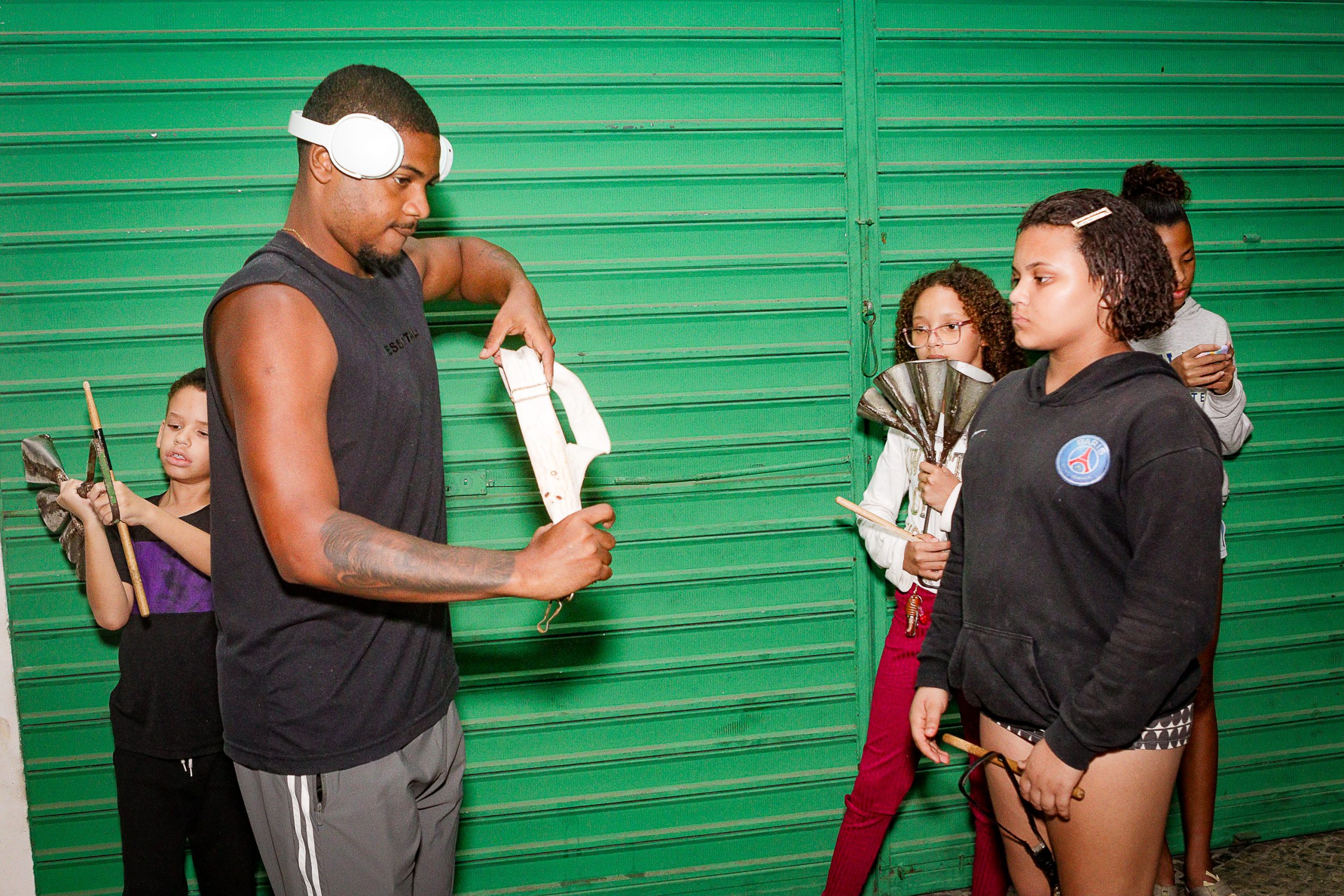
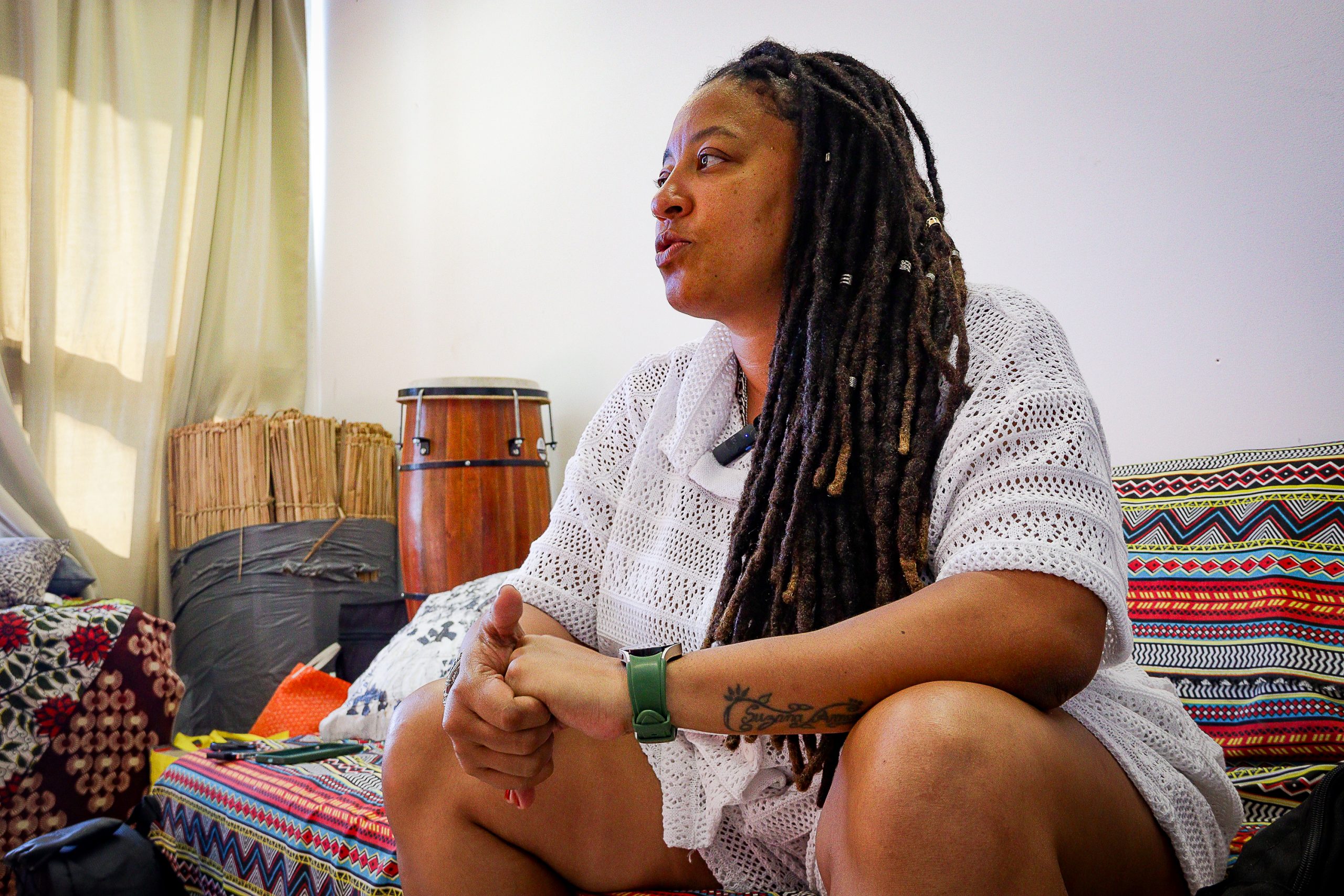
At this point in the conversation, Serrinha born-and-bred Suellen Tavares, 38, jongo teacher and representative of Casa do Jongo, stepped in and shared a bit about her connection to the Mulecada que Agita project. “I saw the project take shape. I saw how things began and the need Quininho identified for the children to have professional training, but with more technical guidance in percussion. I got to know the project when it was still in its embryonic stage—it didn’t even have a name yet! There was really just the desire to do it.” According to her, this is common in Serrinha: doing a lot with few resources and a great deal of determination.
RioOnWatch: From your perspective, how do you see Mulecada que Agita with the change in the group? Do you have any observations about the project’s return with the second, post-pandemic generation? What is your take on that?
Suellen: First of all, I think that we need to think about legacy. It’s a very recent project, if we stop to think about it—a project from 2017—and we already have a first generation training a second one. I say this because, for example, in jongo I’m part of the fourth generation: if we think of Grandma Maria Joana, Master Darcy and Aunt Maria—Delia—as the third generation, then mine is the fourth. The group has 60 years of history. Mulecada que Agita is moving into the second generation, and in another five years there will already be a third one. So, this whole thing of legacy, of passing things along day by day, that’s really what I think matters most: that Serrinha’s legacy is being carried forward.
It’s incredible how, here in Serrinha, the kids have so much rhythm. It’s impressive! Classes last two hours and, in 40 minutes, they already pick up a groove. It feels like it’s already in their blood. In this sense, it’s important for them to know where they come from. And then, when they leave—or rather, when they stop living here, like Quininho, Pretinho and Fofão—they know where to come back to. They know where to recharge and strengthen their own. I think that’s the deal right there. And then there’s also the crew that’s still here, holding it all down.
That’s why, when Badeco called me, I said, “Badeco, this is our house.” The project came back, but since a few things had been happening in Serrinha, he wanted to see if it was okay to occupy Casa do Jongo. I spoke to the coordinators and put them in contact. It’s a huge source of pride to see all this power. I’m very proud.
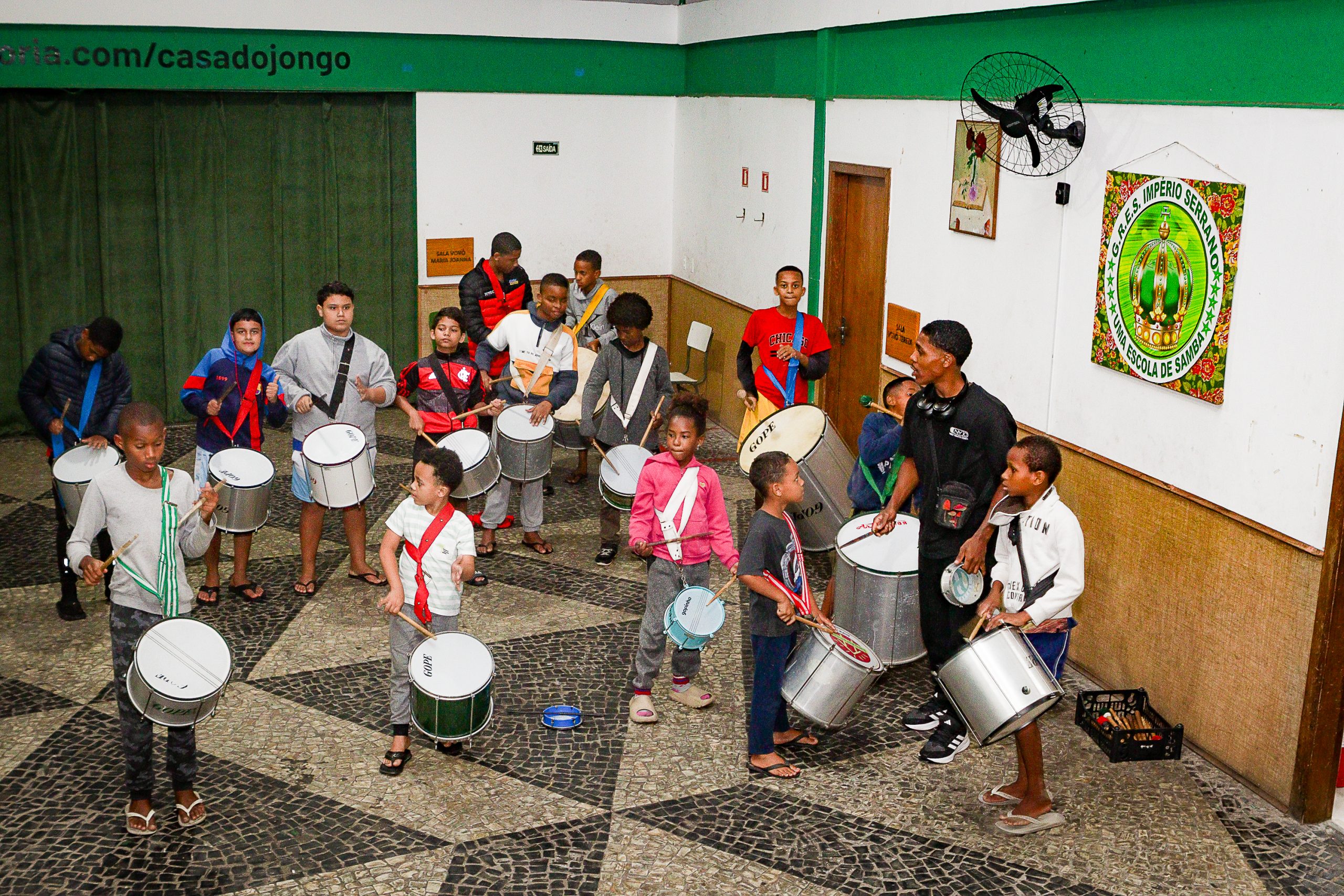
After wrapping up the conversation with Suellen, RioOnWatch was also able to briefly ask two questions of two mothers of Mulecada que Agita students about the project’s impact on their children. The excerpts below come from a conversation with Pamela Oliveira, 28, mother of Anthony Alfredo, 7, and Luna Bouças, 43, mother of Victor Bouças, 10.
RioOnWatch: How significant is Mulecada que Agita to your son?
Pamela: It’s huge! Anthony has changed so much since he joined the project—his desire to create, to lead, his behavior at school and at home. It really helped with his shyness and how he relates to other people.
Ver essa foto no Instagram
Luna: Mulecada que Agita is so much more than a percussion project for Victor—it’s a space where he expresses his love for percussion, where he feels he belongs, a space where he feels sheltered and valued. Every beat on the tamborim is a form of expression, every rehearsal is a learning moment and every performance an achievement. The project helps Victor believe in himself and understand that, with dedication and love, he can go far. More than just training percussionists, Mulecada que Agita shapes citizens, reinforces values like respect, discipline, friendship and teamwork, building a brighter future for him and for so many other children.
Ver essa foto no Instagram
RioOnWatch: How has the project contributed to your child’s relationship with music?
Pamela: The project contributes beyond just music, which is the main goal, I know, but simply being part of a social project with the “uncles” [as Brazilian children often affectionately call male teachers] he admires helps shape the kind of man and future artist he wants to become.
Luna: The project allows Victor to express his love for music. Through percussion, he’s learned to listen, feel and live the rhythm, developing sensitivity, focus and joy. Music has become a source of love, happiness and expression of feelings. Every strike on the instrument is full of emotion, pride and hope, reinforcing Victor’s self-confidence and showing his ability to shine, delight and move people with his gift.
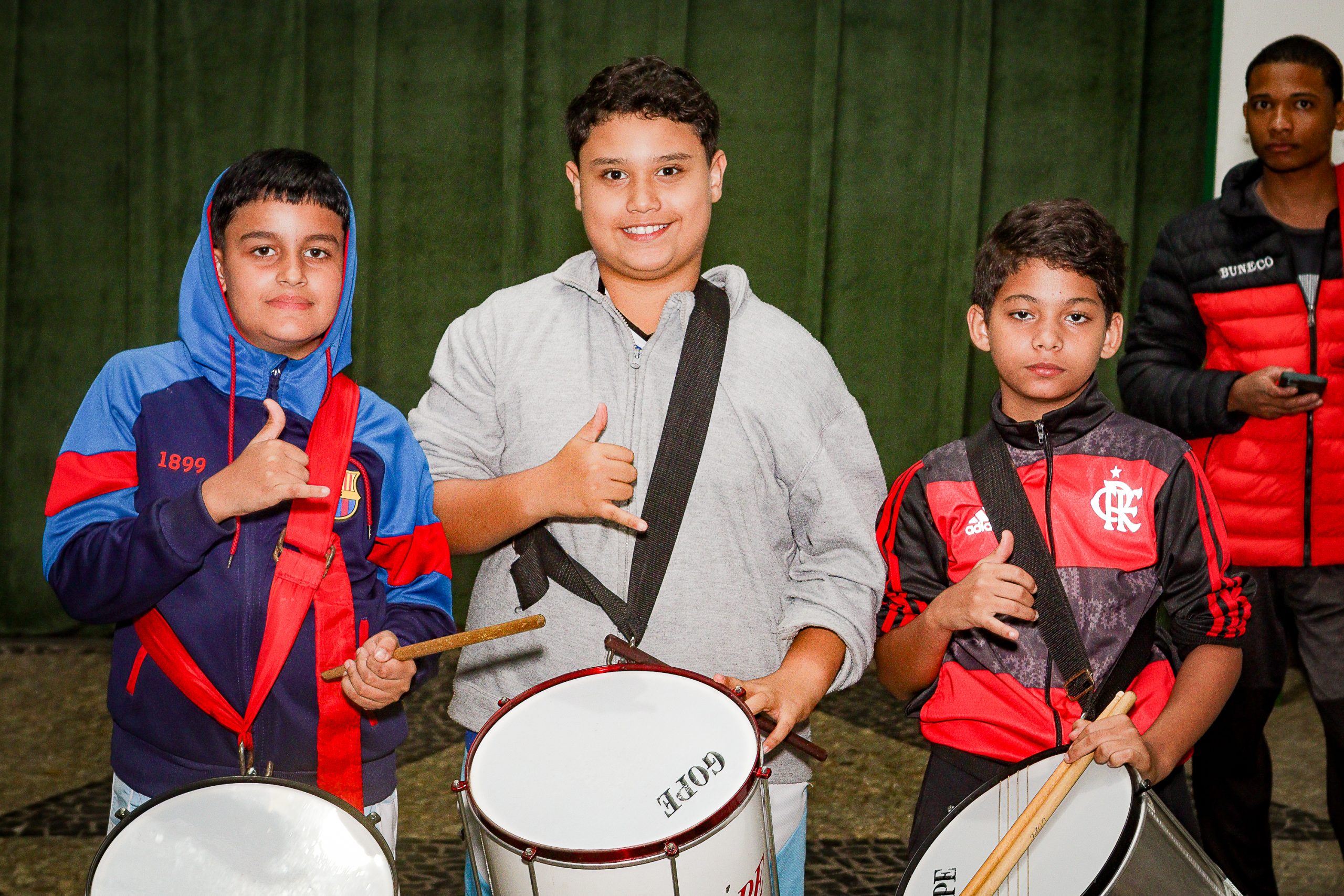
Mulecada que Agita classes take place every Wednesday at 6pm at Casa do Jongo da Serrinha.
“Any child
Plays pandeiro, surdo and cavaquinho,
Sings along with birds
Without missing a beat
If you don’t believe it
We can and will prove it
But you better believe it,
We’re not the type to cheat nobody
That’s where melody lives
In the Joy of Serrinha!”
— Fundo de Quintal, Prazer da Serrinha (1988)
About the author: Rhuan Gonçalves is a native of Macaé, a city in the north of Rio de Janeiro state. He holds a degree in History from the Pontifical Catholic University of Rio de Janeiro (PUC-Rio). A photographer for the Imagens do Povo Collective, linked to the Favelas Observatory, located in the favelas of Maré, he is a percussionist for samba schools Império Serrano and Estação Primeira de Mangueira.