
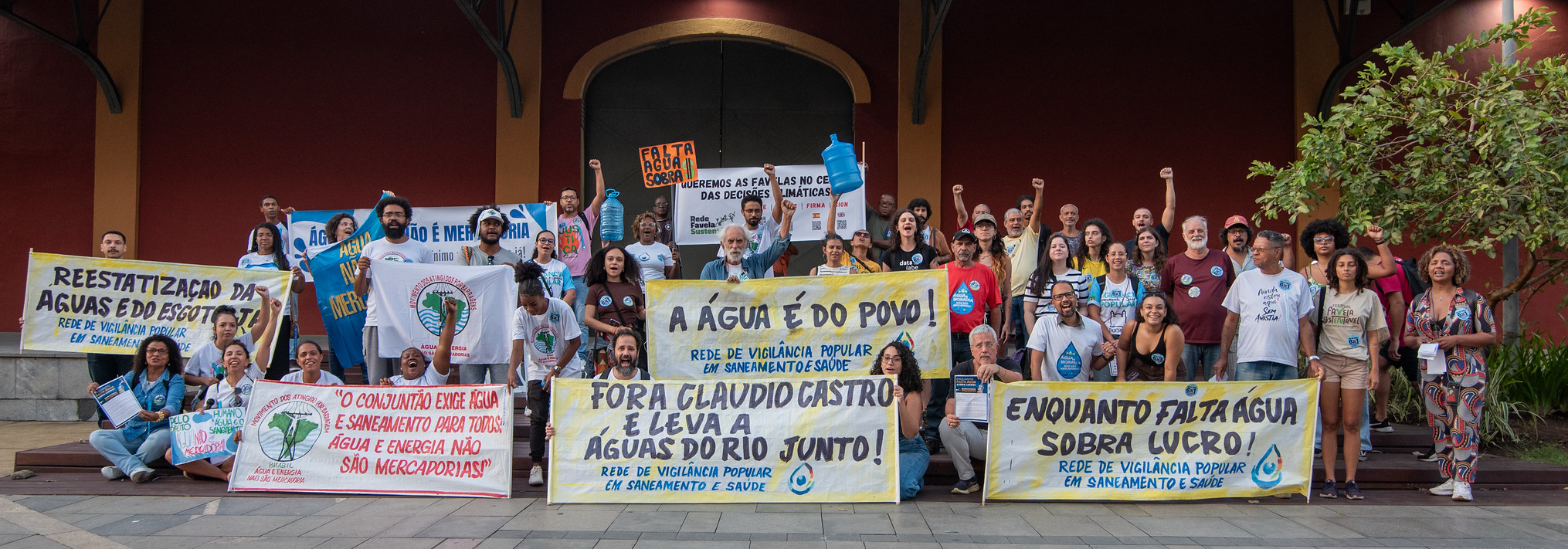

On March 23, a day after World Water Day, an action organized by the Popular Network for Sanitation and Health Monitoring brought together civil society representatives and grassroots popular movements* to protest in front of private water utility Águas do Rio, in downtown Rio de Janeiro, demanding access to water and sanitation as a fundamental human right.
A Protest to Call Out Abuses
In front of an unmarked Águas do Rio headquarters (there was no company logo), with at least two Military Police vehicles and a few company employees present, protesters laid banners on the ground with messages such as: “End Águas do Rio’s contract,” “While water is scarce, profits abound!” and “Restatize water and sewerage.” The protest carried an indignant tone denouncing low quality, expensive services provided by Águas do Rio since privatization. The company today operates in most of the city of Rio and a few other municipalities in the state. But protesters also called out Iguá, responsible for water and sewerage in the city’s Southwest Zone and municipalities in the state’s interior, as well as Rio+Saneamento, which serves 24 neighborhoods in the West Zone and some municipalities in Greater Rio region, such as Itaguaí and Seropédica.
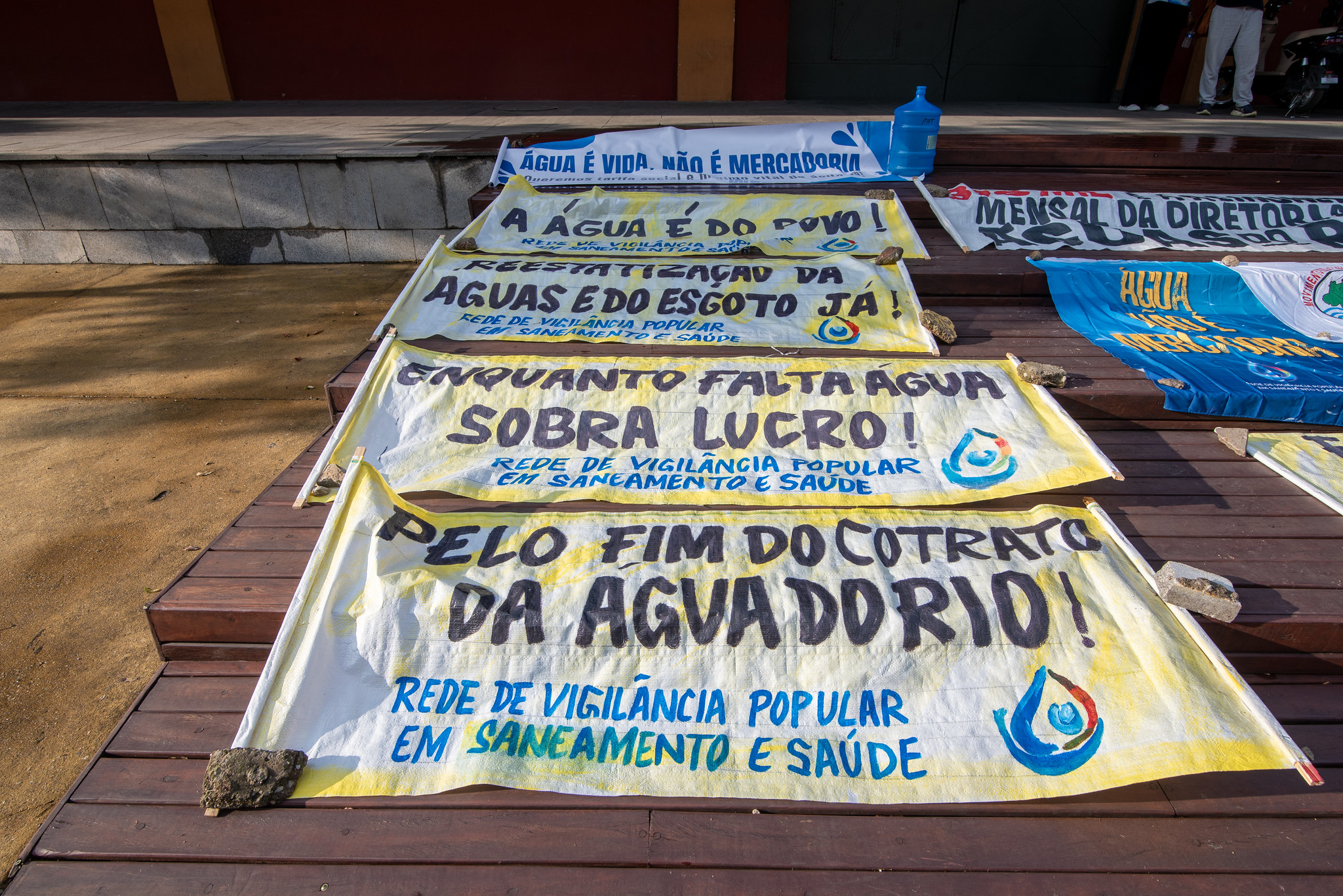
The mobilization focused on the deterioration of access to water following the privatization of water and sewage services, which had previously been handled by public utility CEDAE. The privatization was carried out by former governor Cláudio Castro in 2021. Protesters criticized the granting of these contracts to Águas do Rio. According to reports from residents of favelas across Greater Rio, a fear they had was confirmed: access to these services worsened after privatization.
During his remarks, political science professor João Roberto Lopes Pinto, from the Federal University of the State of Rio de Janeiro (UniRio), emphasized the importance of the mobilization and pointed to irregularities that Águas do Rio has been committing during its operations in the state. These allegations are the subject of an investigation opened by the State Public Prosecutor’s Office, which has been examining the involvement of the state government, Águas do Rio and CEDAE, which remains responsible for producing drinking water for Greater Rio de Janeiro. In fact, its Guandu Water Treatment Plant (WTP), located in Nova Iguaçu, is the largest continuous production water treatment plant in the world.
“We’re here with a small group, but the movement we represent, the organizations, have added tremendously to the discussion and struggle for the human right to water and sanitation. And what we want to say today to Águas do Rio and to the Cláudio Castro administration, which is stepping down at this very moment, is that we are closely monitoring the signs of irregularities in Águas do Rio’s concession contract. Águas do Rio claimed there was an error in the contract and that the sewerage coverage indicator was incorrect [generating higher costs for the company]. They took an emblematic case, Magé, because it was stated that there was 40% sanitation coverage there when, in fact, it was found that this figure was 0%.
So Águas do Rio is now claiming it needs to be compensated, because it wasn’t just Magé but several other cases [as well]. Cases of overestimation of sanitation accounting indicators. The company is requesting an economic-financial rebalancing of the contract of approximately R$1.3 billion (~US$252 million). Now, the question we ask Cláudio Castro, regulatory agency AGENERSA and [national development bank] BNDES, which structured the contract, is: how did this mistake get through?
After three years, the Cláudio Castro administration tells Águas do Rio that ‘CEDAE will pay.’ Get CEDAE to solve the issue and, while you’re at it, go ahead and adjust your rates—[which did take place] at the end of last year. In other words, the Cláudio Castro administration places the burden on the population and on public utility CEDAE, compromising the latter’s finances… And now it’s discussing the sale of whatever is left of CEDAE. And who wants to buy it? Aegea—Águas do Rio—now wants to take over water production.” — João Roberto Lopes Pinto
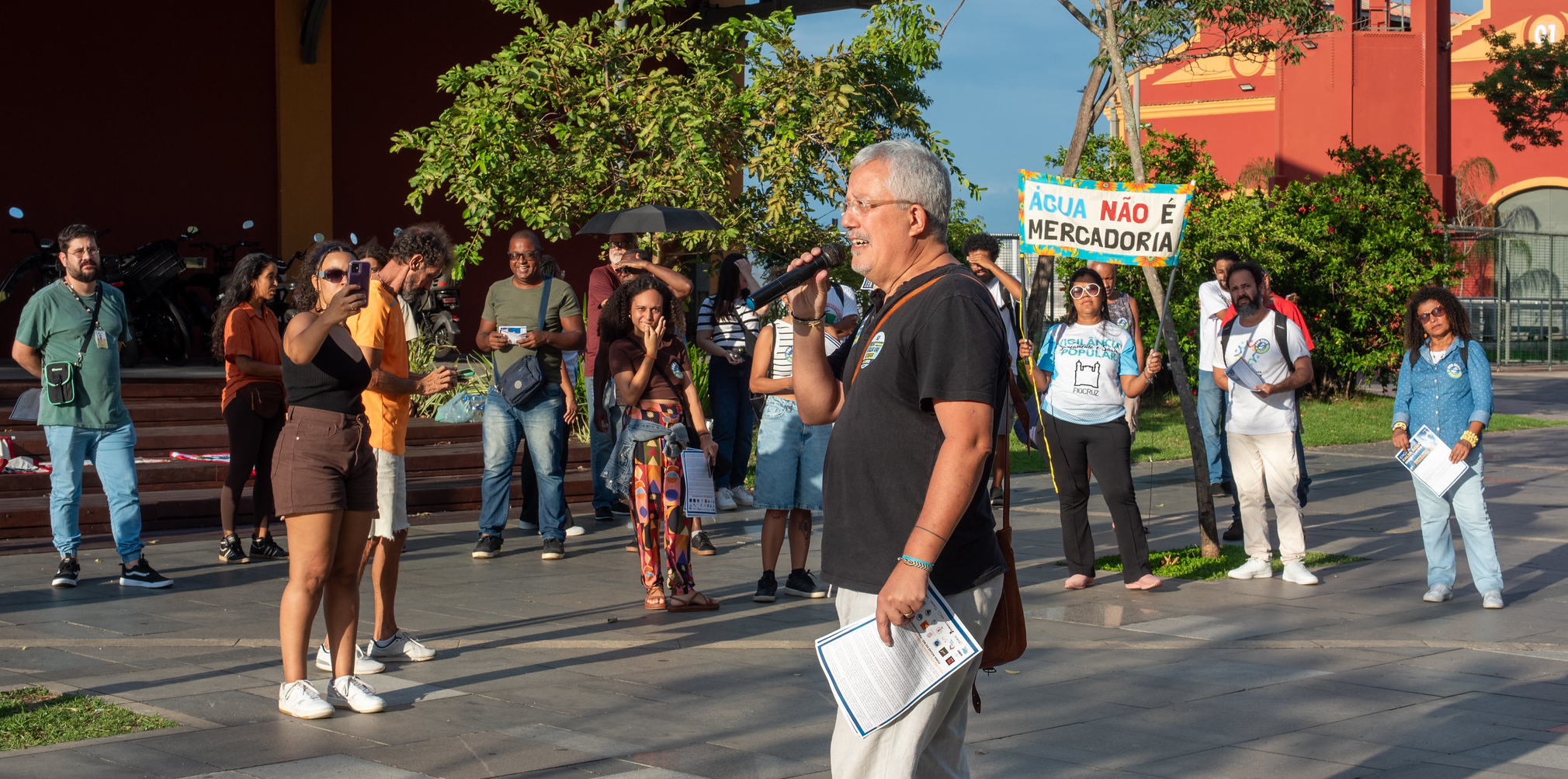
Suelen Souza, a member of the national coordination of the Movement of People Affected by Dams (MAB, by its Portuguese acronym), led a call-and-response chant that joined everyone in one voice:
“Today, March 23, 2026, we—social movements and civil society organizations—are here in front of Águas do Rio’s headquarters to denounce the abuses committed by the company in collusion with the Cláudio Castro government.
After four years of this service concession, problems have multiplied—and it is the people who feel it most. Abusive rate increases, 24% above inflation. A bill that was already heavy has become impossible to pay. Some people have to choose between eating and drinking water.
And even while paying a fortune, the water always runs out. Pipelines keep bursting.
The company has already accumulated over 100,000 lawsuits in the Court of Justice—70 a day; that’s 70 families a day taking Águas do Rio to court. Meanwhile, its four directors each earn R$368,000 (~US$71,000) a month, nearly R$400,000 (~US$77,500). While people struggle to survive, they’re swimming in money.
There are serious indications of corruption. Aegea, Águas do Rio’s parent company, paid R$70 million (US$13.5 million) in bribes across six states, including here in Rio.
The concession contract was signed with mistakes—errors that only benefited the company. And now the people will foot the bill: R$1.2 billion (~US$232.3 million) in compensation for Águas do Rio, taken from CEDAE—that is, from our money, from public funds.
AGENERSA, which should be defending the population, has become the company’s lawyer. Instead of issuing fines, it turns a blind eye. Instead of protecting the people, it protects those who exploit them.
And the funds generated by the concession—the money that came in when the service was privatized—were used by Cláudio Castro to hire 27,000 campaign operatives.
And all the while, Águas do Rio swims in its element. It made R$1.7 billion (~US$329 million) in three years—with 70% going to shareholders: Itaú, Singapore Fund, Equipav, people who don’t even live here, taking our money while water runs dry in people’s taps.
Now the government wants to sell what’s left of CEDAE precisely to Águas do Rio? ‘Cause if they do that, the company will own everything. It’ll become a private water monopoly and you better get ready ’cause rates will rise even more while service, as bad as it is, will get worse.
For all this, we won’t just take it. We won’t keep quiet. We demand the immediate termination of Águas do Rio’s concession contract and demand the restatization of sanitation in Rio de Janeiro.
Out Águas do Rio! Out Cláudio Castro! Water’s not a commodity. Water is the people’s right. It’s health, it’s dignity, it’s life. People’s lives are not for sale.”
In Favelas and Peripheries, “The Problem Runs Deeper”
Rejany Ferreira dos Santos, a geographer and researcher at the Canal do Cunha Watershed Observatory, spoke about the difficulties families in favelas and peripheral areas face in paying increasingly expensive water bills. In this context, she pointed to the restatization of water distribution and sanitation as a solution to improve access for these families, highlighting gender as an additional factor—women and girls are disproportionately affected by unequal access to water.
“Water and sewerage need to be restatized—especially because there’s a population, the people living in favelas and peripheral areas, who won’t have access, particularly to proper sewage treatment. We know that rate increases impact people’s lives, especially the lives of women and single-parent families. When rates go up, it directly affects the family budget. And we know that, when there’s no water, there’s no food. So it’s essential to restatize so that favela and peripheral populations can get proper service. In this context, we also need to talk about the minimum vital allowance of water. There’s a portion of the population that can’t afford the rates, but life can’t exist without water.” — Rejany Ferreira dos Santos, Canal do Cunha Watershed Observatory
Clara Sacco, executive director of DataLabe, points out that, in most cases in favela and peripheral areas, service providers offer low quality, which leads many residents to experience water scarcity or even lack access to water distribution and sanitation services.
“We’ve been talking since this privatization process began. Exchanging ideas… with our colleagues from the Sustainable Favela Network… [it’s obvious that in] favelas and peripheral areas, the problem runs deeper. [These] are areas seldom covered by service providers. As [civil society] organizations, we’re thinking about the actual management of these places. It’s clear that there are no [necessary] major works [taking place] in areas where the infrastructure is outdated… At DataLab, our fight is for data on water and basic sanitation to be at least minimally representative of reality. We need to keep an eye on the priorities of service providers in these areas, we need to bear in mind what information is being produced, since this is the information that will serve as the basis for [the service providers’] decision-making, and we have to demand transparency as long as they are operating these services.” — Clara Sacco
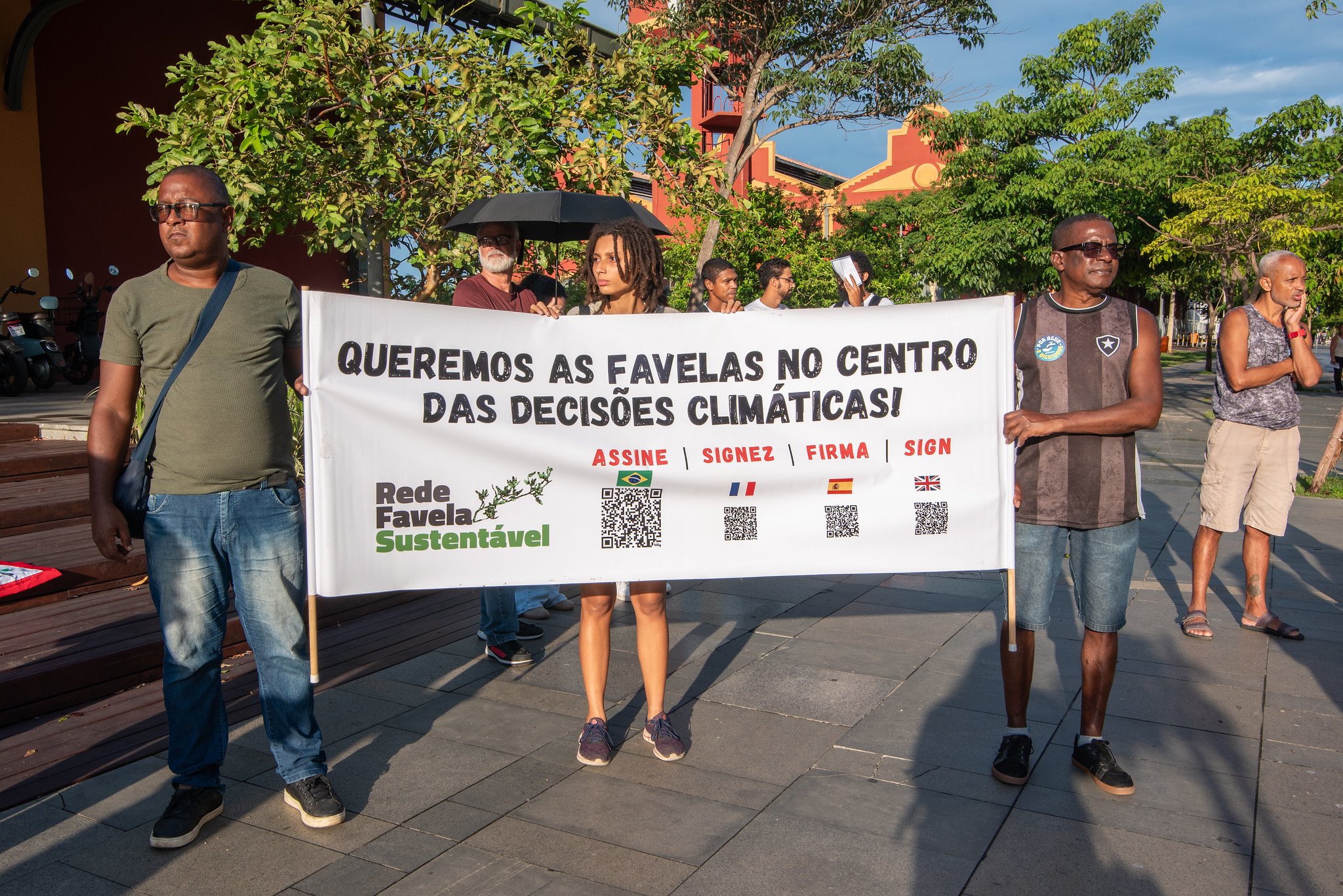
The Sustainable Favela Network** was at the demonstration with its COP Letter From the World’s Informal Settlements, which has been gathering signatures from around the world to highlight the importance of centering the most vulnerable in climate decision-making. Nélio Lopes, coordinator of the Haroldo de Andrade Sustainable Socioeducational Project (PSSHA) in Barros Filho, spoke about the difficulties of accessing water in favelas.
“When we talk about water, we remember our ancestors. It’s like the samba that says, ‘lata d’água na cabeça: lá vai Maria’ [there goes Maria, balancing a tin of water on her head]. So those of us who live in favelas still carry the pain of watching our grandmothers and ancestors carry water, fetch water from wells, drink water however they could… I live in Complexo de Terra Nostra, in Barros Filho, which has the third-lowest Human Development Index numbers in the city of Rio de Janeiro. The folks from [Águas do Rio] are setting up water meters in a place that doesn’t have basic sanitation; where people don’t have water tanks, where people don’t have schools, where every day is a struggle… So community leaders are tied hand and foot. They can no longer bring water to residents, because everything depends on Águas do Rio and people have no water… There’s no environmental education, there are no job opportunities… We ask that they look to the favelas.” — Nélio Lopes
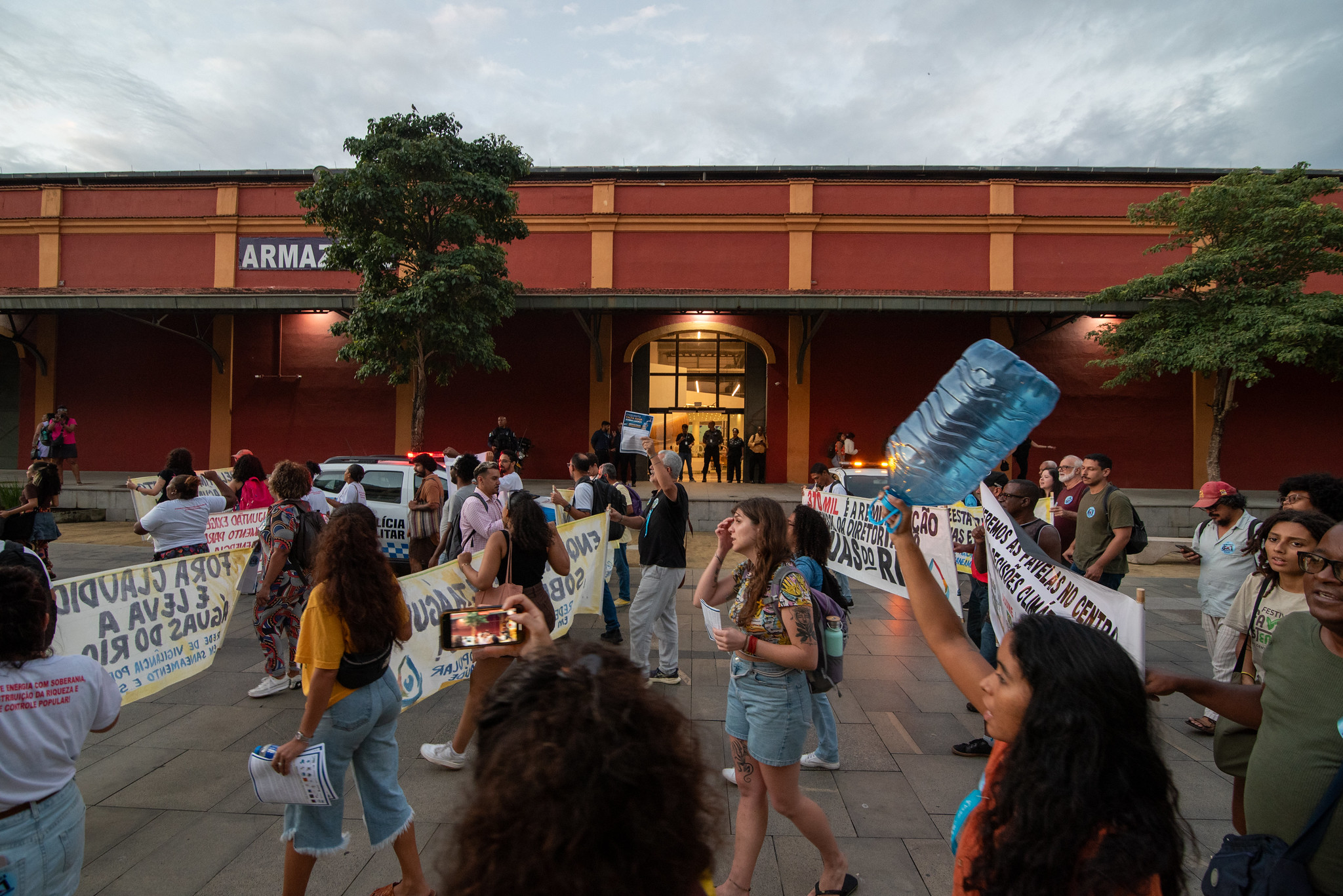
At the end of the demonstration, protesters marched past Águas do Rio’s headquarters, holding banners and chanting slogans, in a collective expression of outrage.
View the Full Album of the World Water Day Demonstration:

*Present at the demonstration were representatives from the Political Science Department at the Federal University of the State of Rio de Janeiro (UniRio), the Canal do Cunha Watershed Observatory, the Movement of People Affected by Dams (MAB), the Fiocruz National School of Public Health, the People’s Budget Forum, FASE, the School of Social Work at the State University of Rio de Janeiro (UERJ), Fiocruz Mata Atlântica, FAM Rio, DataLab, the Sustainable Favela Network (SFN) and the Women’s Secretariat of the Unified Workers’ Central (CUT). Also in attendance were staff members of Federal Deputy Tarcísio Motta, State Deputy Marina do MST, City Councilman William Siri and City Councilwoman Mônica Benício.
**The Sustainable Favela Network (SFN) and RioOnWatch are both initiatives realized by not-for-profit organization Catalytic Communities (CatComm).
About the author: Bárbara Dias was born and raised in Bangu, in Rio’s West Zone. She has a degree in Biological Sciences, a master’s in Environmental Education, and has been a public school teacher since 2006. She is a photojournalist and also works with documentary photography. She is a popular communicator for Núcleo Piratininga de Comunicação (NPC) and co-founder of Coletivo Fotoguerrilha.