


This article is part of a series on the 2026 Brazilian elections, focusing on the perspectives of Greater Rio’s favelas.
In the book Como Nasce um Miliciano? (How Is a Militiaman Born?), journalist Cecília Olliveira builds a narrative based on a rigorous journalistic investigation that, according to her, took two decades to conduct. Covering all of the Rio de Janeiro municipality and the neighboring Baixada Fluminense region within Rio state, Olliveira interviews specialists, activists, favela residents, agents from the State’s various repressive institutions and authorities.
How Is a Militiaman Born? is an archaeological study of Rio de Janeiro’s milícias, local militias characterized by off-duty police mafias that have come to dominate over 50% of the city’s territory, typically generating more terror, exerting greater economic and political control, and repressing local populations more than drug gangs, which still occupy the international imaginary as Rio’s primary protagonists of organized crime. Published in 2025, the book portrays the militia’s power project, its tentacles and its ever-growing role in Rio state elections.
The Life and Death of Cabo Bené: How Are Militiamen Born?
Olliveira traces a historical and political analysis of the militia in Rio de Janeiro state dating back to the 1960s. The militias are an offshoot of death squads. These vigilante groups, formed by police officers, proliferated initially in Greater Rio’s Baixada Fluminense region during the 1970s and 1980s.
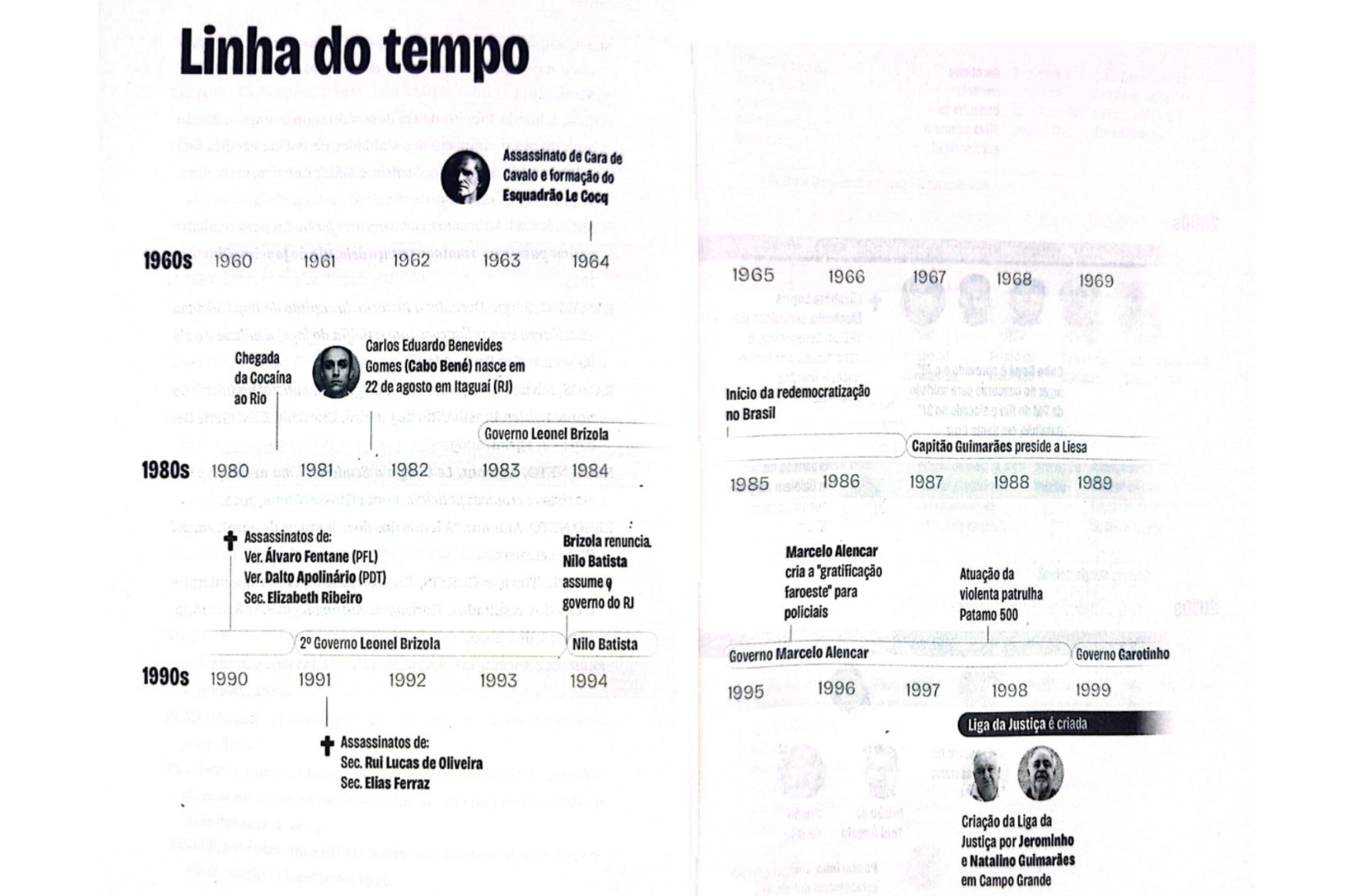
However, instead of choosing to tell this story in an abstract way through generic milestones and information, Olliveira tells the history of the militia through the life story of Carlos Eduardo Benevides Gomes, known as Cabo [Corporal] Bené. In doing so, she demonstrates that the militiaman does not emerge as a single “deviation” or an isolated aberration: he is the product of the institutional, political and economic machinery that links State agents, illegal markets and territorial control.
“The objective of large [police] operations [in favelas] is not necessarily to dismantle the criminal structure, but to reorganize the balance of power within the militias and reinforce the State’s authority over these groups, establishing new agreements and consolidating political alliances.” — José Cláudio Souza Alves
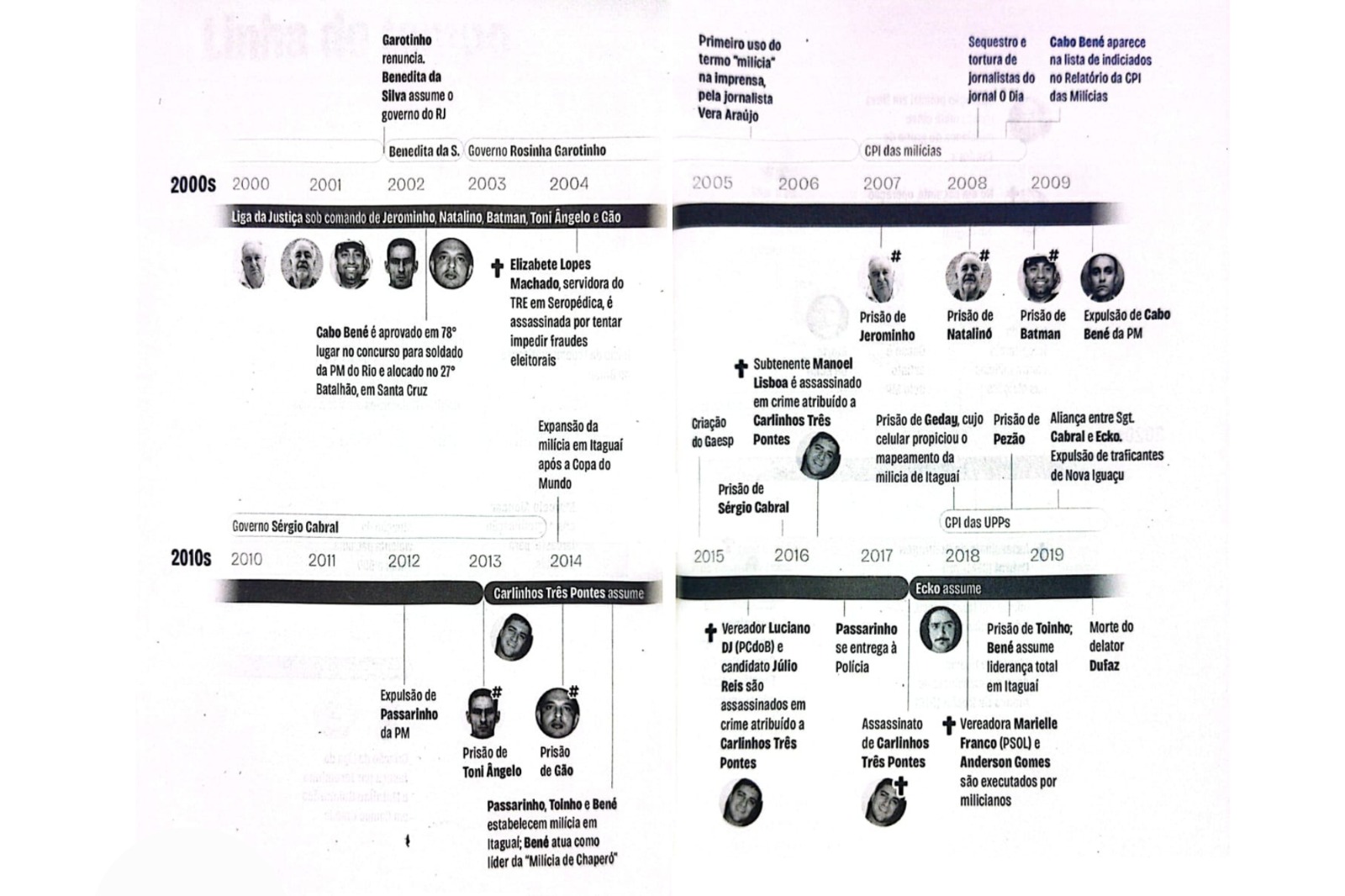
Olliveira’s choice is no accident. More than telling the story of a single character, she uses Bené as the common thread for an analysis of a mode of State violence. Through his story, she explores the precariousness of public security, shady alliances between police officers and gangs, their infiltration into politics and business and other themes.
This allows the reader to follow, on a human scale, through a flesh-and-blood character, the metamorphosis of a Military Police officer into a militiaman. She asks: How does a person who enters the force through a highly competitive public exam and spends years at the Police Academy become a habitual killer and a militia leader?
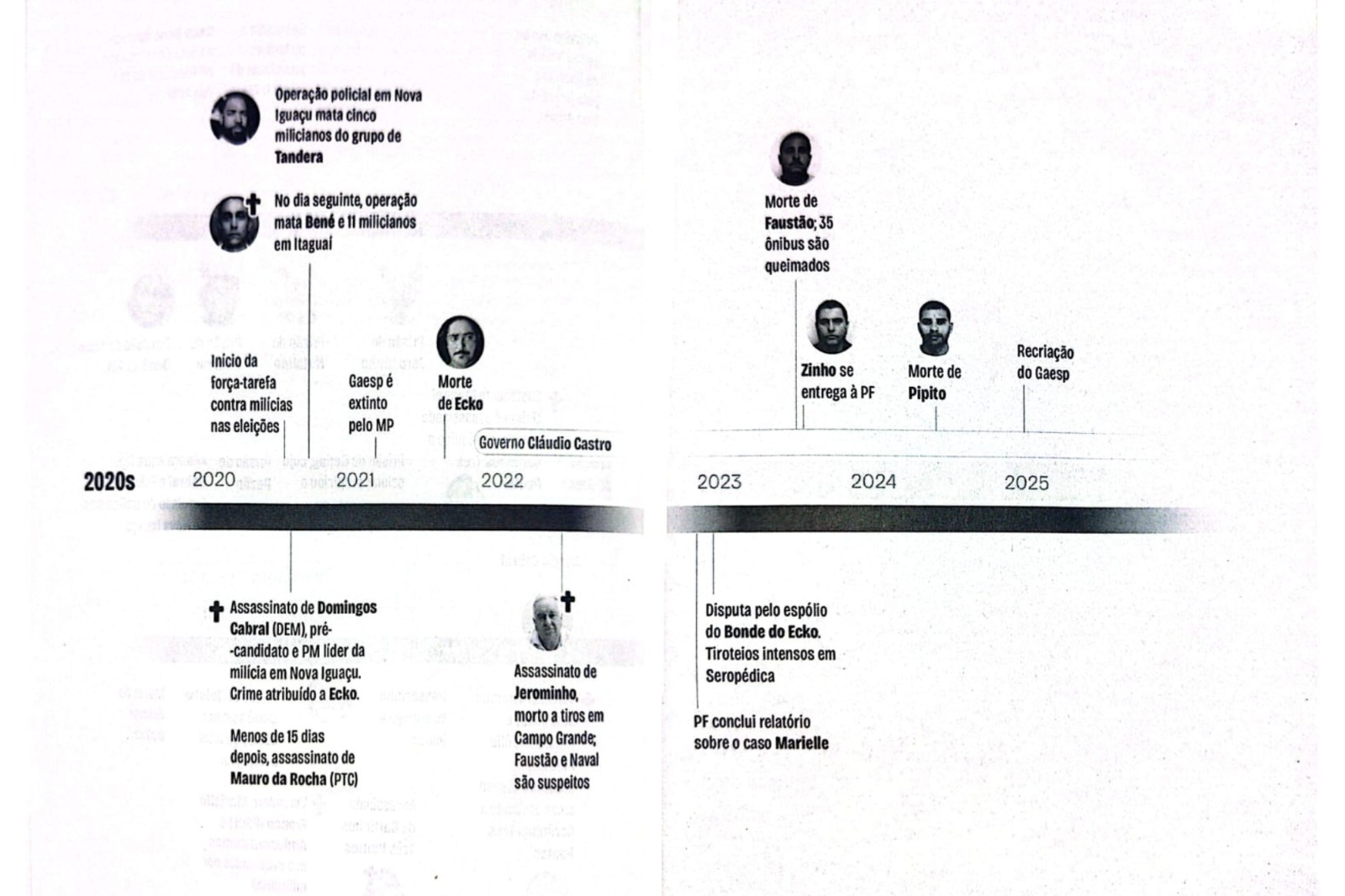
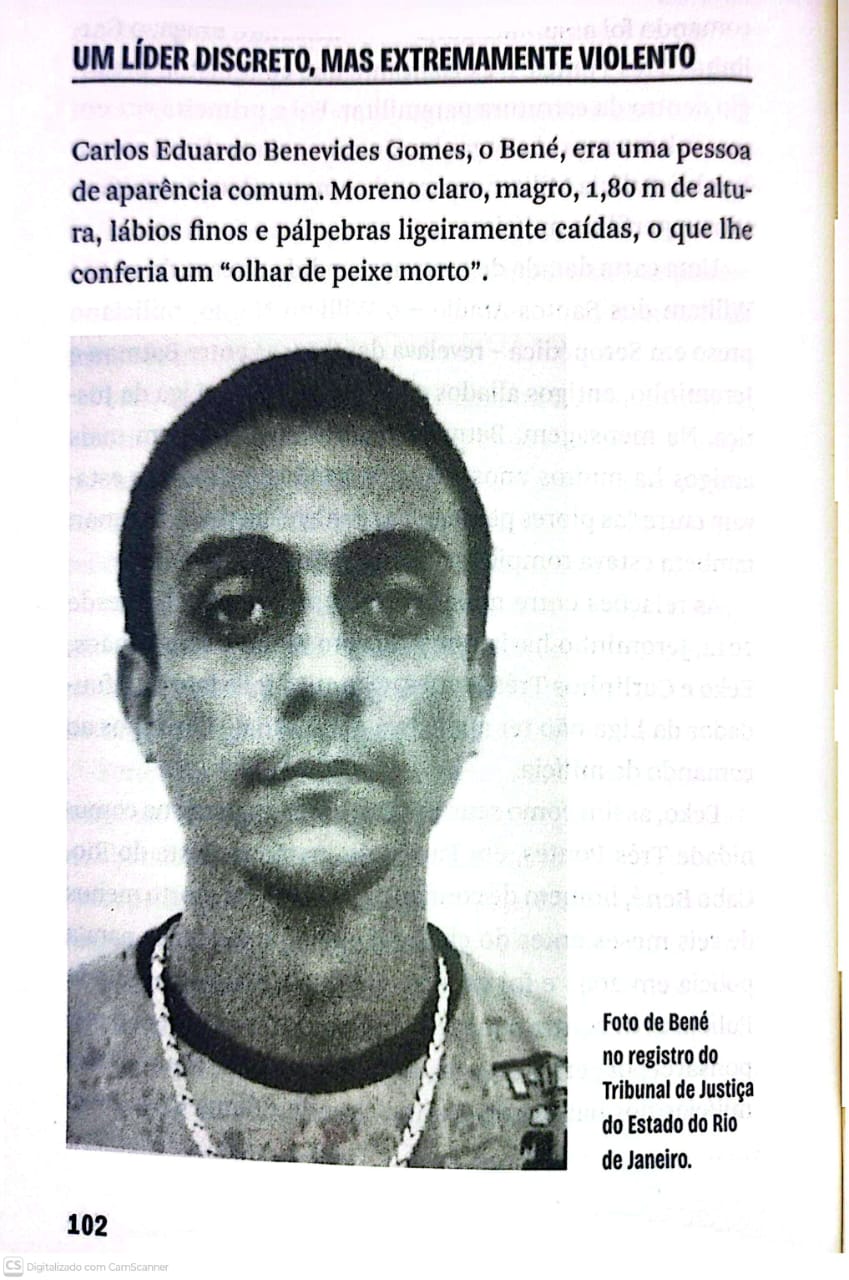
This narrative choice gives the text the speed of a news report while also lending the book sociological density. Bené appears not merely as an individual, a source or an interlocutor: he is the embodiment of a system.
Bené’s rise reveals the mechanisms by which experience in the police forces, armed control of territory, networks of loyalty and the ease of movement between legality and crime combine to produce militia power.
Cabo Bené joined the Rio de Janeiro Military Police (PMERJ) in the early 2000s, starting the soldiers’ training course in 2002. According to Olliveira, this moment is decisive because it inserts Bené not only into a public career but into an institutional universe marked by the logic of war, the promotion of armed toxic masculinity and networks of sociability among police officers that extend beyond formal service.
After graduating, Bené was stationed at the 27th Military Police Battalion in Santa Cruz, in Rio’s West Zone, where he met Antônio Carlos de Lima, known as Toinho, who would become his partner in the militia. The author uses this starting point to show that Bené’s time in the police was not merely part of his backstory: it was there that he acquired training, prestige, access to weapons, the ability to move throughout the territory and the connections that would later prove crucial in the militia world.
Bené got more directly involved in the dynamics of the militia in the neighboring municipality of Itaguaí and Santa Cruz, in Rio’s West Zone, through this network of relationships. He was ultimately expelled from the Military Police in 2009 after being arrested by Civil Police officers in a bar in the West Zone neighborhood of Campo Grande for illegal possession and carrying of firearms, among other offenses.
His expulsion, however, did not mark a break with the world of policing. On the contrary: it marked the moment when he began to openly convert the capital he accumulated within the police force into criminal capital.
Outside the Military Police, Bené further established himself as a militia leader alongside Toinho. This partnership helps explain the transformation of the militia in Rio de Janeiro state throughout the 2000s and 2010s.
Instead of acting solely as armed groups for “security” and extermination, the militia began to function as business structures for territorial domination. As true crime bureaus, exploiting clandestine markets and essential services through extortion: by charging protection fees, controlling informal transport, selling cooking gas (at premium prices) and illegal Internet services, among other activities.
In this context, Bené appears as an important player in the expansion in Itaguaí—a strategic municipality in the Baixada Fluminense and in the West Zone’s area of influence.
“The Port of Itaguaí [is crucial because it receives] one of the militia’s most important and lucrative businesses: TV Box, a device that provides unauthorized access to pay TV channels and streaming platforms, an evolution of ‘gatonet‘ [pirated cable].” — Cecília Olliveira
Over the course of his rise, Bené went from being a mere local enforcer to becoming a more prominent player in the reconfiguration of the region’s militias. According to the book, he took part in a period when these groups were already operating in increasingly sophisticated ways, including through a “franchise” system, expanding their areas of control and forging political and economic alliances.
The author shows that Bené did not simply move from legality into crime. He navigated a gray area in which police training, the use of force, protection networks and the economic exploitation of territory reinforced one another until his death on October 15, 2020. Along with 11 other men, on the eve of the 2020 municipal elections, Cabo Bené was killed during a police operation in Itaguaí.
Bené’s death was presented as a blow against the local militia. However, it serves as proof that the militia is bigger than individual bosses. It is rooted in enduring networks of police protection, political interests, territory-based businesses and the armed control of everyday life.
Multiple Militias, New Alliances: A History of Fragmentation and a Robust Hierarchy
According to Olliveira, the first major shift in the history of Rio state’s militias was the transition from dispersed groups to a coordinated network. This culminated in the creation of the Liga da Justiça (Justice League), which brought together militia bosses from the West Zone and provided s a model that had previously been fragmented and unstable.
The Liga da Justiça is important because it marks the militia’s transition from a local arrangement to a structure of coordination between territories, economic interests and political protection. Under this umbrella, the militia expanded its business repertoire and began to compete not only for communities, but also for votes, public contracts and institutional influence.
At the same time, of the Liga da Justiça’s own force carried within it the seeds of future rifts. According to Olliveira, the consolidation of a hegemonic militia bloc generated disputes over succession, revenue and the autonomy of local commands. In other words, the militia’s “unification” of the West Zone did not eliminate fragmentation altogether; it merely reorganized it around a more solid hierarchy.
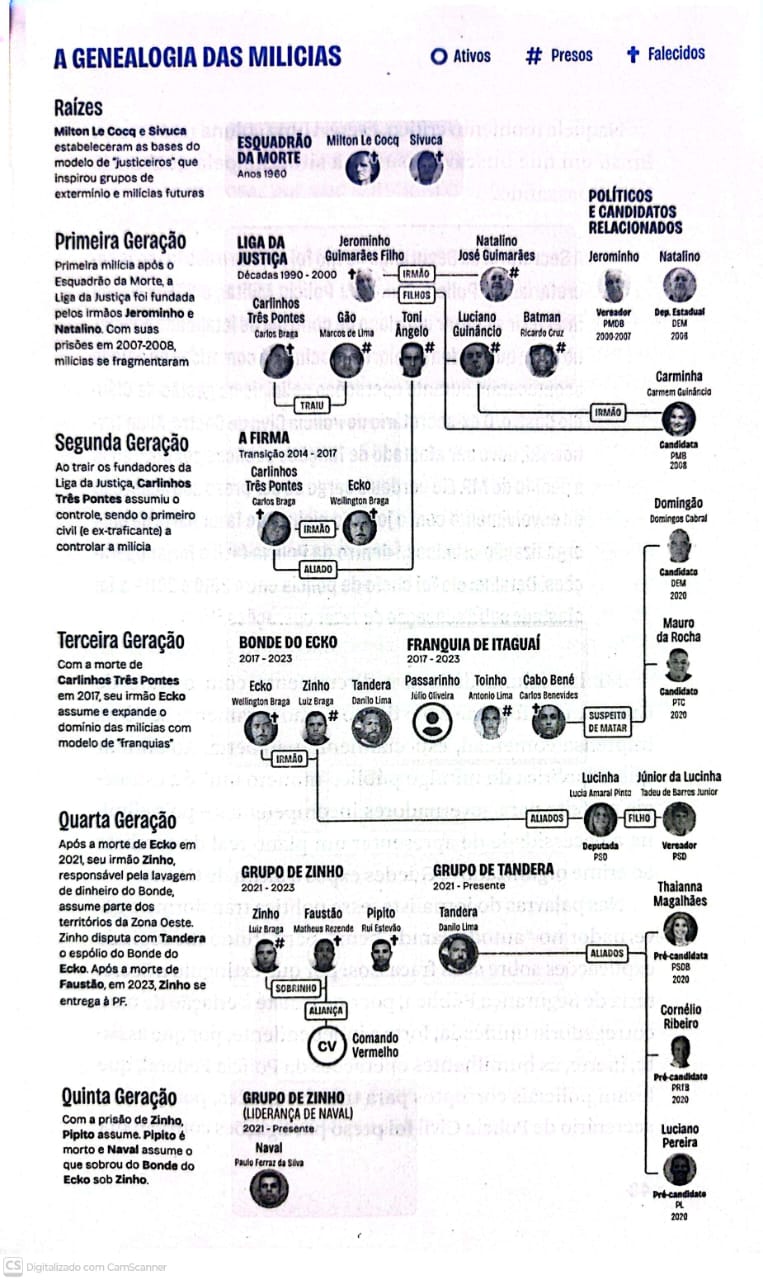
The second decisive moment was the rise of the Braga family, especially Carlinhos Três Pontes and, later, Wellington da Silva Braga, known as Ecko. They turned the Liga da Justiça’s legacy into something closer to a criminal conglomerate. This is where Olliveira situates the shift to a system of “franchises”: smaller or independent militias ceased to exist merely as autonomous gangs and came to be absorbed, subordinated, or pressured into joining a larger structure, one that provided protection, combat know-how, logistical support and political backing in exchange for loyalty and a share in profits.
Expansion into areas such as Itaguaí, Santa Cruz, Campo Grande and parts of the Baixada Fluminense did not happen in a linear fashion, but through annexations, pacts and wars. The Bonde do Ecko (Ecko’s Gang) thus became a milestone in the history of the militia’s subdivisions because it centralized power while, at the same time, multiplying local operational fronts, each with its own leadership, revenue and degree of autonomy.
According to Olliveira, to follow Bené’s trajectory was to follow the transformation of a Military Police officer into the leader of a Bonde do Ecko franchise. His partnership with Toinho shows how the big militia model depended on mid-level bosses capable of running territorial wars and local business operations. Bené is, therefore, the link between the militia’s “big brand” and its expansion throughout Greater Rio.
Bené embodies the moment when the subdivision of the militia ceases to be merely geographic and becomes functional, with regional bosses responsible for imposing the conglomerate’s authority in strategic areas. From then on, the history of the militias in Greater Rio is also the history of their rifts. The most emblematic case being that of tensions between Ecko and Tandera.
Today, Greater Rio is home to an ecosystem of competing militia factions, though they remain linked by the same business logic and their relationship with the State. The legacy of the Liga da Justiça, the Bonde do Ecko, Tandera and others endures in the form of a territorialized market that combines extortion with monopolized services.
Militias currently operate through: land grabbing, particularly in environmentally protected areas; illegal sand mining and extraction; the fuel sector; fraudulent businesses for money laundering; monopolies over the cooking gas trade, cable television and Internet services; land subdivisions, rental exploitation and real estate development; drug trafficking; vote-herding practices; armed control of territories; the collection of protection fees; control of informal transport; contract killings; the systematic use of violence as a market-regulating principle; and assassinations as a form of political influence. All of this in symbiosis with the State and its agents.
The Militia Is Not a Parallel Power: It Is the State at Work
Olliveira makes this point repeatedly throughout the book: the militia is not a parallel power. It is a phenomenon that grows from within the State, through its own agents, drawing on the State’s institutions as well as its symbolic legitimacy. It is no coincidence that the militias were once known as polícia mineira [literally “Minas-style police,” this is an older Rio term for extralegal police protection rackets] and enjoyed the explicit public support of politicians and public authorities.
“The militia is not a parallel power—it is the State itself working for the benefit of criminal groups, often made up of elected officials. It is no coincidence that five former Rio governors have been arrested or that city councilors and state legislators maintain direct ties to these groups. What we see is not a failure of the system, but rather the system operating exactly as planned.” — Cecília Olliveira
For this reason, Olliveira and other scholars reject categories that obscure the defining characteristic of the militia. This is the case with the term “narco-militia.”
“That is a huge lie. The idea that there is a narco-militia is a misconception. High-ranking military personnel have not disappeared; they simply blend into the background as part of their own strategy, ensuring their continued place within the system. What really matters to these officers is preserving their careers and their right to carry firearms [otherwise illegal in Brazil], since this allows them to move freely through different spheres of society.” — José Cláudio Souza Alves
This demonstrates one of the journalist’s greatest strengths: her ability to foster deep conceptual discussions about categories and their impact on the debate around militias without becoming overly complicated or excessively academic. This while refusing to embrace simplistic explanations.
Olliveira shows that the militia is a specific form of power, sustained by a combination of police ethos, social authoritarianism, illegal markets and political capital. In this sense, the book’s title is particularly apt: How Is a Militiaman Born? It refers not only to the moment when a police officer turns criminal, but to a deeper social and institutional process, where the boundaries between legality and illegality were already eroded long before any public official explicitly embraces crime.
The militiaman is born from a culture of war and impunity; from toxic, precarious and armed masculinity; from institutional and social networks of protection; and from a State that outsources, tolerates and directly participates in violence, also for the purpose of turning a profit. The result is a portrait in which the militia emerges not as an anomaly outside the State, but as its latest iteration, transforming the State’s repertoire of coercion into an extremely profitable model of business and territorial governance.
Olliveira’s central reflection is that if the militia is a byproduct of the State apparatus itself, then fighting it requires more than highly publicized police operations in favelas. For this, we must visit the gated condos of Barra da Tijuca, offices of public officials and state government agencies. It means rethinking police training, oversight of the State’s repressive apparatus and the militias’ pervasive influence over elections and infiltration into every branch of government. And ultimately, it is about changing the architecture of public security, the political economy of peripheral areas and the alliances between violence, votes and markets.
Ver essa foto no Instagram
About the author: Julio Santos Filho has been Chief Editor of RioOnWatch since 2020. Holding a bachelor’s degree in International Relations (UFF) and a master’s degree in Sociology (IESP-UERJ), in 2021 he edited the award-winning series “Rooting Anti-Racism in the Favelas.” This project won silver at The Anthem Awards in the Diversity, Equity, and Inclusion category for Best Local Awareness Program, the Megafone Activism Award for Best Independent Media Report, and two motions of praise and recognition from the Rio de Janeiro City Council’s Special Commission to Combat Racism.