
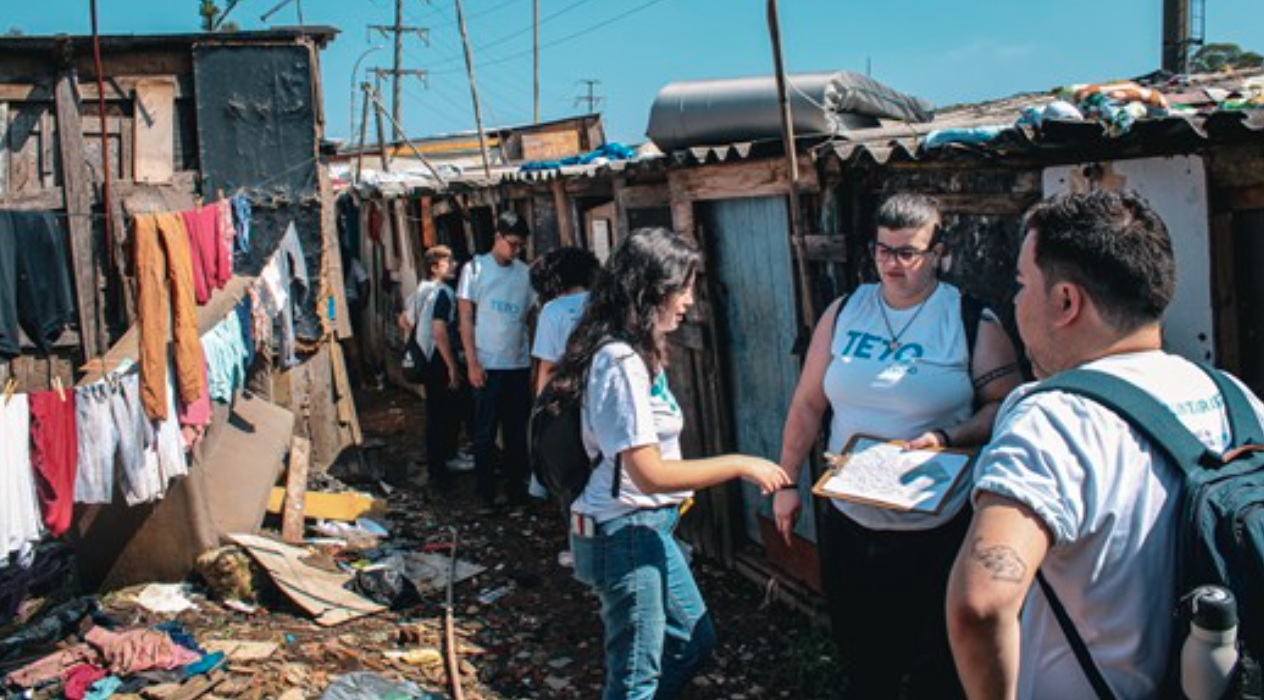

For the original article by Camila Jordan published in Observatório do Terceiro Setor, click here.
In May of this year, Baku, Azerbaijan, hosted the 13th World Urban Forum—the largest global event on the future of cities, held every two years by UN-Habitat. WUF13 was unprecedented in scale, bringing together over 58,000 participants from 176 nations. And for those working with social housing, it made evident that the global housing crisis has reached a breaking point—and that this affects, disproportionately and cruelly, exactly those whom society and public authorities ignore the most.
I was in Baku representing TETO Brasil. It was both a privilege and a responsibility. As I keep repeating, housing needs to be at the center: it is the first line of defense against the effects of the climate crisis. This is not rhetoric. It is the reality of millions of Brazilian families currently living through an acute housing crisis.
A New Center of Gravity on the Global Agenda
The UN-Habitat 2026-2029 Strategic Plan marks an important turning point: for the first time in many years, adequate housing is at the center of the global urban agenda, not as a side issue to development, but as a fundamental human right, directly linked to dignity, health, safety and a family’s ability to access every other opportunity in life.
The Baku Call to Action, the document that emerged from Baku, is the result of months of consultation with civil society organizations, local governments, community movements, researchers and leaders from around the world—a process to which we also contributed. It recognizes what those working in favelas have known for decades: the housing crisis is not accidental. It is structural, systemic and politically produced. Around the world, an estimated 3.4 billion people currently live in inadequate housing. In Brazil alone, over 17 million people live in informal settlements.
This global momentum matters. It creates a window of opportunity for countries like Brazil to accelerate reforms, scale up investment and, perhaps most difficult of all, ensure financing reaches those who need it most.
Climate and Housing: An Equation That Can No Longer Be Ignored
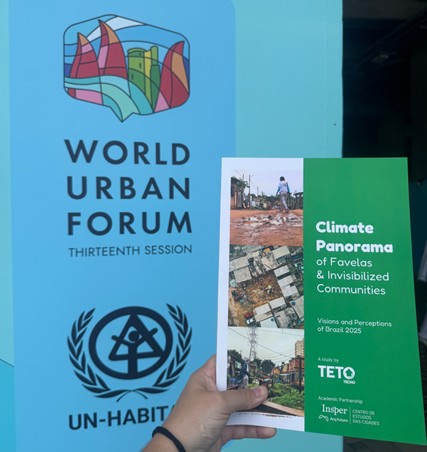
One of WUF13’s most powerful themes was the connection between the climate crisis and housing. This was no coincidence: the floods that devastated communities in Rio Grande do Sul, the rains that bring down hillsides in São Paulo state and the extreme heat that silently kills in neighborhoods without tree cover—all of these strike first, and far harder, those living in precarious housing.
Climate Panorama, a new study brought to Baku by TETO, conducted in partnership with Insper and with institutional support from UN-Habitat, mapped 119 informal settlements across Brazil to understand how residents perceive the effects of the climate crisis on their communities and in their homes. The findings are striking and solutions already exist—many developed by communities themselves, waiting for governments to adopt them with the urgency the crisis demands.
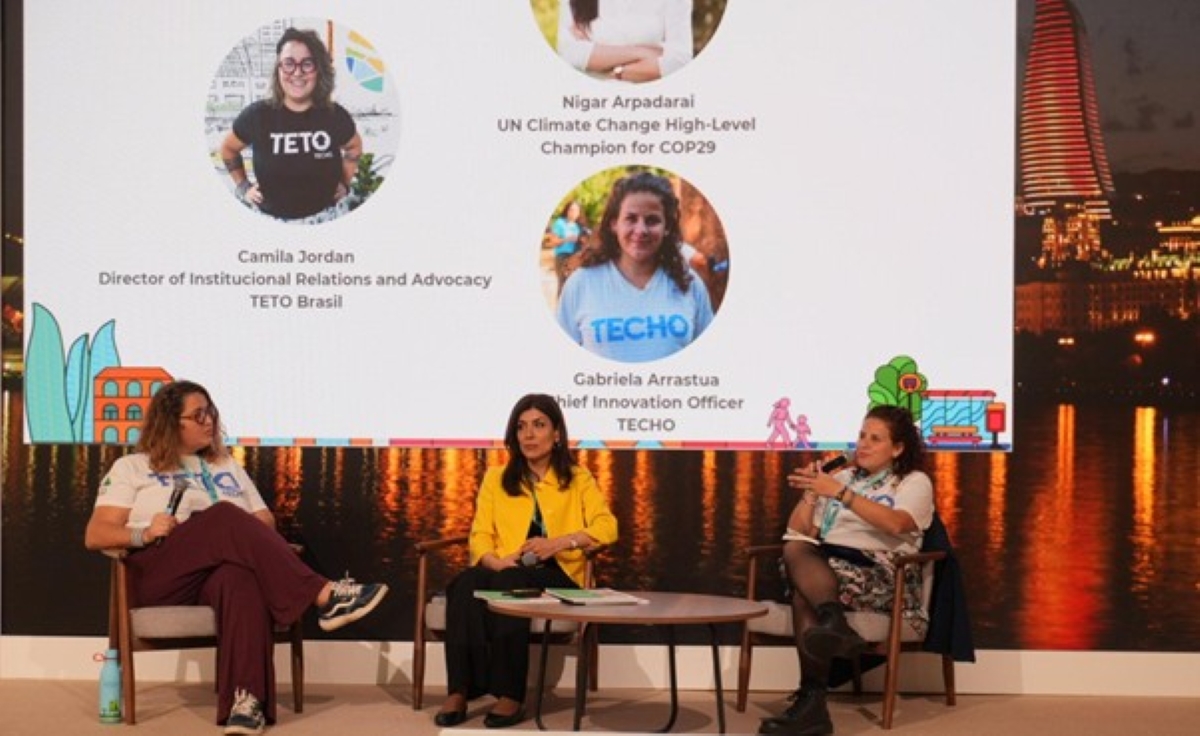
In one of the forum’s most memorable panels, we had the opportunity to bring our Latin American experience into dialogue with Nigar Arpadarai, the UN Climate Change High-Level Champion for COP29, to discuss precisely this challenge: how to use hyperlocal data and hyperlocal needs to influence national and federal decision-making arenas, where resources must be allocated and distributed to reach these communities. It is a problem of governance, political will and financing—all three at once.
The Baku Call to Action makes this point clearly: families living in favelas and informal settlements bear the brunt of floods, extreme heat, landslides and environmental degradation. They are also the ones who receive the least support. Those facing a housing emergency are, by definition, on the front lines of every crisis—without protection, without data and without a voice in the arenas where decisions are made.
Funding That Never Reaches Those Who Need It
An entire chapter of the Baku Call to Action is dedicated to a problem anyone working in philanthropy or social finance in Brazil knows well: funding does not reach where it is needed most. Housing finance systems are fragmented, disconnected and inaccessible to the lowest-income families. Public investment is shrinking. Private financing fails to reach the communities where it is needed most.
In Brazil, this problem has an even more specific dimension: housing has historically been one of the causes least supported by national philanthropy. While health, education and the environment mobilize donations and impact investments with relative ease, the housing emergency continues to be treated as a government responsibility—one the government itself has also failed to address. The result is an enormous gap, filled by organizations like TETO despite insufficient resources and growing demand.
While there is no shortage of global commitments, what is missing is for those commitments to be converted into accessible, long-term resources distributed where they are most needed. The Baku Call to Action explicitly calls on development banks, the private sector, governments and philanthropy to develop new financing mechanisms that reach favelas and informal settlements—and for housing to stop being treated as a high-risk, low-return investment when, in fact, it is the foundation of everything.
The Emergency That Cannot Wait
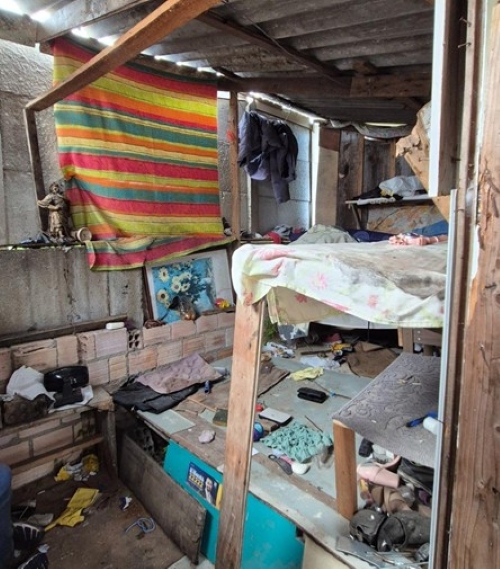
TETO works with a tangible reality: families living today in the most precarious makeshift homes without sanitation, exposed to floods and landslides, without privacy or security. The emergency housing we build is not a permanent solution—and we have never claimed it is. It is a bridge between the violation and the guarantee of rights, between urgency and structural solutions, between invisibility and recognition.
Before any intervention, we carry out a legal and technical assessment of the area. We reduce immediate risks to life and guarantee a minimum standard of dignity while public authorities and society work to develop long-term solutions. To claim that only definitive solutions matter is to ignore that some families’ lives are at risk right now. The emergency cannot wait. In the same way no one waits for a structural solution to eat, no one should have to wait for adequate housing.
What’s Next
We left Baku galvanized. The next World Urban Forum, two years from now, will take place closer to home, in Mexico, on our continent. It will be an opportunity to show up in force: with our teams, with our community leaders, with the data we continue to produce and with the voices of those surviving the crisis.
The momentum exists. The global agenda is finally aligned with what Brazil’s favelas have been demanding for decades. What we need now is to turn this alignment into real resources, concrete policies and financing that reaches communities on the ground.
Because no family should have to live through a housing emergency. And until that becomes a reality, we will be there, building homes.
About the author: Camila Jordan is an urban planner with a Masters in Public Administration from Columbia University. Director of Institutional Relations and Advocacy at TETO Brasil, she specializes in housing justice and was recognized by Bloomberg Línea as one of the 500 most influential people in Latin America.