
![The Rio AI City project claims to be sustainable: “An approach grounded in local realities transforms the data center into an open, multifunctional campus that reflects Rio’s cultural dynamics, strong local identity, and Brazil’s environmental richness,” [according to Hyphen], the international architecture firm that developed the project.](https://rioonwatch.org/wp-content/uploads/2026/09/Rio-AI-City-calls-itself-sustainable.jpg "The Rio AI City project claims to be sustainable: “An approach grounded in local realities transforms the data center into an open, multifunctional campus that reflects Rio’s cultural dynamics, strong local identity, and Brazil’s environmental richness,” [according to Hyphen], the international architecture firm that developed the project.")

This article is part of our series reflecting on the impacts of mega-events on Rio de Janeiro 10 years after the 2016 Olympic Games.
As the Rio AI City project, a data center complex slated to be the largest in Latin America, developed by Elea Data Centers in partnership with the City of Rio in the Olympic Park area, moves forward, residents find themselves having to debate the project without opportunities for dialogue and understanding with the City. Described as “one of the world’s first sustainable AI districts,” the company reports an initial energy capacity of 1.5 GW, with RJO1 in operation and RJO2 under construction, and states that the project will use waterless cooling systems. But won’t a project of this scale generate costs for the population?
The so-called “cloud,” the global network of servers that store, manage and process all of our data on the Internet, relies on infrastructure that occupies physical space: buildings, servers, cables, substations, cooling systems and a continuous supply of electricity.
What this physical infrastructure might mean for Brazil’s water, energy and neighborhoods was the focus of the roundtable discussion “Impacts of Data Centers on Brazil’s Water Security,” held on August 25 at the Center for Legal and Political Sciences of the Federal University of the State of Rio de Janeiro (UniRio) in Botafogo. The event brought together Maria das Graças, from the State, Economic Groups and Public Policies research group (ECOPOL), affiliated with UniRio’s Center for Studies and Research on Social Struggles (NELUTAS); Fabrina Furtado, a professor in the Graduate Program in Social Sciences in Development, Agriculture and Society (CPDA) at the Federal Rural University of Rio de Janeiro (UFRRJ); and Sandra Quintela, an economist and member of the coordinating team at Jubilee South Brazil Network. The discussion was moderated by João Roberto Lopes Pinto, professor at UniRio’s School of Political Science and coordinator of ECOPOL/NELUTAS. The event was organized by the Popular Network for Sanitation and Health Monitoring and the Cry of the Excluded.
The panel discussed the significant additional physical infrastructure now required by the growth of artificial intelligence and its potential effects on resources and communities, especially in areas that have historically suffered from lack of water, electricity and sufficient housing.
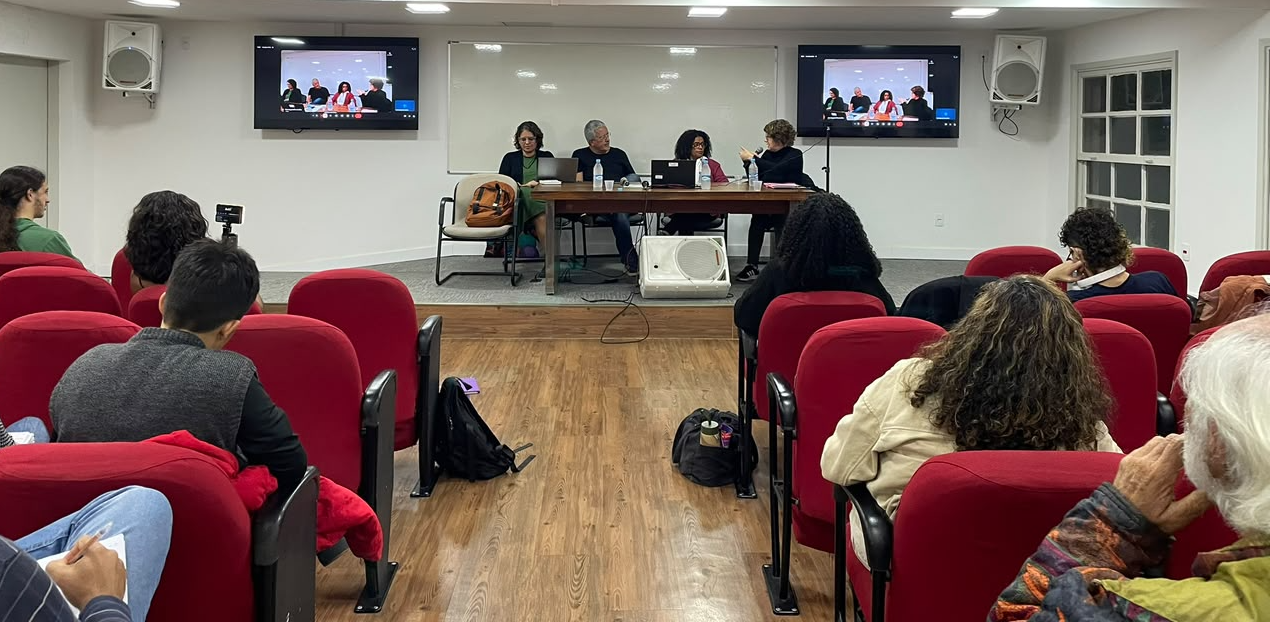
It was precisely the idea of a seemingly immaterial technology that sparked the discussion. Maria das Graças presented the results of research on the “materiality of the cloud” and compared data centers to a “digital factory floor”: highly automated structures with servers operating continuously and a constant need to dissipate the heat generated by processing.
In her assessment, the State is not merely a regulator. Federal, state and municipal policies have been creating incentives, regulations and infrastructure to attract large-scale projects. Das Graças questioned, however, what preliminary studies, social compensation measures and environmental safeguards accompany this process.
By bringing the debate to Rio, she contrasted the need for operational continuity at these facilities with the reality of communities that face water supply shortages and inadequate sanitation. For the researcher, the issue is not limited to the technology used inside the buildings, but also involves the priorities established for the use of public infrastructure and resources.
“The cloud isn’t in the sky, it’s on the ground.” — Fabrina Furtado
According to the UFRRJ researcher, focusing solely on a data center’s direct water consumption may overlook other stages in the chain that support digital infrastructure.
She cited electricity generation, equipment manufacturing, mineral extraction and the construction and maintenance of data centers. The question, therefore, would not be merely “how much water” a facility uses, but where and how the resources needed for its operation are sourced and which communities live with these processes.
The professor also questioned the use of labels such as “green” or “sustainable” in isolation. The use of electricity from renewable sources or more efficient technologies, she said, does not eliminate the need to examine how the energy infrastructure was built and what territorial conflicts may accompany it.
The northeastern state of Ceará was given as a concrete example. The Pecém Data Center, located in Caucaia in the Fortaleza metropolitan area, is part of a project associated with ByteDance, the parent company of TikTok. In May, the Federal Public Prosecutor’s Office (MPF) and the Federal Public Defender’s Office (DPU) recommended adjustments to its environmental licensing process before the start of operations. Both agencies identified weaknesses in the environmental assessment, demanded consultation with the Anacé Indigenous people and other traditional communities and called for enhanced monitoring of water, electricity supply, archaeological and socio-environmental issues.
For Furtado, cases like the one in Caucaia serve as a reminder that large-scale development projects do not arrive in “empty areas.” They are established in places where communities, ways of life, other infrastructure and pre-existing conflicts already exist.
Sandra Quintela broadened the discussion to include the impacts perceived by residents living near large facilities. In addition to water and electricity, she highlighted land use, urban planning, noise, vibration, electronic waste and quality of life. According to her, these issues tend to be addressed and regulated by different government agencies, without an integrated assessment of their cumulative effects.
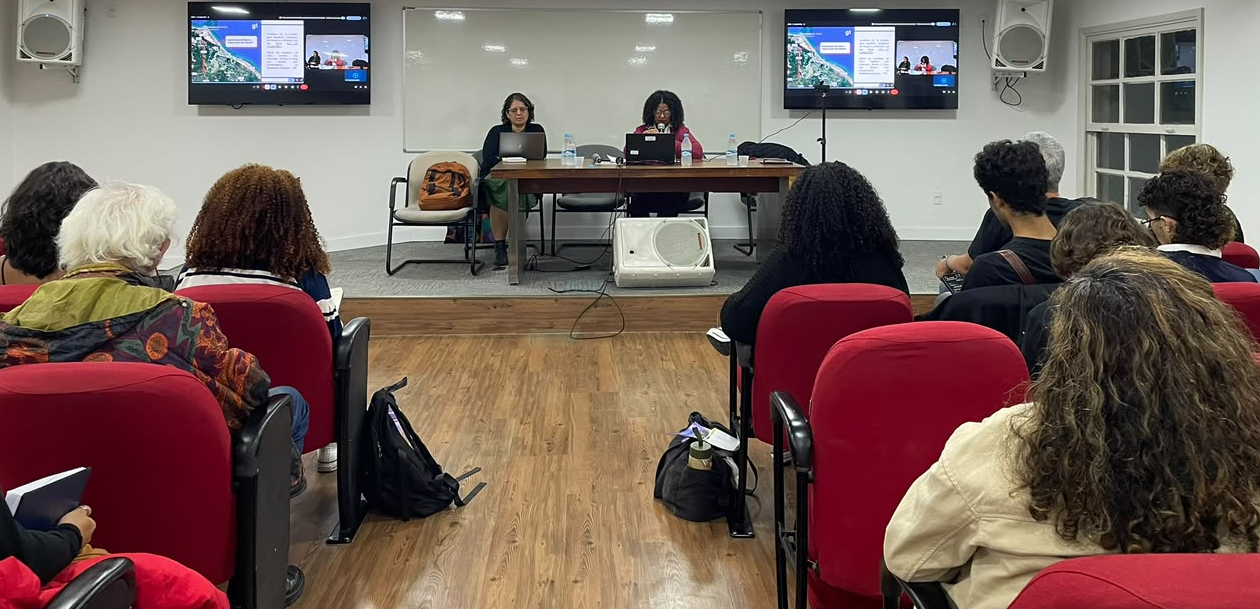
The economist mentioned movements in the United States against the expansion of data centers and argued that international experiences should serve as a warning to Brazil. She also linked the rush for new projects to competition among states and municipalities for investments, tax incentives, land and infrastructure.
The promise of job creation was another point questioned during the roundtable discussion. Participants distinguished between jobs created during the construction of data centers and those maintained after highly automated facilities begin operations. They called for greater transparency regarding the economic commitments made by these projects because, after all, there are few long-term jobs associated with these facilities.
This concern was also reflected in audience participation. Licinio Machado Rogério, president of the Federation of Residents’ Associations of the Municipality of Rio de Janeiro (FAM-Rio) and one of the coordinators of the Urban Mobility Forum, argued that water and electricity consumption, noise and the actual generation of jobs should be discussed before projects are presented to the public merely as a sign of development, as is usually the case.
Toward the end, the panelists returned to the rapid advancement of artificial intelligence. Furtado warned that focusing responsibility on the individual use of digital tools could shift the discussion away from the corporate scale of the technology and from decisions made by companies and governments regarding where and under what conditions to install the infrastructure that supports it.
The discussion concluded by reinforcing an idea that ran through the presentations: what appears to be immaterial on screens depends on concrete structures and decisions regarding electricity, water, land use and public investment. For the participants, this discussion needs to take place before the projects are firmly established.
“What comes first? The thirst of machines or the lives and basic needs of our populations?” — Maria das Graças
About the author: Felipe Migliani has an undergraduate degree in journalism from Unicarioca and post-grad in Investigative Journalism and Data Journalism. He works as a reporter and media advisor, having published stories with outlets such as Meia Hora, Estadão, Agência Lume, PerifaConnection, Ambiental Media, Gênero e Número, Olhos Jornalismo and ND Mais.