
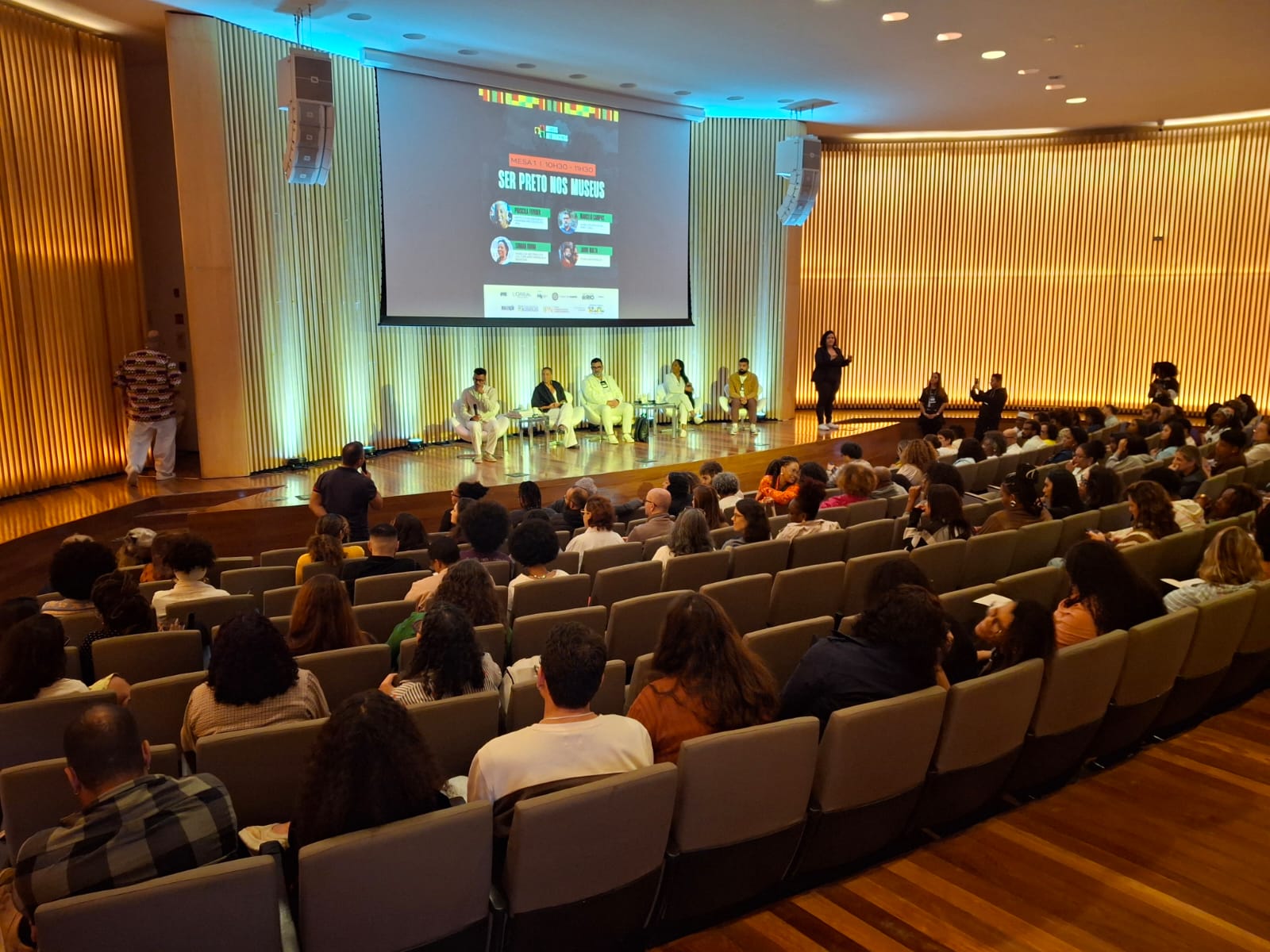

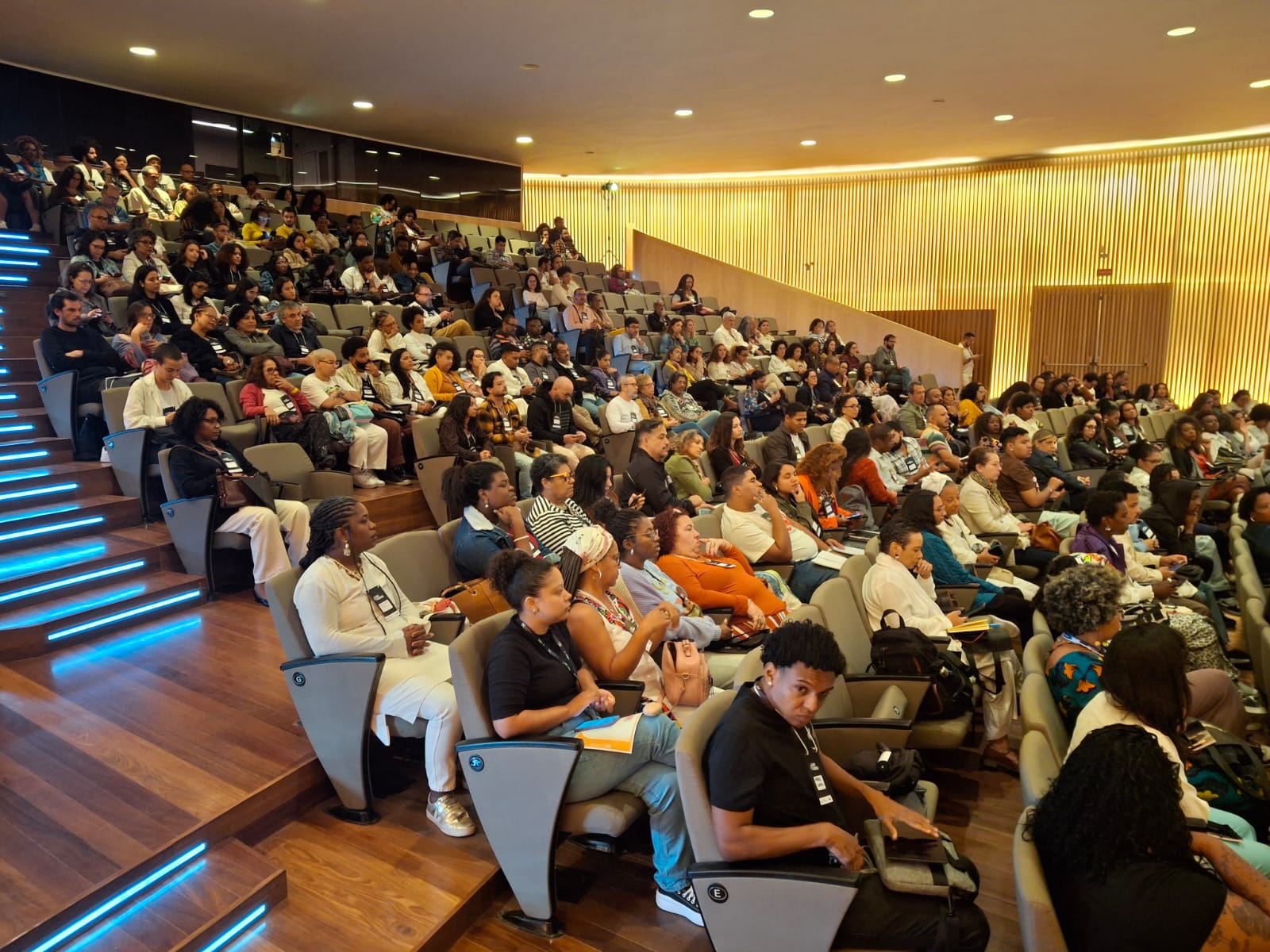
On Friday, May 30, Rio de Janeiro’s Museum of Tomorrow, located in the city’s Port Region, hosted the 1st Seminar of the Anti-Racist Museums Program. Co-organized by the New Blacks Institute (IPN) and the Brazilian Institute of Museums (Ibram), the seminar marked the starting point of a program which aims to establish an anti-racist agenda within museum spaces. Rooted in the philosophy of “aquilombamento,” the program will train 200 professionals from museums and cultural centers across Rio, São Paulo, and Bahia in anti-racist practices.
Representing the Museum of Afro-Brazilian History and Culture (MUHCAB), the institution’s director-president, Sinara Rúbia, took part in the panel “Being Black in Museums,” highlighting the symbolic and structural impact of Black women’s presence in strategic positions within museums. Read Sinara’s full speech below:
My story doesn’t start with me…
Based on the knowledge preserved through my family’s oral tradition—and in the face of the erasure surrounding the origins of Black people in our country—I choose to reaffirm that my story begins with my great-great-grandmother, Rufina.
It passes through Francelina, my great-grandmother.
It echoes in the steady footsteps of my grandmother, Antônia.
It gains shape in the courage of my mother, Tânia.
It lives in me, Sinara.
And carries on, bright and full of hope, in my daughter, Sara.
Six generations. A lineage of strength. Of wisdom passed on through glances, through touch, through care… Of stories that survived the crossing, forced silence, erasure…
Today, I stand here, in this symbolic space—the Museum of Tomorrow—to speak from a place I inhabit with courage and awareness:
Being a Black woman in the museum.
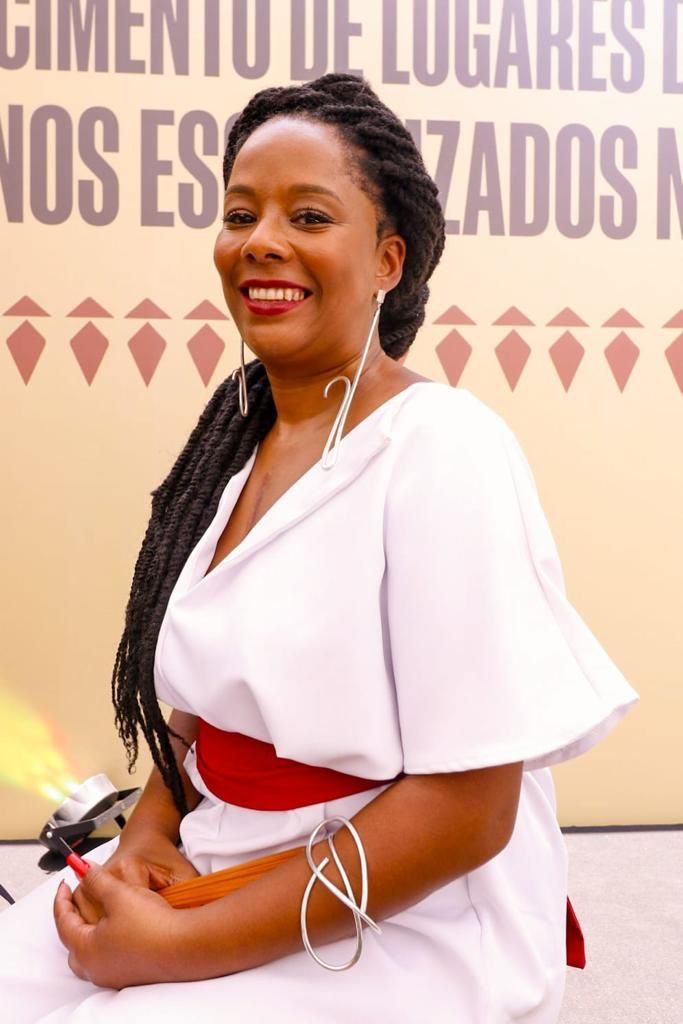
I am the director-president of MUHCAB, the Museum of Afro-Brazilian History and Culture. But before that, I am a daughter of the diaspora. An educator, a writer, a storyteller. I live inspired by the griot tradition.
Through the paradigm of the griots of the diaspora—whose epistemological knowledge is preserved through oral tradition—I know that a museum is not just a place to store objects:
It is a place to ignite memories.
For a long time, museums were spaces where Black people appeared as objects, not as subjects. We were on walls, but not in the planning. In collections, but not in leadership. In photos, but denied a voice.
Today, in this auditorium, I see something that for a long time was denied to us: Black presence. Abundant. Powerful. Speaking from a place of voice.
But let us not be mistaken, and I must say this clearly: this is still not the norm. It still challenges structures.
My presence in a position of cultural leadership is still an exception. An exception that must urgently become the rule.
Because being a Black woman in a position of institutional leadership also means confronting everyday racism. It means being pierced by doubts—unspoken, but always implied.
It means constantly having to prove that you know. That you are capable. That you are worthy. That you are knowledgeable.
It means having to prove that you can direct a Black museum like MUHCAB, or any museum for that matter. Like this one, for example: the Museum of Tomorrow.
And still, even with all these daily challenges, this is my place. And with my head held high and my feet firmly planted, I say:
I am where I’m meant to be.
At MUHCAB, we built a museum that not only preserves stories and histories, but summons life. It calls upon youth. It brings forth knowledge that was left aside.
There, every cultural project, every workshop, every discussion group, every samba circle, every training session [we hold]—it’s more than just an activity.
It’s reparation in motion.
Being a Black woman in the museum means no longer accepting that others speak about us, without us. It means occupying the curatorship office, the decision-making office, the budget office—when there is a budget.
Being a Black woman in the museum means recognizing yourself in other Black women who, like me, tread solitary paths, but are not alone. We exist. And when we come together, structures tremble.
Being a Black woman in the museum means breaking with time.
It means facing the past, eye to eye. Building a present where we fit in fully. And imagining a future in which our existence is not resistance, but celebration.
Today, in this museum of tomorrow, I affirm: tomorrow begins when we walk in. With our memories. Our stories. Our names.
And when we walk in together, it’s not just the museum that changes—it’s the world.
Thank you. And much axé.*
*Axé is a word of Yoruba origin used in Afro-Brazilian religions. It refers to a sacred life force that flows through all things. Using it here as a final greeting, Sinara Rúbia offers her audience and the reader strength, blessings, and positive energy. It is a farewell, and a wish for power, connection, and protection.