
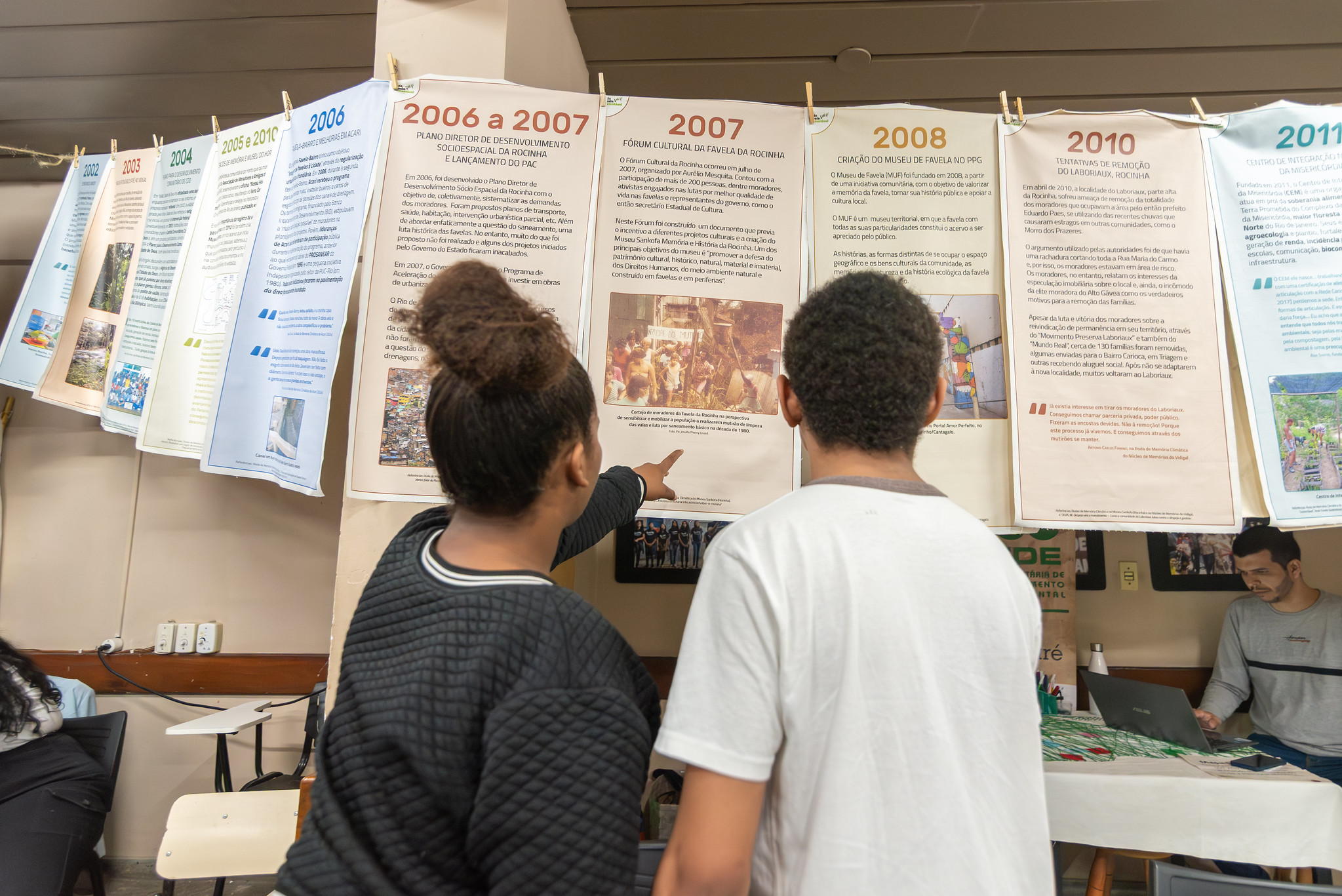

Following an enthusiastic reception during its tour through Maré, Acari and Rio das Pedras—favelas where it held a busy schedule of activities—the Favela Climate Memory exhibition has arrived in City of God, in Rio de Janeiro’s West Zone. Organized by the Sustainable Favela Network (SFN)*, the exhibition has been open to the public since September 17 at Dorcelina Gomes da Costa and three other municipal schools in the community. The Alfazendo Group, a founding member of the SFN from City of God, was responsible for the local tour, deeply engaging almost all students and faculty at the four host schools. Moving forward, the Favela Climate Memory exhibition materials are being integrated into the teaching materials of Eco Rede, the socio-environmental education project run by Alfazendo in numerous local schools.
On opening day at the Dorcelina Gomes da Costa Municipal School, young educators from the Eco Rede project used the exhibition’s banners, timeline and Basin of Memories to engage students in discussion about the history of City of God. Gabrielle da Conceição da Silva, pedagogical coordinator of Eco Rede, explained the idea.
“The [Eco Rede] project has been running in the community for 14 years. Every year we come up with a different idea: memory games, puzzles, giant board games… This year, our proposal is a little different: an exhibition.” — Gabrielle da Conceição da Silva
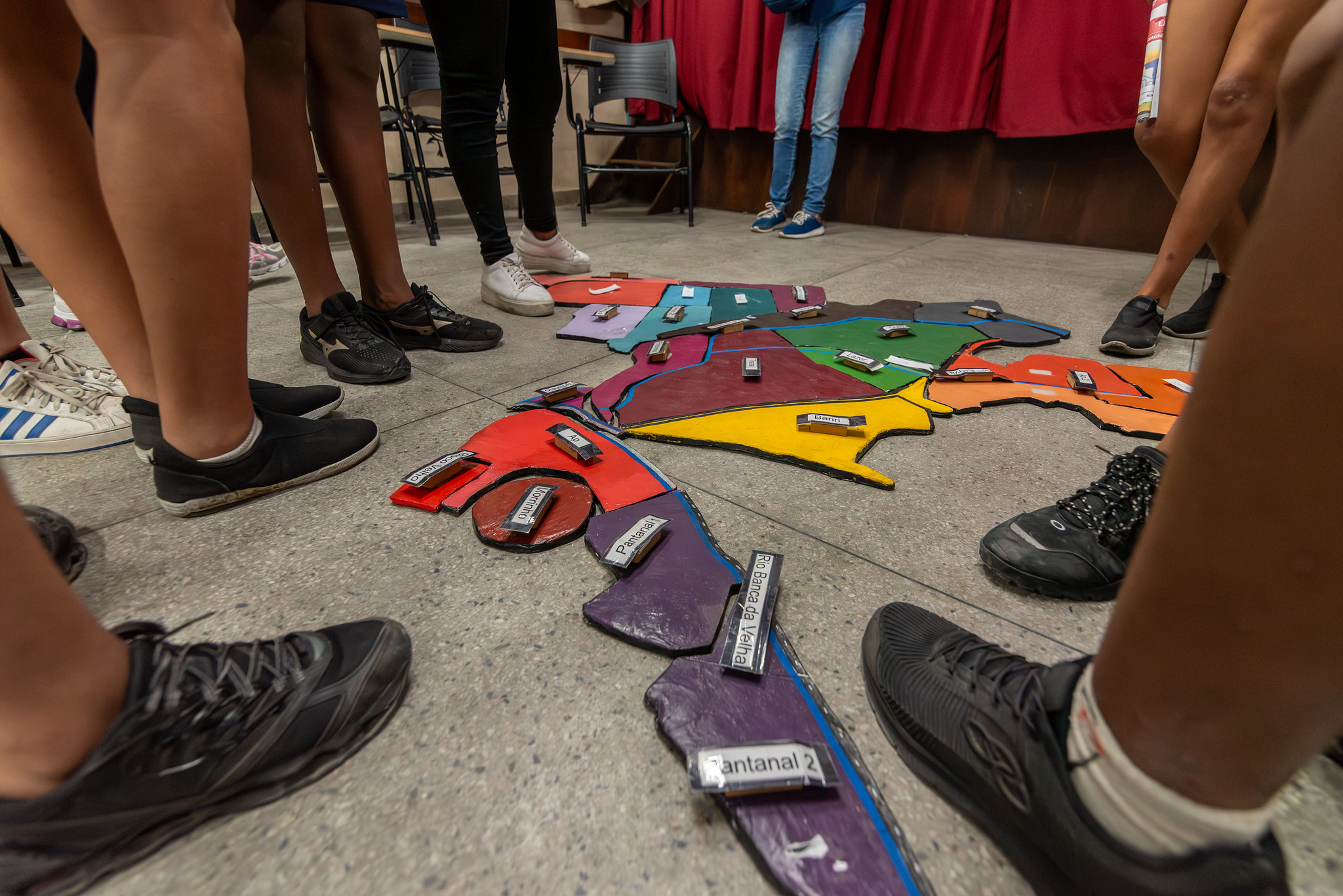
During the socio-environmental educational activity led by Eco Rede, three young educators divided students into three groups to explain the historical context of City of God’s creation in 1966 and share the climate challenges the community has experienced since its founding. Evelyn Cristina Neves spoke about the favela’s origin.
“City of God used to be a farm. In 1966, before the construction [of housing] was completed [initially to accommodate workers], residents who were forcibly evicted from favelas [victims of floods in central parts of the city] came to live here. [It’s important] that we talk about this, about the floods and those who were displaced and brought to City of God, which was not built for us residents. It was created for [nearby] workers… but then [came the issue of] people displaced by floods and forced evictions, [and those impacted by the climate events] came to live here.” — Evelyn Cristina Neves
During the morning activities on September 17, Portuguese language teacher Luciano Vicente accompanied his class to the opening of the exhibition. He reflected on how people were settled in City of God.
“The way people were placed [in City of God] was flawed, because they came from forced evictions, and they [the authorities responsible] did this in a haphazard way. Another point [a student] raised was that [back then] there was only mud and weeds [here]. In other words, people were just put here, most of them far from their jobs. And [the authorities] didn’t provide… [the] other forms of assistance that should have been available, such as schools, health clinics and transportation… which led to population growth in City of God, without support.” — Luciano Vicente
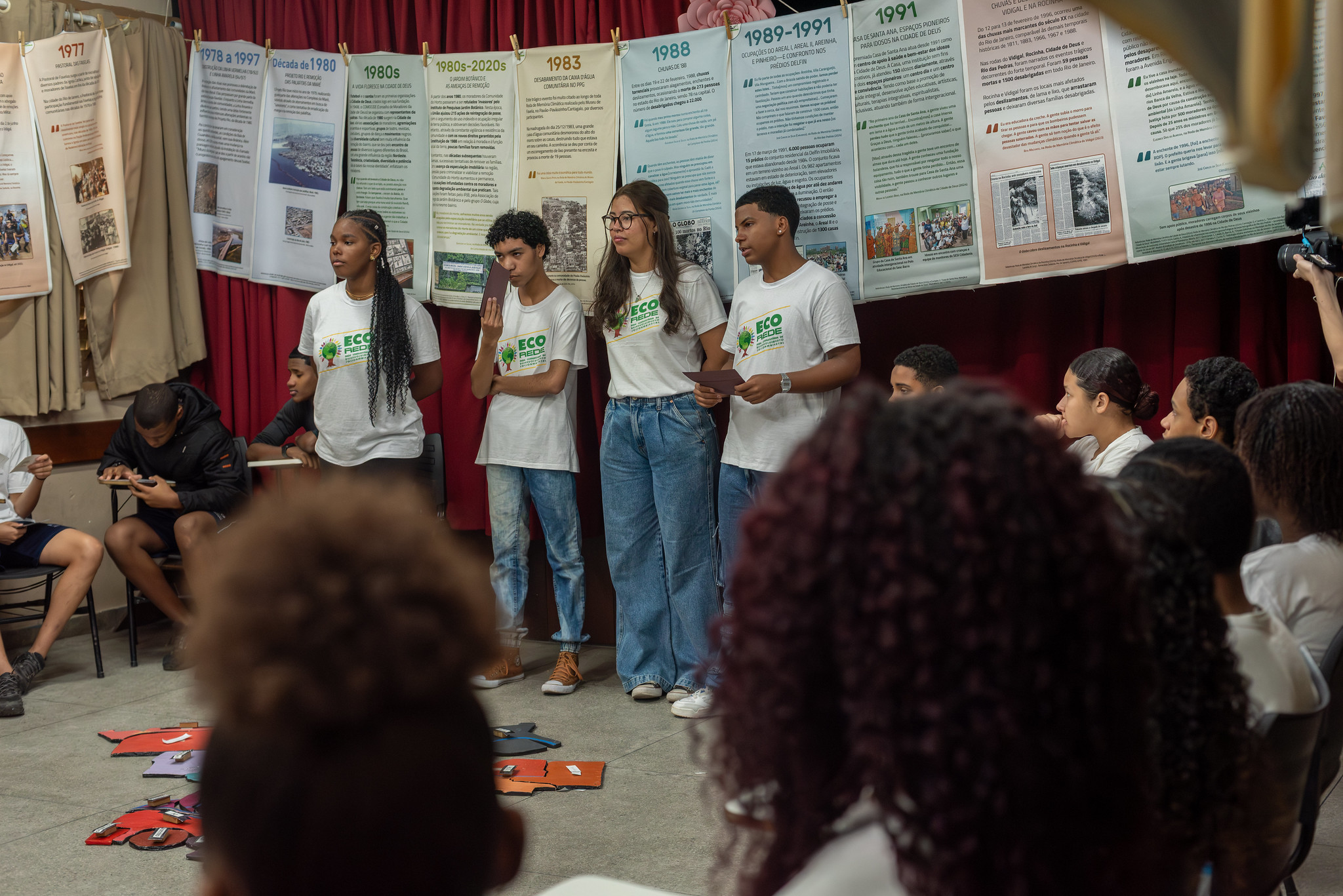
Middle and high school students from six different courses participated in the opening, each with approximately 30 students, aged 12 to 16. Kayky Cristiano Soares Silva, a first-year high school student, shared what he learned.
“I really like to learn new things… I got to learn more about the whole timeline, from the founding of City of God til today. It was really cool. We studied and asked questions that people their age… were able to answer… about climate change in the favela.” — Kayky Cristiano Soares Silva
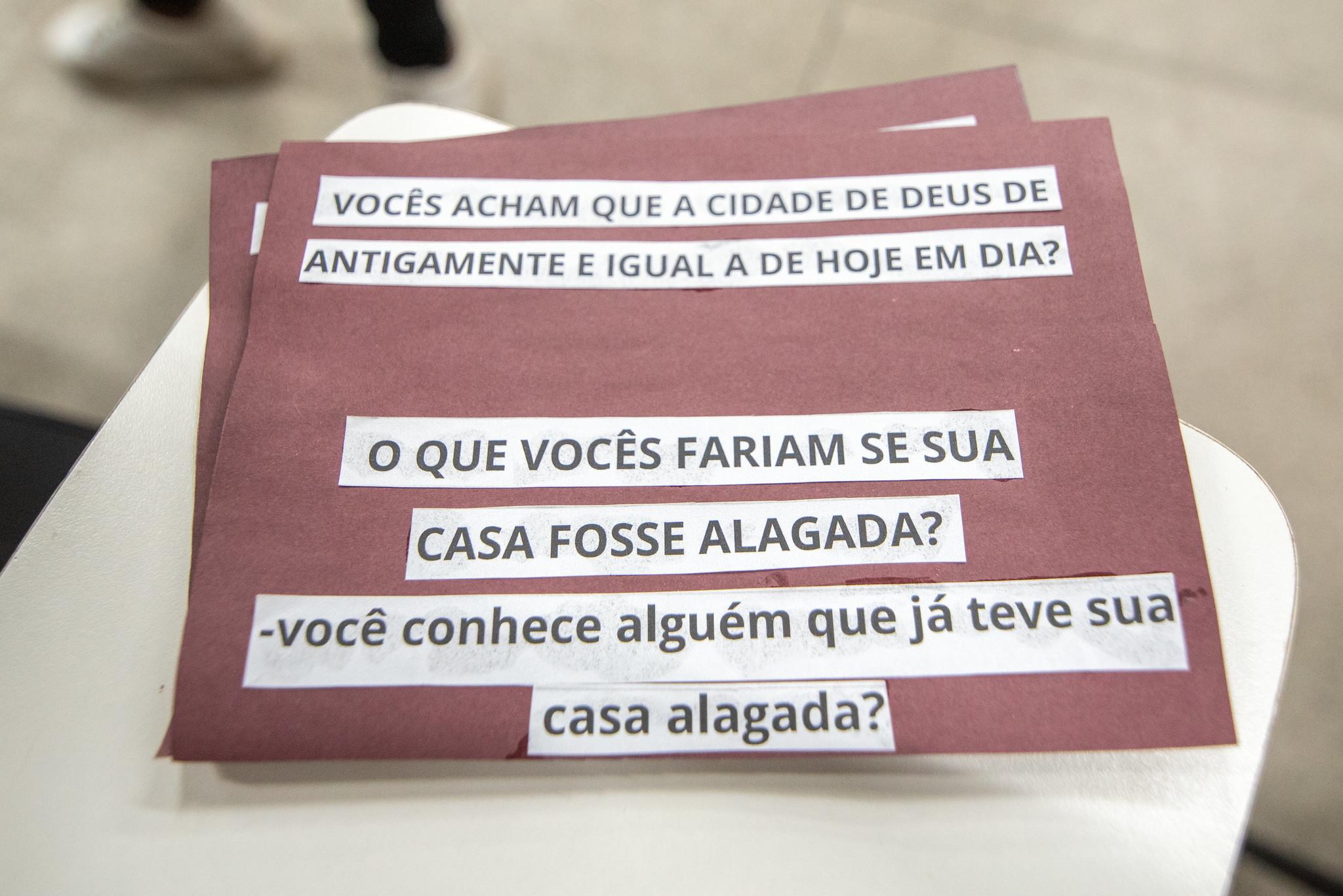
Throughout the activity, students discussed other topics related to local climate memories, reflecting collectively on what Rio Grande, City of God’s main river, used to be like and what it is like now; whether they usually see many or few trees on their way to school; the impacts of climate change on the favela; whether City of God in the past was the same as it is today; what they would do if their house flooded; and whether they know someone whose house has been flooded. The aim of the conversation was to encourage students to participate with their own experiences and stories they hear from their elders.
Iara Oliveira, founder and coordinator of Alfazendo, took the opportunity to discuss the 1996 flood, a poignant event for the community.
“There was a big flood in City of God, in which 62 people died. Some weren’t found because the water took them away… So this is why it’s important for us to remember. Today I am 58 years old, I’m the same age as City of God, [and] I have experienced two floods. The aim is not for you to relive a flood, but for you to understand that City of God is cut by three rivers, [and to grasp] the importance of caring for the rivers, and of paying attention to the issue of flooding. This side might not flood, but in Rocinha 2—the area all the way at the back [of the community]—people panic when it rains. Climate change brings a very strong sense of panic for people. Because when you’re not home, when you’re out working, you might come back to find your house flooded. That’s why it’s important to relive [it] and remember that environmental racism is precisely linked to this.” — Iara Oliveira
School principal Verônica Cintra frequently collaborates with Eco Rede. She shared her experience of hosting the exhibition at the school.
“It is really great, really important, to have the return of this exhibition here at the school, and here in City of God, and to know that City of God is a key protagonist of these socio-environmental actions. Particularly to show how unequally climate change issues affect low-income areas, which is what we call environmental racism. For our school, which follows an anti-racist curriculum, this is a crucial reflection to bring into [the school community].” — Verônica Cintra
View the Photo Album of the Opening of the ‘Favela Climate Memory’ Exhibition in City of God:

*The Sustainable Favela Network (SFN) and RioOnWatch are both initiatives of not-for-profit organization Catalytic Communities (CatComm). The ‘Favela Climate Memory’ exhibition brings together 1,145 testimonials from 382 residents of ten favelas across Rio de Janeiro, collected and analyzed over three years, produced through a collective oral history project. The exhibition was developed by eleven museums and favela memory collectives that are members of the SFN: the Maré Museum (Complexo da Maré favelas), the Sankofa Museum (Rocinha favela), the Historic Orientation and Research Nucleus of Santa Cruz (organizer of the Antares climate memory circle), the Favela Museum (Pavão-Pavãozinho/Cantagalo favelas), the Vidigal Memories Nucleus (Vidigal favela), Alfazendo (City of God favela), the Serra da Misericórdia Integration Center (Complexo da Penha favelas), the Horto Museum (Horto favela), Fala Akari (Acari favela), Conexões Periféricas (Rio das Pedras favela), and the Evictions Museum (Vila Autódromo favela).
About the author: Bárbara Dias was born and raised in Bangu, in Rio’s West Zone. She has a degree in Biological Sciences, a master’s in Environmental Education, and has been a public school teacher since 2006. She is a photojournalist and also works with documentary photography. She is a popular communicator for Núcleo Piratininga de Comunicação (NPC) and co-founder of Coletivo Fotoguerrilha.