
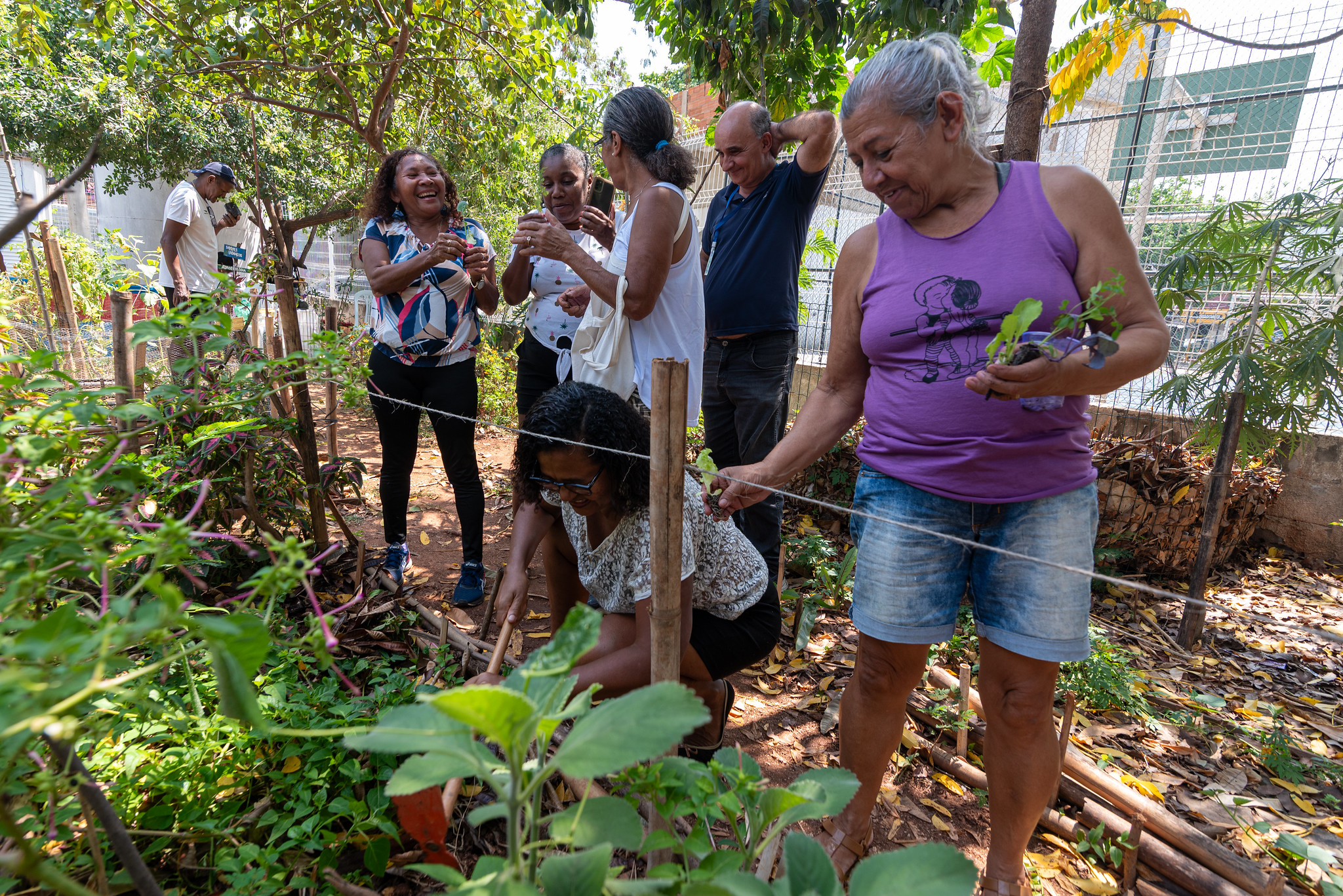

The community of Parque Arará, one of the favelas that make up Complexo do Arará in Benfica, Rio de Janeiro’s North Zone, gathered on the morning of October 7 for a collective action to plant seedlings and further their socio-environmental education. Organized by the Parque Horácio Women’s Movement in partnership with the Olympic Medalist Maurício Silva Family Health Clinic, the activity at the Lilian Cecília Social Garden—a green space in the favela—offered attendees a rich exchange of knowledge about agroecology and medicinal herbs.
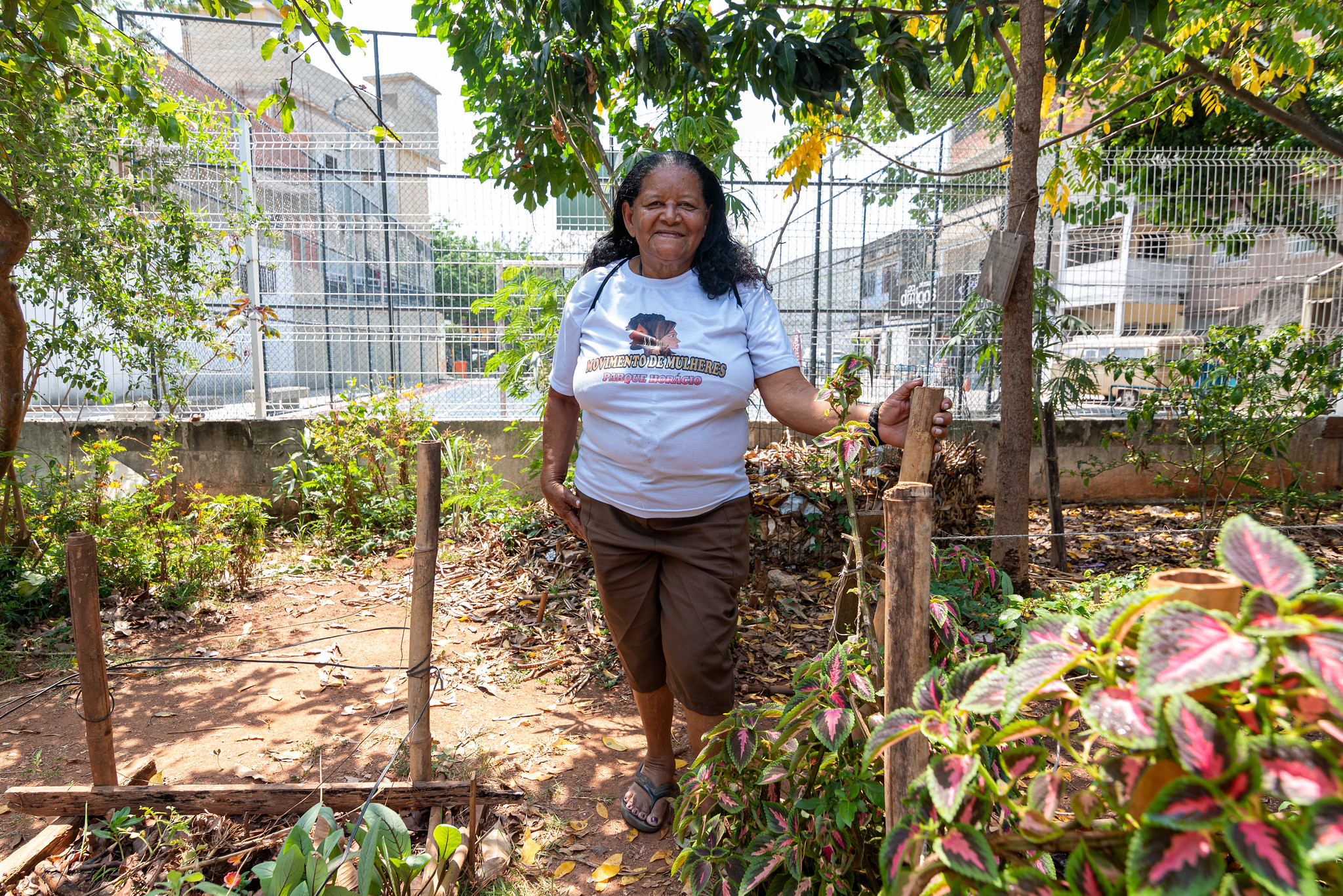
Part of the Sustainable Favela Network‘s* Collective Calendar, the activity received technical support from allies, including professors and researchers, who worked together with residents and organizers from Complexo do Arará. Community organizer and founder of the Parque Horácio Women’s Movement, Maria Aparecida Vieira—or Tia Cida, as she is known—explained the origins of the project.
“I was the one who brought the garden here. I’m a community leader, and I have a project in Parque Horácio called the Parque Horácio Women’s Movement. Professor Sérgio Anversa helped us start the garden, and now the residents keep it going. It’s our community garden, full of medicinal plants.” — Maria Aparecida Vieira
The day began with a discussion circle and a class on medicinal plants and agroecology. This first activity also marked Sérgio Anversa’s farewell from the project. A biologist and environmental studies professor, and a member of the Pluri-se Collective | Plural and Inclusive, Anversa was one of the technical allies who, alongside Carla Mota—an environmental researcher and professor of social communication and marketing at Unisuam, and also part of the Pluri-se Collective—helped build the community garden.
Mota and Anversa arrived at Arará in 2023 through an invitation to take part in the event “Natural Agriculture Workshop and Our Tour on the Green Roof,” organized by Luiz Cassiano of the Green Roof Favela project, who is also from the community. The event was held in the small square next to the Family Health Clinic. It was there, together with the clinic’s then-managers, that the idea to start a garden came about, with the goal of encouraging residents to make more use of the clinic. Initially, the garden aimed to support the treatment of psychiatric patients diagnosed with anxiety and depression, most of whom live in Complexo do Arará.
The Family Health Clinic garden officially opened in 2024, when Tia Cida met professors Mota and Anversa and rallied community residents to join the project through her collective, the Parque Horácio Women’s Movement.
Today, the garden is home to hog plum, mango, and pink pepper trees; non-conventional food plants (PANCs) like ora-pro-nobis; and conventional crops like corn and okra, along with sunflowers. The space has become an important gathering place for the community and a spot for reflection. Noticing this, Anversa saw an opportunity to turn the garden into a classroom.
“We imagined a garden where we could talk about the state of the world. So we envisioned a sustainable garden—but within a concept of sustainability that also engaged in dialogue with the world. That’s why we didn’t just start planting right away. We first worked on restoring the soil. It took a long time before the plants could grow naturally. They then began to thrive on their own, and we avoid creating uniform garden beds: we mix plants so that they’re always interacting, each helping the other. Because the objective here isn’t to provide food, but to create a garden that can stimulate a debate by incorporating questions of origin and ancestral knowledge… and little by little, they start to show up: through medicinal herbs, religious herbs and some of the concepts [that patients themselves] bring. Now, the community embraces [the garden].” — Sérgio Anversa
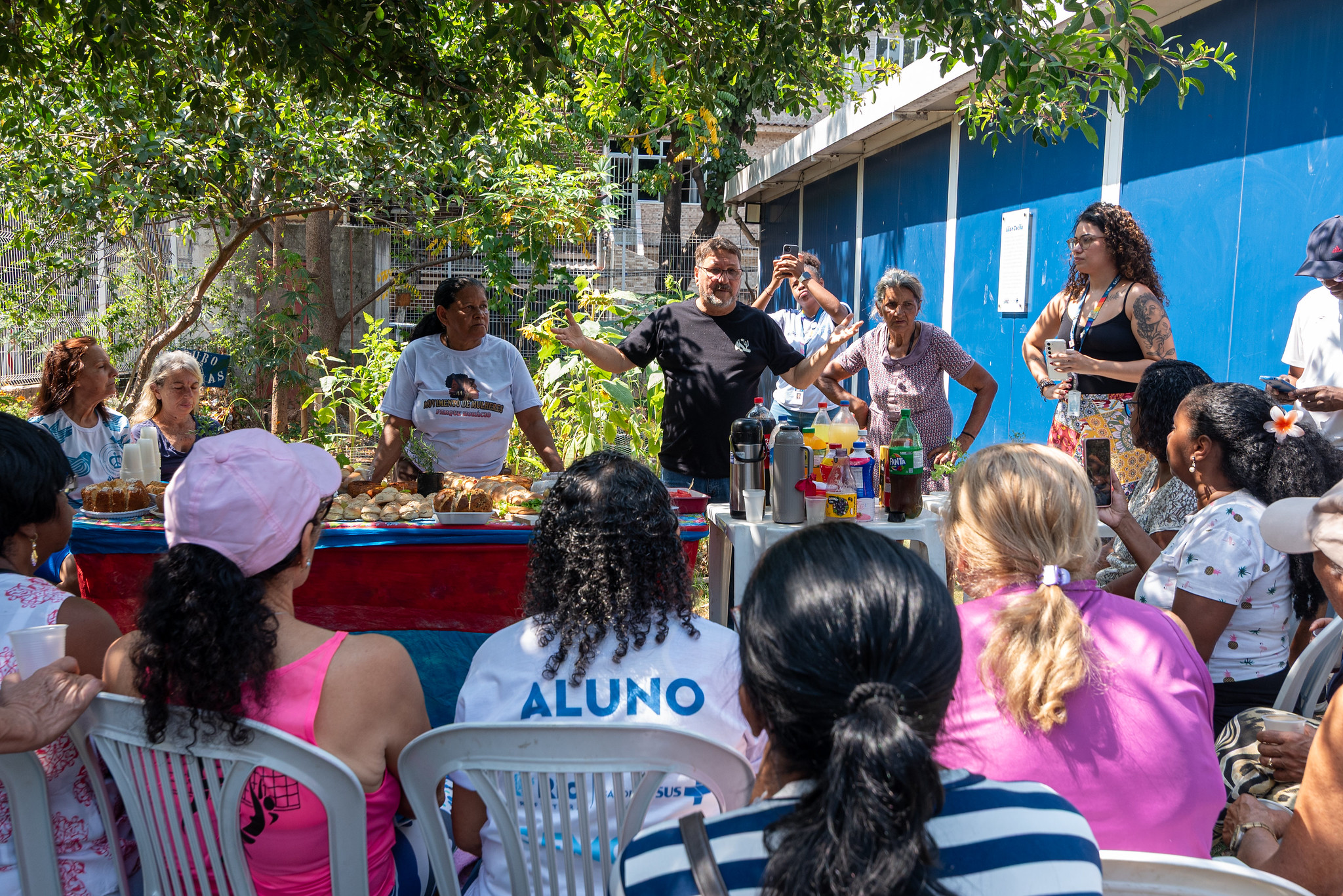
In the discussion circle, Professor Carla Mota explained that the garden is more than a space to produce food: it’s an instrument for socio-environmental education.
“We saw an opportunity for the garden to serve as a tool for socio-environmental education. It was never our intention to produce large volumes of food. The goal was more about reclaiming ancestral knowledge, since many of the plants come from Brazil’s countryside. We also held discussion circles on socio-environmental topics, letting all express themselves freely, challenging some of the logic of industrial food production—having to use fertilizer, control pests, and dominate the soil—and introducing a different logic: integrating with nature, respecting our own soil and cycles, knowing when to harvest, and when to bloom.” — Carla Mota
Originally from the state of Maranhão, Lusinete Carneiro is a former resident of Arará and now lives in the favela Barreira do Vasco. One of the oldest participants in the garden, Dona Lu, as she is known, explains the routine for caring for the space.
“I come to the garden with pleasure, to water [the plants]. We’ve planted many seedlings that didn’t survive, and some that did. I come at least two or three times a week, water, and meet Cida and Otília. The girls always come as well—we check on things, eat guava… Yesterday I came with Cida and added some [fertilized soil] here, using [leaf mulch] from over there.” — Lusinete Carneiro
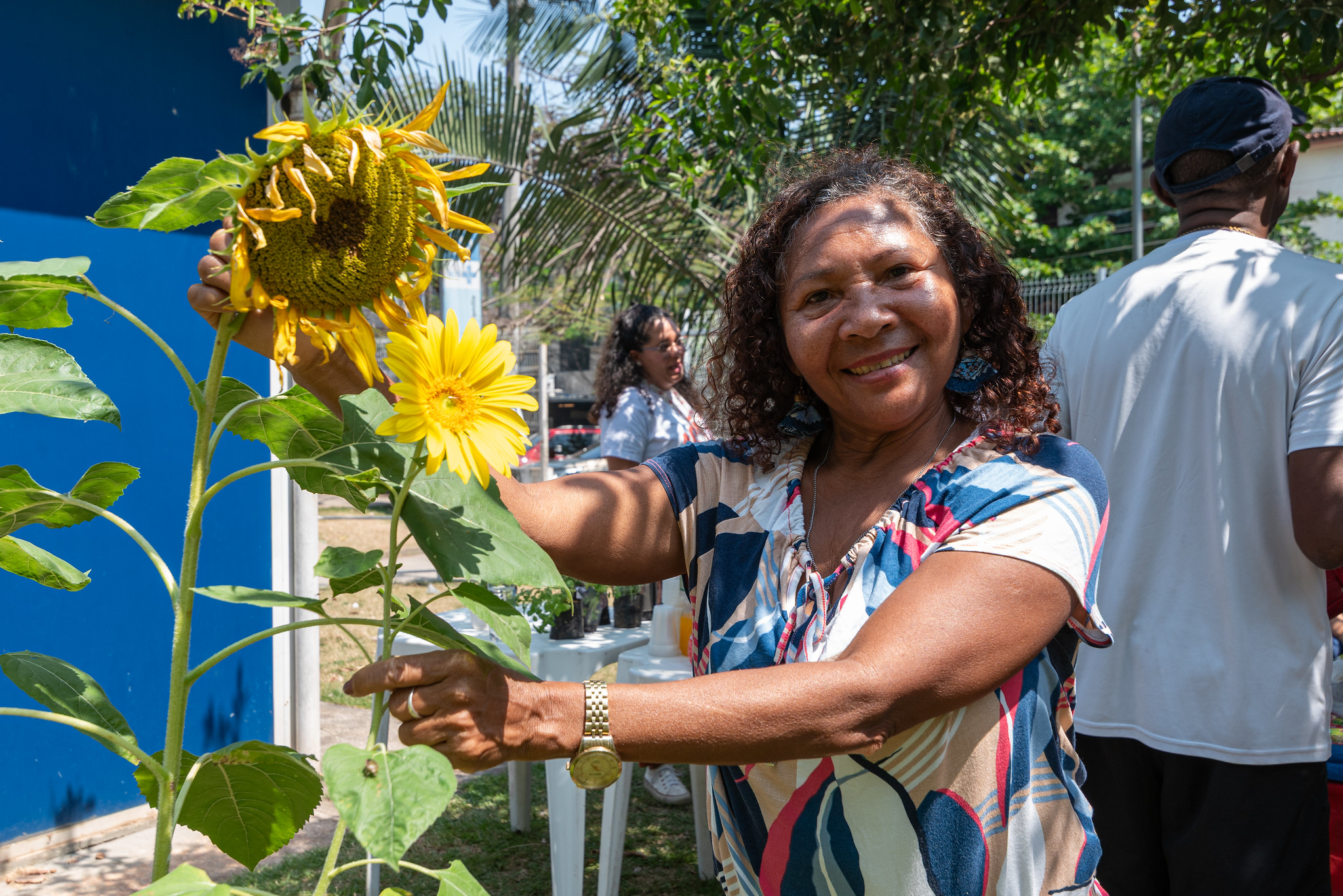
Luciane Alves de Almeida, a homemaker and resident of Arará, says that the sociability provided by the garden reduces her anxiety and gives her valuable moments to contemplate nature.
“With all the busyness of daily life, here in the garden we have moments that are ours—chatting with friends, enjoying nature, and taking care of our mental health. In the busyness of home life—as homemakers, mothers, and wives—we get caught up in the daily hustle and bustle, and there’s nothing better than this garden, which allows me to fully relax and feels wonderful.” — Luciane de Almeida
Thalita Madalena, a nutritionist and current manager of the Family Health Clinic, emphasizes the importance of the garden as an Integrative and Complementary Health Practice (PICS in the Brazilian acronym), which complements conventional treatments within Brazil’s Unified Health System (SUS).
“I was very happy to get here and find a community garden. It’s a community garden in the sense that it carries the idea of reconnecting with the earth, of growing closer to the soil—something we’ve kind of lost. Especially in our generation, that’s a connection that’s been somewhat lost. Here [in the community], we notice a high prevalence of anxiety and depression among the population… So reconnecting with the soil brings an exchange of energy and a sense of calm, along with an interaction with the environment. There’s also the question of being able to plant your own food, of sharing with others, and exchanging knowledge—a person who knows how to grow one plant can trade a seedling with someone who knows another plant… Beyond that, we can talk about healthy eating, promoting health, medicinal plants, and phytotherapy, which is part of integrative practices used for teas, baths, and tinctures… These Integrative and Complementary Health Practices have been part of Brazil’s Public Health System for some time.” — Thalita Madalena
After the discussion circle, a hearty breakfast was served with naturally fermented bread made by José Júlio de Abreu, a baker from another North Zone favela, Vila Cruzeiro, who works with artisanal bread. He explained that they are made with “levain, the mother dough, a bread of easy absorption that keeps you feeling full.” Juices and coffee also added to this moment of connection. Wrapping up the day’s activities, residents and participants joined a collective action to plant rue, lettuce and collared greens.
In addition to cultivating and caring for the soil, the community garden has become a space for socio-environmental reflection, social interaction, community strengthening, exchanges of affection and initiatives that support the well-being and mental health of Parque Arará residents.
View the Photo Album of the Complexo do Arará Community Garden Collective Action:

About the author: Bárbara Dias was born and raised in Bangu, in Rio’s West Zone. She has a degree in Biological Sciences, a master’s in Environmental Education, and has been a public school teacher since 2006. She is a photojournalist and also works with documentary photography. She is a popular communicator for Núcleo Piratininga de Comunicação (NPC) and co-founder of Coletivo Fotoguerrilha.