
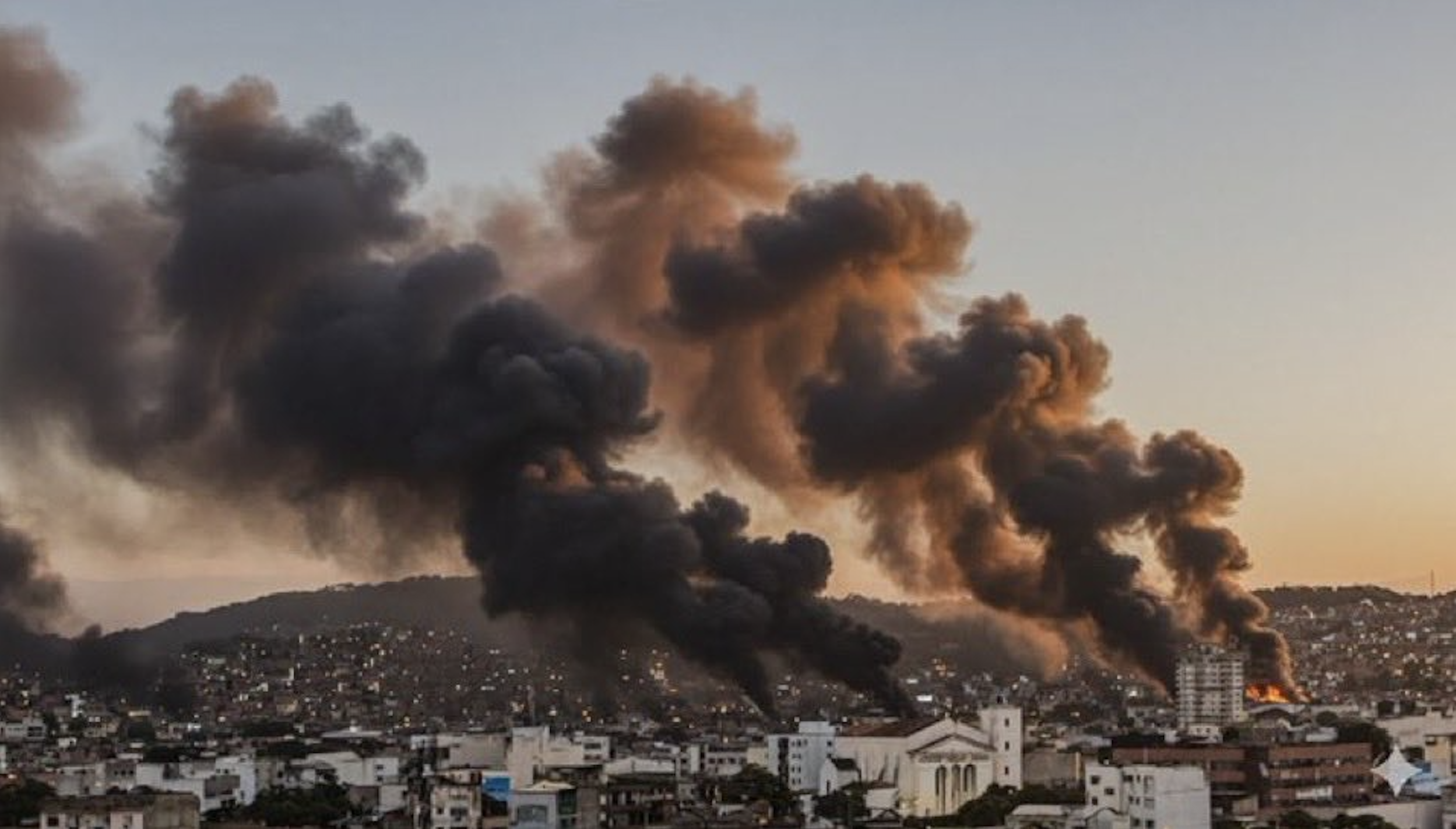

This article is part of RioOnWatch’s ongoing #VoicesFromSocialMedia series, which compiles perspectives posted on social media by favela residents and community organizers about events and societal themes that arise.
October 28, 2025, will go down as one of the most traumatic and violent days in Rio de Janeiro history. A massive police operation, launched in the favelas of Complexo do Alemão and Complexo da Penha in the city’s North Zone, was aimed at executing arrest warrants against members of the Comando Vermelho (Red Command) drug trafficking faction active in these communities. However, the operation took on unimaginably brutal proportions.
Within a few hours, official sources already reported 64 people killed—including four police officers—and 81 arrested. The number of victims is more than twice as many as those killed in the city’s previous deadliest massacre, the Jacarezinho Massacre of 2021. Rio de Janeiro’s current governor, Cláudio Castro, has led three of the four deadliest police operations in the history of a city already notorious for police violence. The episode has sparked international concern over Rio’s ability to host major events scheduled for next week, as well as the COP30 climate conference, set to take place in two weeks in the Amazon city of Belém.
The speed with which killings, arrests, and weapon seizures took place in the North Zone favela complexes triggered mass retaliation across nearly every part of the Rio de Janeiro Metropolitan Region, resulting in road blockages in neighborhoods such as Ilha do Governador, Engenho Novo, Taquara, Freguesia, Pavuna, Cascadura, Ramos, and Barros Filho; in favelas such as Maré and City of God; and in the city’s downtown region, including Rua Riachuelo, which runs through the Bairro de Fátima and Lapa neighborhoods. See a list of all the neighborhoods impacted at the end of this article.
Ver essa foto no Instagram
Post summary: In Lins, the avenue was closed, and buses had to drive the wrong way.
Ver essa foto no Instagram
Post summary: On Ilha do Governador, a bus blocked Praça do Avião in an attempt to restrict access to the island, heightening tension among residents. Access to Tom Jobim International Airport (Galeão) was closed and major expressways—Linha Vermelha, Linha Amarela, and Avenida Brasil—partially blocked. With mobility severely compromised and the operation ongoing, the advice is clear: only travel in Rio if absolutely necessary.
The widespread atmosphere of terror, especially in the favelas, lasted until the early hours of Wednesday, October 29, when the residents of Complexo da Penha themselves began locating and removing bodies from a wooded area within the region.
So far, according to the Rio de Janeiro Public Defenders’ Office, the operation has already caused over 130 deaths, making it the deadliest action in the state’s history.
At around 1:48pm on October 28, Rio’s Operations and Resilience Center (COR) declared a Level 2 alert, indicating high-impact threats to public safety in the city at that time.
Among residents of the communities targeted by the massive operation, the atmosphere was one of intense violence and fear. In a video, residents recorded a police armored truck, the caveirão, entering Complexo do Alemão while several people were still moving about the streets.
Ver essa foto no Instagram
Several roads were temporarily closed due to shootouts, such as the Grajaú–Jacarepaguá expressway, which connects the North and West Zones.
Ver essa foto no Instagram
Post summary: Police officers open fire on the Grajaú–Jacarepaguá expressway.
Ver essa foto no Instagram
Post summary: The so-called “Operation Containment,” announced by Governor Cláudio Castro (PL) as the largest in Rio’s history, ended in a massacre. Over 60 people were killed in Penha and Alemão, including two police officers and dozens still unidentified. Businesses and schools closed, residents were caught in crossfire, and at least three people were hit by stray bullets. The operation, claimed to target the Comando Vermelho, repeats the pattern of war on favelas and the extermination of Black and peripheral populations that has characterized Castro’s administration.
In response, residents of Complexo do Alemão and Complexo da Penha marched through their communities in protest against the unprecedented atrocity.
Ver essa foto no Instagram
Post summary: During the confrontation in Complexo da Penha and Complexo do Alemão, residents took to the streets and alleys calling for peace. The demonstration took place amid the gunfire that marked the police operation in the area.
Several favela collectives and movements spoke out on social media, especially those directly affected by the operation, such as the Serra da Misericórdia Integration Center (CEM), in Serra da Misericórdia, Penha; the Straight Talk Institute; and the community journalism outlet Voz das Comunidades, both from Complexo do Alemão.
Ver essa foto no Instagram
Post summary: Signs in the photo say: ‘The favela wants to live,’ ‘We deserve to live without the fear of dying.’
In an interview with mainstream media, also shared on social media, Raull Santiago of the Straight Talk Institute denounced the lack of planning and the flaws of the current security model, which continue to be defended by public officials.
“We’re talking about the summary execution of over 60 people, including young people and adults who may or may not be involved in the illegal drug world. We’re talking about residents, we’re talking about police officers. These people are now just numbers, but in practice [what’s happening is] the modus operandi [in Rio de Janeiro]; there’s nothing new here. It’s just a repeat of police operations and the various massacres that have taken place many times in Rio. Once again, Complexo da Penha and Alemão are central targets of this atrocity. We have over 60 executed bodies. This goes down in history in terms of brutality. I’m not calling it a killing, I’m calling it a massacre. People had heart attacks, elderly folks had tachycardia, mothers of children with disabilities, with autism were in absolute despair amid the day’s chaos in Complexo do Alemão.” — Raull Santiago
Ver essa foto no Instagram
By putting an entire population at risk, the operation unprecedentedly disrupted routines and services across the city. The main expressways were blocked, including Linha Vermelha, Linha Amarela, and Avenida Brasil; throughout the afternoon, access to Galeão International Airport was impossible due to the closure of Avenida Vinte de Janeiro, which connects the airport to Estrada do Galeão, also closed at Praça do Avião. Schools and universities—including UFRJ, UERJ, UFF, UFRRJ, UNIRIO, PUC-Rio, and others—suspended the rest of the day’s activities, even though they are located kilometers away from the operation area. According to a video posted on IDMJ Racial’s social media, around 40 schools had their activities interrupted.
Ver essa foto no Instagram
Post summary: The State holds the monopoly on violence; everything happens as a result of the State’s action or inaction. The more than 60 deaths and the chaos that engulfed Rio de Janeiro on October 28, 2025, are a direct reflection of the State’s political choice to invest in violence instead of social policies. Over R$19 billion (~US$3.5 billion) have been spent on police forces, raids, armored trucks, drones, helicopters, and combat equipment. The more than 40 schools that closed, workers unable to get home, and blocked streets are not the result of criminal action—they are the outcome of political decisions to wage war rather than invest in life.
Ver essa foto no Instagram
Post summary: Due to extreme violence in Rio de Janeiro today (October 28), affecting access to the Seropédica and Nova Iguaçu campuses, the Rural Federal University of Rio de Janeiro (UFRRJ) is suspending all evening academic and administrative activities.
Business establishments and other services closed earlier than usual, which brought forward rush hour and caused widespread chaos in public transportation. Train and metro stations, bus stops, and the main ferry terminal were overcrowded due to employees leaving early.
Ver essa foto no Instagram
Post summary: Hard night for Rio workers trying to get home at Central do Brasil train station. Today has gone down in the state’s recent history.
Bus drivers’ unions requested that vehicles on routes passing through areas affected by the operation and the retaliatory actions return to depots. Seventy-one buses were reportedly used as barricades, and 204 lines were affected. Data from Rio’s Operations and Resilience Center indicated that the Transbrasil and Transcarioca BRT corridors, as well as BRT feeder services, were impacted by the events. In a video posted on social media, a driver said he was instructed to return to the depot for safety reasons.
Ver essa foto no Instagram
Post summary: Rio Ônibus faced another historic day of disruptions on October 28. Seventy-one buses were used as barricades and 204 routes were affected amid the massive police operation in Complexo da Penha and Complexo do Alemão. The union stayed in constant contact with the Military Police, Mayor Eduardo Paes, and Governor Cláudio Castro to keep buses running and ensure passenger and worker safety.
Ver essa foto no Instagram
In Rio das Pedras, in the West Zone, workers had to walk home due to the lack of buses. Mobility difficulties delayed and even canceled bus departures at Novo Rio Bus Terminal.
The spread of false information about the police operation and its aftermath also marked the day. However, most of the fake news was quickly debunked by community media. One of the most widely circulated false claims alleged that Rio had entered a Level 4 alert, which was verified and refuted by Agência Lupa. Additionally, rumors of instability and road closures in Rocinha circulated, which were denied by Rocinha Alerta.
Ver essa foto no Instagram
Dubbed “Operation Containment,” the massive police operation carried out on October 28 in Complexo do Alemão and Complexo da Penha surpassed the brutality of the 1992 Carandiru massacre in São Paulo, in which 111 people were killed. On the morning of October 29, as residents located, retrieved, and identified the bodies of their relatives, they exposed the true extent of the violence to which Rio’s favelas are subjected.
Ver essa foto no Instagram
Post summary: “Unfortunately, this is not the biggest massacre in our state, it’s the biggest massacre in our country…” The statement comes from the founder of the Favela News Agency (ANF) at the newspaper A Voz da Favela.
Powerful testimonies also emerged from mutual support groups, a hallmark among favela residents, including one from the area most affected.
“They just posted a video of the boys who were killed. Guys, it’s just horrible, horrible, horrible. God forbid!… Only God can have mercy on everyone, because this isn’t something you do, not even to an enemy, [not even] to an animal, you know? What they did to those boys… Dear God! We’ll never truly grasp what happened up there—not even in this whole life we have ahead of us will we be able to comprehend what those boys went through up there… I haven’t slept, my blood pressure’s so high. My daughter has a fever. I’m not sure if I should go see the doctor or stay home. The terror continues. Past midnight, the police were still here, in the woods. [Meanwhile,] residents were out searching for their relatives, loved ones, family members. What a situation! I honestly wouldn’t want to be in [any family member’s] shoes. It’s the worst situation in the world! If we, who aren’t family, who aren’t directly involved, feel this way, imagine those who had to pick up [the mutilated bodies of] their relatives up there! Of their husbands, their family members. What a horrible situation! May God have mercy on every one of them… Regardless of what they did or didn’t do, they were human beings. If the whole thing was about warrants, then it was about [arrest] warrants—not about nearly 200 death certificates! But unfortunately, this is the Brazil we live in.” — Testimonial from a neighbor, a resident of Serra da Misericórdia, where bodies began to pile up on the morning of October 29
The unprecedented brutality and terror of this operation reignited the debate over the effectiveness of the tragic model of public security typically adopted by the state of Rio, drawing the attention of the highest levels of government—who were neither consulted nor involved—to the issues of police lethality, its ineffectiveness, and the disastrous and lasting impacts of such actions on the population. Minister of Justice Ricardo Lewandowski stated that he had not received any contact from Governor Cláudio Castro regarding the need for federal support for the operation. On October 29, the Presidency and the Civil House met to discuss measures to address the impacts, damages, and aftermath of what has now become the deadliest police massacre in Rio de Janeiro’s history.
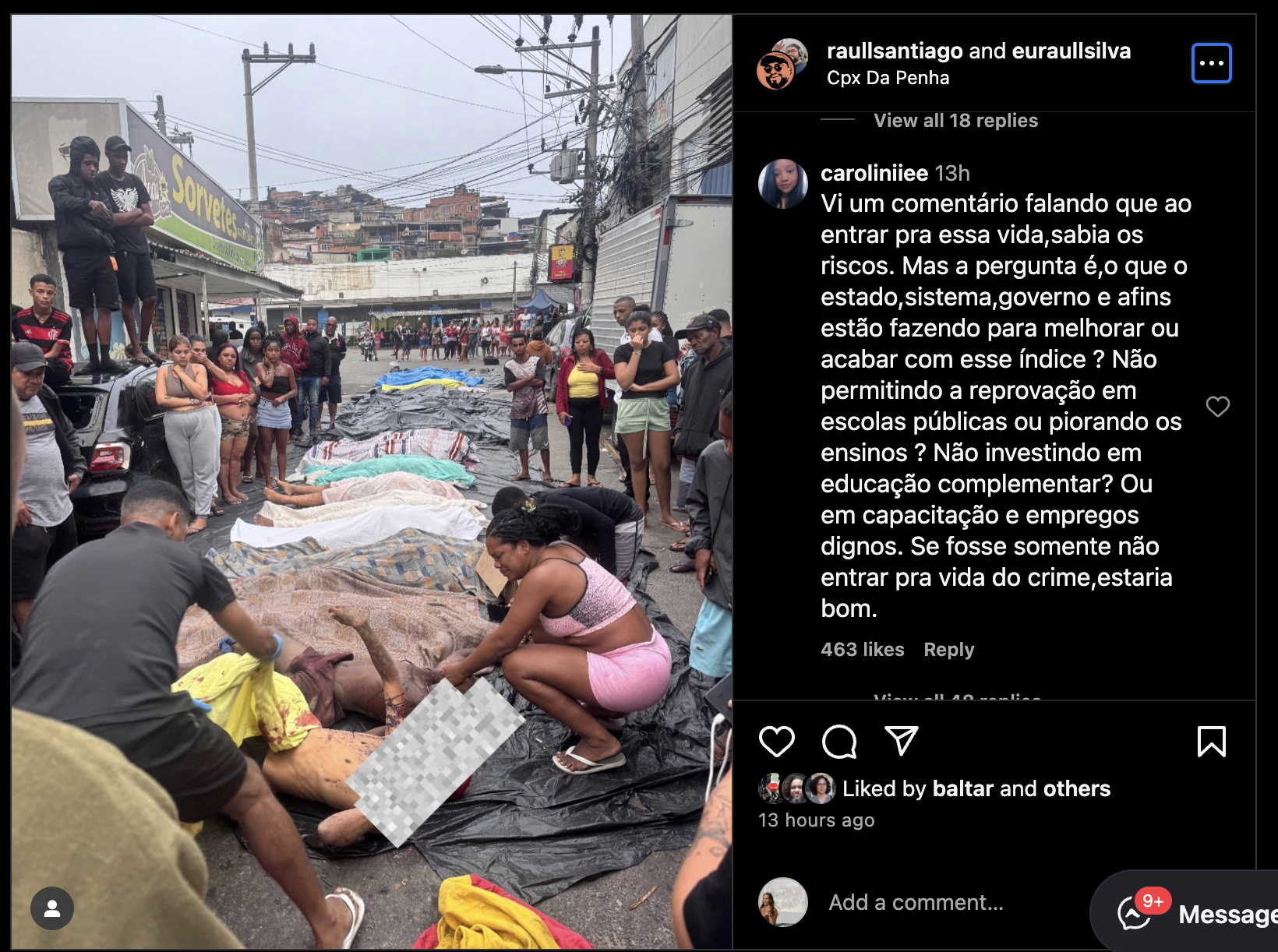
The priority for families affected by the operation on October 29 was to locate the bodies of those who had gone missing. Over 60 corpses were found and gathered by residents at Praça São Lucas in Penha. Most bore signs of summary execution—gunshots to the head, bound, stabbed, showing marks of torture. One had been decapitated. Family members of victims and social movements are organizing to expand the search for bodies in the woods of Vacaria and Serra da Misericórdia on October 30. On the same day, Minister of Human Rights Macaé Evaristo and Minister of Racial Equality Anielle Franco will visit the favelas and meet with residents. Demonstrations against the Penha and Alemão massacre will take place across Brazil on Friday, October 31. In Rio, the demonstration is expected to occur in Penha, at a time yet to be determined.
Areas Where Direct Impacts Were Identified:
North Zone
- Avenida Vinte de Janeiro and Estrada do Galeão, on Ilha do Governador
- Grajaú–Jacarepaguá Expressway, both directions, near Lins
- Linha Vermelha, near Nova Holanda and Pavuna, towards Baixada Fluminense
- Linha Amarela, near the toll plaza, towards Barra da Tijuca
- Avenida Ernani Cardoso, near the Guanabara supermarket, in Água Santa
- Rua Bornéo, in Cascadura, partially blocked, between Rua Miguel Rangel and Rua Sanatório
- Rua Vinte e Quatro de Maio, near Sampaio
- Avenida Brasil, both directions, near Benfica
- Avenida Brasil, both directions, near Bonsucesso
- Avenida Brasil, both directions, near the exit to Ilha do Governador, in the Maré area known as Sem Terra
- Avenida Brasil, near Piscinão de Ramos, towards downtown
- Avenida Brasil, in Barros Filho, near Fazenda Botafogo, towards downtown
- Avenida Brasil, both directions, in front of Shopping Guadalupe
- Estrada Camboatá (also in Guadalupe)
- Rua Cabuçu and Rua Lins de Vasconcelos (both in Lins)
- Avenida Pastor Martin Luther King Jr., in Engenho da Rainha
- Avenida Vicente de Carvalho, both directions, in several stretches
- Avenida Dom Hélder Câmara, near Quintino and other stretches
- Avenida Chrisóstomo Pimentel de Oliveira, in Anchieta
- Avenida Marechal Rondon, in São Francisco Xavier, both directions
- Estrada do Itararé, in Ramos
- Avenida Itaóca, in Inhaúma
- Rua Dias da Cruz, near Rua Camarista Méier, and Rua Vinte e Quatro de Maio, both in Méier
- Rua Barão do Bom Retiro, near Rua Araújo Leitão, in Engenho Novo
- Rua Teodoro da Silva, in Vila Isabel
West Zone
- Avenida Brasil, near the Deodoro overpass, towards downtown
- Avenida Brasil, Deodoro, towards Santa Cruz
Southwest Zone
- Linha Amarela, near City of God
- Rua Edgard Werneck, near Avenida Geremário Dantas, towards Fundão, and near Giro do Cebolinha
- Estrada do Gabinal, Freguesia neighborhood
- Avenida Ayrton Senna, near Ponte Santos Dumont, towards Linha Amarela
- Estrada Miguel Salazar Mendes de Morais, in Taquara
- Avenida das Américas, both directions, near BRT Pombal station
- Avenida Engenheiro Souza Filho, main road connecting Rio das Pedras and Muzema
Central Region
- Rua Riachuelo (between Bairro de Fátima and Lapa)
- Avenida Paulo de Frontin, near Rua do Bispo, towards downtown
- Praça Marechal Hermes, near INCA, in Santo Cristo
South Zone
- Rua das Laranjeiras, corner with Rua Pereira da Silva
- Rua do Catete
Other Identified Impacts:
- Closure of Linha Amarela, near the toll plaza, due to gunfire coming from Complexo do 18, according to witnesses
- Shootout at Morro do Turano (no reports of injuries)
- Forced closure of businesses in several locations:
- Grande Tijuca: Rua Conde de Bonfim, Rua Uruguai, and Praça Saens Peña
- Itanhangá, near the Tijuquinha, Muzema, and Rio das Pedras favelas
- Camorim, in the Southwest Zone
Metropolitan Region
- BR-101 (Niterói–Manilha Highway): near Piscinão de São Gonçalo and Viaduto de Manilha, in São Gonçalo
- RJ-106: near the Arsenal neighborhood, in São Gonçalo
- Attempted blockade at the entrance of Tribobó, in São Gonçalo
- RJ-104: near the descent of Caixa d’Água neighborhood, towards Niterói, in São Gonçalo
- Covanca, towards Venda da Cruz, in São Gonçalo
- Santa Catarina favela, in São Gonçalo
- BR-040 (Washington Luís Highway): near Jardim Gramacho, in Duque de Caxias