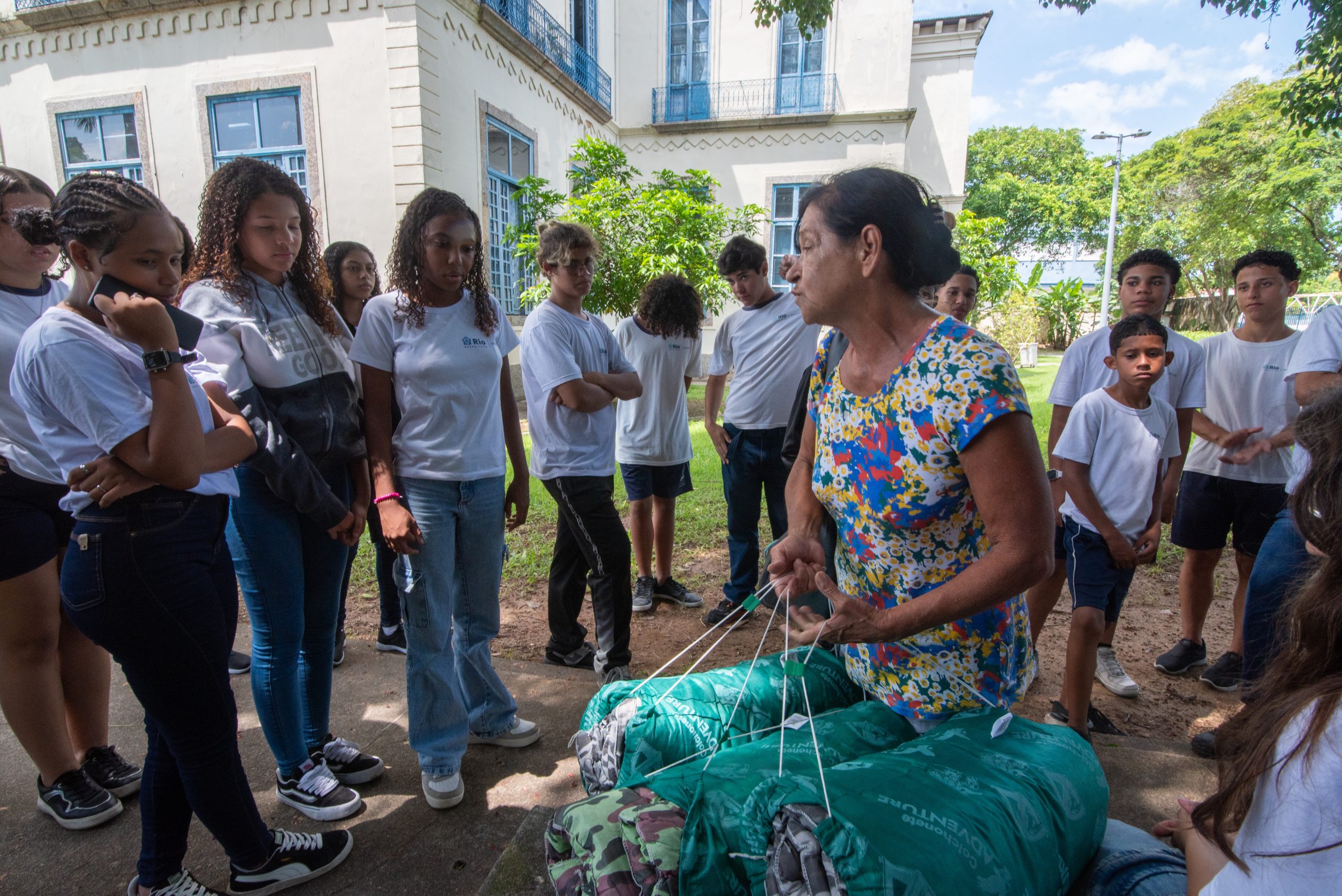
Marlene Ayres holds three sleeping mats that were donated to her by the Secretariat of Social Assistance while she speaks to students at the Princesa Isabel Municipal School, during a visit to the Favela Climate Memory exhibition in Santa Cruz. She was one of those affected by the recent floods that devastated the West Zone of Rio de Janeiro. Photo: Bárbara Dias
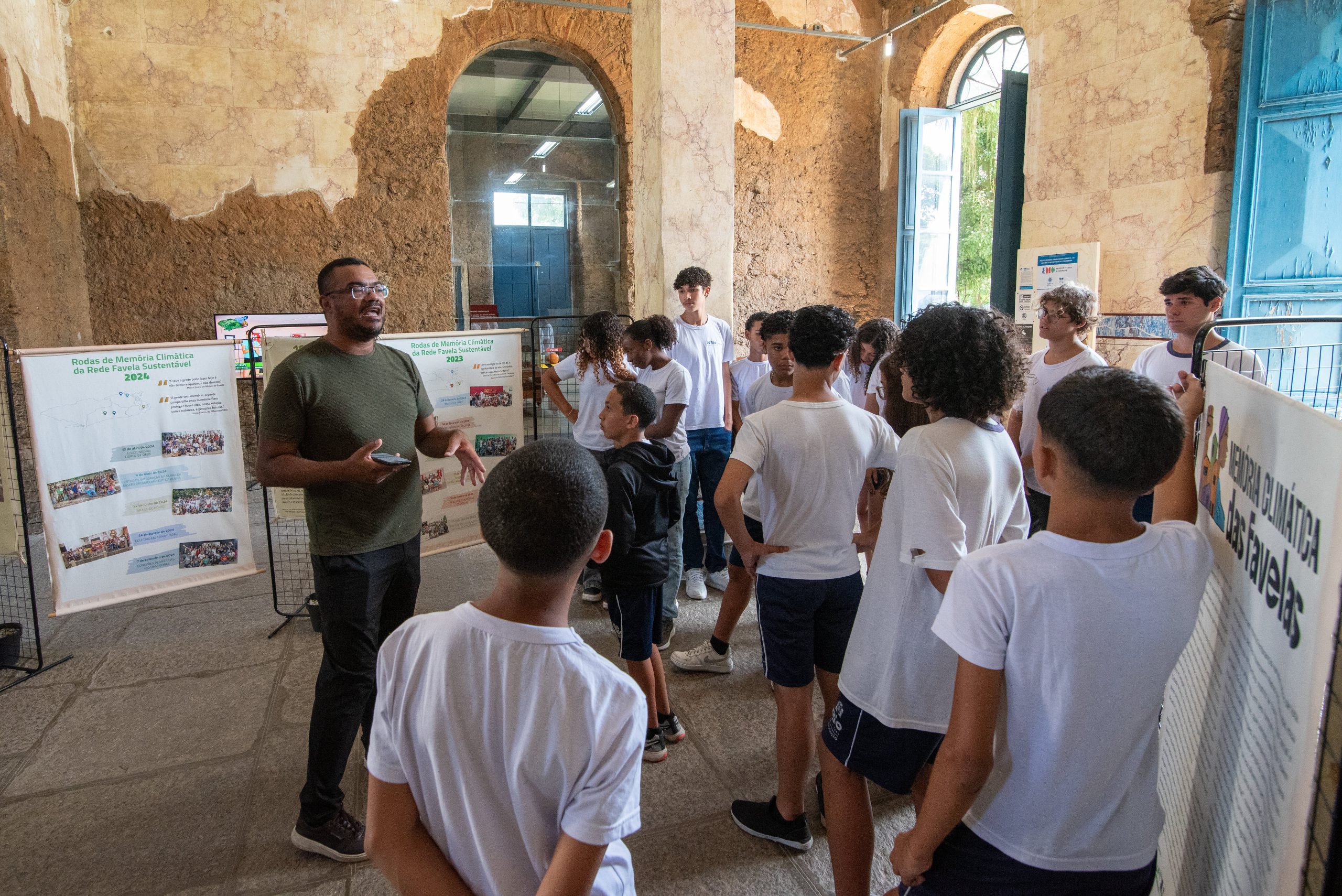
On March 3, students and teachers from the Princesa Isabel Municipal School visited the exhibition and were able to learn more about the process of putting it together. Bruno Almeida, coordinator of NOPH, described for the group how the exhibition proposal came about:
“We thought up the Favela Climate Memory project, which has now visited ten favelas across the city of Rio de Janeiro. One of those was Antares [in Santa Cruz]. We set up a discussion circle to better understand the process of climate change and what the community remembers about its effects. We also learned about the solutions used within the communities.”
Bruno Almeida leads a guided tour of the Favela Climate Memory exhibition in Santa Cruz with students from the Princesa Isabel Municipal School. Photo: Bárbara Dias
While students learned about the idea behind the exhibition, Santa Cruz was still experiencing the after-effects of the heavy rains that hit the West Zone and the Greater Rio area in February and March 2026. On February 26, the region was one of the most severely affected, and a few days later, on March 1, the scene repeated itself. The impacts were primarily felt in Antares, where the Cação Vermelho River overflowed. Many residents lost furniture and personal items as their homes were flooded.
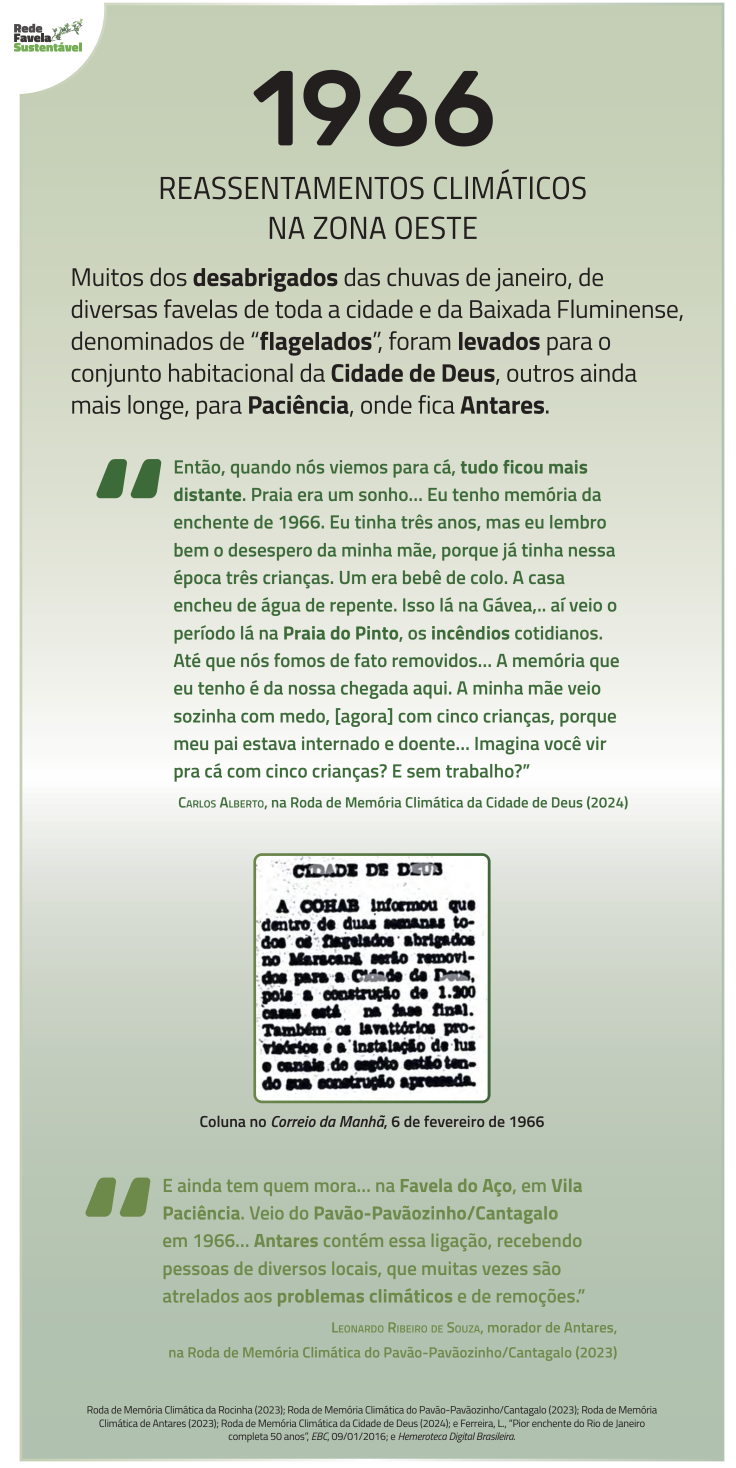
Visitors could see Antares represented in the Favela Climate Memory exhibition’s timeline, made up of 60 panels documenting historic moments drawn from discussion circles in ten different favelas. One of the panels shows the forced resettlement process that led to the creation of Antares, resulting from the impact of rains in other regions of the city in 1966:
Panel from the Favela Climate Memory exhibition’s timeline representing 1966: “Climate Resettlement in the West Zone.”
“Many of those left without homes due to the rains in January, called ‘flagelados’ [disaster victims], came from favelas all over the city and the Baixada Fluminense and were taken to the City of God housing complex. Others were taken even further away, to Paciência, where Antares is.” — Panel from 1966 on the Favela Climate Memory Timeline
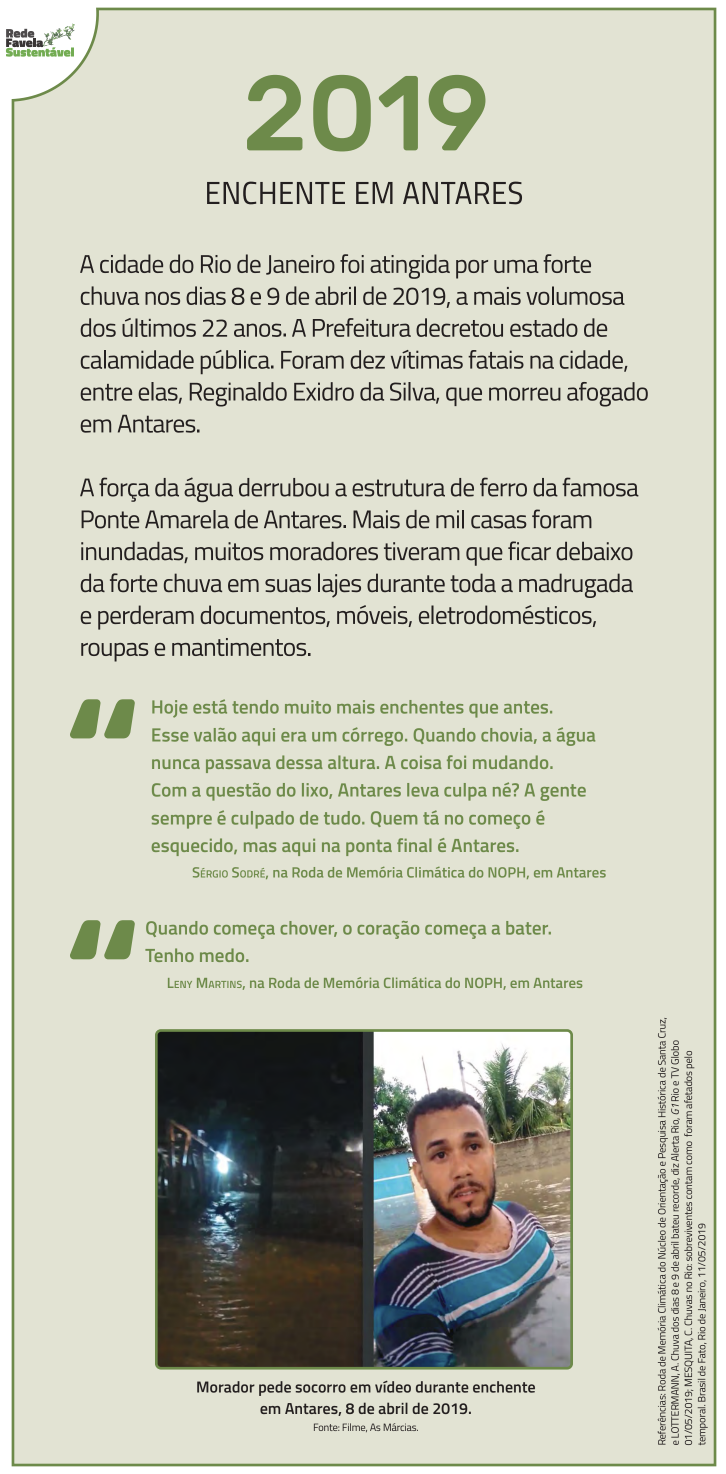
Further along the timeline, the floods of February 2026 recalled a recent, troubling panel from 2019:
“The city of Rio de Janeiro was hit by heavy rains on April 8 and 9, 2019, the heaviest rainfall in 22 years. The city government declared a state of emergency. There were ten fatalities across the city, among them Reginaldo Exidro da Silva, who drowned in Antares. The force of the water brought down the iron structure of the famous Ponte Amarela in Antares. Over 1,000 houses were flooded and many residents had to remain on their rooftops under heavy rain throughout the night, losing documents, furniture, electronics, clothes and provisions.” — Panel from 2019 on the Favela Climate Memory Timeline
The Municipal Secretariat of Social Assistance received residents affected by the rains at the Palacete Princesa Isabel to register them and provide emergency aid and sleeping mats. Unfortunately, the Favela Climate Memory exhibition recorded new testimonials and new climate memories from the favelas in real time.
Marlene Ayres Neto, a resident of Antares, was one of those affected by the recent flood. She joined the students’ discussion circle, taking place outside, and shared her story with the group.
The climate memory represented on the banners and timeline proved to be ongoing, with a live account of a recent climate memory from just a few days earlier:
“I live on Avenida Antares and I am shaking! I’m still in a state of shock. The Cação Vermelho River overflowed where two other rivers meet and we were pulled out by firefighters.
We urgently need to raise awareness in favelas about trash disposal, about being more careful with sewage channels, you know? Because, every day, every year that goes by, climate change is only getting worse. Forgive me, I’m still in shock—I never thought I’d live through something like this in my life. It simply [turned] into a sea. The firefighter who came to rescue us helped us get out of there. I’m not even going back, because it will just keep rising higher each year… I’ve lived there for 18 years. This is the second flood I’ve experienced. You, the youth, are our hope. Our hope is that you will become more aware, not throw trash [just anywhere], and be very careful with anything going into the rivers so they don’t get blocked. Start taking care of our nature for a better future. You are our hope—the hope for your children, the hope for your grandchildren.”
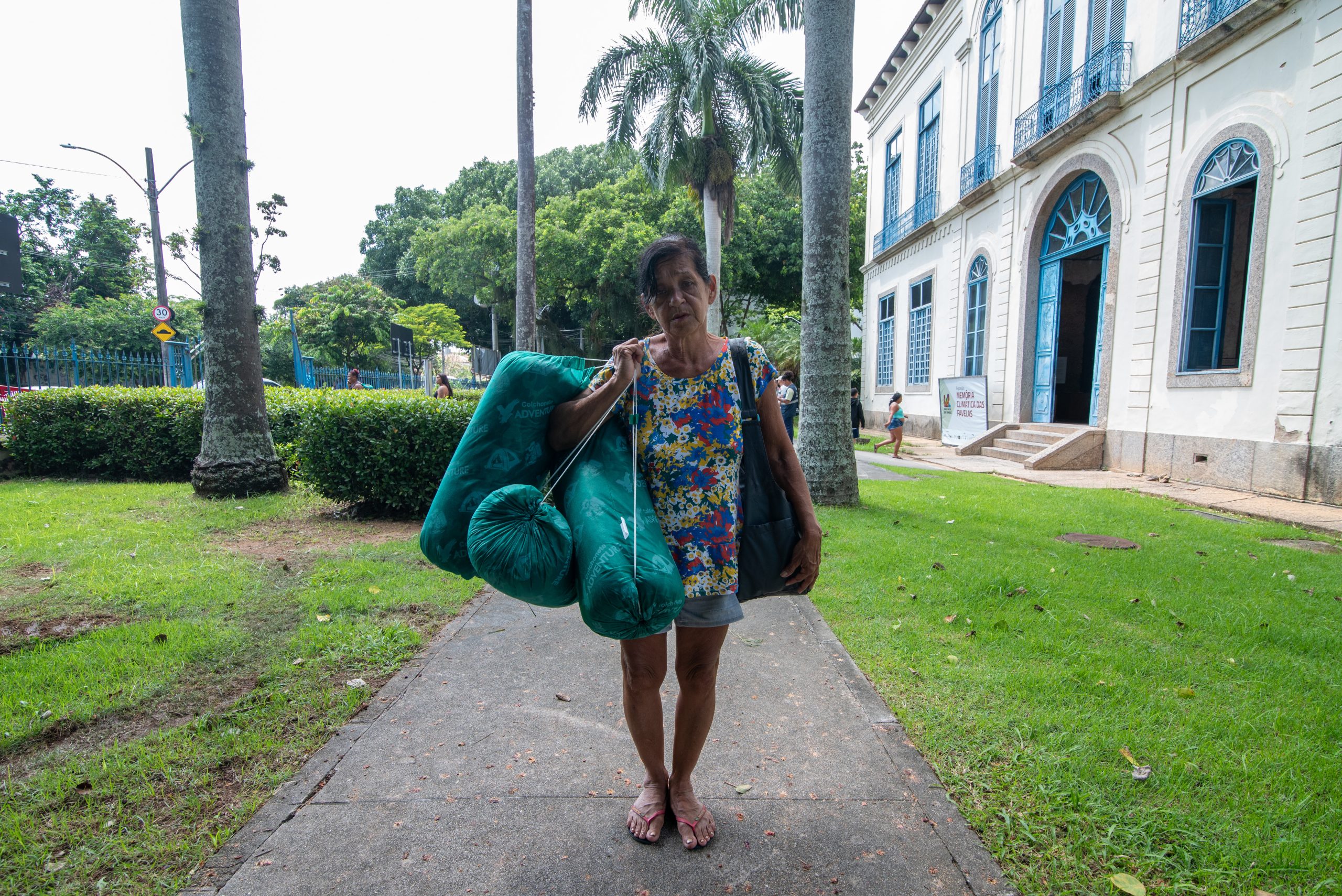
Marlene Ayres carries three sleeping mats that she received at the Palacete Princesa Isabel, in Santa Cruz. Amid visits by students from the Princesa Isabel Municipal School to the Favela Climate Memory exhibition, people affected by recent floods were receiving support from the Municipal Secretariat of Social Assistance. Photo: Bárbara Dias
Bruno Almeida added to Marlene’s remarks, stating how difficult it is to lose all of your belongings in a flood, as well as stressing the urgency of public policies to prevent the population from suffering so frequently from the impacts of the floods:
Panel from the Favela Climate Memory exhibition’s timeline representing 2019: “Flood in Antares.”
“It’s very sad. We see the images, but when we speak to the person, it’s hard to react. What can you say to them? What can we offer in a situation like this? Only support. And right now, what we did at the exhibition was just that: listen… These are issues that aren’t just [limited to] floods, to the water rising and falling a little—it’s losing all your possessions, and every time [this happens], people have to rebuild their homes from scratch. It’s almost like a war, you know? Except that ours could be prevented through public policy.”
After the discussion circle, the students, still reeling from this account, returned to the exhibition. History teacher Milena Williston spoke about the experience:
“I thought the exhibition was really interesting. I’d never seen anything like what I saw here today. I don’t know if it was a coincidence or not, given what’s happening right now. We see things from the past, the residents’ accounts, the way the project is organized—I thought that was really great. And they [the students] are really excited about the photos. I think it’s so important for them to see that the population, them included, needs to understand that people don’t just suffer from a lack of public policy. People need to take care of what they have. Because we see that flooding happens not just due to a lack of public policy, but also—as that lady asked [everyone here]—that we don’t throw trash [into the rivers] and take care of them.”
Tiago Oliveira, a 15-year-old student, noted that a lack of understanding of these memories can lead to problems from the past being repeated:
“I thought the exhibition was very interesting! The way that Bruno himself specifically talked about how all the discussion circles worked and how people forget about these memories and how [extreme climate] events that happened a long time ago, that are forgotten, end up happening again… As if it keeps happening over and over again.”
The Favela Climate Memory exhibition is on display at the Palacete Princesa Isabel, inside the Santa Cruz Municipal Cultural Center Doutor Antônio Nicolau Jorge, located on Rua das Palmeiras Imperiais, s/n. The exhibition is open Tuesday to Saturday, from 10am to 3pm, through March 31. Entrance is free.
*The Sustainable Favela Network (SFN) and RioOnWatch are both initiatives of not-for-profit organization Catalytic Communities (CatComm). The ‘Favela Climate Memory’ exhibition brings together 1,145 testimonials from 382 residents of ten favelas across Rio de Janeiro, collected and analyzed over three years, produced through a collective oral history project. The exhibition was developed by eleven museums and favela memory collectives that are members of the SFN: the Maré Museum (Complexo da Maré favelas), the Sankofa Museum (Rocinha favela), the Historic Orientation and Research Nucleus of Santa Cruz (organizer of the Antares climate memory circle), the Favela Museum (Pavão-Pavãozinho/Cantagalo favelas), the Vidigal Memories Nucleus (Vidigal favela), Alfazendo (City of God favela), the Serra da Misericórdia Integration Center (Complexo da Penha favelas), the Horto Museum (Horto favela), Fala Akari (Acari favela), Conexões Periféricas (Rio das Pedras favela), and the Evictions Museum (Vila Autódromo favela).
About the author: Bárbara Dias was born and raised in Bangu, in Rio’s West Zone. She has a degree in Biological Sciences, a master’s in Environmental Education, and has been a public school teacher since 2006. She is a photojournalist and also works with documentary photography. She is a popular communicator for Núcleo Piratininga de Comunicação (NPC) and co-founder of Coletivo Fotoguerrilha.
Support RioOnWatch’s tireless, critical and cutting-edge hyperlocal journalism, online community organizing meetings, and direct support to favelas by clicking here.