

 This article is part of a series created in partnership with the Behner Stiefel Center for Brazilian Studies at San Diego State University, to produce articles for the Digital Brazil Project on environmental justice in the favelas through RioOnWatch.
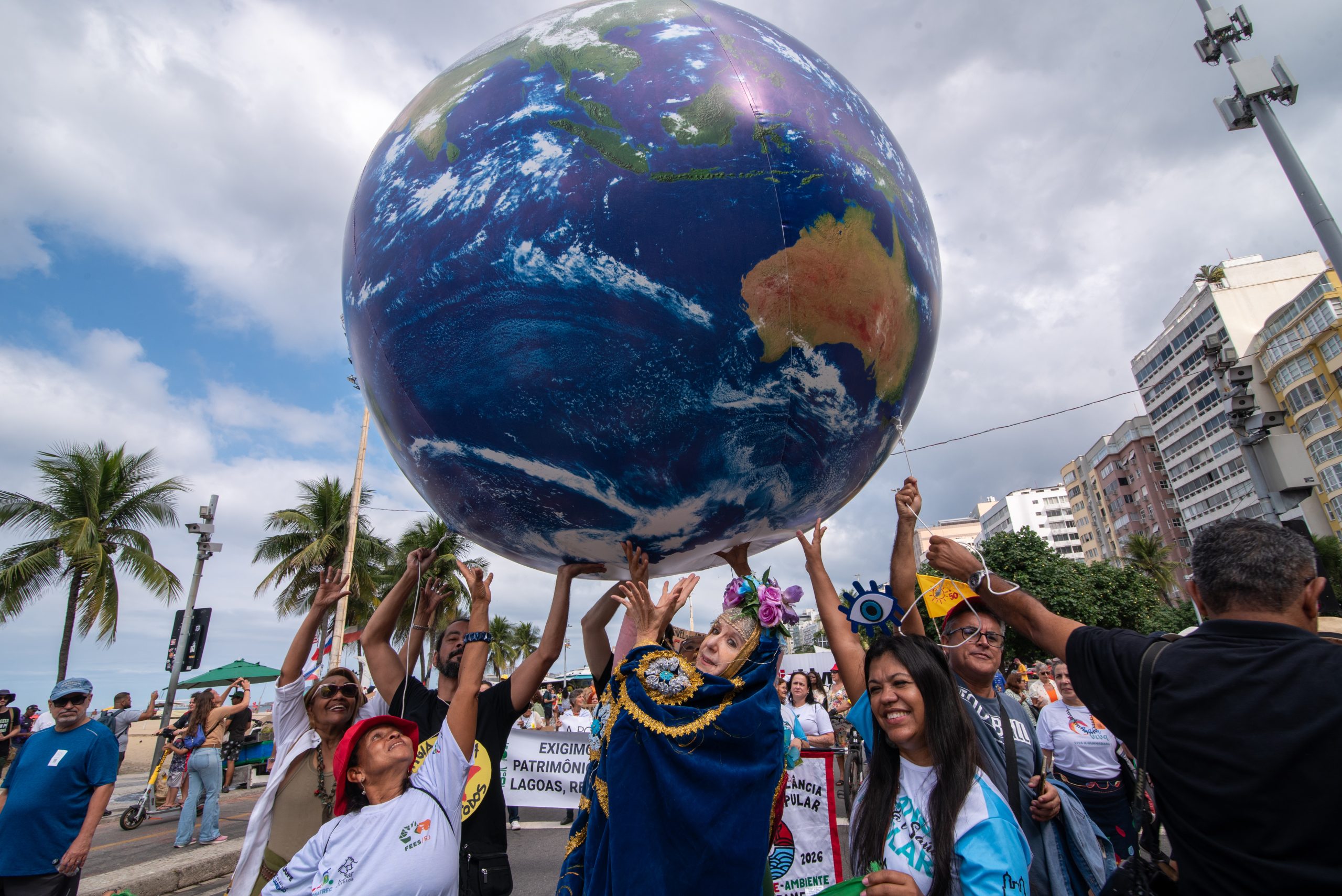
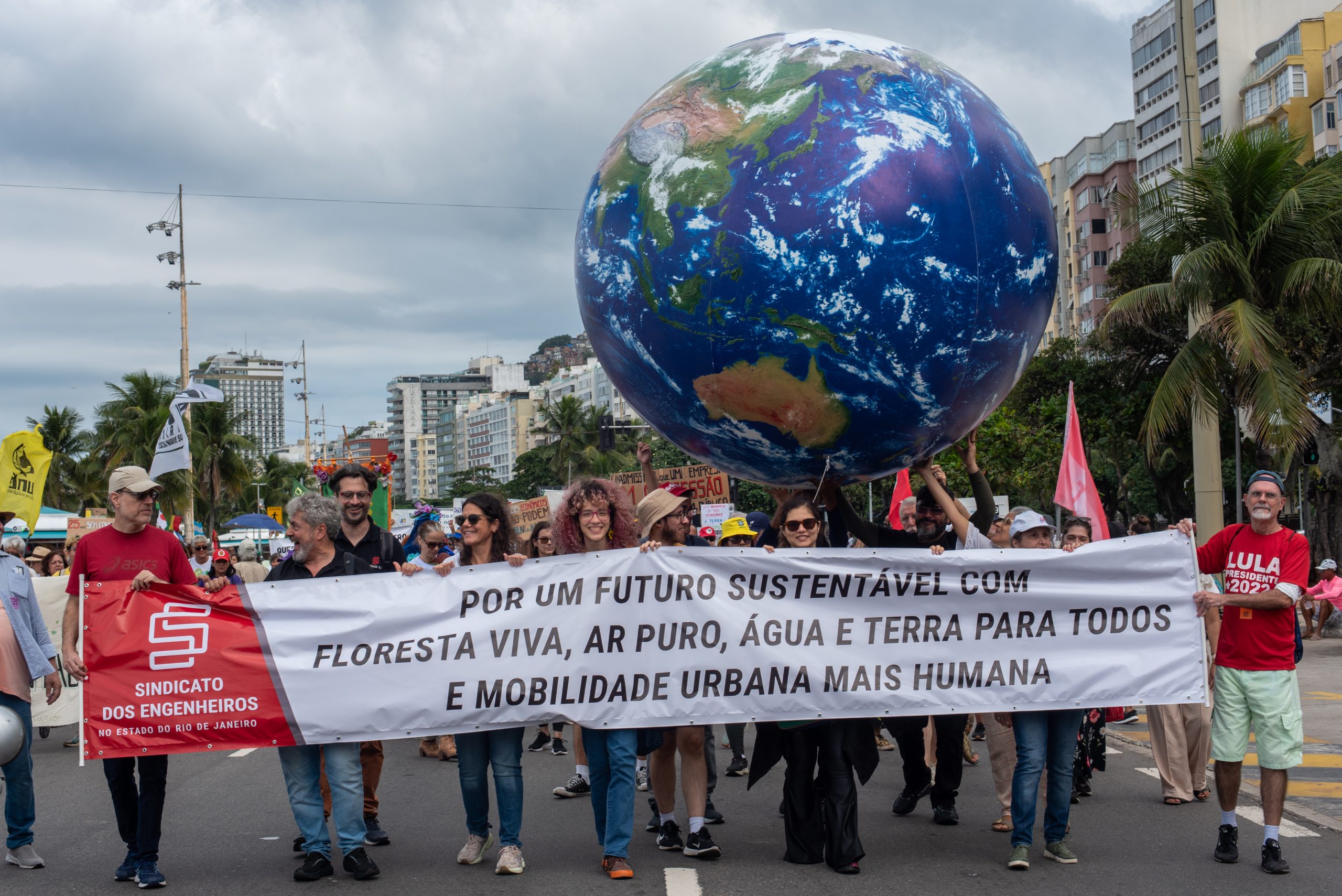
To kick off the week leading up to World Environment Day on June 5, the Rio de Janeiro State Forum for Environment and Agriculture (Femaarj) organized an environmental rally. Held along the Copacabana beachfront in Rio’s South Zone on May 31, the event brought together approximately 500 people, including activists, members of grassroots movements, favela organizers, Indigenous peoples, traditional communities, researchers and scientists.
The movement was collectively built by 210 organizations. In addition to participating in the rally, these organizations also drafted the Environmental Rally Pledge, which remains open for signatures. Jorge Cacá, from the Rio de Janeiro State Engineers’ Union (SENGE-RJ), delivered the event’s opening remarks:
“This rally is an act of collective construction. It is an act by socio-environmental activists who have been building [this mobilization] since January, recognizing the need to bring together Rio de Janeiro’s socio-environmental and trade union movements.”
At the rally’s meeting point, the microphone remained open so participants could speak, raise concerns and share relevant initiatives. Laudicéia Basílio, from the Rio de Janeiro Socio-environmental Network for Solidarity Recycling and the Circular Economy of Waste Pickers, spoke about the work of waste pickers, whose labor is almost always rendered invisible:
“My activism focuses on the solidarity and circular economies and on issues related to the leadership of waste pickers, who carry out recycling without pay or recognition from the government. Let me be clear: we are the ones cleaning and reutilizing these raw materials, bringing sustainability to our city.”
Antônio Oscar, from the Network of Committees Monitoring Municipal Waste Management Plans, expressed concern about the lack of compliance with the National Solid Waste Policy (Law 12.305, enacted August 2, 2010):
“Every municipality is required to have an integrated waste management plan. And both the development and implementation of that plan have to guarantee public participation. That’s why every municipality needs to have a monitoring committee. Its role is exactly that: to monitor the process. First, it needs to determine whether the municipality is complying with the law—in other words, whether it has a plan in place. And if it does, how is public participation being guaranteed? The Network of Committees has been trying to do this in a coordinated way… Based on these plans, we will assess each municipality’s recycling rate and set targets so that… recycling and the inclusion of waste pickers are prioritized.”
José Miguel, from the Duque de Caxias Ecocity Association, called out the dumping of one billion liters of leachate into Guanabara Bay every year, citing data from the Living Bay Movement:
“Some thinkers consider this to be environmental racism, in the sense that waste is sent to poorer cities, leaving behind an environmental liability. The Jardim Gramacho landfill has been closed since 2012, but it is still leaking leachate, as it did throughout its three decades of operation. So we want to draw attention to the problem of leachate leaking into Guanabara Bay. The Guanabara Bay Basin Committee created a working group and has been accumulating knowledge on this problem.”
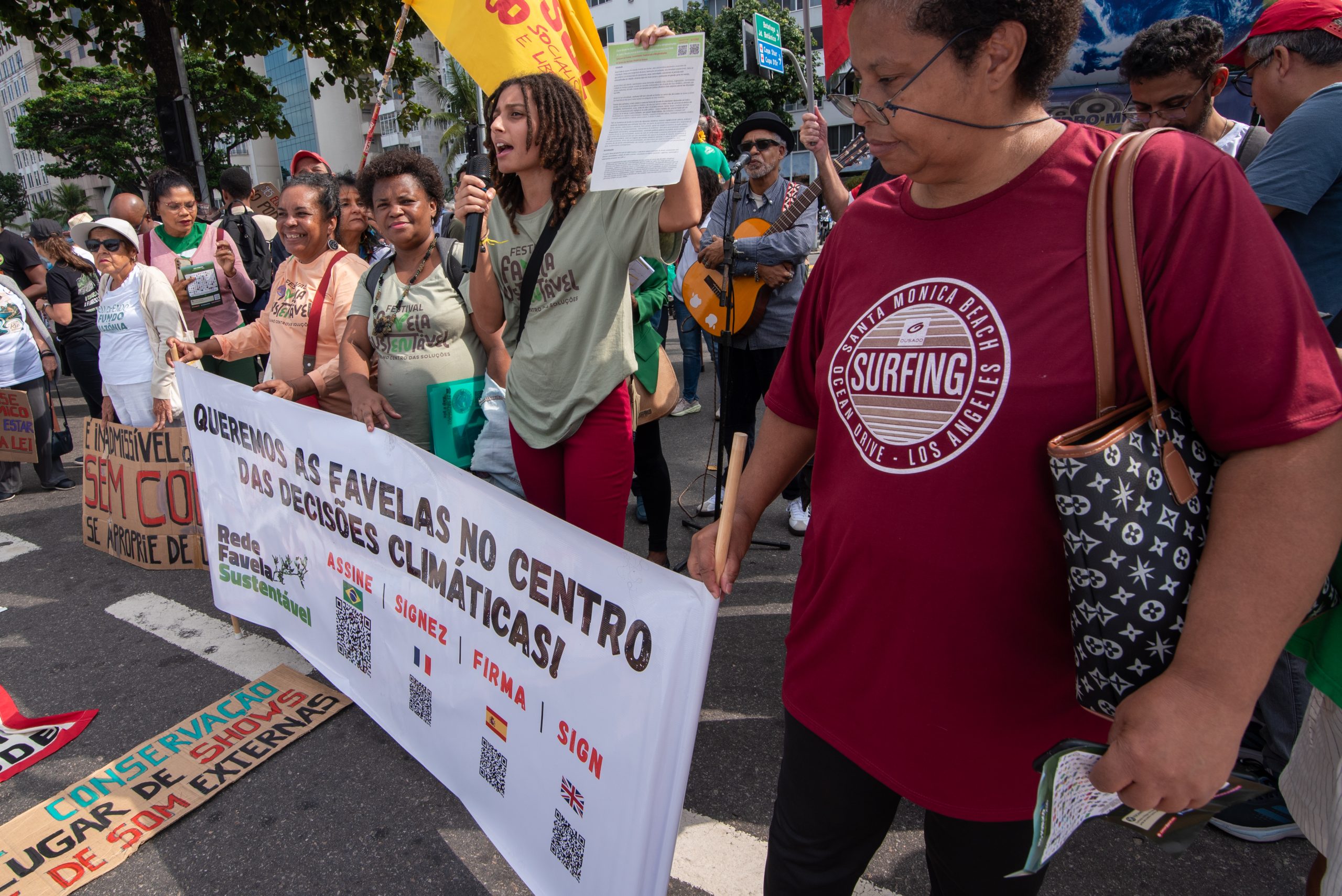
Thaysa Santos, a member of the Sustainable Favela Network (SFN)* and a community organizer at Affective Earth, called on everyone to learn about the Favelas Climate Letter:
“We are here representing the Sustainable Favela Network, which wrote the Favela Climate Letter in 2025. [We are] the most disinvested territories. We took this letter to COP30… We need to keep pushing the agenda of [adequate] sanitation in the favelas because these are the places hardest hit by flooding and where people still don’t have access to safe drinking water. We need to keep making these demands and pushing these issues forward on behalf of our communities, because… favelas have suffered greatly from the lack of sanitation. There are degraded rivers that we need to restore. We need to advocate for these issues so we can influence the development of public policies.”
The Sustainable Favela Network stood alongside other movements mobilized in defense of climate and socio-environmental justice. With 30 of its members present, from favelas across Greater Rio, the network’s main demand was that favelas be placed at the center of climate decision-making. Claudia Queiroga, a community chef and creator of Bora com Queiroga, a cooking school in the Nova Campinas neighborhood of Duque de Caxias, said:
“It’s important to place the SFN, [grassroots] organizations and favelas at the center of these discussions. That’s why we’re here. We mobilized the network so that member collectives could be here as part of this movement. Because this is the only way that voices from within the favelas will be heard. We have to be here so that we can make decisions together and bring this discussion into the favelas.”
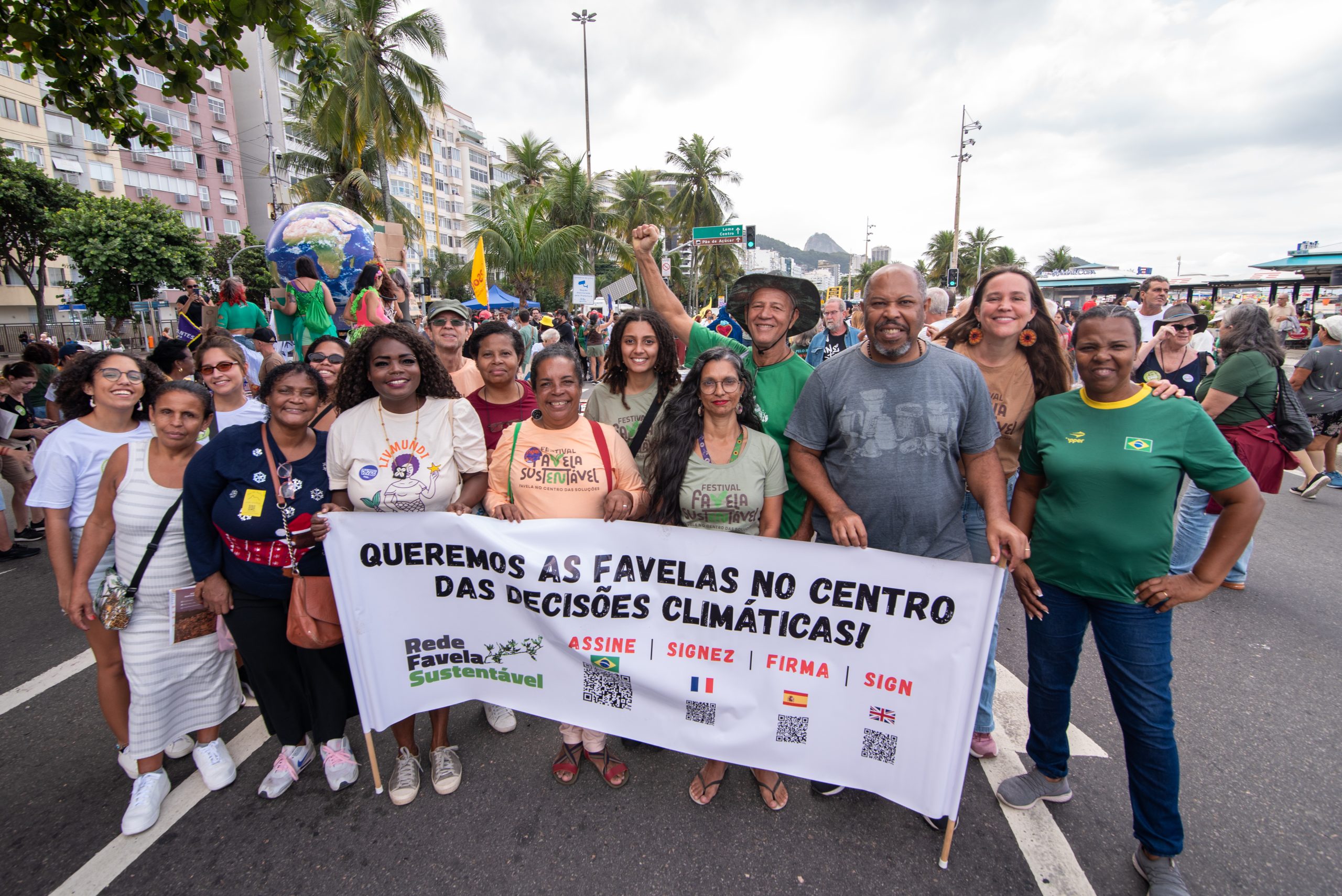
After speeches addressing myriad issues—including poor sanitation, flooding, water shortages and waterborne diseases, as well as the urgent need to resume urban planning focused on preserving green spaces in cities, recycling, air pollution and the energy transition—the march set off along the waterfront.
At the end of the march, the Environmental Rally Pledge was read aloud. It was signed by over 210 socioenvironmental organizations and trade unions across Rio de Janeiro state. Its demands include the radical transformation of the state’s environmental governance, which should be guided by climate justice and the fight against environmental racism.
The Pledge puts forth 23 demands, divided into nine priority areas:
- Water as a right, not a commodity;
- A just energy transition based on renewable energy;
- Zero deforestation in both biomes and cities, with urban forest restoration;
- The cleanup of Guanabara and Sepetiba Bays;
- Monitoring air quality in the state’s 92 municipalities in accordance with World Health Organization (WHO) guidelines;
- Strengthening environmental agencies through civil service examinations and increased oversight;
- Implementation of the National Solid Waste Policy with the inclusion of waste pickers;
- Agroecology and food sovereignty; and
- Prior consultation with Indigenous peoples, quilombola and traditional communities.
View the Full Photo Album:

About the Author: Bárbara Dias, born and raised in Bangu in Rio de Janeiro’s West Zone, has worked as a photojournalist and documentary photographer since 2016, focusing on human rights, socioenvironmental justice, religious traditions and favela communities. A popular communicator trained by Núcleo Piratininga de Comunicação (NPC), she is a Journalism student at Candido Mendes University (UCAM) and a co-founder of Coletivo Fotoguerrilha (2016–2025). Dias holds a degree in Biology from Rio de Janeiro State University (UERJ), a Master’s in Environmental Education from the Federal Institute of Rio de Janeiro (IFRJ), and teaches in the state public school system.