
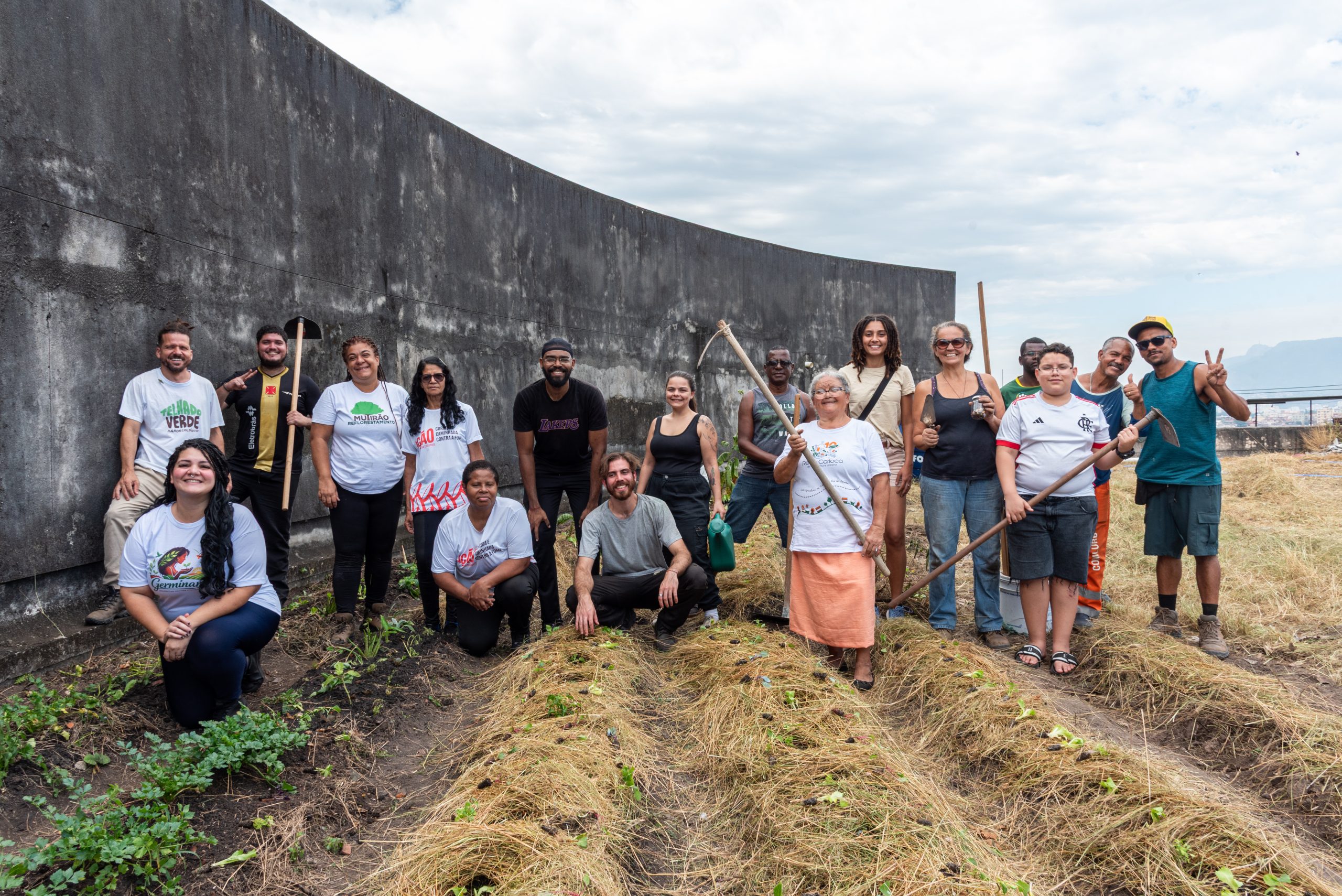

The garden beds at the João Bosco Community Garden, in Complexo do Alemão, received care and affection from 30 volunteers on August 8 during a revitalization collective action organized by Josefa Maria da Conceição, the inspiring and much-loved Dona Josefa. The community garden sits atop a decommissioned water reservoir and has been turning a previously unproductive concrete area into a space for growing and producing food in the favela.
The activity brought together collectives that participate in the Alemão Environmental Commission and the CPX Popular Action Plan Forum, Agroecological Green Roof, Green Is Worth the Fight, Verdejar Socio-Environmental, the Reservoir Residents’ Association, as well as members of the Sustainable Favela Network (SFN)* and technical allies from the Federal University of Rio de Janeiro’s (UFRJ) MUDA Agroecology Collective Action and Visão Coop. The collective action was part of the SFN’s Collective Calendar.
Dona Josefa, an environmental educator, agroecological farmer in Complexo do Alemão and member of the Alemão Environmental Commission, led the activities with the energy and knowledge of a community matriarch:
“The goal is to strengthen this space and Denner’s work. We can’t just sit back or work alone. We need to bring people together to work with us… As part of the CPX Popular Action Plan Forum and the Complexo do Alemão Environmental Commission, we meet every month. So, we came here to strengthen this space right from the start.”
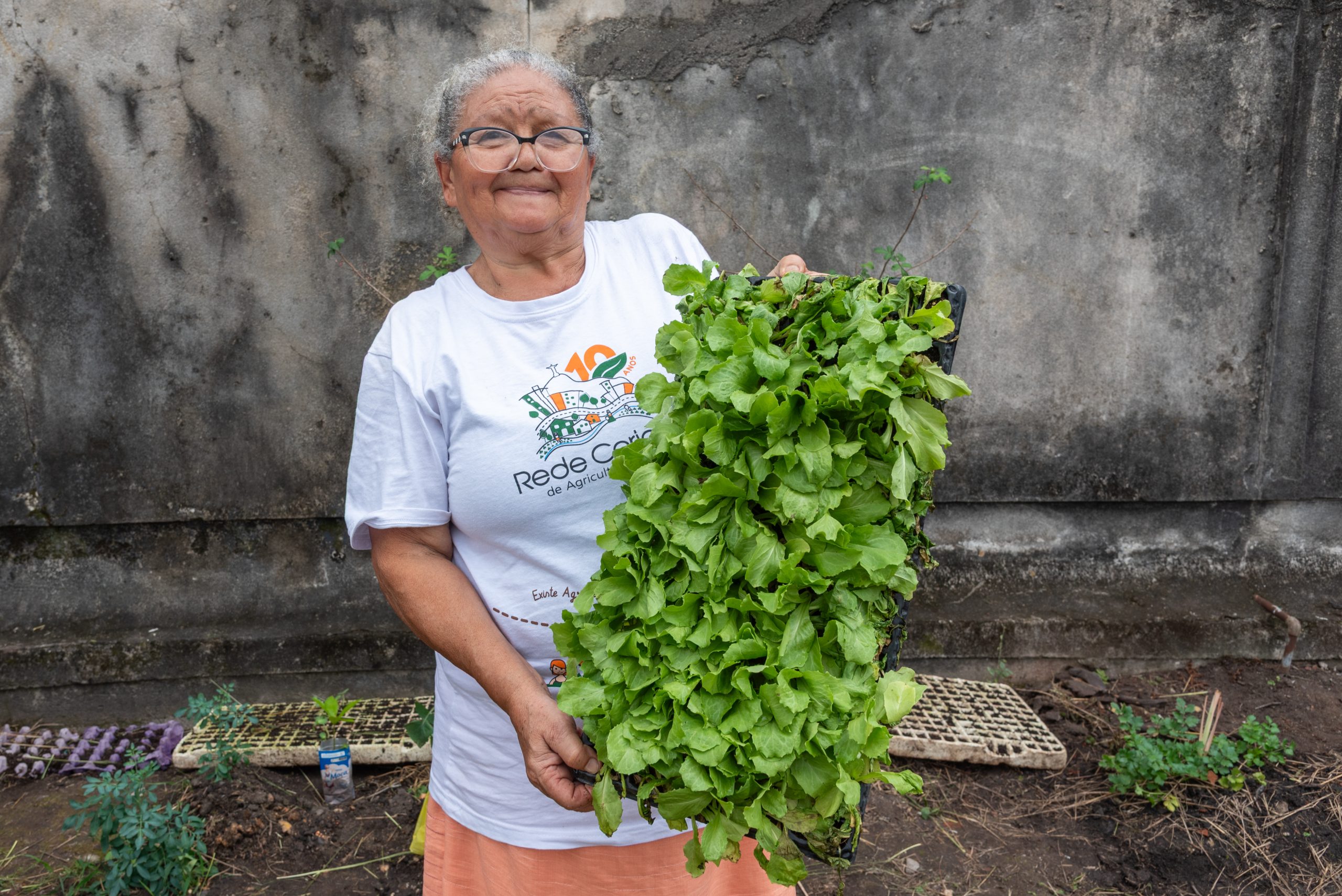
Denner Noia, born and raised in Complexo do Alemão, is an artist, environmentalist, community organizer, popular educator and member of the Visão Coop team. He is also a member of the Alemão Environmental Commission and is responsible for the João Bosco Community Garden. He spoke about the use of the former reservoir’s rooftop and the garden’s name, which pays tribute to a resident who pioneered planting at the site:
“We have this industrial-scale reservoir, this huge space that was abandoned for a long time. It basically became a vacant lot where people would dump their trash… First, we held a collective action to clean up the space, then another to clear all the overgrowth. And then we started the garden. There used to be a resident, someone born and raised here, who took care of it on his own. The harvest? He shared it with the community. His name was Mr. João Bosco. So, when the president of the residents’ association approached me about creating a community garden up here, everyone I talked to mentioned Mr. João Bosco and the work he’d done. We reached out to his family and told them about the project, and they gave us their permission. They liked the tribute, so we named the garden after him.”
The day’s activities started with a collective, collaborative breakfast. After the meal, the collective action focused on clearing the land, cleaning and maintaining the garden beds and planting approximately 600 vegetable seedlings—including lettuce, arugula and chives—as well as some flowering plants.
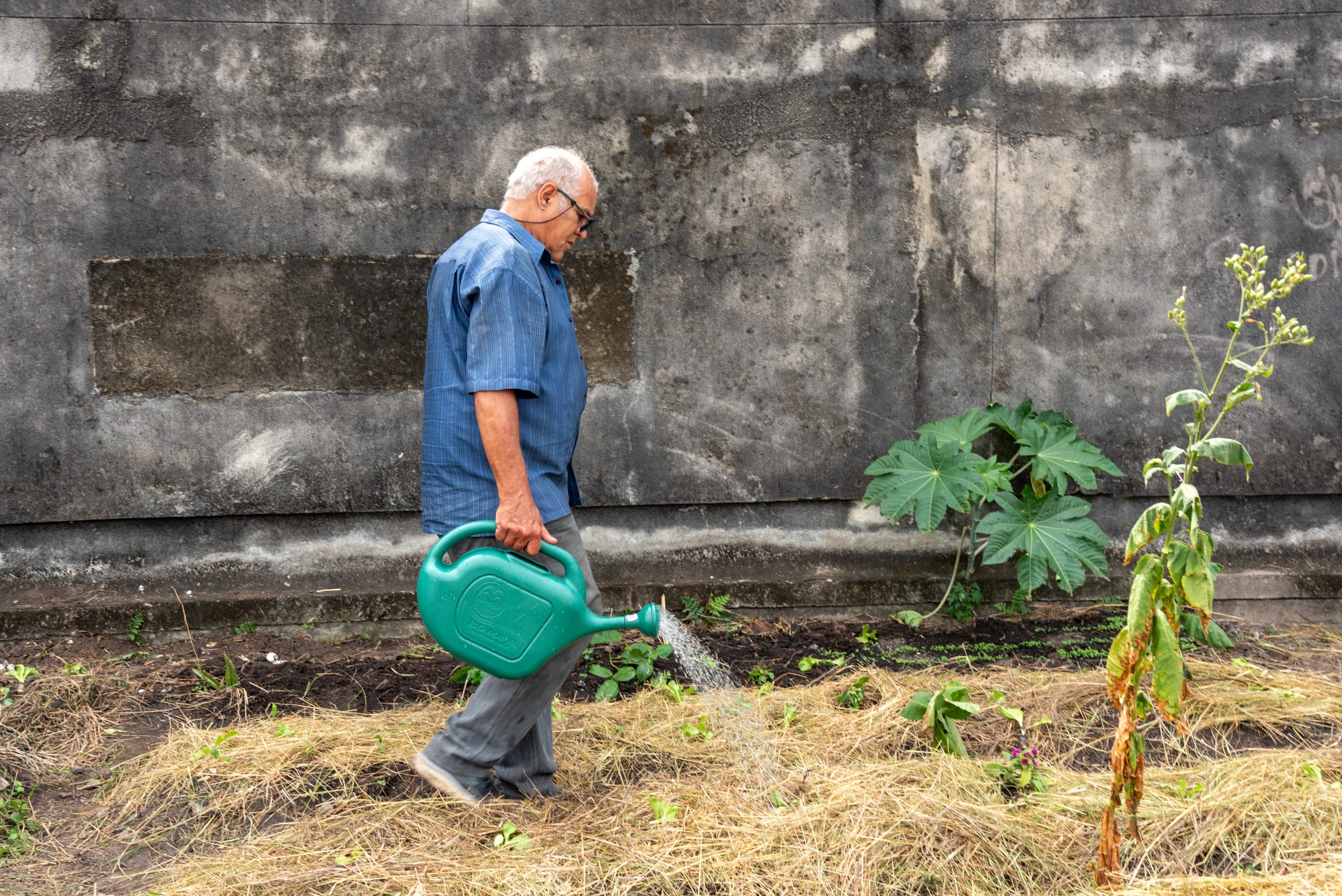
The day’s cultural activity was a reading of the cordel piece Community Garden at the Complexo do Alemão Reservoir, authored by José Franklin da Silveira, a cordelista (a storyteller in the Brazilian folk literary form known as cordel) and Complexo do Alemão resident who is also a member of the Alemão Environmental Commission. Da Silveira shared some of the story of how the reservoir was gradually turned into a garden:
“Celebrating the so-called Environment Week,
Along with a hardworking crew,
I heard about the effort and thought I’d lend a hand,
Though this kind of work to me was new.
We were there to revive a community garden,
Called João Bosco, created in solidarity,
Because nothing here is ever done alone.Up at dawn to make my way, I went out of curiosity,
To see the green crew at work, caring for it with sincerity.
I like those who protect this part of the city,
And now I too am part of the Environmental Commission,
Of the Complexo do Alemão Forum,
Together, they quickly welcomed my admission.
[…]The place where we gathered is known as the reservoir,
In the past, it held plenty of water in store,
For our people and factories spread out near and far.
No one agreed, but I thought the building was well made,
And when it was running, its sounds kept boredom away.
People died, so they shut it down. It was the only way.
The water tank then became a parking lot.The front was taken over for policing,
So we gathered on the soil-covered rooftop.
Our job was to care for it and new seedlings sow,
Eight months had passed with no one there to hoe…
This time, we mean it—we won’t let it go,
We restored one garden island and created another,
Then cleared the weeds and planted fruit trees together.”
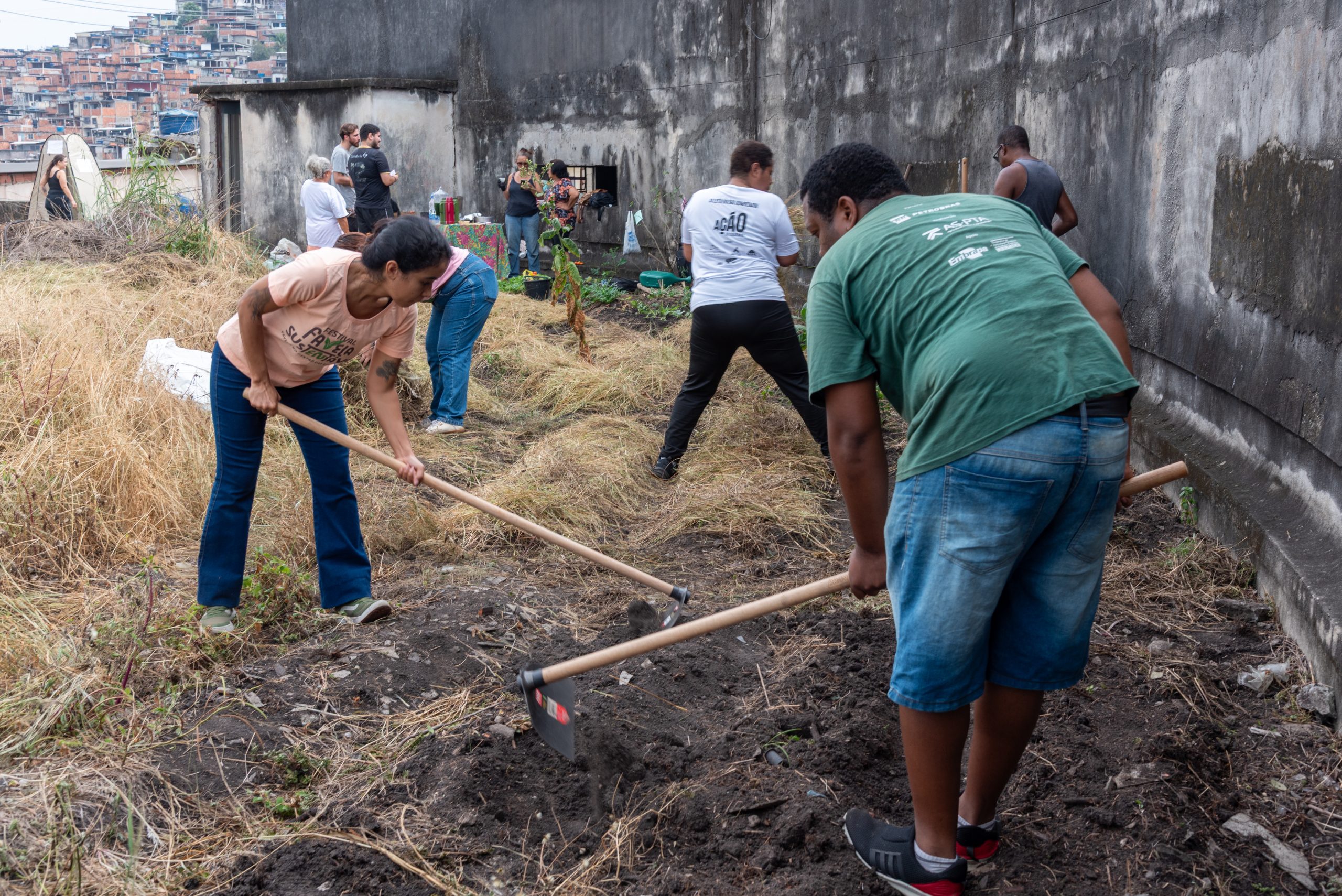
Pedro Torres, a geographer at UFRJ and community outreach worker with the MUDA project, explains how the university’s partnership with the community works:
“The first step is to visit and, above all, get to know the people, see what they want, what they expect, what their wishes are, where they want to be. Then I keep listening and talking, and we look at the space, see what might be interesting, what we think would work best… Sometimes, everything can be done. So, it’s about seeing what people want, what the challenges are, what will be easier and what will be harder.”
Jéssica Devita, manager of Agroecological Green Roof, promotes reforestation and care for Serra da Misericórdia. Another member of the Alemão Environmental Commission, she explains how other local collectives and groups help strengthen socio-environmental initiatives in the community:
“Today’s collective action is part of the calendar of the Alemão Environmental Commission and the Complexo do Alemão Popular Action Forum, aimed at promoting these spaces, which have great potential to help us work on local environmental issues. We’re always carrying out these efforts in spaces throughout Complexo do Alemão, and today we’re working to strengthen this even further… so that, as a real team, a collective from the community, we can increasingly promote environmental education.”
The João Bosco Community Garden created a possibility for green occupation of an abandoned reservoir in the middle of the favela, turning a once-unproductive area into garden beds filled with vegetables and flowers and a space for agroecological work and building collective dreams.
See More Photos in the Album:

*The Sustainable Favela Network (SFN) and RioOnWatch are both initiatives of not-for-profit organization Catalytic Communities (CatComm).
About the author: Bárbara Dias was born and raised in Bangu, in Rio’s West Zone. She has been a photojournalist and documentary photographer since 2016, focusing on human rights, socio-environmental justice, religions and favela communities. A popular communicator trained by the Piratininga Communication Center (NPC), she is currently pursuing a degree in Journalism at Candido Mendes University (UCAM). A co-founder of Coletivo Fotoguerrilha (2016–2025), she holds a degree in Biological Sciences from the State University of Rio de Janeiro (UERJ), a master’s in Environmental Education from the Federal Institute of Rio de Janeiro (IFRJ), and is a public school teacher.