Articles written by Catherine Osborn:
Morar Carioca Stalled in 89 Favelas Before Construction Plans Finalized: The Case of Pica-Pau
May 2nd
Irenaldo, President of the Pica-Pau Residents' Association, strolls behind a cyclist on one of Pica-Pau's main streets.
Irenaldo Honório da Silva, president of the Pica-Pau Residents’ Association, is at a loss. The small favela where he has led community organizing efforts for over twenty years, slightly north of Maré along Avenida Brasil, has in the past eighteen months witnessed robust commitments to what will be the first large-scale public upgrades in its history, those from the municipal Morar Carioca program. Teams of architects, technical surveyors, and social scientists have visited, noting the locations of abandoned buildings that could be converted into schools and More >
Rocinha, Gramacho and Port Planners Say: Participation is Vital
Apr 13th
On March 22, favela upgrades and compensatory damages for garbage pickers were on the agenda at a panel on “inclusive urbanism” at Studio X Rio, a satellite project of Columbia University’s Graduate School of Architecture, Planning, and Preservation (GSAPP). Located in a rehabbed historic building in Rio’s downtown Praça Tirandentes, Studio X had especially full programming during North American spring break, when Columbia students came to showcase their research and dialogue with citizens and local actors in architecture and planning.
Participatory planning is certainly the exception rather than the rule when it comes to urban development in Rio, and the panelists were More >
A History of Favela Upgrades Part III: Morar Carioca in Vision and Practice (2008 – Present)
Apr 2nd
This is Part 3 of a three-part series on the History of Favela Upgrades in Rio. Click for Part 1 and Part 2.
The cable car in Complexo de Alemão, opened in 2011, was funded through the federal Growth Acceleration Program (PAC).
In Rio, the end of the 2000s brought a trickle of funding to a few delayed upgrading projects from the Favela-Bairro program and its spinoffs, the Bairrinho and Grandes Favelas programs. During this time the federal Growth Acceleration Program (PAC) began to install public works in favelas as well. These tended to be attention-grabbing projects and those visible from the edges of communities such as the cable car in Complexo More >
From Acari to Rocinha: A forum for community concerns at Favela Não Se Cala
Mar 8th
Francilene Cardoso, sociology Master's student and resident of Chapéu Mangueira
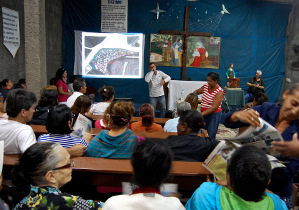
Over sixty favela residents, public defenders, nonprofit workers, and observers filled the chapel at the top of Laboriaux Street in Rocinha on Sunday for a three-hour meeting organized by residents of various North and South Zone favelas. Dubbed “Favela Não Se Cala” (Favela Don’t Be Quiet), the group gathers once a month, in a different community each time. Last month they met in a chapel at the entrance to Cantagalo along the snaking staircase familiar to those who don’t use the famous elevator.
“Everyone who would like to make a comment will More >