
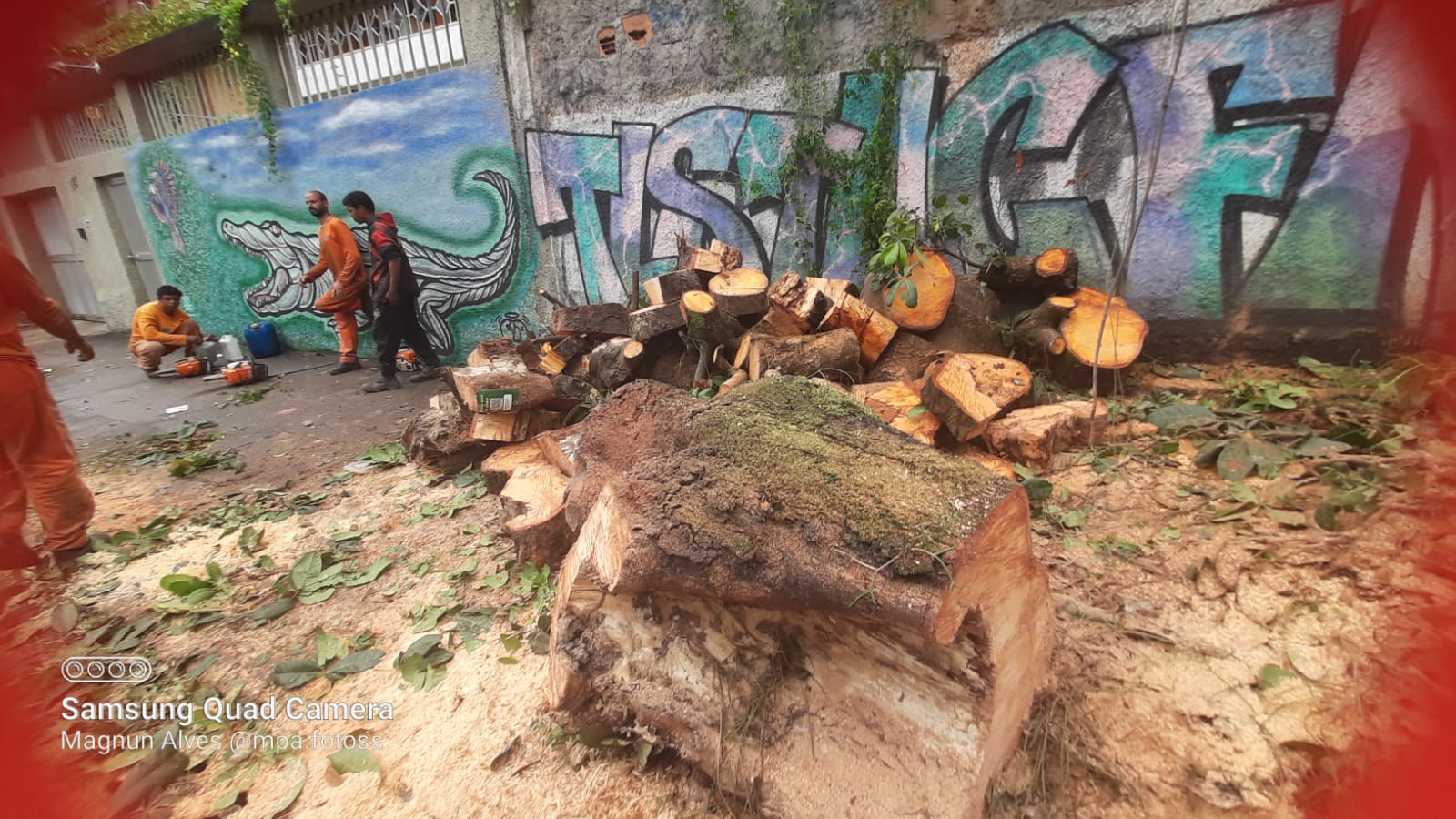

Concerned with the felling of trees across the Taquara neighborhood, in Rio de Janeiro’s West Zone, not far from where the 2016 Olympics took place, community journalist Magnun Alves shared an account on social media about the merciless wave of tree “pruning” that has been devastating the region over the past two years, offering a heartbreaking local account that reinforces recent reporting on RioOnWatch, such as the must-read “Rio Mayor Eduardo Paes Sells Off Iconic Green Spaces” published earlier this month.
Alves is a contributor to his neighborhood newspaper Jornal Abaixo Assinado Jacarepaguá (JAAJ) and documents a range of issues related to everyday life in the region, including predatory pruning, which has been linked to the construction of new real estate developments, commercial establishments and reckless urbanization.
Shade Is Disappearing: Centuries-Old Trees Decimated
Jacarepaguá has slowly been losing its bucolic feel. Lately, what has been moving fastest is the felling of mature trees—the very ones that for years gave shade, cool air and beauty to our streets.
The removal of a tree on Rua Alberto Soares Sampaio, in Taquara, was already completed when I arrived. Caught in the act, I asked [those responsible] if I could see the service order. Politely, they showed me a permit. During the conversation, the usual explanation came up: “For each tree cut down, City Hall plants ten or twenty more.”
The felled tree had been a long-time shelter for birds and an important source of shade in the region. The ground was evidently destroyed, showing that considerable effort was made to remove it.
But an entire ecosystem is lost along with a tree of this size: various birds, marmosets and other forms of life that depended on it. So, the question remains: does our neighborhood really not need trees?
Jacarepaguá already suffers from flooding, because much of the neighborhood is covered by concrete. At other times, we face extreme heat, exacerbated by the lack of green areas. Planting trees in remote areas or on hillsides where wildfires have occurred might even be understandable, but what we are seeing happen is something else: sidewalks that once had trees are being turned into parking areas. And this is not happening only in Jacarepaguá.
More and more, Rio de Janeiro is seeing its mature trees disappear while new developments emerge. A pretty photo of planting a sapling is pointless in a news report or on social media. Anyone who experiences this city knows the difference between a sapling and a tree that took decades to grow.
Other incidents are unfolding throughout the neighborhood. On Avenida dos Mananciais 748, where centuries-old trees, already pruned and starting to regrow, were removed—their trunks were cut up and removed in the night. A short distance away, on this same avenue at number 128, a tree was injected with poison. The method is used to desiccate roots, killing them from the inside out. Another spot, on Estrada do Tindiba at number 2,620, shows where a tree once stood, its soil now cemented over.
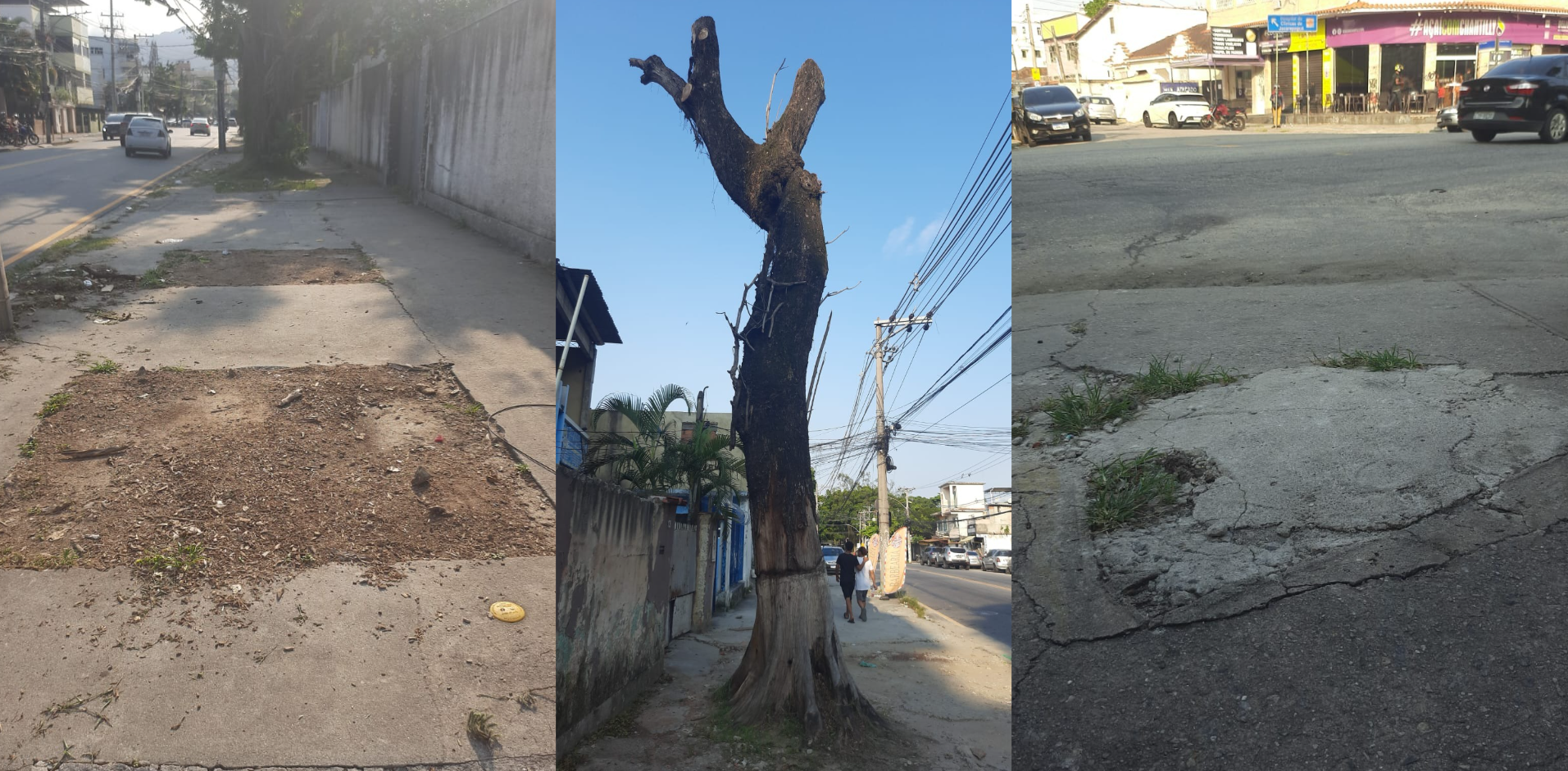
These trees were so robust, with roots so deep, that their removal took more than a night’s work. Following the extraction, what was once a small ecosystem has become nothing but compact earth. Cars began to occupy the sidewalks, turning them into parking spots, infringing on the universal right to come and go, especially at night, on soccer game days and during events at other establishments in the area.
The question remains for us all: what kind of city do we want to leave for the years to come?
In addition to the felling, trees also suffer from poorly executed pruning, when they are cut only on one side. This makes them unstable and increases the risk of falling during major storms—as happened in November 2025.
A city that was once shade and life is now haunted by concrete and heat. Urban landscaping is no longer planned inclusively and often seems to serve developments more than people.
About the author: Magnun Alves is a writer and grassroots communicator. He is author of the children’s book “The Adventures of Arthur in His Mom’s Belly.” He is also mediator of the Encanto do Sertão Carioca collective and a contributor to the newspaper Jornal Abaixo Assinado, reporting on Rio de Janeiro’s West Zone.
Ver essa foto no Instagram