
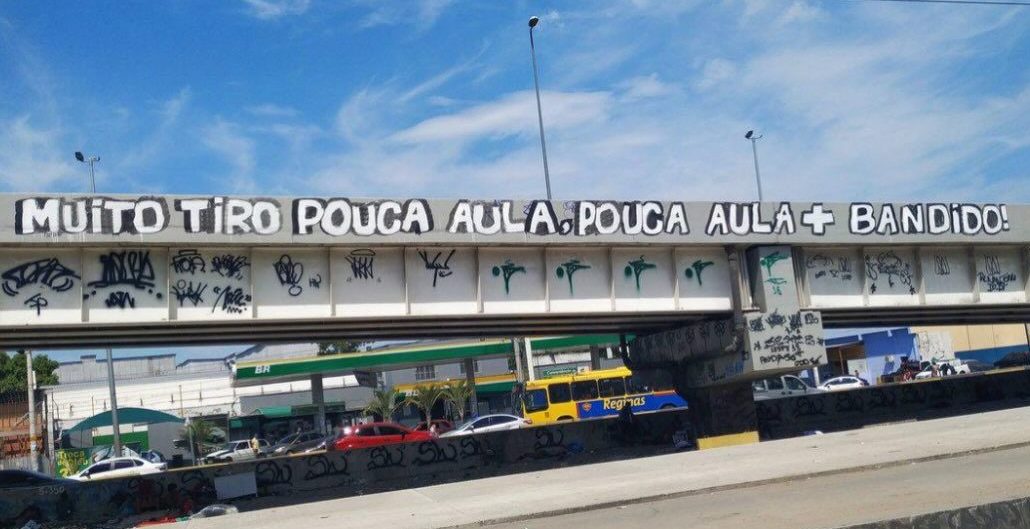

In Rio de Janeiro’s North Zone, leaving home to go to school can mean navigating an environment marked by uncertainty. On days of police operations or armed confrontations, the journey to the classroom is far from guaranteed—and, often, classes do not take place at all.
This is what the new report Interrupted Journeys, produced by Fogo Cruzado Institute in partnership with UNICEF and the Fluminense Federal University’s Study Group on New Illegalities (Geni/UFF), reveals. It shows that armed violence has systematically impacted students’ ability to travel to and from school in Rio de Janeiro, as well as their physical access to educational institutions. In many cases, when students are already at school, police violence prevents classes from continuing and leaves students, teachers and staff trapped inside school buildings amid shootouts.
“Between January 2023 and July 2025, 377 school days recorded at least one impact on school commutes, out of an estimated total of roughly 520 school days, showing that the problem is not limited to exceptional incidents or concentrated in specific periods,” the report explains. Over that period, more than 1.02 million school commutes were impacted.
School Routine Disrupted by Long Interruptions
Interruptions were not only frequent—they were long and occurred at the most critical times of day. Over 52% of incidents on school days began between 6:30 and 8am, precisely when students are commuting to school. On school days, police operations last an average of 8 hours and 13 minutes, with over 78% exceeding two hours and more than half lasting longer than four hours.
In practice, this means that a single incident can disrupt an entire school day and compromise students’ academic progress. This is the assessment of Maria Isabel Couto, Director of Data and Transparency at Fogo Cruzado Institute:
“Instability has become the norm for a significant portion of students. When this becomes routine in certain favelas, we’re dealing with the systemic undermining of the right to education.”
This scenario directly affects teaching and learning. As psychologist and teacher Rian França, who works with children whose routines are regularly interrupted by State violence, explains, disruptions to educational continuity hinder memory consolidation and cognitive organization:
“Children learn through regularity, predictability and repetition. Constant interruptions compromise this process.”
Geographic and Racial Inequality in Access to Education
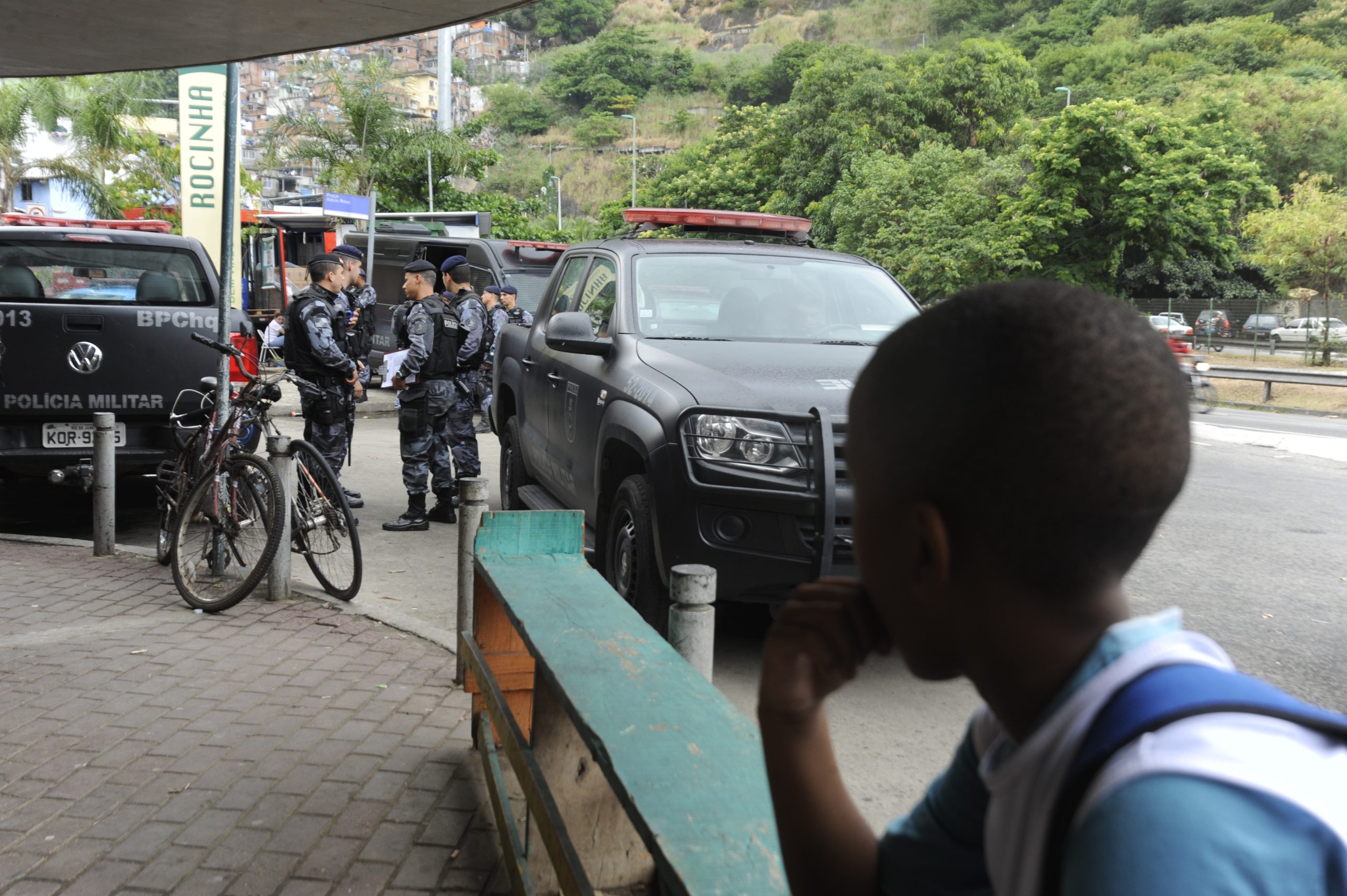
The data show that the impacts of armed violence are not distributed evenly across the city. Of the 96 neighborhoods where disruptions were recorded, just ten account for the majority of incidents. Penha (North Zone) leads with 296 recorded incidents, followed by Jacarepaguá with 108 and Bangu with 89 (both in the West Zone).
This pattern creates profound inequalities in access to education. While in some favelas accumulated disruptions amount to the equivalent of 88 lost school days, in approximately 70 neighborhoods no incidents were recorded during school hours over the period analyzed.
“Armed violence does not create this inequality, but it systematically deepens it. In practice, the data show that a Black student in Rio is far more likely to have their school routine disrupted.” — Maria Isabel Couto
França reinforces that this context has lasting negative impacts that will persist for generations. He also says that “constant disruptions compromise the teaching and learning process and students’ bond with their school.”
Exposure to the problem is widespread. Of the 4,008 municipal schools analyzed, 95.4% recorded at least one disruption during the period. At the same time, close to 323,000 students were enrolled in schools classified as being at moderate, high or very high risk, where disruptions were more frequent and prolonged.
In these areas, the right to come and go is no longer guaranteed. “Instability has become the norm for a significant portion of Rio’s students,” Couto reiterates, stressing that these daily disruptions affecting students who live in favelas should be understood as a violation of rights—a crime against children and adolescents. And this succession of violations produces irreversible emotional and cognitive impacts on favela youth.
“Fear places the brain in a state of heightened alertness, impairing essential functions for learning. This can result in anxiety, a decline in school performance, changes in sleep and, in the long term, an increased risk of dropping out of school.” — Rian França
About the author: Felipe Migliani has an undergraduate degree in journalism from Unicarioca and post-grad in Investigative Journalism and Data Journalism. He works as a reporter and media advisor, having published stories with outlets such as Meia Hora, Estadão, Agência Lume, PerifaConnection, Ambiental Media, Gênero e Número, Olhos Jornalismo and ND Mais.