
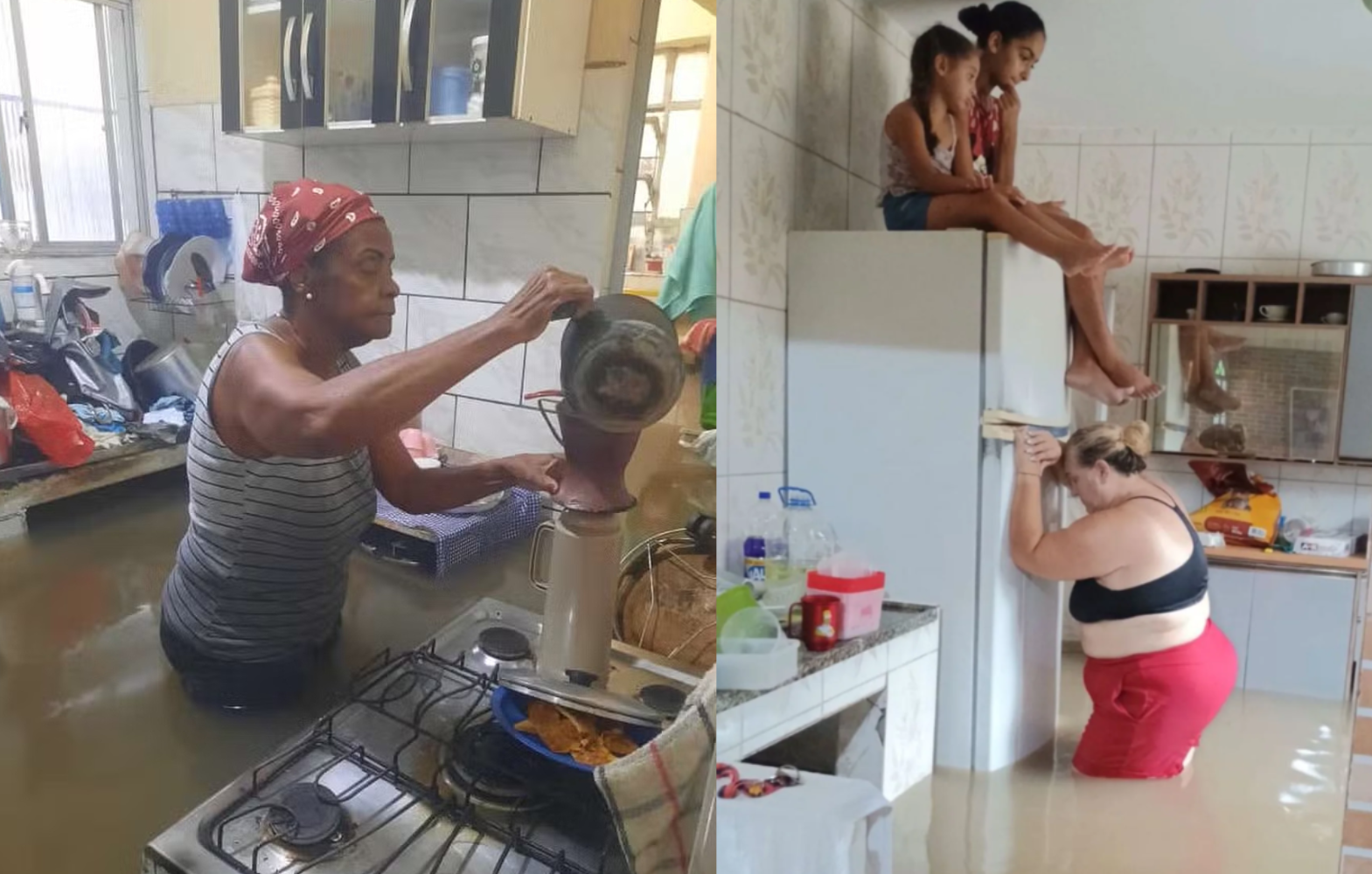


This article is part of RioOnWatch’s ongoing #VoicesFromSocialMedia series, which compiles perspectives posted on social media by favela residents and activists about events and societal themes that arise. It is also part of a series created in partnership with the Behner Stiefel Center for Brazilian Studies at San Diego State University, to produce articles for the Digital Brazil Project on environmental justice in the favelas for RioOnWatch.
Click on the Instagram posts to watch community-produced videos throughout the article.
After over 20 consecutive days of rain, on Monday February 9, 2026, around 6pm, heavy rainfall hit several areas of Greater Rio, causing flooding and landslides. According to reports shared on social media by favela residents, the intensity of the downpour quickly flooded homes, brought down hillsides and formed large pools of water, blocking roads and leaving residents stranded inside and outside their homes.
Ver esta publicação no Instagram
According to a survey conducted by Rio’s Operations and Resilience Center (COR-Rio), the most affected areas were the North Zone and cities of Greater Rio’s Baixada Fluminense and Leste Fluminense regions. However, what COR-Rio’s data do not show is that favelas are the most impacted by extreme climate events. And this is no coincidence.
Ver esta publicação no Instagram
Unfortunately, this situation is not new. RioOnWatch finds itself committed, year after year, to publishing on the fateful effects of rain and other extreme climate events in favelas, as seen in: December 2013, February 2019, April 2019, March 2022, April 2022, January 2023, February 2023, February 2023, March 2023, March 2023, January 2024, January 2024, February 2024, March 2024, December 2024, March 2025 and April 2025.
Ver esta publicação no Instagram
In the Acari favela, in Rio’s North Zone, Ryan Barreto filmed his own home submerged during the flooding and denounced unfulfilled promises by Mayor Eduardo Paes to improve sanitation in the area where he lives.
The Fala Akari collective shared a post compiling scenes that showed several areas of the favela completely underwater.
Ver esta publicação no Instagram
In one of its posts, favela news portal Voz das Comunidades reported that residents of Acari are losing everything they own months after the announcement of multimillion-dollar investments in the local drainage system—projects awaited for decades that still have not left the drawing board.
Ver esta publicação no Instagram
In neighboring Coelho Neto, in the Guaxi favela, residents had their streets and homes overtaken by rainwater.
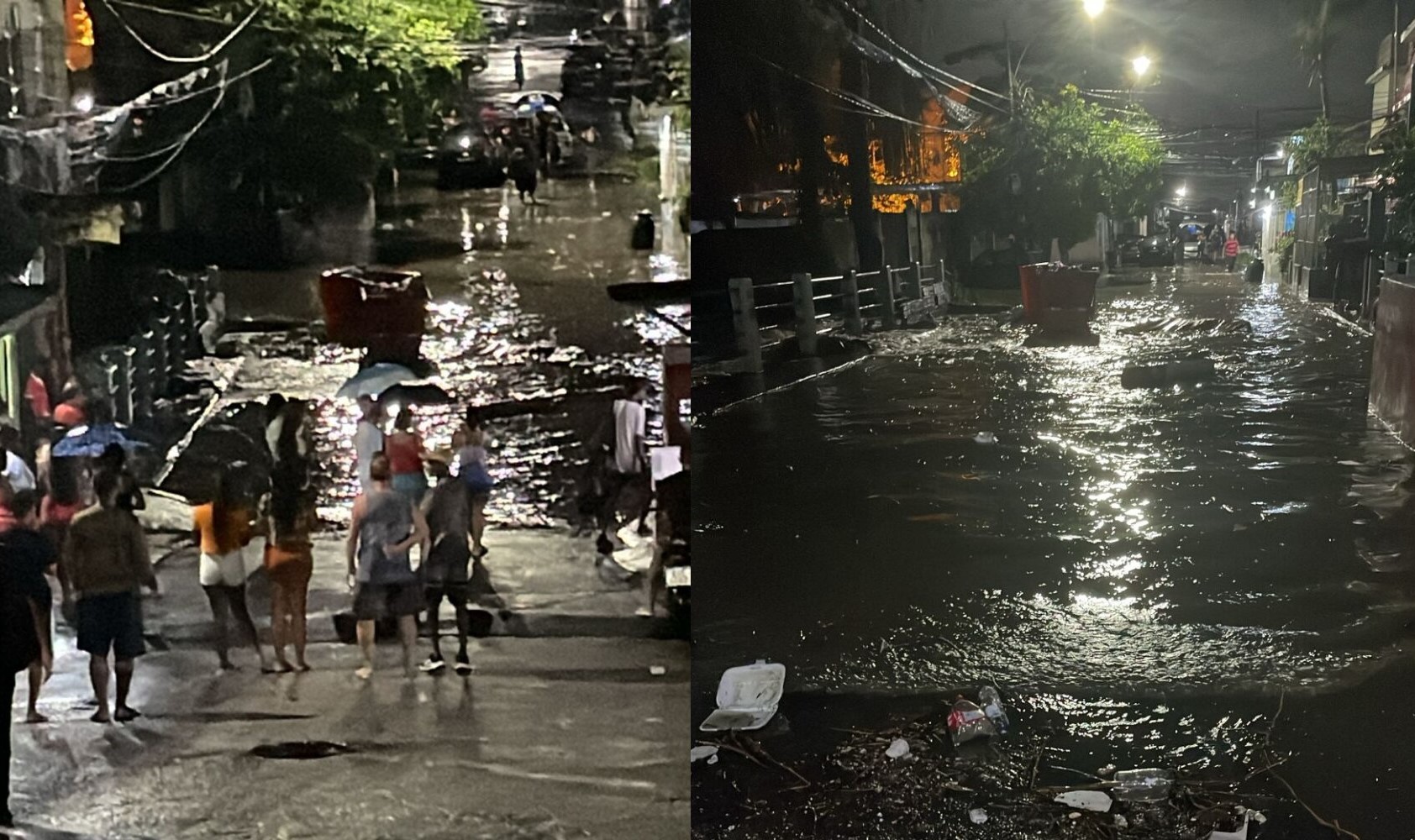
In a video shared by a local community leader, the level and force of the water can be seen sweeping through streets and neighborhoods.
Still in Coelho Neto, heavy rains hit Ocupação Dandara and Terra Prometida, located at Rua Senador Mozart Lago 251. Flooded homes and the total loss of furniture, clothing and food devastated the occupation.
Ver esta publicação no Instagram
In another part of the North Zone, in Jacaré, a video recorded by a neighbor shows a woman trying to get into her home with water at chest level. Getting home from work, she comes face to face with the destruction caused by the rain in her house.
Ver esta publicação no Instagram
Nearby, at Rua Viúva Cláudio, around number 55—better known as Buraco do Lacerda, in the Jacarezinho favela—the area was completely submerged.
Ver esta publicação no Instagram
Jacarezinho also had completely flooded streets, with strong currents running through.
RioOnWatch received videos via messaging groups showing water inside the living room of a family’s home in Jacarezinho.
In the same area, in the Manguinhos group of favelas, a resident filmed from home other residents with water at waist level wading through streets—and even in boats—navigating the community’s submerged roads.
Ver esta publicação no Instagram
The same scene can be seen from another angle. Unfortunately, what stands out most is residents’ despair.
Ver esta publicação no Instagram
Footage from the community shows the state of emergency. In some alleys, the water reached floodgates built at the entrances of some homes to hold back rising waters. This time, however, it took very little for some houses to be inundated.
“This footage is striking. First, it shows from inside the house how someone builds a floodgate at the entrance of their own home, highlighting how [this level of flooding] is a predictable disaster, a recurring problem. Even so, the water still finds a way in, given the height and unevenness clearly visible in the image. Then you see cockroaches, completely unsanitary conditions, showing that this isn’t just water—it’s sewage, bringing serious health risks to the community. Every summer, floods catch the Rio de Janeiro government by surprise. In the face of climate change, proper sanitation can no longer be postponed.” – Alexandre Pessoa Dias, sanitation engineer at Brazil’s national health foundation, Fiocruz
Grassroots communicators from Manguinhos Online and Voz das Comunidades reported from the community’s flooded alleys and exposed environmental racism.
Ver esta publicação no Instagram
The flood claimed a life in Manguinhos. Eliete Alexandre dos Santos, 67, fell ill at home while her house was being hit by water. Due to the flooding, residents were delayed in providing help, and she was taken to the Emergency Care Unit (UPA) still alive. She had hypertension and passed away at the health unit.
Ver esta publicação no Instagram
Due to all the suffering the community endured, the organization Manguinhos Solidário is raising funds to provide essential items for those affected and to support others of the institution’s initiatives.
Ver esta publicação no Instagram
A resident of Jardim América calls out the false promises and electioneering of Mayor Eduardo Paes with claims he would resolve her community’s infrastructure.
Ver esta publicação no Instagram
In other favelas, a similar situation has been reported on social media by residents. In Complexo do Alemão, the ground near a home was anonymously documented as extremely saturated and at risk of landslides.
Ver esta publicação no Instagram
Through social media, Instituto Papo Reto community organizer and Complexo do Alemão resident Raull Santiago commented on the situation faced by the community, emphasizing that action from the relevant authorities is urgently needed. Santiago makes a point of centering climate change and climate justice in his report.
“This is the climate crisis knocking at our door, folks… Always on the same doors, affecting the same bodies… The City knows where it floods, knows which streets turn into rivers, which houses get flooded, which families lose everything again and again. None of this is a surprise. This is repetition. What’s lacking isn’t diagnosis, it’s investment, infrastructure, political priority. Drainage, sanitation, slope containment, urban planning, decent housing… All of this is climate policy… Climate change isn’t just an abstract and distant debate. It appears when the rain falls heavier, when the heat is more extreme. It’s when the poor lose a refrigerator, a mattress, a car, a motorcycle, our documents. We’re left without water, without electricity… Until we put favelas and peripheries (of power) at the center of the climate agenda, the highest costs will always fall with those who have the least.” — Raull Santiago, Instituto Papo Reto
Ver esta publicação no Instagram
In Chatuba, part of Complexo da Penha, a landslide reoccurred leaving several homes vulnerable, unprotected and exposed on unstable hillsides. Nearly in Largo do Metralha, in Complexo do Alemão, a landslide caused a house to collapse. Despite losing everything and the psychological trauma, no family members were injured.
Ver esta publicação no Instagram
Still in the peripheral neighborhoods of the Leopoldina region, on Avenida dos Democráticos, near Exit 7 of the Linha Amarela expressway, the overflow of the Faria-Timbó River—along with the Jacaré River and the Cunha Canal—made roads cutting through the area disappear.
Ver esta publicação no Instagram
In some spots, the water rose high enough to almost completely cover the ground floor of riverside homes.
Ver esta publicação no Instagram
A bus on route 371, which runs between Praça Seca and Praça da República, broke down near the same area. Passengers were filmed having to walk through filthy water to seek shelter.
Ver esta publicação no Instagram
Cars were filmed floating in the floodwaters in Bonsucesso by local residents.
Ver esta publicação no Instagram
Several incidents were reported on Governor”s Island. In Morro do Dendê, however, a landslide occurred behind a woman’s home. During a site visit, the Civil Defense stated that a containment wall will need to be built to ensure the home’s safety.
Ver esta publicação no Instagram
In Rocha Miranda, also in the northern part of the city, one of the sewage channels swelled enough to form a strong current.
In an area of the North Zone closer to downtown, community organizer Allen Martinez, a resident of Barreira do Vasco, denounces the inefficiency of the Morar Carioca upgrading project, which promised to solve the community’s recurring flooding issues.
Ver esta publicação no Instagram
A few kilometers away, near Benfica on Avenida Brasil, people were seen walking along the lane dividers—on the wall, the highest part of the expressway—to avoid contact with the contaminated floodwater.
Ver esta publicação no Instagram
This time around, the West and Southwest Zones were less severely affected. However, there were still reports of fallen trees—including onto power lines—landslides, collapsed walls, flooding and large pools of standing water.
In Vila Kennedy, in the West Zone, streets disappeared beneath floodwaters.
Ver esta publicação no Instagram
Which exposed many children to contamination.
Ver esta publicação no Instagram
Realengo residents—who lack access to quality leisure facilities—were seen swimming under the Viaduto de Realengo.
Ver esta publicação no Instagram
But even if they wanted to swim at Parque Realengo, they would have been swimming in sewage. Inaugurated in June 2024, the municipal park was also submerged under sewage and floodwater.
Ver esta publicação no Instagram
In Vila Militar, workers returning home were forced to step into the water and walk long distances toward Realengo, Magalhães Bastos and Bangu. In many cases, public transport stopped running or ran on irregular schedules and routes, depending on where travel was still possible.
Ver esta publicação no Instagram
On the Santa Cruz line running to the city’s extreme West Zone, train service was temporarily suspended due to flooding of the railway tracks.
Ver esta publicação no Instagram
On the North Zone Belford Roxo line, near Madureira station, passengers trapped inside the train filmed floodwater entering the cars, worried about the risk of electrocution.
On the other side of the city, in the South Zone, the favelas of Rocinha and Vidigal—known for their steep geography—were also hit. Residents watched their streets, alleys and lanes turn into waterfalls of rainwater mixed with sewage and trash.
Ver esta publicação no Instagram
A video recorded by Bruno Thierry shows the risk of accidents involving power poles and vehicle crossings, where pedestrians and drivers tried—unsuccessfully—to escape the torrent.
Ver esta publicação no Instagram
Beyond the risk of electric shocks, alleys and lanes were completely flooded in Rocinha, Brazil’s largest favela.
Ver esta publicação no Instagram
Motorcycles are regularly swept away by the force of the water. In some cases, cars—and even people—have been dragged down the street by the currents generated by summer rains in Rocinha.
Ver esta publicação no Instagram
The rainfall was so intense that, at 7:24pm, COR-Rio declared Risk Stage 3. Across the city, 15 sirens were activated in nine favelas considered at high geological risk: Arrelia and Jamelão, in Andaraí; Formiga, in Tijuca; Parque Silva Vale, in Tomás Coelho/Cavalcanti; Rua Brício de Moraes, in Tomás Coelho; Morro do Sapê and São Miguel Arcanjo, in Vaz Lobo, in the North Zone; and the favelas of Comandante Luiz Souto, in Tanque and Espírito Santo, in Praça Seca, in the Southwest Zone.
Ver esta publicação no Instagram
Sirens also sounded in parts of Greater Rio, including Morro do Estado and Boa Vista, in Niterói, a city in the Leste Fluminense region, across Guanabara Bay from Rio proper.
Ver esta publicação no Instagram
In the historical neighborhood of Jurujuba, in Niterói, a landslide left some residents isolated.
Ver esta publicação no Instagram
Still in the Leste Fluminense region, in the city of São Gonçalo, a hillside collapsed in Morro do Castro, blocking roads and bringing down trees and power poles in the area.
Ver esta publicação no Instagram
Following days of continuous rainfall, favelas such as Complexo do Salgueiro were hit by its effects. Community leaders and organizations, such as Gaia Space, came together to support the population affected.
Ver esta publicação no Instagram
The Baixada Fluminense was another region deeply impacted. In Duque de Caxias, a motorcyclist tried to rescue his bike after it disappeared under the water.
Ver esta publicação no Instagram
Near Praça Menezes Cortes, in downtown Duque de Caxias, the water invaded several businesses.
In the neighborhood of Campos Elíseos, still in the city of Caxias, residents were filmed moving through the streets with water at chest level.
Ver esta publicação no Instagram
Outraged, residents of the city’s Vila Maria Helena neighborhood posted videos on social media asking for help amid the flooding. They demanded that Mayor Netinho Reis take urgent climate mitigation and resilience action.
Ver esta publicação no Instagram
In another major municipality in the Baixada Fluminense, Nova Iguaçu, streets were covered by a large volume of muddy water.
Ver esta publicação no Instagram
About the authors
Amanda Baroni Lopes holds a degree in Journalism from Unicarioca and was part of the first Journalism Laboratory organized by the Maré community newspaper Maré de Notícias. She is the author of the Anti-Harassment Guide in Breaking, a handbook that explains what is and isn’t harassment to the Hip Hop audience and provides guidance on what to do in these situations. Lopes is from Morro do Timbau, a favela within the larger Maré favela complex.
Julio Santos Filho has a Bachelor’s in International Relations (UFF) and a Master’s in Sociology (IESP-UERJ). A Black man from Ilha do Governador, he has worked as editor of RioOnWatch since 2020. In 2021, he edited the series “Rooting Anti-Racism in the Favelas,” a silver medalist in The Anthem Awards.