


This article is part of RioOnWatch’s ongoing #VoicesFromSocialMedia series, which compiles perspectives posted on social media by favela residents and activists about events and societal themes that arise. It is also part of a series created in partnership with the Behner Stiefel Center for Brazilian Studies at San Diego State University, to produce articles for the Digital Brazil Project on environmental justice in the favelas for RioOnWatch.
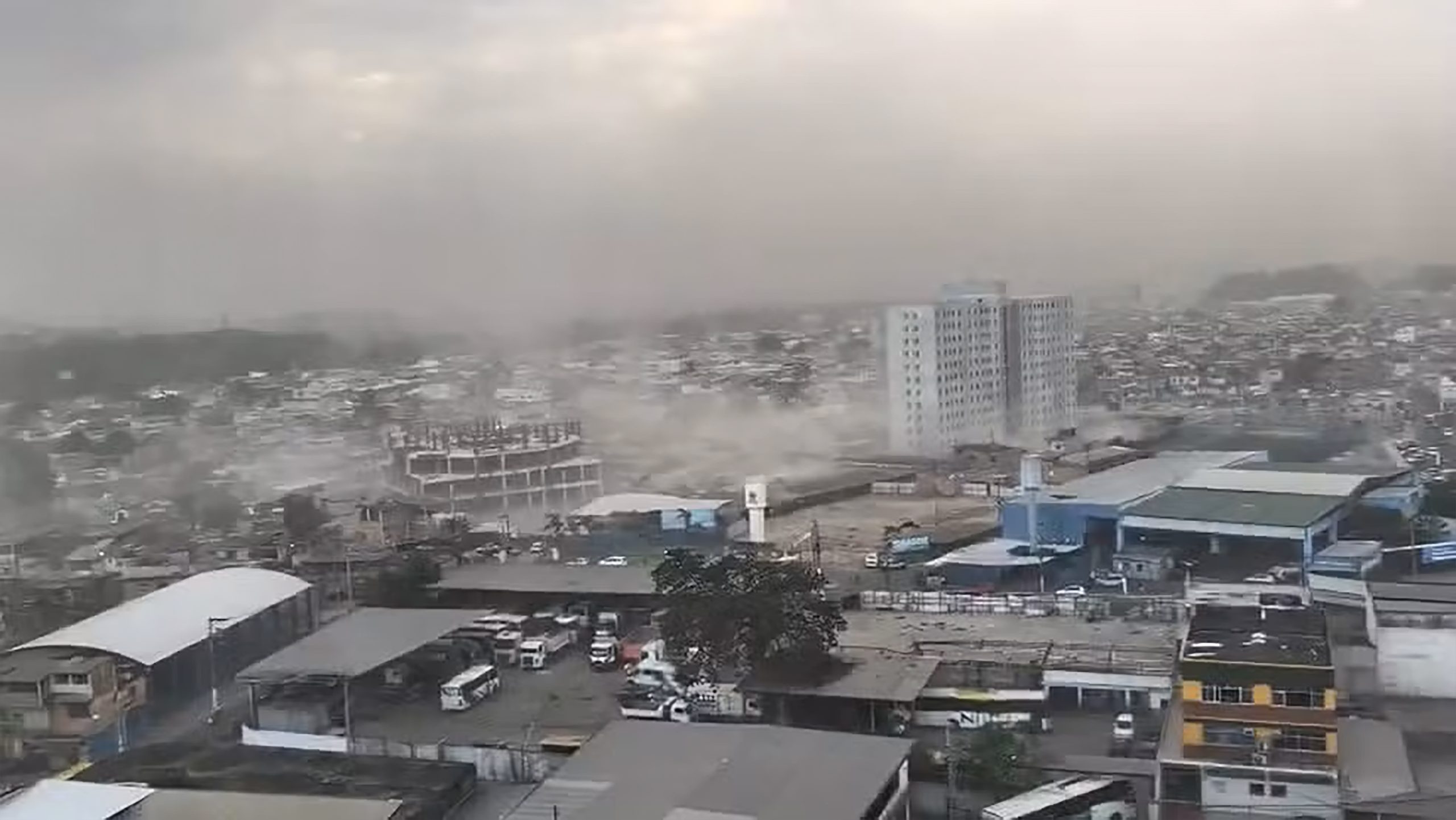
Late afternoon on July 29, an unexpected windstorm hit the Rio de Janeiro Metropolitan Region, bringing chaos, disruption, widespread damage and five deaths. The winds, which exceeded 100 km/h, were caused by a cold front and were early signs of the Super El Niño, which is expected to intensify beginning in September. Two of the five people killed were on Rua Julio Otoni, in Santa Teresa, in Rio’s Central Zone, when a tree and wall collapsed during the storm. Three others were electrocuted in City of God, in the West Zone, while trying to help a relative who suffered an electric shock following a power surge caused by the windstorm.
The extent of the damage led Rio de Janeiro’s Operations and Resilience Center (COR-Rio) to declare Alert Level 2 for high-risk incidents. The strongest winds recorded by COR were in the North Zone, at Galeão Airport, on Ilha do Governador, reaching 105.5 km/h. These were followed by the West Zone, where winds reached 95.4 km/h in Marambaia, 87.5 km/h in Vila Militar and 83.3 km/h in Campo dos Afonsos.
This extreme weather event ranked among the three strongest windstorms in Rio de Janeiro’s history, behind winds of 115.5 km/h recorded in Marambaia in 2019 and 110.2 km/h in Copacabana in 2019, respectively. Rio’s five highest wind-speed records have all occurred in the past seven years, revealing the alarming impact of climate change on the city.
Ver essa foto no Instagram
Given the city’s lack of climate resilience, Rio residents saw their routines change in a matter of minutes. Over 359 incidents involving fallen trees were recorded, while electricity, water, telephone and internet services were disrupted or compromised. The windstorm affected airports, trains, the subway, light rail and ferries, leaving buses and BRTs overcrowded.
Ver essa foto no Instagram
Favelas and Peripheral Areas Always the Most Impacted
In favelas and peripheral areas, parts of homes, including roof tiles and water tanks, were swept away by the wind, causing extensive property damage and putting neighborhoods at risk. Footage from an unidentified location shows residents desperately trying to hold down roofing sheets to keep them from flying away:
Ver essa foto no Instagram
Another video shows a similar scene, in which a person is lifted into the air along with the roof while trying to hold it down:
Ver essa foto no Instagram
In Greater Rio’s Baixada Fluminense region, there were several reports of impacts caused by the structural fragility of homes. In Duque de Caxias, one resident who had just built what was to be her future home saw one of its walls blown to the ground:
Ver essa foto no Instagram
In Nilópolis, a resident captured the moment his neighbor’s terrace was blown away by the wind:
Ver essa foto no Instagram
The force of the wind completely destroyed a roof in São João de Meriti:
Ver essa foto no Instagram
Also in the Baixada Fluminense, in Duque de Caxias, a man was struck by a roofing sheet that came loose.
Ver essa foto no Instagram
Despite requirements that solar panel systems be installed according to guidelines based on the maximum wind speeds each region may experience, in Rio’s North Zone, even solar panels crashed into rooftops. Maré journalist Gizele Martins had part of her roof destroyed by panels that came loose during the windstorm:
Ver essa foto no Instagram
In Vila Cruzeiro, a resident captured the frightening change in the landscape, engulfed in thick haze and dust. The footage shows just how vulnerable metal structures and water tanks become in high winds.
Ver essa foto no Instagram
Fallen Trees
According to COR-Rio, at least 359 trees fell across the city. The neighborhoods most affected were Bangu, Campo Grande and Santa Cruz, in the West Zone; Anchieta, Catumbi and Tijuca, in the North Zone; and Jacarepaguá and Recreio dos Bandeirantes, in the Southwest Zone.
In Maracanã, the windstorm was so strong that pedestrians on the State University of Rio de Janeiro (UERJ) campus had to hold on to trees to keep from being swept away:
Ver essa foto no Instagram
This, however, is not a safe option. Taking shelter under trees is not recommended during storms and high winds. In Tijuca, a man narrowly escaped serious injury when a tree fell:
Ver essa foto no Instagram
The South Zone had major roads blocked off, including Rua Voluntários da Pátria, in Botafogo, bringing traffic to a standstill:
Ver essa foto no Instagram
Back in the West Zone, a tree also fell in Realengo, destroying a vehicle parked on the sidewalk and blocking part of a street:
Ver essa foto no Instagram
In Campo Grande, a tree fell near ParkShopping Campo Grande on Estrada do Monteiro, hitting a beauty salon:
Ver essa foto no Instagram
Power Outages and Transportation Suspended Across the City
At the height of the windstorm, approximately 1.9 million properties lost power across the Metropolitan Region, including those served by service providers Light and Enel.
On Thursday morning, July 30, around 400,000 homes still had no power, according to Light. The most affected neighborhoods were Campo Grande, Bangu, Anchieta, Tijuca, Grajaú, Vila Isabel, Catumbi, Jacarepaguá, Santa Cruz, Santa Teresa and Recreio dos Bandeirantes.
By Friday morning, July 31, over 40 hours after the windstorm, over 140,000 properties had no power in Rio de Janeiro. Residents reported losing food and struggling to resume their daily activities. In Duque de Caxias, residents protested on Avenida Presidente Kennedy and in Xerém:
Ver essa foto no Instagram
There were also protests in Japeri, in the Baixada Fluminense:
Ver essa foto no Instagram
In the city of Rio, residents held a protest on Estrada do Lameirão, in Campo Grande:
Ver essa foto no Instagram
Residents of Engenho Novo, in the North Zone, also took to the streets:
Ver essa foto no Instagram
In Maré, over 50% of homes still had no power over 36 hours after the windstorm:
Ver essa foto no Instagram
There were also reports of fires in homes in the favela during the power outage:
Ver essa foto no Instagram
The power outage disrupted train and subway service, coinciding with the evening rush hour:
Ver essa foto no Instagram
On the subway, trains also came to a standstill due to the power outage, stopping in the middle of the tracks. Trapped inside the cars for around two hours, passengers broke windows in order to breathe:
Ver essa foto no Instagram
Some passengers walked along the tracks to reach the next station:
Ver essa foto no Instagram
Downtown, passengers on the Morro da Providência cable car, an electric mode of transportation, were left stranded as the cars swayed violently in the strong wind gusts.
Ver essa foto no Instagram
Other Impacts of the Windstorm
On Avenida Brasil, a billboard fell on a car and a motorcyclist near the access to Ilha do Governador, causing a serious accident and bringing traffic to a standstill.
Ver essa foto no Instagram
Beachgoers enjoying a sunny afternoon at Praia Vermelha, in Urca, were caught by surprise and rushed to find shelter:
Ver essa foto no Instagram
On Ipanema‘s Arpoador Beach, people fled clouds of sand, flying objects and debris:
Ver essa foto no Instagram
At a square in Conjunto da Marinha, in the West Zone neighborhood of Bangu, the force of the windstorm can be clearly observed:
Ver essa foto no Instagram
Elsewhere in Bangu, a street looked like a scene from a movie:
Ver essa foto no Instagram
In the same area, shopkeepers and street vendors working at the Campo Grande pedestrian shopping district, a major commercial hub, saw their merchandise and stalls knocked to the ground and sent flying within minutes:
Ver essa foto no Instagram
Also in Campo Grande, the roof of a gas station on the Rio-São Paulo Highway collapsed during the windstorm:
Ver essa foto no Instagram
In Barra da Tijuca, workers found themselves in danger. Rope access technicians on a suspended platform were suddenly thrown against the building where they were working. The platform swung with the wind, nearly knocking the workers off with each new impact against the building. Fortunately, they managed to get down safely:
Ver essa foto no Instagram
In Laranjeiras, the headquarters of the Fluminense soccer team had its roof destroyed and activities suspended:
Ver essa foto no Instagram
On Ilha do Governador, the neighborhood hit by the day’s strongest winds, residents at a bus stop shielded themselves from dust and dry leaves blowing through the street:
In Vila Isabel, at Praça Barão de Drummond, known as Praça Sete, home to a street food hub, the winds tore away tarps covering stalls and food trucks:
Ver essa foto no Instagram
In Nova Iguaçu, a city in the Baixada Fluminense, strong winds and a massive cloud of dust ripped a water tank holding hundreds of thousands of liters from the roof of a building dozens of stories high:
Ver essa foto no Instagram
Organizations and Community Organizers Publish Statements
On Instagram, Ana Tobossi, a resident of Complexo da Penha, reflected on how extreme weather events expose socio-environmental inequalities:
“The wind doesn’t blow the same for everyone!! While the city makes the news for chaos, fallen trees and power outages, the impact runs deeper in the favelas: roofs fly off, homes flood, fear returns. If your roof didn’t fly off… we’re not in the same boat! They call it a climate phenomenon. We call it inequality laid bare. The so-called ‘Super El Niño’ only exposes what’s already there: those who have always been the most exposed continue to pay the highest price. In peripheral areas, it’s not just the weather that changes, it’s people’s lives that are put at risk. We keep speaking out, caring and resisting. Because climate justice is also racial justice.”
Cosme Felippsen, a Morro da Providência resident, tour guide and creator of Rolé dos Favelados, highlighted environmental racism as a factor that intensifies the socio-environmental and climate vulnerability of favelas and peripheral areas, drawing attention to the fact that it is not the environment that is racist, but rather decision-makers—those who manage the State:
“The environment isn’t racist—the trees, the climate, nature. It’s people, the authorities, who are racist. We’re going through major changes. We’ve always had storms and floods, but not with this intensity and frequency. And why have [the impacts] increased? Because of the city’s lack of planning, because of the State’s absence [in these places]. When public services don’t reach the favela, that’s environmental racism. Everything we’re experiencing is the result of a lack of planning.”
Ver essa foto no Instagram
As published by Casa Fluminense, the climate and its impacts can no longer be ignored:
“The lack of coordinated climate mitigation and adaptation plans across municipalities of the Metropolitan Region, rather than plans developed separately by each administration, prevents a rapid, coordinated response proportional to the scale of the problem. One of the proposals put forward in the Rio 2030 Agenda to address this scenario is the creation of Local Climate Governance, a climate crisis management structure that would lead and oversee climate adaptation plans and programs, as well as mitigation measures.”
Ver essa foto no Instagram
August 5 and 7: Civil Defense Alerts, With Less Damage
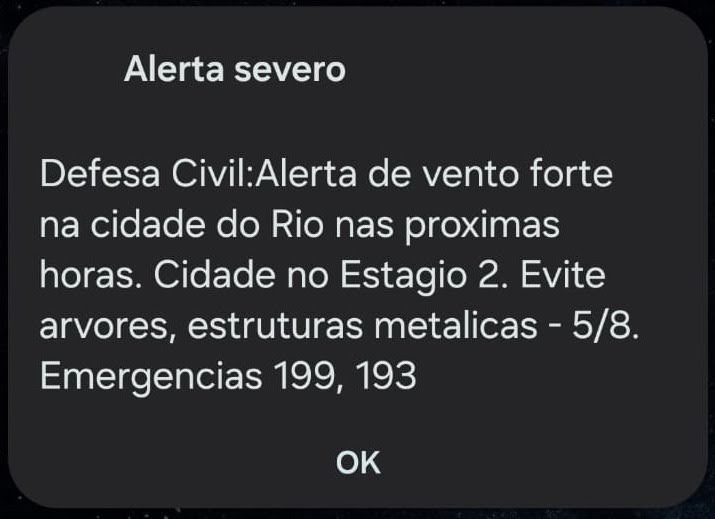
The following week, on the morning of August 5, Rio residents woke up to a new Civil Defense alert on their phones. The message, issued at 5:05am, warned of another round of strong wind gusts, this time reaching up to 75.9 km/h. The alert also announced that the city had entered Alert Level 2, when high-impact incidents are expected across the city. This time, the cause was a bomb cyclone, a type of extratropical cyclone that rapidly loses pressure, significantly increasing wind speeds.
News reports throughout the day stated that new tornadoes had hit southern Brazil for the second week in a row. Meteorologists warned that Rio de Janeiro could face conditions similar to those of the previous week, causing anxiety among locals. In a social media post, Civil Defense alerted residents to a new forecast of strong winds and shared preventive measures in case of an event similar to the July 29 windstorm.
In the early hours of August 7, a new Civil Defense alert, followed that morning by an official announcement from Mayor Eduardo Cavaliere, informed residents that classes would be suspended. Rio residents spent the day on alert, avoiding travel and securing their homes and belongings. Around noon, moderate winds hit the Metropolitan Region, as the City and State governments reinforced their warnings to the public—a different response from the previous week, when the Metropolitan Region had been completely caught off guard by the winds. This time, Civil Defense issued an extreme alert:
Ver essa foto no Instagram
The Rio de Janeiro City and State governments recommended that all non-essential activities end early so residents could return home safely. Through COR-Rio, the City announced that Rio de Janeiro had entered Alert Level 3 at 1pm on August 7. The Tim Maia bike path, on Avenida Niemeyer, was closed between São Conrado Beach and the Vidigal metal footbridge due to strong winds and high waves.
Community media outlet Voz das Comunidades published a compilation of footage showing strong winds in several parts of the city. According to reports, at around 11am, gusts above 60 km/h were recorded in some areas:
Ver essa foto no Instagram
In Realengo, in the West Zone, a tree fell on Avenida Pedro Cunha, near the COHAB housing complex, completely blocking traffic on Rua Capitão Teixeira and Rua Piraquara:
Ver essa foto no Instagram
The winds soon became much weaker, however, and there were no major incidents.
Official Channels for Requesting Assistance
In case of an emergency, the official recommendation is to contact the Fire Department by calling 193 or Civil Defense at 199.
Residents who suffered losses related to power outages, such as damaged appliances and spoiled food, can request reimbursement from Light.
See COR-Rio’s Recommendations for Strong Winds:
AT HOME:
- Close windows, transom windows and cabinet doors to prevent wind from being channeled through the home;
- Keep blinds, curtains or blackout shades closed to prevent shards from scattering if a window breaks;
- Turn off electrical appliances and shut off the gas supply to prevent further damage in the event of a fallen tree;
- Avoid leaving objects that could fall in high places;
- Keep trees in gardens or yards regularly pruned and well maintained;
- Stay alert: if the power goes out, be careful when using candles to prevent fires.
OUTDOORS:
- Do not take shelter under trees or metal structures;
- Avoid outdoor sports, especially in the ocean;
- Avoid cliffs, slopes or unprotected high places;
- Avoid walking under electrical cables, billboards, scaffolding or ladders;
- Do not park vehicles near transmission towers or billboards;
- Do not burn garbage, set fire to vegetation to clear land, light bonfires or throw cigarette butts onto roads or in wooded areas;
- Stay alert: if a tree falls, power lines may have been damaged and the tree may be electrified;
- In these conditions, there is a risk of lightning-related accidents.
About the author: Amanda Baroni Lopes holds a degree in journalism from Unicarioca and was part of the first Journalism Laboratory organized by Maré’s community newspaper Maré de Notícias. She is the author of the Anti-Harassment Guide on Breaking, a handbook that explains what is and isn’t harassment to the Hip Hop audience and provides guidance on what to do in these situations. Amanda was born and raised in Morro do Timbau, Complexo da Maré.
About the author: Bárbara Dias was born and raised in Bangu, in Rio’s West Zone. She has been a photojournalist and documentary photographer since 2016, focusing on human rights, socio-environmental justice, religions and favela communities. A popular communicator trained by the Piratininga Communication Center (NPC), she is currently pursuing a degree in Journalism at Candido Mendes University (UCAM). A co-founder of Coletivo Fotoguerrilha (2016–2025), she holds a degree in Biological Sciences from the State University of Rio de Janeiro (UERJ), a master’s in Environmental Education from the Federal Institute of Rio de Janeiro (IFRJ), and is a public school teacher.